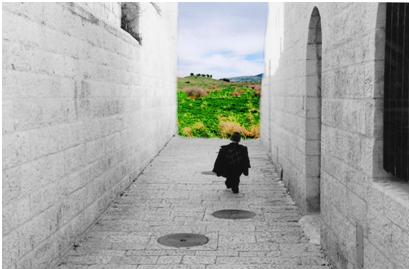
Simchat Torah. It's probably my favorite Jewish holiday - a holiday devoted to the great joy and love our community has for its central holy text, a rollicking physical tribute to the joys of literacy, and the deep and urgent love our tradition has for the Torah, such that we cannot do without reading it and must start from the beginning as soon as we end it. Also, an acknowledgment of the liminal space between finishing the book and beginning it - in those moments between the readings of Deuteronomy and Genesis, who are we? The people who read Torah - and we are done with the Torah? It's scary, terrifying really, this crisis of identity, this moment of the unknown, when we are faced with the reality of our own times without the guidance of the wisdom of the past. I love it because of its recognition of the Torah as a finite book with a beginning and an end, along with its simultaneous assertion that Torah has no boundaries and is not like other books - it continues even when it ends and we don't need to start a new book, because everything is in this one text. I love it because usually we treat the Torah like royalty - turning toward it as it processes across the sanctuary, rising as it enters, etc., but on Simchat Torah we let our guard down and dance with the Torah like an old friend, and everyone can take turns holding the Torah and sharing the intimate physical experience of dancing with the holiest of objects in their tradition. I love it because it is fun - a different kind of fun from many Jewish rituals, not the fun of reading an interesting text or eating a good meal but the fun of movement and energy of beauty and silliness, of togetherness and individual expression. There's a really good explanation of Shemini Atzeret and Simchat Torah at the Shalom Center's website, and if you want to read more about, I recommend starting there.
For our Simchat Torah celebration, Daniel and I joined a large group of HUC students to go to Kibbutz Gezer, a kibbutz that was founded in 1974 by a group of olim (immigrants) from Habonim-Dror, a Zionist youth organization. It fosters liberal Judaism and social justice projects, including bringing in new immigrants from Peru each week to celebrate Shabbat in a liberal Jewish way, leading educational programs for Israeli and American groups, and holding educational and spiritual activities for inmates of Ramle prison. We arrived shortly before the services which were to be held in their outdoor synagogue, and were given a brief tour of Pinat Shorashim, their educational park. We walked around a bit and appreciated the educational tools at the park, which were perhaps not meant for students of our age but are interesting and effective ideas for the teaching some of us might be doing some day whether as Rabbis, Cantors, Educators, or simply Jewish parents. We made our way back to the prayer space, which was overflowing with guests - small children nestled in their parents' arms, nuns and priests, a contingent from an American Reform youth group, people speaking Russian, Hebrew, Spanish, and English. After the service which was led by a charming but somewhat long-winded Rabbi, a klezmer-style band started playing for the seven hakkafot. Frankly, we felt that not enough people danced, and that the dancing didn't last nearly long enough, but for what it was, we managed to have a good time, and to experience the joy of the holiday. We were all quite hungry afterwards as we didn't realize that there wouldn't be dinner at the celebration, so we went out to eat at Spaghettim, a restaurant near our apartment, with a large group from HUC.
This morning, we went to services at Har El, the Reform synagogue around the corner from our apartment, which is an unendingly warm and welcoming congregation. The services were quite full, and after prayer led jointly by the chazzan from Har El and a cantorial professor from HUC, we went out into their front garden to dance with the Torahs to music played by HUC students. The songs were short and the dancing mostly consisted of walking slowly in a circle, but the mood was joyous and the weather was lovely. I carried the Torah for a bit, and found it to be a powerful moment - holding something so holy, and that was for so long not accessible to women, the physicality of my closeness and access to the Torah so that I could feel the stiffness of the parchment through the decorative mantle just as though I were embracing a loved one and feeling his flesh and bones through the fabric of their clothing. After a short while we returned indoors for the Torah reading, the Haftorah reading, the prayer for the rain, and so forth. (SIDE NOTE: It looks, incidentally, like the rain will start soon, just on schedule. This is extremely important, as last year the Kinneret reached its lowest level in five years. The Kinneret (Sea of Galilee) is Israel's main source of drinking water, and Israel is dependent on the rainy season to produce the water that the country needs. Israel currently has two desalinization plants, and will have a third by 2013, and they do make a big difference, but nevertheless, prayers for rain are certainly prayed with urgency.) In the middle of the Torah reading I looked up to find an Orthodox man in the doorway, his dark brown peyot perfectly curled and reaching the tops of his shoulders. I'll admit, his presence scared me a little: was he here to interrupt our service by yelling at us and telling us we were profaning the Torah? Or worse? Would he steal the Torah? Throw something? In retrospect I am ashamed of these fears - he stood in the doorway for about a minute, and when a woman began to read the Torah, he walked away, presumably because he believes that it is forbidden for a man to listen to a woman singing. Perhaps he was just curious, like we are when we visit Orthodox shuls. I should have felt only excitement and joy to have someone else share in our prayes, and I felt fear. For this, I am ashamed. The service went on into the early afternoon, and so after chatting a bit after services, we returned home to eat lunch and then to write about our experiences.
_____________________________________
Simchat Torah wasn't the only interesting thing we've done lately. On Saturday night, Lauren (a cantorial student and friend) and I went to see a show produced by the BaMatMaBat Theater Company and the Professional Women's Theater, titled "Voices from Our Side of the Curtain." (You can read the blog version of the production here) It was an English language production, and all of the participants seemed to be American Jews, living in Israel, many of them about my age. The performance was by and for only women, the idea being that in Orthodox Judaism, many people feel that it is inappropriate for a man to hear a woman's voice, citing a Talmudic prohibition called Kol Isha. The Orthodox women in this production are concerned with issues of modesty but nevertheless feel that they deserve a forum to share there talents and their own stories.
The play was modeled off of the Vagina Monologues - a series of monologues in which women shared their personal stories. Each story helped me to better understand the American Orthodox world, which is in some ways (though not all) very different from the American Reform world, and helped me to respect and understand choices that women make to participate in a society in which they have differing roles from men. I think sometimes I lose sight of the fact that for many Orthodox women, they don't feel that they are being forced to wear "modest" clothing, sit in a separate section, etc. but are actually acting out of their own will and for their own reasons. In my own discomfort that these expectations might be forced upon me, I project this sense that these strictures are a hateful burden onto those who willingly participate in the system of which they are a part.
The first monologue, titled "Bald in the Land of Covered Hair" was an extremely evocative piece about a woman who was diagnosed with breast cancer and has to undergo chemotherapy and have a mastectomy. She is horrified at the notion of losing her hair and her breast, despite the fact that she already wears a wig and clothing that does not emphasize her body. Despite her modest clothing, she has always associated these parts of her body with her femininity. She comes to learn, with the help of an extremely supportive and loving husband, that femininity is something that is within her, and that her body parts are not what make her a woman, or a beautiful person. I suppose that an argument for modest dress is that by de-emphasizing the body, it allows the woman to be more than just her body parts - an argument that I can definately understand, especially having just graduated from university, where many women feel compelled to dress scantily when they are in social settings, as though their body is what they need to emphasize in order to make men interested in them. Nevertheless, I am uncomfortable with the notion that clothes - tight, short, loose, or long - should be important in establishing that a woman is more than her body. And I don't think the clothing solves the problem - is a woman seen less as a womb, a pair of breasts, or smooth legs, whether or not she covers them up? But I'm not writing this post to disagree or to agree with the atitudes in the play - I knew that I was attending a performance about a lifestyle very different from my own, and I was pleased to feel that I understood it as well as I did, and emphasized as well as I did. Although I don't wear clothes that are modest according to an Orthodox definition, I don't tend to wear tight, short clothing or emphasize my body, and yet if I were to lose that part of my body I think I too would undergo a crisis about whether I felt like a whole and complete woman.
The second piece, "Mourning Lullabies," was about an Orthodox couple that is infertile. Initially the woman thinks that it is her own fault, but eventually her husband gets tested and finds out that he is infertile. He offers his wife a divorce, but she tells him that she loves him and that even though it had been both of their dreams to build a family together, she wants to be with him even if it means being childless. This story would have been very different, I think, in a different cultural context - where having children is less at the center of the culture, where artificial insemination by a donated sperm was an option, etc. I wonder if adoption is an option in Orthodox communities - I assume it is, but I'm not sure. In any case, it was very moving to hear a woman speak about giving up her life's dream, to have children, because of her love for her husband.
I won't go through all the pieces in detail, because it occurs to me that this post will then go on for waaay too long and you will stop reading. So briefly, they included a piece about an abusive husband who refused to give his wife a divorce, a piece about a girl who didn't want to be part of the Orthodox world, a piece about a woman who feels that the Orthodox community is failing to retain its children, a piece about a girl who wants to be the perfect Jew but finds this impossible, a piece about an abused wife who doesn't want to leave her husband, a piece about a girl who is attracted to women but cannot act on it because of her Orthodoxy and resolves to be alone for life, a stunning piece about the transformative and communal power of the mikvah, a piece on feminism and it's role for Orthodox women, and a group dance piece about dancing for the sake of loving yourself, and not to attract or please someone else. They were all very beautiful and powerful, and the acting was quite good as well. I hope I'll have a chance to see more of their work this year.
________________________________
In the meantime, I continue to study for the GRE and work on grad school applications. The semester starts pretty soon and in the meantime I am working hard, and making a lot of progress. Keep your fingers crossed for me!
Showing posts with label feminism. Show all posts
Showing posts with label feminism. Show all posts
Tuesday, October 21, 2008

Wednesday, August 20, 2008
A Blog, A Book, and a little procrastination, which never hurt anyone but never helped either...
Paola, as it turns out, is keeping a blog too. In it, she tells me she's written the following about me:
1) I'm from Virginia. The only thing she knows about Virginia is the song "Take Me Home Country Roads," which she loves. When she told me this, I politely corrected her that West Virginia, which is the subject of the song, is not the same as Virginia, though it used to be before the Civil War. She was disappointed, and the first time she wrote about me in her blog, apparently (I haven't read the blog as it is in Italian), she included all of the lyrics to "Take Me Home Country Roads" just for kicks
2) She's been keeping a list of the idioms that I say, as she wants to incorporate them into her English. So far they include: creature of habit, homebody, to find common ground, to walk all over someone, grade inflation, and it's raining cats and dogs. The latter was her favorite, of course.
------
I'm writing on the blog largely to procrastinate from studying for my Hebrew test tomorrow, for which I actually feel pretty prepared, which makes it harder to study as I'm not convinced that I have to. What makes it even harder to study is that there is some kind of concert going on outside that I can hear quite well from the apartment. I thought initially that it was a Birthright Israel event because it included "Sisu et Yerushalayim" "Yachad" and "Od Yavo Shalom Aleinu", but now it sounds more like heavy metal, so who knows.
The accomplishment of the day is that I (A) read an entire relatively lengthy newspaper article in Hebrew about Musharaff's resignation, and while it took me several hours and there were more words in the article that I didn't know than there were words that I did know, in the end I think I understood all of it, and (B) I went to a used book store and bought myself a collection of Hebrew short stories. I was having trouble convincing myself to read the children's book I was trying to get through because frankly it wasn't that interesting and also it was too long. I think short stories will work better. And it makes me super proud that I own a real book in Hebrew - and have the potential to read it.
I met with my advisor today. He tells me that after this summer I am technically allowed to take classes from Hebrew University proper, in Hebrew, if I am so inclined, as I will be at a high enough Hebrew level to do so. I'm thinking I might do that in the spring, but don't feel ready for it yet. In the meantime I think I'm taking something like the following: Hebrew, Readings in Early Yiddish Literature, Multiple Voices in Israeli Society, Jews in the Habsburg Empire. All of this is subject to change, but I thought you might be curious.
Guess I'd better get back to studying...
---
Incidentally, while procrastinating, I read an interesting and upsetting post on the Lilith blog (http://www.lilith.org/blog/?p=346) about a trend in Orthodox communities for mothers to encourage their daughters not to excel academically because they either won't be attractive to men or will feel frustrated and bored when they have to leave their careers by the wayside to take care of their families. I think this an old problem and certainly not exclusive to Jewish communities. And not exclusive to traditional communities that "mainstream" folks can write off as being exceptions. I think the idea that women should be less accomplished, or less forthright about their accomplishments, than men, is so ingrained in our society that even the most accomplished of women are often hesitant to give themselves full credit for their accomplishments. Anyway, the author of the post writes, "It IS difficult to combine a career and motherhood, but striving for mediocrity is not a viable strategy. Subduing young women in the hope that potential husbands will find them more attractive is a damning indictment on religious men and cannot be the basis for a healthy partnership between the sexes in the modern Orthodox world." Thank goodness there are many people who feel this way, too. The real challenge may be, though, in acting in a way that we know, logically, to make sense. I believe that men and women are equal, for instance, but it doesn't stop me from preferring to sit in the passenger seat in the car, to walk behind Daniel on the sidewalk despite his insisting that I walk next to him, to wait for Daniel to tell the host that there will be two for dinner and we prefer to sit outside. These little things, about which I don't really think at the time, are small behaviors that in themselves don't matter at all, but demonstrate perhaps, the internalized notions of gender that have such a huge impact on how we see ourselves and how we live our lives. OK, now for serious I really have to go back to studying for that test...Or I could just strive not to do so well academically, as it might make me more attractive?
PS: You may have noticed that in our technical expertise, Daniel and I (mostly Daniel) have added a section to this blog recommending other blogs we read. If you have any blogs to add to the list, let us know, and seriously check out some of the ones there as they are quite good. We'll add to it if/when we start reading something new.
1) I'm from Virginia. The only thing she knows about Virginia is the song "Take Me Home Country Roads," which she loves. When she told me this, I politely corrected her that West Virginia, which is the subject of the song, is not the same as Virginia, though it used to be before the Civil War. She was disappointed, and the first time she wrote about me in her blog, apparently (I haven't read the blog as it is in Italian), she included all of the lyrics to "Take Me Home Country Roads" just for kicks
2) She's been keeping a list of the idioms that I say, as she wants to incorporate them into her English. So far they include: creature of habit, homebody, to find common ground, to walk all over someone, grade inflation, and it's raining cats and dogs. The latter was her favorite, of course.
------
I'm writing on the blog largely to procrastinate from studying for my Hebrew test tomorrow, for which I actually feel pretty prepared, which makes it harder to study as I'm not convinced that I have to. What makes it even harder to study is that there is some kind of concert going on outside that I can hear quite well from the apartment. I thought initially that it was a Birthright Israel event because it included "Sisu et Yerushalayim" "Yachad" and "Od Yavo Shalom Aleinu", but now it sounds more like heavy metal, so who knows.
The accomplishment of the day is that I (A) read an entire relatively lengthy newspaper article in Hebrew about Musharaff's resignation, and while it took me several hours and there were more words in the article that I didn't know than there were words that I did know, in the end I think I understood all of it, and (B) I went to a used book store and bought myself a collection of Hebrew short stories. I was having trouble convincing myself to read the children's book I was trying to get through because frankly it wasn't that interesting and also it was too long. I think short stories will work better. And it makes me super proud that I own a real book in Hebrew - and have the potential to read it.
I met with my advisor today. He tells me that after this summer I am technically allowed to take classes from Hebrew University proper, in Hebrew, if I am so inclined, as I will be at a high enough Hebrew level to do so. I'm thinking I might do that in the spring, but don't feel ready for it yet. In the meantime I think I'm taking something like the following: Hebrew, Readings in Early Yiddish Literature, Multiple Voices in Israeli Society, Jews in the Habsburg Empire. All of this is subject to change, but I thought you might be curious.
Guess I'd better get back to studying...
---
Incidentally, while procrastinating, I read an interesting and upsetting post on the Lilith blog (http://www.lilith.org/blog/?p=346) about a trend in Orthodox communities for mothers to encourage their daughters not to excel academically because they either won't be attractive to men or will feel frustrated and bored when they have to leave their careers by the wayside to take care of their families. I think this an old problem and certainly not exclusive to Jewish communities. And not exclusive to traditional communities that "mainstream" folks can write off as being exceptions. I think the idea that women should be less accomplished, or less forthright about their accomplishments, than men, is so ingrained in our society that even the most accomplished of women are often hesitant to give themselves full credit for their accomplishments. Anyway, the author of the post writes, "It IS difficult to combine a career and motherhood, but striving for mediocrity is not a viable strategy. Subduing young women in the hope that potential husbands will find them more attractive is a damning indictment on religious men and cannot be the basis for a healthy partnership between the sexes in the modern Orthodox world." Thank goodness there are many people who feel this way, too. The real challenge may be, though, in acting in a way that we know, logically, to make sense. I believe that men and women are equal, for instance, but it doesn't stop me from preferring to sit in the passenger seat in the car, to walk behind Daniel on the sidewalk despite his insisting that I walk next to him, to wait for Daniel to tell the host that there will be two for dinner and we prefer to sit outside. These little things, about which I don't really think at the time, are small behaviors that in themselves don't matter at all, but demonstrate perhaps, the internalized notions of gender that have such a huge impact on how we see ourselves and how we live our lives. OK, now for serious I really have to go back to studying for that test...Or I could just strive not to do so well academically, as it might make me more attractive?
PS: You may have noticed that in our technical expertise, Daniel and I (mostly Daniel) have added a section to this blog recommending other blogs we read. If you have any blogs to add to the list, let us know, and seriously check out some of the ones there as they are quite good. We'll add to it if/when we start reading something new.
Subscribe to:
Posts (Atom)