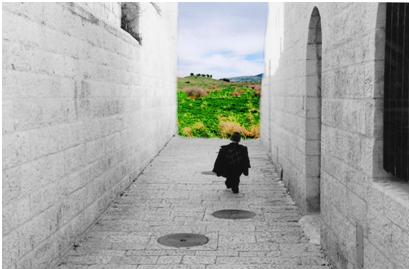
It is a time of beginnings. At the preschool, the first student to wear a t-shirt to school this spring was called to the front of the classroom during circle time. "This is a very good sign," the teacher said, "now the days will get much much longer and the sun will shine and it will be hot and we can put our coats way up in the closet and start wearing sandals and t-shirts to school."
The beautiful weather feels more to me like the end of the school year, and more and more I find myself searching online for interesting things to do in New York next year (for instance, did you know that at Wednesdays at noon to 4pm there are free tours of the pre-Revolutionary African graveyard at 290 Broadway at Duane Street?) and thinking less and less about being here in Jerusalem. And yet we still have months left!
Classes began this week, but were interrupted by Purim (about which Daniel plans on posting this afternoon, I think, so I won't step on his toes). I am taking: Yiddish, Sholom Aleichem, Masculinity and Nationhood in Hebrew Literature, Anthropology of Israel, and possibly a course on Collective Memory in the Palestinian/Israeli conflict, as well as Hebrew. I have not yet had all of these classes because of Purim-related cancellations, but those that I have had are terrific. It was so nice to go back to class and know people in every class I was in - a bit like high school really - with high fives and reunions of friends, and sarcastic comments about how bored we are already when clearly everyone is actually happy to be back. My Hebrew teachers seem much better than last semester, and I think this is going to be a good few months.
My parents' visit was amazing. I don't want to bore them by writing all about it when they, in fact, were there, but I will tell you just a few snippets: they arrived in the pouring rain and cold of Israeli winter and were unpleasantly surprised to be stuck in our apartment to avoid wind and hail for the first day or so. As things calmed down, we left for the Negev, stopping at a Bedouin Museum that was all but deserted, Ben Gurion's Negev home - the very modest dwelling where he spent the last years of his life living out his Zionist vision on a kibbutz, and Makhtesh Ramon, the world's largest crater formed by erosion. There we hiked past beautiful multicolored stones and enjoyed incredible vistas. We traveled to Eilat to relax on a beach not unlike the Jersey shore, save that we could see the Jordanian flag waving in the distance. We ventured into Jordan to visit Petra, an archeological site carved in a crack in rocks of the valley of Arabah. It was the capitol city to the Naboteans, who intricately carved dwellings and truly stunnung burial sites out of the rock. We returned from the South to spend a week in Jerusalem, taking walking tours of the Old City, going to Yemin Moshe, Har Hertzl, the Menachem Begin Heritage Center, Hebrew University, the Museum of the Seam, and more. We even spent a day in Tel Aviv, walking and shopping, and I purchased a dress to wear at Rebecca's wedding. I can't believe we did so much in the two weeks they were here, and it was so terrific to spend time with my parents and to share my life here with them (and show off my Hebrew!)
It promises to be busy for the rest of Daniel's stay here as we're trying to fit in as many opportunities as possible to spend time with friends, see Israel, enjoy the weather, etc. on top of fulfilling our academic obligations. I do intend, though, to be more on top of blogging than I've been these past few weeks, and apologise for my absence from the "blogosphere"
Hope all is well with all of you faithful readers!
Showing posts with label tourism. Show all posts
Showing posts with label tourism. Show all posts
Thursday, March 12, 2009

Saturday, December 6, 2008
A little Israeli Humor
As part of a pilot program called Tarbu-dat (Culture-Religion) at the Reform Synagogue around the corner from where we live, Har El, Daniel and I heard a presentation on the humorous side of being a tour guide in Israel. The presentation was a collection of short stories and jokes as recollected and told by a tour guide who mostly leads Indonesian, Belgian, and Dutch tourists around the country. He spoke in Hebrew, so we didn't understand everything, but I'll share with you a little of what we did understand, as it's pretty funny.
It seems that the humorous situations come out of tourists being naive and out of their element. They want to know exactly the spot where Biblical events happen, and when the tour guide tells them that there is more than one spot believed to be the place where a Biblical event happened, they ask questions like, "It happened more than one time?" At the Kinneret, one tourist saw that the shore was a bit dirty and said, "I understand why he walked on the water, I wouldn't want to walk in this mud either."
In one story, an Indonesian tour group came to a church in front of which was posted a sign that read "No Shorts Allowed" in English. Some members of the group approached the tour guide and told him that two women in the group would not enter the church. The tour guide said, "OK, that's fine, but why don't they want to enter." The tourist responded "It's not that they don't want to enter, it's just that they aren't allowed." The tour guide then realized that the tourists were reading the word "shorts" to mean short people, and that the two very small ladies were staying behind because of what they believed to be a height restriction. Another tourist who saw that sign took off his shorts and entered the church in his bathing suit.
In another story, he took a tour group to Masada, where they seemed to be very excited about the cable car leading up to the site. They got on the car, admired the view, and then at the top got right back on line to go down - as they were more interested in the car than in Masada itself.
At a church in the old city, each ot the panels of stained glass was catalogued and numbered, and one tourist thought that they were for sale, and that the numbers referred to the prices. She was very pleased that they were so inexpensive and tried to ask how she could buy one.
It was an interesting talk, and really fun to be in a group of people all laughing together - but it was also interesting to feel very much on the outside, as I probably have been a "stupid tourist" and could easily be the butt of some of these jokes. (A group of American tourists were told go go to the HaMashbir bus stop and thought they were supposed to go to a place marked "How much beer"). It was interesting that they made fun of the Dutch, Belgian, and Indonesian groups equally, that all tourists are people who don't really understand the context in which they find themselves, and for the people who know all about the place, they seem very naive and silly, and make a lot of mistakes. I think I would have been much less comfortable if he had been specifically making fun of American tourists, because I would have felt targeted as an outsider and I would have realized just how stupid American tourists seem to their tour guides. But he said that he prefers not taking American groups because they are high maintenance. Although I did feel a bit like an outsider listening to these jokes, I think the experience also made me feel like I was on the inside because I knew enough Hebrew that I could laugh along to jokes in Hebrew alongside this group of Israelis. I'm excited that Daniel and I are starting to feel like members of Har El - people recognize us there, are happy to see us, chat with us, remember things about us from the previous time, the cantor even friended me on facebook - that's a pretty big step!
Speaking of Israeli humor, a few days ago I snuck into Daniel's Israel Seminar to hear the Israeli writer Etgar Keret speak to his class (I later learned that Etgar Keret will also be visiting my Hebrew class in a few weeks!) I've read about six of Etgar Keret's stories in Hebrew now and I like them very much. He is a witty and intensely creative writer, who uses colloquial language and short vivid descriptoins. His stories often end with a kind of Joycian epiphany that turn everything on its head, or make the pieces of the story fit together in an unpredictable way. He told us that he is interested in stories and also real-life events that jar people away from their routine ways of thinking and doing and encourage them to view their lives and the world in new and different ways. Etgar Keret is also writes screenplays and graphic novels. He told us that he started writing stories when he was in the army, working long solitary shifts in front of a computer. He brought is first story to his brother, who read it and then used it to pick up his dog's excrement, and it was at that moment that Etgar Keret realized he wanted to be a writer, because the story was something that was still present and active, working in the universe - in his brother's mind and in his own, even if the physical element of the words on the page was discarded. Etgar Keret writes with an unusual sense of humor and pulls at the borders of the realistic to stretch the imagination without completely escaping to the world of fantasy, and he writes about relevant and pertinent issues in Israeli life. His writing is very popular among young people in Israel, though abroad it appeals to an older audience. His writing, incidentally, is popular among Hebrew learners (like ourselves) because it is simple and succinct. It's been translated into many languages including English, so if you have the time it's definately worth checking out. You can read about him here.
It seems that the humorous situations come out of tourists being naive and out of their element. They want to know exactly the spot where Biblical events happen, and when the tour guide tells them that there is more than one spot believed to be the place where a Biblical event happened, they ask questions like, "It happened more than one time?" At the Kinneret, one tourist saw that the shore was a bit dirty and said, "I understand why he walked on the water, I wouldn't want to walk in this mud either."
In one story, an Indonesian tour group came to a church in front of which was posted a sign that read "No Shorts Allowed" in English. Some members of the group approached the tour guide and told him that two women in the group would not enter the church. The tour guide said, "OK, that's fine, but why don't they want to enter." The tourist responded "It's not that they don't want to enter, it's just that they aren't allowed." The tour guide then realized that the tourists were reading the word "shorts" to mean short people, and that the two very small ladies were staying behind because of what they believed to be a height restriction. Another tourist who saw that sign took off his shorts and entered the church in his bathing suit.
In another story, he took a tour group to Masada, where they seemed to be very excited about the cable car leading up to the site. They got on the car, admired the view, and then at the top got right back on line to go down - as they were more interested in the car than in Masada itself.
At a church in the old city, each ot the panels of stained glass was catalogued and numbered, and one tourist thought that they were for sale, and that the numbers referred to the prices. She was very pleased that they were so inexpensive and tried to ask how she could buy one.
It was an interesting talk, and really fun to be in a group of people all laughing together - but it was also interesting to feel very much on the outside, as I probably have been a "stupid tourist" and could easily be the butt of some of these jokes. (A group of American tourists were told go go to the HaMashbir bus stop and thought they were supposed to go to a place marked "How much beer"). It was interesting that they made fun of the Dutch, Belgian, and Indonesian groups equally, that all tourists are people who don't really understand the context in which they find themselves, and for the people who know all about the place, they seem very naive and silly, and make a lot of mistakes. I think I would have been much less comfortable if he had been specifically making fun of American tourists, because I would have felt targeted as an outsider and I would have realized just how stupid American tourists seem to their tour guides. But he said that he prefers not taking American groups because they are high maintenance. Although I did feel a bit like an outsider listening to these jokes, I think the experience also made me feel like I was on the inside because I knew enough Hebrew that I could laugh along to jokes in Hebrew alongside this group of Israelis. I'm excited that Daniel and I are starting to feel like members of Har El - people recognize us there, are happy to see us, chat with us, remember things about us from the previous time, the cantor even friended me on facebook - that's a pretty big step!
Speaking of Israeli humor, a few days ago I snuck into Daniel's Israel Seminar to hear the Israeli writer Etgar Keret speak to his class (I later learned that Etgar Keret will also be visiting my Hebrew class in a few weeks!) I've read about six of Etgar Keret's stories in Hebrew now and I like them very much. He is a witty and intensely creative writer, who uses colloquial language and short vivid descriptoins. His stories often end with a kind of Joycian epiphany that turn everything on its head, or make the pieces of the story fit together in an unpredictable way. He told us that he is interested in stories and also real-life events that jar people away from their routine ways of thinking and doing and encourage them to view their lives and the world in new and different ways. Etgar Keret is also writes screenplays and graphic novels. He told us that he started writing stories when he was in the army, working long solitary shifts in front of a computer. He brought is first story to his brother, who read it and then used it to pick up his dog's excrement, and it was at that moment that Etgar Keret realized he wanted to be a writer, because the story was something that was still present and active, working in the universe - in his brother's mind and in his own, even if the physical element of the words on the page was discarded. Etgar Keret writes with an unusual sense of humor and pulls at the borders of the realistic to stretch the imagination without completely escaping to the world of fantasy, and he writes about relevant and pertinent issues in Israeli life. His writing is very popular among young people in Israel, though abroad it appeals to an older audience. His writing, incidentally, is popular among Hebrew learners (like ourselves) because it is simple and succinct. It's been translated into many languages including English, so if you have the time it's definately worth checking out. You can read about him here.
Subscribe to:
Posts (Atom)