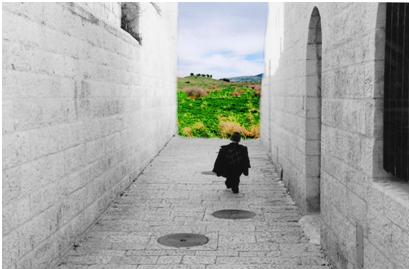
It is a time of beginnings. At the preschool, the first student to wear a t-shirt to school this spring was called to the front of the classroom during circle time. "This is a very good sign," the teacher said, "now the days will get much much longer and the sun will shine and it will be hot and we can put our coats way up in the closet and start wearing sandals and t-shirts to school."
The beautiful weather feels more to me like the end of the school year, and more and more I find myself searching online for interesting things to do in New York next year (for instance, did you know that at Wednesdays at noon to 4pm there are free tours of the pre-Revolutionary African graveyard at 290 Broadway at Duane Street?) and thinking less and less about being here in Jerusalem. And yet we still have months left!
Classes began this week, but were interrupted by Purim (about which Daniel plans on posting this afternoon, I think, so I won't step on his toes). I am taking: Yiddish, Sholom Aleichem, Masculinity and Nationhood in Hebrew Literature, Anthropology of Israel, and possibly a course on Collective Memory in the Palestinian/Israeli conflict, as well as Hebrew. I have not yet had all of these classes because of Purim-related cancellations, but those that I have had are terrific. It was so nice to go back to class and know people in every class I was in - a bit like high school really - with high fives and reunions of friends, and sarcastic comments about how bored we are already when clearly everyone is actually happy to be back. My Hebrew teachers seem much better than last semester, and I think this is going to be a good few months.
My parents' visit was amazing. I don't want to bore them by writing all about it when they, in fact, were there, but I will tell you just a few snippets: they arrived in the pouring rain and cold of Israeli winter and were unpleasantly surprised to be stuck in our apartment to avoid wind and hail for the first day or so. As things calmed down, we left for the Negev, stopping at a Bedouin Museum that was all but deserted, Ben Gurion's Negev home - the very modest dwelling where he spent the last years of his life living out his Zionist vision on a kibbutz, and Makhtesh Ramon, the world's largest crater formed by erosion. There we hiked past beautiful multicolored stones and enjoyed incredible vistas. We traveled to Eilat to relax on a beach not unlike the Jersey shore, save that we could see the Jordanian flag waving in the distance. We ventured into Jordan to visit Petra, an archeological site carved in a crack in rocks of the valley of Arabah. It was the capitol city to the Naboteans, who intricately carved dwellings and truly stunnung burial sites out of the rock. We returned from the South to spend a week in Jerusalem, taking walking tours of the Old City, going to Yemin Moshe, Har Hertzl, the Menachem Begin Heritage Center, Hebrew University, the Museum of the Seam, and more. We even spent a day in Tel Aviv, walking and shopping, and I purchased a dress to wear at Rebecca's wedding. I can't believe we did so much in the two weeks they were here, and it was so terrific to spend time with my parents and to share my life here with them (and show off my Hebrew!)
It promises to be busy for the rest of Daniel's stay here as we're trying to fit in as many opportunities as possible to spend time with friends, see Israel, enjoy the weather, etc. on top of fulfilling our academic obligations. I do intend, though, to be more on top of blogging than I've been these past few weeks, and apologise for my absence from the "blogosphere"
Hope all is well with all of you faithful readers!
Showing posts with label weather. Show all posts
Showing posts with label weather. Show all posts
Thursday, March 12, 2009

Tuesday, September 30, 2008
Cantors, Cooking, Cups, Concert, Camelot
About Rosh Hashana Services: It is in writing about moments such as these that I realize that language is inadequate - or that I don't have the skill to shape my words in such a way that you can understand the full majesty of what we experienced. Seated in a high-ceilinged room at HUC, from whose Eastern wall, made entirely of class, we watched the sun as it set (last night) and ascended (this morning) over the Old City, we listened to and joined in services of such magnificent music that it quite literally brought tears to my eyes. These cantorial students, these people with talent so great, their voices rang out so purely and fully together that they seemed like the heavenly host of angels praising G-d that we read about in the high holiday liturgy. It was especially moving to hear some of our friends, cantorial students, whom I'd never really heard sing, sharing and bearing themselves in front of the congregation and really sanctifying the day with their gifts and their passions. I felt like a guitar that had been strummed and I'm still resonating, within me I'm filling up with music and sound, waves that flow upwards and outwards and fill the whole of me.
In addition to the pheonminal choir of cantorial students, we also had the honor to hear Cantor Eli Schleifer, the director of the cantorial program in Jerusalem. His passion was matched by his control of the music, and his ability to connect the music to the words of the prayers to enhance and elevate the entire experience. He read the Akeidah, speaking the words of G-d and of Abraham with a bold, deep commanding voice, and the words of Isaac with a voice so tentative, so unsure, that he was transformed himself into a timid son following a half-crazed father in search of his G-d at the expense of his own lifeblood. There were so many powerful moments in his prayers, that I simply cannot recount them all. When he sang of mortality his voice began strong and softened until it was a tiny star in the vast, dark, heavens. All of his words, all of his prayers, were so deliberate, so artful. There wasn't a single misplaced note or syllable, not a single word that seemed to be sung by rote or out of obligation to the tradition - all was sincere, all was in a spirit of atonement and celebration, of truly marking life by the seasons in which we live it, by the emotions we experience, and by the limits of our physical bodies and the limitlessness of our souls.
I wish all of you could have been there. It was grand but also participatory, it was awesome, but also down-to-earth, it made me feel as though praying was a holy endeavor, while reminding me that prayer is also a vehicle and a vessel that needs to be brought out of the synagogue and carried around as part of every day life. If I can bring the service with me as I embark on the ten days of tshuva, I will have accomplished much.
Daniel and I were just discussing how difficult we find the ten days of tshuva, because we aren't sure what they mean and how we should act during those days. For instance, is it enough to say to everyone "If I have done you any wrong this year, I am sorry"? Or is that sort of a cop-out as you aren't personally probing to try to remember the wrongs you have committed and you aren't making yourself vulnerable to others by admitting your imperfections? And what if you honestly can't remember something that you did wrong? Or what if you can remember it but it really was just a small thing, and you think it would do more harm than good to bring it up again? Exactly what are we to do during these ten days? Another question is to what extent should we force ourselves to be better people for just these ten days? If I want G-d to judge me for who I am, perhaps I shouldn't change my behavior for ten days, perhaps it is dishonest. Or, perhaps I can take these ten days and try to change and improve myself, nad maybe some of it will stick into the next year. It's like a trial period for New Year's Resolutions - and surely if you do something every day for ten days, it is likely to make an impression on you, and affect your behavior at least in some small way for the rest of the year. I don't know, but I do know that it is important to try to be the best version of yourself at all times, and perhaps focusing on that for ten days will help with focusing on it throughout the year.
As the New Year is beginning, the weather is changing and we're beginning to feel a cold breeze settling on the city of Jerusalem. It will stay, and the sun will seem rarer, and it will be harder and harder to find warmth in the city. It seems like a hard time to begin a New Year - not in the spring when we can rejoice in the warmth of the sun and in the personal freedom that summer offers, but at the cusp of the rainy season, when we are chained to our umbrellas, slaves of our galoshes. But, perhaps too the rainy season is an appropriate way to begin the year, as it is the start of the agricultural cycle, and I am praying for a year that bears plentiful fruit, a year that grows toward the sun, a year that blossoms in vivid colors.
--------------------------------------------
We began our preparations for Rosh Hashanah with cooking, which is itself a deeply spiritual activity. A very wise person once told me that the action of knitting, a practical, creative endeavor of craftingthe long and narrow into the full, soft, and warm, was one of the most spiritual activities that life offers. I'm not sure if that holds true for me, but I would say that I can apply the same to cooking. I love the mysterious way that artcan be created out of the very stuff of the earth - the grain and the leaf, the fruit and the nut. We baked a splendid honeycake in preparation for the holiday. It is rich, dense, and fragrant, with candied ginger, cloves, and nutmeg. We're hoping to have some friends over tomorrow after services to share it with us. For today's potluck lunch, we made a simple yet elegant dish of mushrooms in olive oil, balsamic vinegar, and white wine, and for the potluck dinner we are attending tonight, I tried to replicate the lasagne recipe that Paola taught me a few weeks ago. We spent most of the day yesterday cooking and shopping for food. In addition, we decided to splurge on some items we've been sorely missing: a challah cover, candle sticks, a vessel for ritual hand washing, a set of cups, a set of serving bowls, a steamer, and four mugs. Everything was on sale because of the holiday season and was quite reasonable, and we are pleased at the idea of leaving the apartment well stocked at the end of the year, as we've been so happy with all of the supplies left to us by the previous tenants.
---------------------------------
On Thursday, I took my final exam for my ulpan, and I am now enjoying a month's break. For my first day of break (Sunday), I went to the Ministry of the Interior and finally was able to procure a student visa, thus ending the painful work of half a year. I've begun studying for the GRE Subject Test in Literature in English, though my testing date has been pushed back until November. I have a lot of studying to do for the test, so while I am disappointed at the date change, especially as I am a little antsy that not everything will arrive to the schools I'm applying to on time if it is sent so late, I am pleased to have the extra time to reread Canterbury tales and quiz myself on the names of all of the characters that ever appeared in a work by Shakespeare or Dickens. I've begun reading in English again, I couldn't help myself, and even Hemmingway (who I'm reading now but have never read before) feels like a dear old friend. The lack of a novel these past months has felt deeply physical and personal, like a whole part of my life and my identity had been left stranded at the airport in Toronto. Being able to read in Hebrew helped a little, but I am so glad to be reunited with the English language. I am a bit nervous, however, that this long break will allow too many opportunities to forget to be diligent about language study, and I hope to continue to read in Hebrew and in Yiddish throughout the break. In addition to all this reading, I of course will be applying to graduate school, and am currently working hard at discovering my sense of purpose, so that I can write a statement of purpose to each of these universities. Wish me luck.
---------------------
On Thursday night, Daniel and I strolled to Yung Yiddish. We are rarely out so late at night, and there was an excitement to the bright lights of stores against the stillness of the evening. On the way, we passed through the shuk and I bought Daniel a molten chocolate cake. We passed through bustling Jaffa street and through an empty Rehov Yerimiyhu where we walked past a store displaying fancy, beautiful sukkot.
The crowd at Yung Yiddish was mostly secular this time, and the place was pretty full (maybe 45 people in the audience?). The performer, Theresa Tova, had a deep, pointed, strong, alto voice, and she sang Cabaret/Jazz style Yiddish pieces, many of them also translated into English (She's not a Hebrew speaker), with poise, and a smooth, easy sort of confidence. She was accompanied by a pianest and cellist that she had just met that day, yet the performance was not anxious, and where there were mistakes, they were corrected cooly. Theresa Tova exuded a love for the music that she was singing - an enjoyment of it, and also a belief in it. She had a jazzy, sassy, easy, sultry sort of stage presence. She explained each piece before she sang it, often with jokes and always with smiles. We loved her music, and we found ourselves clapping and singing along to Belz, Sheyn Vi Di Levoyne, Papirosn, and many others. We enjoyed it so much that we bought a CD and when we are back in the States we'll be glad to lend it to you. Theresa Tova is an actor. singer, and writer, based in Toronto (woohoo!) who performes in New York, Poland, Germany, Toronto, and elsewhere. Her mother was a Partisan during the Holocaust, and Tova learned Polish Yiddish in her home.
After Tova finished singing, Mendy Cahan, the head of Yung Yiddish, passed out cups for wine and vodka and made a warm toast to the New Year. Armed with our CD and these warm wishes, we set out into the evening to walk back to our apartment.
----------------------------------------------
It's been so long since I've written that I keep thinking of more that I want to say. Should I tell you about teaching a friend to bake challah and the two huge honey-glazed round challahs we produced? Should I tell you about the Shabbat meal we shared with two friends, or the Shabbat lunch we served to other guests the following day? Should I tell you about the new friend we made at shul on Saturday that we welcomed into our home for lunch the very day we met him? Or about my being called to the Torah for an aliyah at the Conservative shul we enjoy attending on Saturday mornings? I think it would be too much, and take too much of your time. Suffice it to say that it has been a full, full, few days (both in terms of being busy and in terms of consuming a lot of delicious food!)
----------------------------------------------
So instead of ending by telling you more about our week and our life here, I want to end with a thought for the new year. The following quote, which I read on the blog of the Velveteen Rabbi (see the links side of our blog page) struck me as particularly useful in conceptualizing Rosh Hashana:
She Writes: "Today is the birthday of the world." We say it every year; we'll say it on Tuesday and Wednesday, that 48-hour span of time which Jewish tradition mystically considers a single extended day of Rosh Hashanah. But the liturgy says something slightly different than what the simple English rendition would suggest. As Reb Duvid notes, harah means "pregnancy," conception or gestation: not labor, not birth. I've never carried nor borne a child, but I can see from here that they're very different things. Rosh Hashanah isn't the world's "birthday," exactly; it's the day when we celebrate creation's pregnant possibilities.
In studying for this English exam, I found myslelf rereading Tennyson's "The Lady of Shalott," which is about a magical woman who lives in a tower upstream from Camelot. She sits near a window and looks at the world through a mirror, weaving a tapestry that depicts the world that she sees outside. She is forbidden to look out of the mirror itself and to see real life. Ultimately, she sees Lancelot out her window and falls so in love with him that she cannot resist, looks out her window, and as her mirror cracks, she realizes the desolateness of the cursed life she leads. She leaves her tower, carves her name into a boat, lays down upon the boat and floats to Camelot, dying of cold along the way. It is a deeply mournful poem, of the desperate longing to break free from a life cut off from the world and in an act of desparation and of headlong bravery, to experience real life, even just for a moment before the coldness of death.
If creation is pregnant with possibilities, I think "The Lady of Shalott" urges us to take them. To take risks. Not to weave "by night and day a tapestry of colors gay" about the lives of others and the world that lies outside our doors, but to actually go out and to see the world and to live life. It is not easy to do. It is not easy for me to do - my natural inclination is to stay home where I am safe and comfortable, and perhaps this is why it seemed so exciting and unusual to me and Daniel to be out on Thursday night, as we are in fact inside most evenings. But my wish, my hope, my dream for the new year, is that as we enter into a time of the birth of the world, we will not only recognize its potential, but experience and be a part of that potential. I wish you all a sweet and a meaningful new year, a new year of experiences, of action, of headlong fanciful bravery that lasts more than just a moment, but for the whole long and enchanted journey of your lives.
In addition to the pheonminal choir of cantorial students, we also had the honor to hear Cantor Eli Schleifer, the director of the cantorial program in Jerusalem. His passion was matched by his control of the music, and his ability to connect the music to the words of the prayers to enhance and elevate the entire experience. He read the Akeidah, speaking the words of G-d and of Abraham with a bold, deep commanding voice, and the words of Isaac with a voice so tentative, so unsure, that he was transformed himself into a timid son following a half-crazed father in search of his G-d at the expense of his own lifeblood. There were so many powerful moments in his prayers, that I simply cannot recount them all. When he sang of mortality his voice began strong and softened until it was a tiny star in the vast, dark, heavens. All of his words, all of his prayers, were so deliberate, so artful. There wasn't a single misplaced note or syllable, not a single word that seemed to be sung by rote or out of obligation to the tradition - all was sincere, all was in a spirit of atonement and celebration, of truly marking life by the seasons in which we live it, by the emotions we experience, and by the limits of our physical bodies and the limitlessness of our souls.
I wish all of you could have been there. It was grand but also participatory, it was awesome, but also down-to-earth, it made me feel as though praying was a holy endeavor, while reminding me that prayer is also a vehicle and a vessel that needs to be brought out of the synagogue and carried around as part of every day life. If I can bring the service with me as I embark on the ten days of tshuva, I will have accomplished much.
Daniel and I were just discussing how difficult we find the ten days of tshuva, because we aren't sure what they mean and how we should act during those days. For instance, is it enough to say to everyone "If I have done you any wrong this year, I am sorry"? Or is that sort of a cop-out as you aren't personally probing to try to remember the wrongs you have committed and you aren't making yourself vulnerable to others by admitting your imperfections? And what if you honestly can't remember something that you did wrong? Or what if you can remember it but it really was just a small thing, and you think it would do more harm than good to bring it up again? Exactly what are we to do during these ten days? Another question is to what extent should we force ourselves to be better people for just these ten days? If I want G-d to judge me for who I am, perhaps I shouldn't change my behavior for ten days, perhaps it is dishonest. Or, perhaps I can take these ten days and try to change and improve myself, nad maybe some of it will stick into the next year. It's like a trial period for New Year's Resolutions - and surely if you do something every day for ten days, it is likely to make an impression on you, and affect your behavior at least in some small way for the rest of the year. I don't know, but I do know that it is important to try to be the best version of yourself at all times, and perhaps focusing on that for ten days will help with focusing on it throughout the year.
As the New Year is beginning, the weather is changing and we're beginning to feel a cold breeze settling on the city of Jerusalem. It will stay, and the sun will seem rarer, and it will be harder and harder to find warmth in the city. It seems like a hard time to begin a New Year - not in the spring when we can rejoice in the warmth of the sun and in the personal freedom that summer offers, but at the cusp of the rainy season, when we are chained to our umbrellas, slaves of our galoshes. But, perhaps too the rainy season is an appropriate way to begin the year, as it is the start of the agricultural cycle, and I am praying for a year that bears plentiful fruit, a year that grows toward the sun, a year that blossoms in vivid colors.
--------------------------------------------
We began our preparations for Rosh Hashanah with cooking, which is itself a deeply spiritual activity. A very wise person once told me that the action of knitting, a practical, creative endeavor of craftingthe long and narrow into the full, soft, and warm, was one of the most spiritual activities that life offers. I'm not sure if that holds true for me, but I would say that I can apply the same to cooking. I love the mysterious way that artcan be created out of the very stuff of the earth - the grain and the leaf, the fruit and the nut. We baked a splendid honeycake in preparation for the holiday. It is rich, dense, and fragrant, with candied ginger, cloves, and nutmeg. We're hoping to have some friends over tomorrow after services to share it with us. For today's potluck lunch, we made a simple yet elegant dish of mushrooms in olive oil, balsamic vinegar, and white wine, and for the potluck dinner we are attending tonight, I tried to replicate the lasagne recipe that Paola taught me a few weeks ago. We spent most of the day yesterday cooking and shopping for food. In addition, we decided to splurge on some items we've been sorely missing: a challah cover, candle sticks, a vessel for ritual hand washing, a set of cups, a set of serving bowls, a steamer, and four mugs. Everything was on sale because of the holiday season and was quite reasonable, and we are pleased at the idea of leaving the apartment well stocked at the end of the year, as we've been so happy with all of the supplies left to us by the previous tenants.
---------------------------------
On Thursday, I took my final exam for my ulpan, and I am now enjoying a month's break. For my first day of break (Sunday), I went to the Ministry of the Interior and finally was able to procure a student visa, thus ending the painful work of half a year. I've begun studying for the GRE Subject Test in Literature in English, though my testing date has been pushed back until November. I have a lot of studying to do for the test, so while I am disappointed at the date change, especially as I am a little antsy that not everything will arrive to the schools I'm applying to on time if it is sent so late, I am pleased to have the extra time to reread Canterbury tales and quiz myself on the names of all of the characters that ever appeared in a work by Shakespeare or Dickens. I've begun reading in English again, I couldn't help myself, and even Hemmingway (who I'm reading now but have never read before) feels like a dear old friend. The lack of a novel these past months has felt deeply physical and personal, like a whole part of my life and my identity had been left stranded at the airport in Toronto. Being able to read in Hebrew helped a little, but I am so glad to be reunited with the English language. I am a bit nervous, however, that this long break will allow too many opportunities to forget to be diligent about language study, and I hope to continue to read in Hebrew and in Yiddish throughout the break. In addition to all this reading, I of course will be applying to graduate school, and am currently working hard at discovering my sense of purpose, so that I can write a statement of purpose to each of these universities. Wish me luck.
---------------------
On Thursday night, Daniel and I strolled to Yung Yiddish. We are rarely out so late at night, and there was an excitement to the bright lights of stores against the stillness of the evening. On the way, we passed through the shuk and I bought Daniel a molten chocolate cake. We passed through bustling Jaffa street and through an empty Rehov Yerimiyhu where we walked past a store displaying fancy, beautiful sukkot.
The crowd at Yung Yiddish was mostly secular this time, and the place was pretty full (maybe 45 people in the audience?). The performer, Theresa Tova, had a deep, pointed, strong, alto voice, and she sang Cabaret/Jazz style Yiddish pieces, many of them also translated into English (She's not a Hebrew speaker), with poise, and a smooth, easy sort of confidence. She was accompanied by a pianest and cellist that she had just met that day, yet the performance was not anxious, and where there were mistakes, they were corrected cooly. Theresa Tova exuded a love for the music that she was singing - an enjoyment of it, and also a belief in it. She had a jazzy, sassy, easy, sultry sort of stage presence. She explained each piece before she sang it, often with jokes and always with smiles. We loved her music, and we found ourselves clapping and singing along to Belz, Sheyn Vi Di Levoyne, Papirosn, and many others. We enjoyed it so much that we bought a CD and when we are back in the States we'll be glad to lend it to you. Theresa Tova is an actor. singer, and writer, based in Toronto (woohoo!) who performes in New York, Poland, Germany, Toronto, and elsewhere. Her mother was a Partisan during the Holocaust, and Tova learned Polish Yiddish in her home.
After Tova finished singing, Mendy Cahan, the head of Yung Yiddish, passed out cups for wine and vodka and made a warm toast to the New Year. Armed with our CD and these warm wishes, we set out into the evening to walk back to our apartment.
----------------------------------------------
It's been so long since I've written that I keep thinking of more that I want to say. Should I tell you about teaching a friend to bake challah and the two huge honey-glazed round challahs we produced? Should I tell you about the Shabbat meal we shared with two friends, or the Shabbat lunch we served to other guests the following day? Should I tell you about the new friend we made at shul on Saturday that we welcomed into our home for lunch the very day we met him? Or about my being called to the Torah for an aliyah at the Conservative shul we enjoy attending on Saturday mornings? I think it would be too much, and take too much of your time. Suffice it to say that it has been a full, full, few days (both in terms of being busy and in terms of consuming a lot of delicious food!)
----------------------------------------------
So instead of ending by telling you more about our week and our life here, I want to end with a thought for the new year. The following quote, which I read on the blog of the Velveteen Rabbi (see the links side of our blog page) struck me as particularly useful in conceptualizing Rosh Hashana:
She Writes: "Today is the birthday of the world." We say it every year; we'll say it on Tuesday and Wednesday, that 48-hour span of time which Jewish tradition mystically considers a single extended day of Rosh Hashanah. But the liturgy says something slightly different than what the simple English rendition would suggest. As Reb Duvid notes, harah means "pregnancy," conception or gestation: not labor, not birth. I've never carried nor borne a child, but I can see from here that they're very different things. Rosh Hashanah isn't the world's "birthday," exactly; it's the day when we celebrate creation's pregnant possibilities.
In studying for this English exam, I found myslelf rereading Tennyson's "The Lady of Shalott," which is about a magical woman who lives in a tower upstream from Camelot. She sits near a window and looks at the world through a mirror, weaving a tapestry that depicts the world that she sees outside. She is forbidden to look out of the mirror itself and to see real life. Ultimately, she sees Lancelot out her window and falls so in love with him that she cannot resist, looks out her window, and as her mirror cracks, she realizes the desolateness of the cursed life she leads. She leaves her tower, carves her name into a boat, lays down upon the boat and floats to Camelot, dying of cold along the way. It is a deeply mournful poem, of the desperate longing to break free from a life cut off from the world and in an act of desparation and of headlong bravery, to experience real life, even just for a moment before the coldness of death.
If creation is pregnant with possibilities, I think "The Lady of Shalott" urges us to take them. To take risks. Not to weave "by night and day a tapestry of colors gay" about the lives of others and the world that lies outside our doors, but to actually go out and to see the world and to live life. It is not easy to do. It is not easy for me to do - my natural inclination is to stay home where I am safe and comfortable, and perhaps this is why it seemed so exciting and unusual to me and Daniel to be out on Thursday night, as we are in fact inside most evenings. But my wish, my hope, my dream for the new year, is that as we enter into a time of the birth of the world, we will not only recognize its potential, but experience and be a part of that potential. I wish you all a sweet and a meaningful new year, a new year of experiences, of action, of headlong fanciful bravery that lasts more than just a moment, but for the whole long and enchanted journey of your lives.
Sunday, September 14, 2008
A Few Updates
I just got back from a short, yet productive, meeting with Yehuda Stolov, the head of the Interfaith Encounter Association, an organization for which I plan on volunteering a few hours a week. We began by introducing ourselves to each other briefly, and then discussing what kinds of tasks I'd be willing to do. We came up with three possible tasks for the year: helping with fundraising, sorting and keeping track of e-mail addresses, and translating encounter groups' reports from Hebrew into English. The last of these is the most interesting to me but probably the least helpful to them as right now Yehuda does this task himself and is probably more qualified for the task. But hopefully I'll get to do some of it as it would certainly be good Hebrew practice for me! Really, I didn't expect this volunteering to be particularly interesting, but I believe in and am excited about the organization and wanted to help out in some small way that fit with what I imagine will be my busy schedule this year. In addition to volunteering, I will also be taking part in an interfaith encounter group. Yehuda told me that there are three groups that would be good for me in Jerusalem and that while each received identical training they are all quite different because of the people who are in the groups. One is located on Mt. Scopus, at Hebrew University, and is composed entirely of students. One meets around the corner from where we live and is for young professionals. The third (least convenient for me to meet with in terms of location but perhaps the most interesting?) is composed of five young Jews from Jerusalem and five young Palestinians from Hebron, a city in the West Bank. It meets in Jerusalem once a week. None of these groups is meeting during the summer, so I do have a little while to think about which group(s) I'll be a part of - any of them I think would be a great experience.
A bit about the Interfaith Encounter Association, because I think they are a truly inspiring group. Yehuda told me that the organization was founded seven years ago, when a few participants of other interfaith dialogue groups decided to form a new model because they felt that the old model wasn't working. According to Yehuda, the old model only encouraged participation by those few individuals who had already begun some work in interfaith studies. It mostly consisted of lectures or panels with passive listeners, which has its benefits as the group can control what kind of information is presented, but is ineffective if the goal is to have people get to know each other and lose their fears of one another. IEA was formed to encourage larger numbers of people from all walks of life to participate in an interactive and open form of dialogue. The group is only focused on religious issues and takes no political stances, nor does it have political conversations. They believe that religion can be a solution to conflicts and not only a cause, and that through coming together to talk about religion, members of diverse groups can lose their fear of one another and see themselves in the other. IEA's goal is to be a social movement involving thousands of groups accross the country, and to change the social fabric of Israel in a grassroots way by getting people to simply talk to one another. Seven years ago, IEA consisted of two interfaith dialogue groups, now it consists of something like 23 groups and thousands of active members. Some of its projects include weekend retreats, School Coexistance Projects that bring together Palestinian and Israeli school groups to talk about neutral issues (one group was recently educated on dental care, for instance), Womens Interfaith Encounter groups, three Youth Interfaith Encounter groups, and a Middle East Abrahamic Forum including groups from Egypt, the Palestinian Authority, Iran, Jordan, Turkey, and Israel. IEA has been recognized by UNESCO as an actor of the global movement for a culture of peace, a United Nations initiative. In 2006, IEA received the Immortal Chaplains Foundation's 2006 Prize for Humanity.
Flipping through the reports of various IEA events, I read about a Hannukah/Eid Al Adha party at a member's house, Palestinian and Israeli fifth graders doing a road clean-up together, a mother's day celebration where women from various groups came together to do programs on cooking, cosmetics, and sports, and art, a meeting of Christian, Muslim, and Druze women to discuss the issue of young marraige age, an evening of folklore and theater in a diverse community, meetings and presentations in churches, mosques, synagogues, and a Druze worship house, a meeting on the importance of dialogue led by a social worker and a psychologist, a bazaar at a community center where underprivileged people could come and get what they might need for an upcoming holiday, a conversation comparing and contrasting foods eaten by different groups, a discussion of holy day practices, a discussion of how different individuals relate to the idea of identity, what sounds like an intense discussion on predestination, conversion, sin, redemption, and asking forgiveness from G-d in Islam and Judaism, reading Hebrew and Arabic translations of Martin Luther King, Jr. together, an interfaith meeting of healthcare workers to discuss the influence of interpreters in healthcare settings, and the list goes on and on and on and on. In 2007, IEA held a total of 120 programs comprised of 96 inter-religious study sessions in the general program, 20 in the Women’s Program, and 4 in
the Young Adults program. The IEA website is quite informative, so if you want to learn more, you should definately check it out.
-------------------------
Yesterday, Daniel and I had some friends over for creme brulee french toast (made out of the challah which I've come to enjoy baking on Fridays) after Shabbat services. We played games, chatted, and had a great time. In the evening, we went to an HUC Havdalah event, a magical way to invite the week to begin again after the slow and lazy sigh of Shabbat.
----------------------
On Friday evening, Daniel and I went to the Jerusalem Great Synagogue, an Orthodox synagogue right around the corner from our apartment. It is a huge and impressive building. The foyer is home to an exhibit of artistic mezzuzot, which Daniel and I browsed eagerly as we nervously watched other people out of the corner of our eyes to figure out where we should go for services. Eventually we made our way up a grand flight of stairs, and parted as I headed further up, to the women's balcony. On the way, I walked next to an old lady with pleasantly crinkled leathery skin and smiling eyes, whose head was covered with a brown kercheif as though she were plucked out of a film about East European Jewish life in the 1800's. She said to me in Hebrew "A lot of stairs", and I smiled at her and walked up them slowly with her, just to be sure she made it to the top safely.
At the top, I sat next to a row of women with small children who chattered and cooed throughout the service, which would have been beautiful music to listen to had not the woman on the other side of me insisted on shushing the children almost constantly and chastizing their mothers for bringing them to shul if they were going to make so much noise. Everyone was very nice to me and there was a sense of community up there in the women's balcony. Not very many people seemed to be praying, but everyone seemed to be having a good time.
I had trouble following the prayers in the prayerbook - the chazzan faced the ark and prayed ferverently in an Ashkenazi accented Hebrew - but the prayer was nevertheless beautiful. The chazzan's voice was operetic and soulful, powerful, warm, and pointed, and it carried throughout the high-ceilinged, grand sanctuary. One of the most noticable features of the synagogue was its stained glass windows, tall, large, detailed, and glimmeringly colorful in the setting sun of Shabbat evening.
---------------------
On Thursday night, we had our accross the hall neighbors over for dinner. I arrived home from ulpan a bit early and began cooking and cleaning as soon as I got home. Mom, you would have been impressed to find me on my hands and knees cleaning the floor. I even dusted! (for those of you who don't know, I am an incredibly messy person, so this was no small feat). We made vegetarian quiche stuffed with parsnips, red pepper, parsely, and squash, steamed broccolli, oven roasted potatoes, and red lentil soup. Everything smelled delicious and we were very proud of ourselves when at 6:30 we sat down on the couch and waited for our guests to arrive, any minute. Any minute turned into a half hour, and we didn't know what to do - should we knock on their door? Wait longer? Should we assume they had forgotten and eat dinner? A half hour is a long time... Finally Daniel knocked on their door... three separate times.... and we waited some more. At 7:10 our neighbors arrived, flowers in hand. We think maybe the timing was a cultural difference we weren't prepared for, and our only question is, if they invite us over would it be uncouth for us to show up on time?
Our neighbors are Hebrew speakers whose English is not as good as our Hebrew, so the conversation was entirely in Hebrew. Thank goodness that they like to talk, because we can both understand much more than we can say. It was a lovely evening full of stories and laughter. We heard about their experiences in the army, how they met, about their children and grandchildren, their family histories, and more. We talked about literature and language, about food, and quite a bit about religion. They are very interesting, intellectual, warm, and patient people and we are excited at the possibility of growing close to them - and improving our Hebrew through interacting with them!
--------------------
Otherwise, things here have been quiet. Jerusalem is cooling down a bit - today there were clouds in the sky and the air was cool and calm until the afternoon - so much so that I may need to rethink my wardrobe in the upcoming weeks. Today I walked home from IEA in the afternoon and arrived home flushed from the heat, but the sun is setting now and the cool breeze from the window is pleasant and soothing. We haven't used the window fans in a few days.
I've been working on a presentation that I have to give on Thursday to my literature class about Amos Oz, and I imagine that it will be the primary concern of my week - devising questions to ask the class about the section we will read, looking up pertinent words, and reiterating to myself that I won't compleltely embarass myself when I try to speak Hebrew in front of the class with at least some semblance of an air of authority.
--------------------------
Daniel and I have noticed that while we love our blog, as it is a way for us to record, express, and process our experiences here in Isreal, it is in some ways a false way of keeping in touch because we don't have the opportunity to hear about all of your adventures. So, in your free time and when you get a chance, please send us e-mails, facebook messages, comments, phone calls, or whatever, and let us know how you are. We miss all of you so much.
A bit about the Interfaith Encounter Association, because I think they are a truly inspiring group. Yehuda told me that the organization was founded seven years ago, when a few participants of other interfaith dialogue groups decided to form a new model because they felt that the old model wasn't working. According to Yehuda, the old model only encouraged participation by those few individuals who had already begun some work in interfaith studies. It mostly consisted of lectures or panels with passive listeners, which has its benefits as the group can control what kind of information is presented, but is ineffective if the goal is to have people get to know each other and lose their fears of one another. IEA was formed to encourage larger numbers of people from all walks of life to participate in an interactive and open form of dialogue. The group is only focused on religious issues and takes no political stances, nor does it have political conversations. They believe that religion can be a solution to conflicts and not only a cause, and that through coming together to talk about religion, members of diverse groups can lose their fear of one another and see themselves in the other. IEA's goal is to be a social movement involving thousands of groups accross the country, and to change the social fabric of Israel in a grassroots way by getting people to simply talk to one another. Seven years ago, IEA consisted of two interfaith dialogue groups, now it consists of something like 23 groups and thousands of active members. Some of its projects include weekend retreats, School Coexistance Projects that bring together Palestinian and Israeli school groups to talk about neutral issues (one group was recently educated on dental care, for instance), Womens Interfaith Encounter groups, three Youth Interfaith Encounter groups, and a Middle East Abrahamic Forum including groups from Egypt, the Palestinian Authority, Iran, Jordan, Turkey, and Israel. IEA has been recognized by UNESCO as an actor of the global movement for a culture of peace, a United Nations initiative. In 2006, IEA received the Immortal Chaplains Foundation's 2006 Prize for Humanity.
Flipping through the reports of various IEA events, I read about a Hannukah/Eid Al Adha party at a member's house, Palestinian and Israeli fifth graders doing a road clean-up together, a mother's day celebration where women from various groups came together to do programs on cooking, cosmetics, and sports, and art, a meeting of Christian, Muslim, and Druze women to discuss the issue of young marraige age, an evening of folklore and theater in a diverse community, meetings and presentations in churches, mosques, synagogues, and a Druze worship house, a meeting on the importance of dialogue led by a social worker and a psychologist, a bazaar at a community center where underprivileged people could come and get what they might need for an upcoming holiday, a conversation comparing and contrasting foods eaten by different groups, a discussion of holy day practices, a discussion of how different individuals relate to the idea of identity, what sounds like an intense discussion on predestination, conversion, sin, redemption, and asking forgiveness from G-d in Islam and Judaism, reading Hebrew and Arabic translations of Martin Luther King, Jr. together, an interfaith meeting of healthcare workers to discuss the influence of interpreters in healthcare settings, and the list goes on and on and on and on. In 2007, IEA held a total of 120 programs comprised of 96 inter-religious study sessions in the general program, 20 in the Women’s Program, and 4 in
the Young Adults program. The IEA website is quite informative, so if you want to learn more, you should definately check it out.
-------------------------
Yesterday, Daniel and I had some friends over for creme brulee french toast (made out of the challah which I've come to enjoy baking on Fridays) after Shabbat services. We played games, chatted, and had a great time. In the evening, we went to an HUC Havdalah event, a magical way to invite the week to begin again after the slow and lazy sigh of Shabbat.
----------------------
On Friday evening, Daniel and I went to the Jerusalem Great Synagogue, an Orthodox synagogue right around the corner from our apartment. It is a huge and impressive building. The foyer is home to an exhibit of artistic mezzuzot, which Daniel and I browsed eagerly as we nervously watched other people out of the corner of our eyes to figure out where we should go for services. Eventually we made our way up a grand flight of stairs, and parted as I headed further up, to the women's balcony. On the way, I walked next to an old lady with pleasantly crinkled leathery skin and smiling eyes, whose head was covered with a brown kercheif as though she were plucked out of a film about East European Jewish life in the 1800's. She said to me in Hebrew "A lot of stairs", and I smiled at her and walked up them slowly with her, just to be sure she made it to the top safely.
At the top, I sat next to a row of women with small children who chattered and cooed throughout the service, which would have been beautiful music to listen to had not the woman on the other side of me insisted on shushing the children almost constantly and chastizing their mothers for bringing them to shul if they were going to make so much noise. Everyone was very nice to me and there was a sense of community up there in the women's balcony. Not very many people seemed to be praying, but everyone seemed to be having a good time.
I had trouble following the prayers in the prayerbook - the chazzan faced the ark and prayed ferverently in an Ashkenazi accented Hebrew - but the prayer was nevertheless beautiful. The chazzan's voice was operetic and soulful, powerful, warm, and pointed, and it carried throughout the high-ceilinged, grand sanctuary. One of the most noticable features of the synagogue was its stained glass windows, tall, large, detailed, and glimmeringly colorful in the setting sun of Shabbat evening.
---------------------
On Thursday night, we had our accross the hall neighbors over for dinner. I arrived home from ulpan a bit early and began cooking and cleaning as soon as I got home. Mom, you would have been impressed to find me on my hands and knees cleaning the floor. I even dusted! (for those of you who don't know, I am an incredibly messy person, so this was no small feat). We made vegetarian quiche stuffed with parsnips, red pepper, parsely, and squash, steamed broccolli, oven roasted potatoes, and red lentil soup. Everything smelled delicious and we were very proud of ourselves when at 6:30 we sat down on the couch and waited for our guests to arrive, any minute. Any minute turned into a half hour, and we didn't know what to do - should we knock on their door? Wait longer? Should we assume they had forgotten and eat dinner? A half hour is a long time... Finally Daniel knocked on their door... three separate times.... and we waited some more. At 7:10 our neighbors arrived, flowers in hand. We think maybe the timing was a cultural difference we weren't prepared for, and our only question is, if they invite us over would it be uncouth for us to show up on time?
Our neighbors are Hebrew speakers whose English is not as good as our Hebrew, so the conversation was entirely in Hebrew. Thank goodness that they like to talk, because we can both understand much more than we can say. It was a lovely evening full of stories and laughter. We heard about their experiences in the army, how they met, about their children and grandchildren, their family histories, and more. We talked about literature and language, about food, and quite a bit about religion. They are very interesting, intellectual, warm, and patient people and we are excited at the possibility of growing close to them - and improving our Hebrew through interacting with them!
--------------------
Otherwise, things here have been quiet. Jerusalem is cooling down a bit - today there were clouds in the sky and the air was cool and calm until the afternoon - so much so that I may need to rethink my wardrobe in the upcoming weeks. Today I walked home from IEA in the afternoon and arrived home flushed from the heat, but the sun is setting now and the cool breeze from the window is pleasant and soothing. We haven't used the window fans in a few days.
I've been working on a presentation that I have to give on Thursday to my literature class about Amos Oz, and I imagine that it will be the primary concern of my week - devising questions to ask the class about the section we will read, looking up pertinent words, and reiterating to myself that I won't compleltely embarass myself when I try to speak Hebrew in front of the class with at least some semblance of an air of authority.
--------------------------
Daniel and I have noticed that while we love our blog, as it is a way for us to record, express, and process our experiences here in Isreal, it is in some ways a false way of keeping in touch because we don't have the opportunity to hear about all of your adventures. So, in your free time and when you get a chance, please send us e-mails, facebook messages, comments, phone calls, or whatever, and let us know how you are. We miss all of you so much.
Subscribe to:
Posts (Atom)