Showing posts with label Yung YiDDiSH. Show all posts

Friday, November 14, 2008

Blue Cat Cabaret


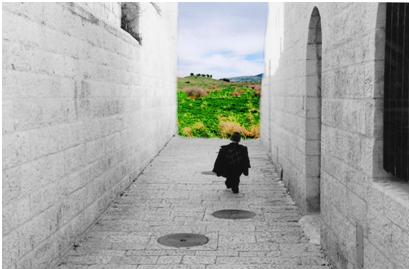
Last night, Daniel and I made our way over to Yung Yiddish for a night of entertainment - and were surprised and delighted by the performance we saw there. "Di Bloye Katz" (pictured ablove) a performance of reenactment of 1920's cabaret was tremendously entertaining. The couple performing Ruth Levin (vocals) and Avishai Fisz (piano), perform under the personas of Ewa Przyżiszka - a melodramatic primadona in a flapper outfit complete with a black peacock feather on her hat and a long, black cigarette holder dangling from her black lace gloved hand, and Arturo Fogacz-Bergamescu, a clumsy pianist who supplies masterful music, but interrupts it with his adoring outbursts of emotion in reaction to Przyziszka's songs. In between her songs, Pryzysiska narrates the concert in a heavily Polish accented English, complete with the deep sighs, pregnant pauses, and dramatic tonality of an exotic European sophisticate playing to an audience of admirers. She spoke in short, terse sentences that were drawn out to full melodramatic effect: "Why do I have misfortune? Why do I have not luck?..." or "No one recognizes my lonliness" or "sex appeal, it is a nice feeling, but now I will sing a song about a feeling which is more nice: love." Her physical movements are reminiscent of old silent films - big arm gestures, eyes open wide and fluttering or blinking, putting her hand dramatically to her ear when she hears something, throwing her head back and pressing the back of her hand to her forehead as though she will faint, and more - all emphasizing her long slender arms, and her big eyes made more dramatic with dark mascara. All of the pieces were sung in Yiddish, and they were love songs, songs of sorrow, and songs of lonliness. The show opened and closed with a song titled "Sex Appeal," which Pryzyziskzka sang with coy smirks, rolled eyes, and fingers spread wide in jazzy hands. In between pieces the pianist would clap, cry, and laugh at inappropriate times, hit notes on the piano 'accidentally' during the narration, and drop things behind the piano that he then walked around and picked up. He, with his untied bow tie, pince-nez glasses, and deadpan face, was certainly one of the highlites of the show. The entire performance was a unpredictable, unforgettable and thoughrally enjoyable blend of physical comedy, historical reenactment, dramatic flair, and plain old good music. "Di Bloye Katz" played to a packed audience of all ages, and the performance was a definite hit.

Tuesday, September 30, 2008

Cantors, Cooking, Cups, Concert, Camelot

About Rosh Hashana Services: It is in writing about moments such as these that I realize that language is inadequate - or that I don't have the skill to shape my words in such a way that you can understand the full majesty of what we experienced. Seated in a high-ceilinged room at HUC, from whose Eastern wall, made entirely of class, we watched the sun as it set (last night) and ascended (this morning) over the Old City, we listened to and joined in services of such magnificent music that it quite literally brought tears to my eyes. These cantorial students, these people with talent so great, their voices rang out so purely and fully together that they seemed like the heavenly host of angels praising G-d that we read about in the high holiday liturgy. It was especially moving to hear some of our friends, cantorial students, whom I'd never really heard sing, sharing and bearing themselves in front of the congregation and really sanctifying the day with their gifts and their passions. I felt like a guitar that had been strummed and I'm still resonating, within me I'm filling up with music and sound, waves that flow upwards and outwards and fill the whole of me.

In addition to the pheonminal choir of cantorial students, we also had the honor to hear Cantor Eli Schleifer, the director of the cantorial program in Jerusalem. His passion was matched by his control of the music, and his ability to connect the music to the words of the prayers to enhance and elevate the entire experience. He read the Akeidah, speaking the words of G-d and of Abraham with a bold, deep commanding voice, and the words of Isaac with a voice so tentative, so unsure, that he was transformed himself into a timid son following a half-crazed father in search of his G-d at the expense of his own lifeblood. There were so many powerful moments in his prayers, that I simply cannot recount them all. When he sang of mortality his voice began strong and softened until it was a tiny star in the vast, dark, heavens. All of his words, all of his prayers, were so deliberate, so artful. There wasn't a single misplaced note or syllable, not a single word that seemed to be sung by rote or out of obligation to the tradition - all was sincere, all was in a spirit of atonement and celebration, of truly marking life by the seasons in which we live it, by the emotions we experience, and by the limits of our physical bodies and the limitlessness of our souls.

I wish all of you could have been there. It was grand but also participatory, it was awesome, but also down-to-earth, it made me feel as though praying was a holy endeavor, while reminding me that prayer is also a vehicle and a vessel that needs to be brought out of the synagogue and carried around as part of every day life. If I can bring the service with me as I embark on the ten days of tshuva, I will have accomplished much.

Daniel and I were just discussing how difficult we find the ten days of tshuva, because we aren't sure what they mean and how we should act during those days. For instance, is it enough to say to everyone "If I have done you any wrong this year, I am sorry"? Or is that sort of a cop-out as you aren't personally probing to try to remember the wrongs you have committed and you aren't making yourself vulnerable to others by admitting your imperfections? And what if you honestly can't remember something that you did wrong? Or what if you can remember it but it really was just a small thing, and you think it would do more harm than good to bring it up again? Exactly what are we to do during these ten days? Another question is to what extent should we force ourselves to be better people for just these ten days? If I want G-d to judge me for who I am, perhaps I shouldn't change my behavior for ten days, perhaps it is dishonest. Or, perhaps I can take these ten days and try to change and improve myself, nad maybe some of it will stick into the next year. It's like a trial period for New Year's Resolutions - and surely if you do something every day for ten days, it is likely to make an impression on you, and affect your behavior at least in some small way for the rest of the year. I don't know, but I do know that it is important to try to be the best version of yourself at all times, and perhaps focusing on that for ten days will help with focusing on it throughout the year.

As the New Year is beginning, the weather is changing and we're beginning to feel a cold breeze settling on the city of Jerusalem. It will stay, and the sun will seem rarer, and it will be harder and harder to find warmth in the city. It seems like a hard time to begin a New Year - not in the spring when we can rejoice in the warmth of the sun and in the personal freedom that summer offers, but at the cusp of the rainy season, when we are chained to our umbrellas, slaves of our galoshes. But, perhaps too the rainy season is an appropriate way to begin the year, as it is the start of the agricultural cycle, and I am praying for a year that bears plentiful fruit, a year that grows toward the sun, a year that blossoms in vivid colors.

--------------------------------------------

We began our preparations for Rosh Hashanah with cooking, which is itself a deeply spiritual activity. A very wise person once told me that the action of knitting, a practical, creative endeavor of craftingthe long and narrow into the full, soft, and warm, was one of the most spiritual activities that life offers. I'm not sure if that holds true for me, but I would say that I can apply the same to cooking. I love the mysterious way that artcan be created out of the very stuff of the earth - the grain and the leaf, the fruit and the nut. We baked a splendid honeycake in preparation for the holiday. It is rich, dense, and fragrant, with candied ginger, cloves, and nutmeg. We're hoping to have some friends over tomorrow after services to share it with us. For today's potluck lunch, we made a simple yet elegant dish of mushrooms in olive oil, balsamic vinegar, and white wine, and for the potluck dinner we are attending tonight, I tried to replicate the lasagne recipe that Paola taught me a few weeks ago. We spent most of the day yesterday cooking and shopping for food. In addition, we decided to splurge on some items we've been sorely missing: a challah cover, candle sticks, a vessel for ritual hand washing, a set of cups, a set of serving bowls, a steamer, and four mugs. Everything was on sale because of the holiday season and was quite reasonable, and we are pleased at the idea of leaving the apartment well stocked at the end of the year, as we've been so happy with all of the supplies left to us by the previous tenants.

---------------------------------

On Thursday, I took my final exam for my ulpan, and I am now enjoying a month's break. For my first day of break (Sunday), I went to the Ministry of the Interior and finally was able to procure a student visa, thus ending the painful work of half a year. I've begun studying for the GRE Subject Test in Literature in English, though my testing date has been pushed back until November. I have a lot of studying to do for the test, so while I am disappointed at the date change, especially as I am a little antsy that not everything will arrive to the schools I'm applying to on time if it is sent so late, I am pleased to have the extra time to reread Canterbury tales and quiz myself on the names of all of the characters that ever appeared in a work by Shakespeare or Dickens. I've begun reading in English again, I couldn't help myself, and even Hemmingway (who I'm reading now but have never read before) feels like a dear old friend. The lack of a novel these past months has felt deeply physical and personal, like a whole part of my life and my identity had been left stranded at the airport in Toronto. Being able to read in Hebrew helped a little, but I am so glad to be reunited with the English language. I am a bit nervous, however, that this long break will allow too many opportunities to forget to be diligent about language study, and I hope to continue to read in Hebrew and in Yiddish throughout the break. In addition to all this reading, I of course will be applying to graduate school, and am currently working hard at discovering my sense of purpose, so that I can write a statement of purpose to each of these universities. Wish me luck.

---------------------

On Thursday night, Daniel and I strolled to Yung Yiddish. We are rarely out so late at night, and there was an excitement to the bright lights of stores against the stillness of the evening. On the way, we passed through the shuk and I bought Daniel a molten chocolate cake. We passed through bustling Jaffa street and through an empty Rehov Yerimiyhu where we walked past a store displaying fancy, beautiful sukkot.

The crowd at Yung Yiddish was mostly secular this time, and the place was pretty full (maybe 45 people in the audience?). The performer, Theresa Tova, had a deep, pointed, strong, alto voice, and she sang Cabaret/Jazz style Yiddish pieces, many of them also translated into English (She's not a Hebrew speaker), with poise, and a smooth, easy sort of confidence. She was accompanied by a pianest and cellist that she had just met that day, yet the performance was not anxious, and where there were mistakes, they were corrected cooly. Theresa Tova exuded a love for the music that she was singing - an enjoyment of it, and also a belief in it. She had a jazzy, sassy, easy, sultry sort of stage presence. She explained each piece before she sang it, often with jokes and always with smiles. We loved her music, and we found ourselves clapping and singing along to Belz, Sheyn Vi Di Levoyne, Papirosn, and many others. We enjoyed it so much that we bought a CD and when we are back in the States we'll be glad to lend it to you. Theresa Tova is an actor. singer, and writer, based in Toronto (woohoo!) who performes in New York, Poland, Germany, Toronto, and elsewhere. Her mother was a Partisan during the Holocaust, and Tova learned Polish Yiddish in her home.

After Tova finished singing, Mendy Cahan, the head of Yung Yiddish, passed out cups for wine and vodka and made a warm toast to the New Year. Armed with our CD and these warm wishes, we set out into the evening to walk back to our apartment.

----------------------------------------------

It's been so long since I've written that I keep thinking of more that I want to say. Should I tell you about teaching a friend to bake challah and the two huge honey-glazed round challahs we produced? Should I tell you about the Shabbat meal we shared with two friends, or the Shabbat lunch we served to other guests the following day? Should I tell you about the new friend we made at shul on Saturday that we welcomed into our home for lunch the very day we met him? Or about my being called to the Torah for an aliyah at the Conservative shul we enjoy attending on Saturday mornings? I think it would be too much, and take too much of your time. Suffice it to say that it has been a full, full, few days (both in terms of being busy and in terms of consuming a lot of delicious food!)

----------------------------------------------

So instead of ending by telling you more about our week and our life here, I want to end with a thought for the new year. The following quote, which I read on the blog of the Velveteen Rabbi (see the links side of our blog page) struck me as particularly useful in conceptualizing Rosh Hashana:

She Writes: "Today is the birthday of the world." We say it every year; we'll say it on Tuesday and Wednesday, that 48-hour span of time which Jewish tradition mystically considers a single extended day of Rosh Hashanah. But the liturgy says something slightly different than what the simple English rendition would suggest. As Reb Duvid notes, harah means "pregnancy," conception or gestation: not labor, not birth. I've never carried nor borne a child, but I can see from here that they're very different things. Rosh Hashanah isn't the world's "birthday," exactly; it's the day when we celebrate creation's pregnant possibilities.

In studying for this English exam, I found myslelf rereading Tennyson's "The Lady of Shalott," which is about a magical woman who lives in a tower upstream from Camelot. She sits near a window and looks at the world through a mirror, weaving a tapestry that depicts the world that she sees outside. She is forbidden to look out of the mirror itself and to see real life. Ultimately, she sees Lancelot out her window and falls so in love with him that she cannot resist, looks out her window, and as her mirror cracks, she realizes the desolateness of the cursed life she leads. She leaves her tower, carves her name into a boat, lays down upon the boat and floats to Camelot, dying of cold along the way. It is a deeply mournful poem, of the desperate longing to break free from a life cut off from the world and in an act of desparation and of headlong bravery, to experience real life, even just for a moment before the coldness of death.

If creation is pregnant with possibilities, I think "The Lady of Shalott" urges us to take them. To take risks. Not to weave "by night and day a tapestry of colors gay" about the lives of others and the world that lies outside our doors, but to actually go out and to see the world and to live life. It is not easy to do. It is not easy for me to do - my natural inclination is to stay home where I am safe and comfortable, and perhaps this is why it seemed so exciting and unusual to me and Daniel to be out on Thursday night, as we are in fact inside most evenings. But my wish, my hope, my dream for the new year, is that as we enter into a time of the birth of the world, we will not only recognize its potential, but experience and be a part of that potential. I wish you all a sweet and a meaningful new year, a new year of experiences, of action, of headlong fanciful bravery that lasts more than just a moment, but for the whole long and enchanted journey of your lives.

Friday, August 22, 2008

my first visit to Yung Yiddish

Yesterday's was an afternoon of language learning. I came home, and decided I'd had enough of Hebrew and I was going to work a little bit on Yiddish. I'd printed out a story in Yiddish that had been published in Pakn Treger (the National Yiddish Book Center's magazine) a few months ago - the stories are published in the magazine with the Yiddish on one page and the translation on the opposing page. I printed out both, but have decided to write my own translation and not to look at the published one, and to compare notes when I'm finished. It is a long story and at the rate I'm going it will take me something like two weeks if I do a little every day. We'll see how it goes.

When I got sick of doing Yiddish, I switched to Hebrew. I decided to write the essay that's due Sunday, so I could free up my time over the weekend to work on my homework for literature class, which includes writing a short childhood memoir (Yes!!!) and a literary critique (Double Yes!!). In the meantime, I wrote my essay on - and I did not choose the topic myself - Is it possible/acceptable to create art about the Holocaust? I answered the question by telling a few anecdotes about art that I felt either successfully or unsuccessfully honored the Holocaust. I then went on to discuss the ideas of Theodore Adorno, who famously declared that to write a poem after the Holocaust is simply barbaric. He later went on to revisit this quotation and to note that in our era of incomprehensible suffering, art is necessary. I discussed how I agree with Adorno's sense of the tension between wanting to honor the unspeakable by not trying to describe it - in describing it perhaps you lessen or soften it, and in creating something beautiful or aesthetically pleasing in some way, you make suffering more palatable - and wanting to remember and acknowledge the unspeakable by speaking (and creating) of it. This was not an easy essay to write in Hebrew, and I hope that what I wrote in Hebrew at least makes grammatical sense, if nothing else.

At 7:00 I left the apartment to go to Yung Yiddish, the organization with whom I've been in contact with for quite a while in anticipation of interning/volunteering while I am in Jerusalem. I had told the director of Yung Yiddish that I would meet him there at 8:00, a half hour before this evening's program, to introduce myself. I got on the bus and asked the driver to make sure I was on the right bus. I told him I'd never been to Rehov Yerimiyhu before and asked if he could let me know when we were there. After a while I pulled out my map and checked some street signs. I noticed that we were on Yerimiyhu, only in an area where it has a different name. "Great!" I thought, "we must be almost there!" It was 7:50. The bus driver didn't say anything to me, and after a while I noticed that we were on bigger roads with bigger stores and things were getting farther apart. More and more the signs said things like "To Tel Aviv" rather than "To City Center." I was getting a bit nervous, but was willing to trust the bus driver a bit longer. We were off my map, but I thought maybe we were going only a little out of the way and then would be going back toward Yerimiyhu. It was 8:00 and I didn't bring the Yung Yiddish phone number with me. We drove into a suburb. We were going pretty slow because it seemed there were bus stops every few seconds. I said to the bus driver, "Excuse me, but I don;t know where we are. I wanted to go to Yerimiyhu and you told me..." He hit his forehead with the palm of his hand. "I forgot," He said, "And I have to keep going this way." "What should I do?" I asked him. He said, "Stay here and return with me." When we had reached the end of the route and he was turning around, he stopped the bus and had me point to where I wanted to go on a map. He told me we would be there soon. We picked up lots of people along the way and made a lot of stops, but when we got to Yerimiyhu he didn't forget this time. So, I got off the bus at Yerimiyhu. It was 9:00. That is not a type-o. So, I get off the bus and realize that I am alone in the dark in an ultra-Orthodox neighborhood. I am wearing a longsleeved shirt and a skirt that just barely covers my knees. Not very modest for this area, but not disrespectfully immodest either, I think.

Nevertheless, I definately felt uncomfortable and a bit worried, particularly as I didn't know where I was going. The bus dropped me off at number 14 or so and Yung Yiddish is 52. I walked for a while and then asked a nice-looking older woman for directions. She said I was only at 38 and should just keep going straight. Eventually, I came to a small building with a sign out in front that read "Yung Yiddish"

Yung Yiddish is housed in the basement of a small building. The walls were lined with old friendly-looking Yiddish books crowded into bookshelves that encroached into the performance space. In one nook there was technical/sound equipment hidden by curtains and sheets that made it look like a colorful circus tent. Staff kept poppin their heads in and out of the tent to speak to the performer and ask if the music was loud enough. There were rows of seats on two sides - maybe enough to seat fifty. Most of the seats were filled and some people were standing in the back, near the door. I found myself a seat near the back. The room was unbearably hot - no fans or air conditioners. The audience was composed of a mish mosh of characters - an elderly woman sat next to me and it seemed that she only speaks Yiddish. At first she ignored me but after a while of my singing along to some of the music, she started to smile at me, and then she said to me in Yiddish, "You are so young to know Yiddish!" There were a few ultra-orthodox men, a fifty-something couple with the woman wearing pants and a t-shirt, a secular family with Yiddish speaking kids, there was a man with a T-shirt that said "Toronto" on it, a gap-toothed man who sang and danced vivaciously, and many others - I would venture to say that few of the people at Yung Yiddish seemed like people I would have been likely to encounter anywhere else. The performer, Tommy Schwartz, has this incredible deep, warm, voice, and speaks slowly with an enchanting lilt when he tells stories. He sang popular Yiddish cabaret songs like "Di Grine Kuzine," "By Mir Bistu Sheyn," "Vus Dergeisti Mir Di Lorn" and "Der Rebbe Elimelich," and in between them interspersed anecdotes and jokes in Yiddish. Occasionally he would translate what he was saying to English (Though I was proud and surprised to realize that not only did I understand most of the Yiddish, but I also already knew most of the songs) - I'm not sure if he knows Hebrew, and I think from what I understood of his speaking, he is from Hungary. After his many fabulous songs, Mendy, the director of Yung Yiddish, stood up to sing. He sang a piece I was not familiar with - it was very theatrical and evocative, and eerily heartbreaking. Mendy has a sweet tenor voice and the performance was done with genuine feeling, as though he were a well trained stage actor, which for all I know may be the case. He was followed by another woman who sang Edith Piaf's "Le Vie en Rose" translated into Yiddish - it was exquisite. The whole evening was fun, people sang along, commented to each other, mostly in Yiddish but some in Hebrew, about the performances, and at the back a woman translated the Yiddish into Hebrew for some people who didn't know the Yiddish. It was rare that there was silence in the room during a performance- people were drinking, greeting friends, etc. After a little singing and a few speeches, wine and vodka was passed around so we could make a toast to Tommy, in whose honor all of this was happening. The toast was followed by more songs for the audience to sing to. At one point I had a chance to introduce myself to Mendy when he went outside for some fresh, cool air. He was very excited to meet me and told me to stay until the end so he could have a chance to talk to me. I was a bit worried about catching the bus but stayed anyway. At the end of the concert someone asked me in Yiddish, and then when it took me a minute to understand what he was saying asked again in Hebrew, where I had learned the songs from - did I learn Yiddish from my parents? I told him that I studied some Yiddish in university. He asked if I speak it, and I said, "yes, but not well" - he asked if I speak Hebrew and I said, "I also speak Hebrew, but not well." He said, "Great, then we will speak a cocktail of languages" and we proceeded to have a conversation that was a mishmosh of Hebrew and Yiddish, which was absolutely perfect. Yiddish was his first language, he learned it from his parents. It seems that most of the people at YY learned Yiddish from their parents, whether in Orthodox homes or because their parents were immigrants to Israel whose native language was Yiddish. He lives in Tel Aviv but is very fond of YY (whose headquarters are in Tel Aviv) and comes when he can to the Jerusalem programs. It seemed that a lot of the people at YY knew each other and were regular attendees. It's a strange, quirkly, little community that I am excited to be a part of. As everyone was starting to leave, Tommy Schwartz approached me and asked me in Yiddish, "where are you from pretty young woman?" I responded "I'm from the US" and he responded, "Well, we can't all be perfect." Then he pinched my cheek, and left. Mendy sat down to speak to me for a bit - first we had to decide what language to speak in. We settled on English. He told me that he is very excited that I am interested in helping out, and that I can basically do whatever I want or think is needed. The headquarters are in Tel Aviv, but if for instance I wanted to work at YY twice a week in the afternoons, he would start advertising that the Jerusalem YY library would be open those hours, and that there would also be someone there to answer the phone. He said the books are in some semblace of order but could use a better system of organization, so that might be a good place to start. He also said that the biggest problem YY faces is with regard to funding. He's having problems holding on to the Tel Aviv location, and in general is concerned about fundraising. I told him I don't have much experience with that, and he asked me if I am a good writer. I said that in English, yes, I like to write. He was very excited about this. He suggested that I could write articles about Yung Yiddish events and that once a month I could produce an English language newsletter about YY that he could send to current or potential supporters. I told him that this is something that I could definately do. We parted, both expressing our excitement to be working with one another. He will be in New York for a few weeks, and then there's the holdiays and all that, so we're not sure when I would start, but at least we've met and that will get the ball rolling a bit.

I am really excited to be getting involved in this unique organization, and it is fun that Mendy is so excited for me to help out and so willing to have me do basically whatever I want if I think it will help. I think this will be a great learning opportunity for me - a chance to speak Yiddish, to experience Yiddish culture through music, lectures, and books, and a way to become a part of something in Jerusalem that involves no Americans and no people my age - a chance to get a little bit outside the 'bubble' and outside my comfort zone, and to explore. I'm sure that you will be hearing much more about YY on this blog in the future.

Tuesday, August 12, 2008

Electives, classes, and other scheduling topics.

Today was the first day of electives in ulpan. Electives will meet for one hour, three times a week. They are with other students in our level, but not necessarily from our class (I think I'm one of only two people from my class in my elective). The elective I chose is about Hebrew literature, and we will be reading excerpts from novels, poetry, and plays. I am very excited about this - excited to be reading "real" writing, and to be learning from it, excited to be learning about creative expression in Hebrew, an aspect of language that is in some ways entirely different from day to day speech and from factual articles, and excited to have some variety added to the ulpan schedule, to work with a new teacher, and to meet new students. The German girl I made friends with on the first day is in my literature class - her name is Eva and she seems really nice, so I hope I'll get to know her better. She and her friend Tobias (also German, also studying theology) are here all year, and they both live near me, so I hope I'll take the initiative to ask them to do something outside of class.
I'm finding that I am very shy at ulpan. I've spoken to a few people, but it is hard for me to do. Most people live in Kfar HaStudentim (the student village) and have roommates and friends they spend time with outsideof class. I don;t hav this and because of that I feel a little left out. But I have been seeing the same people on the bus every day, so I suppose after a time I might get to know them. Also, once I am in graduate seminars it may get easier.
Yesterday I attended a graduate student orientation. I received the course offering directory and learned a bit about the graduate school - there are something like 270 graduate students at Rothberg International School, half of whom are MA students and half of whom are visiting students (like me!) Visiting students don't have any requirements and can basically take whatever they want. We can take classes from the course offerings, or we can take classes offered through Hebrew University itself - each department publishes a list of classes in that department that are taught in English, and I can take those if I wish, or any class in Hebrew if I am so brave. I plan on taking Hebrew, Intermediate Yiddish, a course about Israeli history or society (I have quite a few to choose from!) and, depending on whether or not it is taught this semester, probably I will also take Yiddish literature in English translation. In the spring there is a translation studies class that I think would be pretty awesome - but I have a long time to decide about the spring! (In fact, I have a whole month still to decide about the fall...)
At the orientation I met a girl in the MA program who is from China. She was a religious studies major in China and she is here to get an MA in communal leadership studies. Afterwards she wants to move to Toronto, where her boyfriend is working. She seems really nice, but her Hebrew is at the beginnners level and her English isn't that great, so it was hard to communicate with her. Maybe I'll see her again as well, during graduate student events. I hope so!
Soon enough I'll also be starting my out of school activities. I've been in contact with the heads of Yung YiDDiSH and the Interfaith Encounter Association, respectively, and have arranged to meet each of them in the relatively near future (YY next week and IEA in early September). I hope to volunteer for YY about twice a week and to go to many of their programs, and I hope to volunteer for IEA once a week, and to join the Hebrew University encounter group. I am very excited about all of these opportunities!
I am settling into a routine here and basic things like taking the bus to class, stopping at the store on the way home to pick up a few things, etc. don't seem as scary anymore. The less intimidating all of this is, the more I think I'm going to like it here.