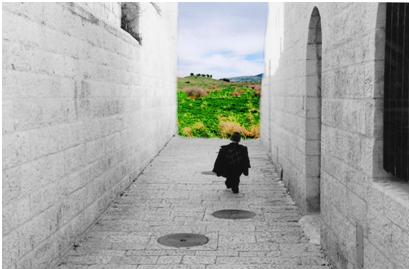
.יום הזכרון לשואה ולגבורה בארץ
Last night and today were Yom Hashoah (Holocaust Memorial Day). In Israel, this day is called "Memorial Day for Holocaust and Heroism" or Yom Hazikaron l'Shoah ul'gvurah. The commemoration day was inaugurated in 1951 in Israel, and it took decades for widespread Diaspora communities to regularly honor the day. Originally (and until about 20 years ago), this day focused much more on the "Heroism" than the "Holocaust" in Israel. The Jewish resistance fighters (partisans) were the center of attention, and for decades, they were featured prominently in Yom Hashoah ceremonies. Only in recent years (as partisan fighters have died and Israeli society has changed) have Israelis come to associate more with the victims of the Holocaust. Over the last 24 hours, the Yom Hashoah Jessica and I have experienced have been focused on the victims of Nazi aggression and the role that Israel has to play in the story.
Every year, Yad Vashem, the Holocaust museum in Jerusalem, puts on a ceremony for Yom Hashoah that is televised throughout the country (and almost universally watched among Jewish families). HUC was fortunate to receive tickets, so Jessica and I were able to attend the event in person.
We arrived two hours early, expecting large crowds and wanting good seats. We were very impressed with the ease with which we made it through the numerous security checks and to our seats. One of my classmates remarked today how meaningful it was that, for once, Israelis weren't being pushy. People seemed more patient last night, more sensitive.
The ceremony itself was very interesting, especially as this was an avowedly secular, state-sponsored commemoration. The army featured prominently, placed sequentially beside two statues in the Warsaw Ghetto Courtyard of Yad Vashem, thus effectively displaying a progression of "Jews on the Marching to their Deaths" to "Partisan Fighters" to "Soldiers of Israel Defending the People of Israel." Throughout the ceremony, this was the message: The Holocaust was a planned tragedy, and Israel was the closest thing to a "happy ending" that the Jews could hope for. Moreover, there are still people today who would plan a Holocaust against the Jews, and the State of Israel is the only thing that can prevent that.
This was the message that struck me the most. Both Israel's President (Shimon Peres) and its Prime Minister (Benjamin Netanyahu) included a healthy dose of politics in their speeches. Each of them condemned the World Conference against Racism, which is being boycotted by 10 nations (the US, Israel, Australia, Canada, Germany, Italy, the Netherlands, Sweden, Poland, and New Zealand) because of its heavy anti-Zionist message. They also cited Mahmoud Ahmadinejad and Iran as a critical threat against the Jewish people and called on the world to discredit him. (The same night, Ahmadinejad gave a speech at this conference so anti-Israel and anti-Jewish that at least 30 nations' representatives walked out.) Of course, they spoke about the tragedy of the Holocaust with force, condemning "Nazi Germans and their helpers" for the crimes they committed against the Jewish people. But the message rang loud and clear: the State of Israel is the only entity that exists to protect Jews against the possibility of another Holocaust.
In addition to these speeches, the former Chief Ashkenazi Rabbi of Israel, Meir Lau, gave a moving account of his own experience during the Holocaust, and a letter written by a child killed during the war was recited by an FSU-born Israeli actress. The singer Achinoam Nini (known outside of Israel as Noa) performed several pieces, as did an Israeli girls' choir (all of whom sang beautifully). The chief cantor of the Army sang a version of El Malei Rachamim (traditionally a prayer of comfort but used here as a dirge of mourning), the current Chief Sephardi Rabbi read a Psalm, and the current Chief Ashkenazi Rabbi led the Mourner's Kaddish.
The most powerful part of the ceremony for me (perhaps because it is most similar to what I'm used to) was the lighting of the six torches. Each torch was lit by a survivor (or two, in the case of the pair of twins) whose story was narrated and displayed via video. Many of the stories were of children separated from parents, forced to live in a ghetto or concentration camp, or of children who managed to escape the worst by virtue of Righteous Gentiles or partisan fighters. Each of the six stories was very Zionist, describing an early and ardent commitment to the Land of Israel that was able to be fulfilled. Although the Zionist component stood out, the rest of the story narration was similar to other Yom Hashoah events I've attended.
I'm not surprised that this event was so Zionist. After all, we were in Israel! Perhaps what was most interesting, then, was the negotiation between religious and secular. Of the 80 minute ceremony, probably 15 or 20 minutes was "religious." During those times (as at others), the soldiers stood at attention - and just before the Kaddish was recited, a large number of men in the crowd (including myself) produced and put on a kippah. Of course, only Orthodoxy was represented, but the Kaddish was led with men and women sitting next to each other, and there wasn't a stir when Noa and the choir sang. (Generally, ultra-Orthodox people consider it against Jewish law for men to hear women sing.) There weren't very many ultra-Orthodox people in the crowd, but the Chief Rabbis were both present and "well-behaved." The State respected them and vice versa.
However, the political speeches were definitely a new component for me. I knew to expect them, so I wasn't caught off guard, but before this year, I would never expect Yom Hashoah to be so political. A couple years ago at UVA, the Darfur Week of Conscience ended on Yom Hashoah, and Hillel worked with STAND (Students Taking Action Now: Darfur) to plan a week of programming together. Yom Hashoah itself, though, was (as I recall) reserved for commemoration of the Holocaust. The political message was implicit but not mentioned during Yom Hashoah itself. This event at Yad Vashem was different.
I'm not criticizing, though. This is how they do it publicly in Israel. Anyway, I'm not sure I'd get much out of an official religious ceremony because it would by definition have to be Orthodox. What we experienced last night was engaging, interesting, and very moving for a lot of students. I myself was in a fairly analytical state of mind, so I wasn't emotionally taken by the ceremony, but I understand that it was very powerful.
This morning, HUC sponsored its own Yom Hashoah commemorations, which were fairly different from Yad Vashem's. Our service this morning included what one would expect in a morning service, though we sang less than usual and included readings about the Holocaust. After a half-hour break, we were encouraged to stand in front of HUC for the 10:00 siren, which I'd heard about before coming to Israel.
On Yom Hashoah, at 10:00 in the morning, sirens sound throughout the country with the tacit understanding that people will stop what they are doing for two minutes. In my imagination, the country stopped entirely for this time period, but of course, the reality never lives up to the ideal. At 10:00, as expected, the sirens went off, and the cars stopped in the streets and their drivers got out. One driver honked his horn, though after about 30 seconds, he too decided to stand in the street and pay his respects. Three construction workers across the street were, like us, watching the stopped traffic, though other (presumably Arab) construction workers continued to use their buzz saw inside the building. A driver took advantage of the slowed traffic to pass the stopped cars. For the most part, the area around me became still, but of course, it wasn't as dramatic as I had expected.
Back in the courtyard of HUC was our own Yom Hashoah ceremony. This was more familiar to me with poems, music and song, personal stories, prayers, and a name-reading at the end. There were certainly similarities to the Yad Vashem ceremony (HUC's was designed by Israeli as well as American students), but the Zionist factor was significantly reduced. The ceremony was well planned and powerful, but again, I found myself being too analytical to get carried away. Don't get me wrong - of course I teared up a couple times. But I'm usually much more moved by Yom Hashoah than I was this year.
For the past several years, I've been intimately involved with Hillel's planning of Yom Hashoah's commemoration. I've picked up Holocaust survivors from their hotel, read names of victims at 2:00 in the morning, and helped plan the Week of Conscience mentioned above. Each of these experiences (and more) have been very moving and meaningful to me. But I realize now that very few people (and Jessica is one of them) experienced Yom Hashoah at UVA in this way. Most of the people read names for 15 or 20 minutes and possibly came to an event or the survivor's presentation. This year, I spent about 4 hours directly engaged with Holocaust commemoration (which would usually be considered a lot), but it seemed less powerful to me than before.
One thing I learn from this is that it can be hard to reach someone who didn't participate in the planning of an event. You do what you can do, but the "audience" has to bring itself to the table in order to be affected. I wasn't entirely present, so I didn't get all I could out of Yom Hashoah this year. I will keep this in mind not only for my own commemoration of similar events in the future but also when I'm planning such events.
In conclusion, the past 24 hours have been special, unique, and impactful - but I've learned more about Israel than about the Holocaust. I think that's okay - it is what it is, after all. And yet I find myself wishing for greater eloquence about the depth of the day. Perhaps next year, when I'm not in Jerusalem anymore.
Let me conclude with a poem that I did find moving that was included in HUC's memorial service this morning.
Yizkor by Abba Kovner, translated by Jules Harlow
We shall remember our brothers and sisters,
The city houses and the country houses,
The shtetl streets rushing like rivers
And the lonely inn on the country road --
The aged man and the features of his face,
The mother in her kerchief,
The young girl with her braids,
The child,
The people Israel in thousands of communities
Among all the human families,
The entire assembly of Jews
Brought down to slaughter on the soil of Europe
By the Nazi destroyer,
The man who suddenty screamed
And while screaming died,
The woman, clutching her infant to her breast,
Whose arms gave out,
The infant groping for his mother's nipple
Finding it blue and cold.
The feet,
The feet that sought refuge,
Though flight was no longer possible,
And those who made their hands into a fist,
The fist that gripped the iron,
The iron that became the weapon of vision,
Of despair, and of rebellion,
And those, the pure of heart,
Those whose eyes were opened,
Those who risked their lives,
Though they lacked the power to triumph.
We shall remember the day,
The day in its brightness, the sun that rose
Over the bloody conflagration,
The lofty silent heavens.
We shall remember the mounds of dust
Beneath the gardens in bloom.
The living shall remember their dead
For they are forever before us.
Look! Their eyes dart round and about,
Allowing us no peace, no peace,
Until our lives become worthy of their memory.
Showing posts with label Holocaust. Show all posts
Showing posts with label Holocaust. Show all posts
Tuesday, April 21, 2009

Wednesday, October 22, 2008
Israel Seminar Journal
.יומן סמינר ישראל
Today, our Israel Seminar class went to Yad Vashem and Mount Herzl. Although I don't have the time to write tonight about our full experience, I can share the journal entry that I composed for class. Enjoy!
There are many American Jews who find themselves in dialogue with two extreme relationships with Israel. On the one hand, their Jewish identity can be completely separate from Israel, based instead on the thriving American Jewish community. On the other hand, it can be difficult to discount Israel as the Jewish State and Homeland as well as the self-identified representative of world Jewry. Yad Vashem, an Israeli memorial to a world Jewish event that occurred in the Diaspora, is a symbol of the interplay between the undeniable reality of valid Jewish experience outside the land of Israel and the Israelocentric model of Jewish identity.
The primary association I had while visiting Yad Vashem today was of personal stories. In nearly every room, several televisions showed witnesses recounting their experiences - some were composed and some were crying; some were speaking Hebrew and some English. Personal profiles were found throughout the galleries, highlighting individual survivors and victims of the Shoah. A house of a wealthy German Jew was reconstructed to give visitors a sense of pre-war Jewish life in Germany, and people’s clothes, books, and personal effects were placed throughout the museum. More than anything else, to me, this museum was a mosaic of personal stories woven together against the backdrop of world events and passions.
Of interest, though not surprising, is that nowhere did I hear a non-Jewish voice telling her story. While non-Jewish narratives were briefly represented, and while the Righteous of the Nations were honored with their own gallery, personal stories were reserved for Jews. Moreover, one can interpret the final steps of the museum as a continuation of that story through the visitor. The final gallery is comprised of a display of witnesses’ quotes with contemplative music and a hypothetical visitor can refocus his attention on him and his own relation to the stories just explored. As the visitor walks out into the clear, green Jerusalem air, he hardly needs the seven David Ben Gurions or the singing of Hatikva to remember that he is currently standing in the free State of Israel, the one place on earth where a second Shoah is guaranteed not to occur. The implicit assumption made in the case of this hypothetical visitor is that he is Jewish and that his story includes a visit to his Jewish Homeland. Although the museum also targets non-Jews, this final experience, after so many hours hearing about the personal stories of the Shoah, enables a Jew to imagine herself as the personal legacy of those terrible events and as secure in her Jewish home.
For these reasons, Yad Vashem has a strong claim as the Jewish Shoah memorial. Other Holocaust museums may focus on righteous gentiles, historical context, etc., but the museum in Israel focuses on Jews and their perspectives. To better understand the context in which Israel can make this claim, we can turn to the fourth chapter of Charles Liebman’s and Eliezer Don-yehiya’s Civil Religion in Israel (Univ. of California Press, Berkeley, 1983): The Civil Religion of Statism.
The Statists who worked to build a civic religion in Israel, including most prominently David Ben Gurion, saw Jewish life in Israel as naturally superior to Jewish life anywhere else. Ben Gurion is seen as a proponent of “Israelocentrism, which [is defined] to mean, ‘that all which is done by Jews in Israel is central, vital, critical for the Jewish people and for Jewish history … [and] what is done by Jews in the Diaspora is … secondary’” (87). Having built a Jewish state from the ground up, Ben Gurion and his allies would not tolerate the focus of Judaism being anywhere else. This centrality of the State of Israel was based on an assertion that only among Jews could Jews be safe. In 1945, Ben Gurion stated baldly that the place of Jews is in a Jewish land and that their presence anywhere else is an invitation to disaster: “The cause of our troubles and the anti-Semitism of which we complain result from our peculiar status that does not accord with the established framework of the nations of the world. It is not the result of the wickedness or folly of the Gentiles which we call anti-Semitism” (104). Although Ben Gurion recognized the tragedy of the Shoah, he nonetheless saw it as a curable symptom of being exiled from the Land of Israel. To him, Israel is the true final solution to the Jews’ problems: “The one suitable monument to the memory of European Jewry … is the State of Israel” (106). These founders, then, saw Israel as the ultimate sanctuary and home of all Jews and worked tirelessly to create a Jewish society that would unite Jews as Israelis in a new country of progress and security.
In the face of such a deliberate and fervent insistence on Israel’s centrality to world Judaism, one can hardly be surprised at Yad Vashem’s unspoken assertion that it is the Jewish Holocaust museum. As a Diaspora Jew who disagrees with Ben Gurion’s association of the period of the creation with the State of Israel with “the days of the Messiah” (86), however, I feel a responsibility to challenge the claimed ultimacy of Yad Vashem. Certainly I recognize the power and validity of the stories shared within its walls, and I find the museum to be a moving, brilliant, and effective memorial to the Shoah; nevertheless, I also believe that Jews can find meaning in other Holocaust museums around the world. While the United States Holocaust Memorial Museum, for example, might be considered to highlight a “human rights” perspective as compared to Yad Vashem’s “Jewish narratives” perspective, this nevertheless is a true and valid perspective with which Jews can build a meaningful connection to the events and people of the Shoah. If I should ever find myself leading Jews to Yad Vashem, I would want to make clear the history and context of the Israelocentrism inherent in the creation of the museum. I do not believe that this context takes away from the stories being told in the museum, but a fuller appreciation of the Israel experience would be enriched by a nuanced understanding of Israel’s historical relationship to the problems of Diasporic Judaism.
Today, our Israel Seminar class went to Yad Vashem and Mount Herzl. Although I don't have the time to write tonight about our full experience, I can share the journal entry that I composed for class. Enjoy!
There are many American Jews who find themselves in dialogue with two extreme relationships with Israel. On the one hand, their Jewish identity can be completely separate from Israel, based instead on the thriving American Jewish community. On the other hand, it can be difficult to discount Israel as the Jewish State and Homeland as well as the self-identified representative of world Jewry. Yad Vashem, an Israeli memorial to a world Jewish event that occurred in the Diaspora, is a symbol of the interplay between the undeniable reality of valid Jewish experience outside the land of Israel and the Israelocentric model of Jewish identity.
The primary association I had while visiting Yad Vashem today was of personal stories. In nearly every room, several televisions showed witnesses recounting their experiences - some were composed and some were crying; some were speaking Hebrew and some English. Personal profiles were found throughout the galleries, highlighting individual survivors and victims of the Shoah. A house of a wealthy German Jew was reconstructed to give visitors a sense of pre-war Jewish life in Germany, and people’s clothes, books, and personal effects were placed throughout the museum. More than anything else, to me, this museum was a mosaic of personal stories woven together against the backdrop of world events and passions.
Of interest, though not surprising, is that nowhere did I hear a non-Jewish voice telling her story. While non-Jewish narratives were briefly represented, and while the Righteous of the Nations were honored with their own gallery, personal stories were reserved for Jews. Moreover, one can interpret the final steps of the museum as a continuation of that story through the visitor. The final gallery is comprised of a display of witnesses’ quotes with contemplative music and a hypothetical visitor can refocus his attention on him and his own relation to the stories just explored. As the visitor walks out into the clear, green Jerusalem air, he hardly needs the seven David Ben Gurions or the singing of Hatikva to remember that he is currently standing in the free State of Israel, the one place on earth where a second Shoah is guaranteed not to occur. The implicit assumption made in the case of this hypothetical visitor is that he is Jewish and that his story includes a visit to his Jewish Homeland. Although the museum also targets non-Jews, this final experience, after so many hours hearing about the personal stories of the Shoah, enables a Jew to imagine herself as the personal legacy of those terrible events and as secure in her Jewish home.
For these reasons, Yad Vashem has a strong claim as the Jewish Shoah memorial. Other Holocaust museums may focus on righteous gentiles, historical context, etc., but the museum in Israel focuses on Jews and their perspectives. To better understand the context in which Israel can make this claim, we can turn to the fourth chapter of Charles Liebman’s and Eliezer Don-yehiya’s Civil Religion in Israel (Univ. of California Press, Berkeley, 1983): The Civil Religion of Statism.
The Statists who worked to build a civic religion in Israel, including most prominently David Ben Gurion, saw Jewish life in Israel as naturally superior to Jewish life anywhere else. Ben Gurion is seen as a proponent of “Israelocentrism, which [is defined] to mean, ‘that all which is done by Jews in Israel is central, vital, critical for the Jewish people and for Jewish history … [and] what is done by Jews in the Diaspora is … secondary’” (87). Having built a Jewish state from the ground up, Ben Gurion and his allies would not tolerate the focus of Judaism being anywhere else. This centrality of the State of Israel was based on an assertion that only among Jews could Jews be safe. In 1945, Ben Gurion stated baldly that the place of Jews is in a Jewish land and that their presence anywhere else is an invitation to disaster: “The cause of our troubles and the anti-Semitism of which we complain result from our peculiar status that does not accord with the established framework of the nations of the world. It is not the result of the wickedness or folly of the Gentiles which we call anti-Semitism” (104). Although Ben Gurion recognized the tragedy of the Shoah, he nonetheless saw it as a curable symptom of being exiled from the Land of Israel. To him, Israel is the true final solution to the Jews’ problems: “The one suitable monument to the memory of European Jewry … is the State of Israel” (106). These founders, then, saw Israel as the ultimate sanctuary and home of all Jews and worked tirelessly to create a Jewish society that would unite Jews as Israelis in a new country of progress and security.
In the face of such a deliberate and fervent insistence on Israel’s centrality to world Judaism, one can hardly be surprised at Yad Vashem’s unspoken assertion that it is the Jewish Holocaust museum. As a Diaspora Jew who disagrees with Ben Gurion’s association of the period of the creation with the State of Israel with “the days of the Messiah” (86), however, I feel a responsibility to challenge the claimed ultimacy of Yad Vashem. Certainly I recognize the power and validity of the stories shared within its walls, and I find the museum to be a moving, brilliant, and effective memorial to the Shoah; nevertheless, I also believe that Jews can find meaning in other Holocaust museums around the world. While the United States Holocaust Memorial Museum, for example, might be considered to highlight a “human rights” perspective as compared to Yad Vashem’s “Jewish narratives” perspective, this nevertheless is a true and valid perspective with which Jews can build a meaningful connection to the events and people of the Shoah. If I should ever find myself leading Jews to Yad Vashem, I would want to make clear the history and context of the Israelocentrism inherent in the creation of the museum. I do not believe that this context takes away from the stories being told in the museum, but a fuller appreciation of the Israel experience would be enriched by a nuanced understanding of Israel’s historical relationship to the problems of Diasporic Judaism.
Friday, August 22, 2008
my first visit to Yung Yiddish
Yesterday's was an afternoon of language learning. I came home, and decided I'd had enough of Hebrew and I was going to work a little bit on Yiddish. I'd printed out a story in Yiddish that had been published in Pakn Treger (the National Yiddish Book Center's magazine) a few months ago - the stories are published in the magazine with the Yiddish on one page and the translation on the opposing page. I printed out both, but have decided to write my own translation and not to look at the published one, and to compare notes when I'm finished. It is a long story and at the rate I'm going it will take me something like two weeks if I do a little every day. We'll see how it goes.
When I got sick of doing Yiddish, I switched to Hebrew. I decided to write the essay that's due Sunday, so I could free up my time over the weekend to work on my homework for literature class, which includes writing a short childhood memoir (Yes!!!) and a literary critique (Double Yes!!). In the meantime, I wrote my essay on - and I did not choose the topic myself - Is it possible/acceptable to create art about the Holocaust? I answered the question by telling a few anecdotes about art that I felt either successfully or unsuccessfully honored the Holocaust. I then went on to discuss the ideas of Theodore Adorno, who famously declared that to write a poem after the Holocaust is simply barbaric. He later went on to revisit this quotation and to note that in our era of incomprehensible suffering, art is necessary. I discussed how I agree with Adorno's sense of the tension between wanting to honor the unspeakable by not trying to describe it - in describing it perhaps you lessen or soften it, and in creating something beautiful or aesthetically pleasing in some way, you make suffering more palatable - and wanting to remember and acknowledge the unspeakable by speaking (and creating) of it. This was not an easy essay to write in Hebrew, and I hope that what I wrote in Hebrew at least makes grammatical sense, if nothing else.
At 7:00 I left the apartment to go to Yung Yiddish, the organization with whom I've been in contact with for quite a while in anticipation of interning/volunteering while I am in Jerusalem. I had told the director of Yung Yiddish that I would meet him there at 8:00, a half hour before this evening's program, to introduce myself. I got on the bus and asked the driver to make sure I was on the right bus. I told him I'd never been to Rehov Yerimiyhu before and asked if he could let me know when we were there. After a while I pulled out my map and checked some street signs. I noticed that we were on Yerimiyhu, only in an area where it has a different name. "Great!" I thought, "we must be almost there!" It was 7:50. The bus driver didn't say anything to me, and after a while I noticed that we were on bigger roads with bigger stores and things were getting farther apart. More and more the signs said things like "To Tel Aviv" rather than "To City Center." I was getting a bit nervous, but was willing to trust the bus driver a bit longer. We were off my map, but I thought maybe we were going only a little out of the way and then would be going back toward Yerimiyhu. It was 8:00 and I didn't bring the Yung Yiddish phone number with me. We drove into a suburb. We were going pretty slow because it seemed there were bus stops every few seconds. I said to the bus driver, "Excuse me, but I don;t know where we are. I wanted to go to Yerimiyhu and you told me..." He hit his forehead with the palm of his hand. "I forgot," He said, "And I have to keep going this way." "What should I do?" I asked him. He said, "Stay here and return with me." When we had reached the end of the route and he was turning around, he stopped the bus and had me point to where I wanted to go on a map. He told me we would be there soon. We picked up lots of people along the way and made a lot of stops, but when we got to Yerimiyhu he didn't forget this time. So, I got off the bus at Yerimiyhu. It was 9:00. That is not a type-o. So, I get off the bus and realize that I am alone in the dark in an ultra-Orthodox neighborhood. I am wearing a longsleeved shirt and a skirt that just barely covers my knees. Not very modest for this area, but not disrespectfully immodest either, I think.
Nevertheless, I definately felt uncomfortable and a bit worried, particularly as I didn't know where I was going. The bus dropped me off at number 14 or so and Yung Yiddish is 52. I walked for a while and then asked a nice-looking older woman for directions. She said I was only at 38 and should just keep going straight. Eventually, I came to a small building with a sign out in front that read "Yung Yiddish"
Yung Yiddish is housed in the basement of a small building. The walls were lined with old friendly-looking Yiddish books crowded into bookshelves that encroached into the performance space. In one nook there was technical/sound equipment hidden by curtains and sheets that made it look like a colorful circus tent. Staff kept poppin their heads in and out of the tent to speak to the performer and ask if the music was loud enough. There were rows of seats on two sides - maybe enough to seat fifty. Most of the seats were filled and some people were standing in the back, near the door. I found myself a seat near the back. The room was unbearably hot - no fans or air conditioners. The audience was composed of a mish mosh of characters - an elderly woman sat next to me and it seemed that she only speaks Yiddish. At first she ignored me but after a while of my singing along to some of the music, she started to smile at me, and then she said to me in Yiddish, "You are so young to know Yiddish!" There were a few ultra-orthodox men, a fifty-something couple with the woman wearing pants and a t-shirt, a secular family with Yiddish speaking kids, there was a man with a T-shirt that said "Toronto" on it, a gap-toothed man who sang and danced vivaciously, and many others - I would venture to say that few of the people at Yung Yiddish seemed like people I would have been likely to encounter anywhere else. The performer, Tommy Schwartz, has this incredible deep, warm, voice, and speaks slowly with an enchanting lilt when he tells stories. He sang popular Yiddish cabaret songs like "Di Grine Kuzine," "By Mir Bistu Sheyn," "Vus Dergeisti Mir Di Lorn" and "Der Rebbe Elimelich," and in between them interspersed anecdotes and jokes in Yiddish. Occasionally he would translate what he was saying to English (Though I was proud and surprised to realize that not only did I understand most of the Yiddish, but I also already knew most of the songs) - I'm not sure if he knows Hebrew, and I think from what I understood of his speaking, he is from Hungary. After his many fabulous songs, Mendy, the director of Yung Yiddish, stood up to sing. He sang a piece I was not familiar with - it was very theatrical and evocative, and eerily heartbreaking. Mendy has a sweet tenor voice and the performance was done with genuine feeling, as though he were a well trained stage actor, which for all I know may be the case. He was followed by another woman who sang Edith Piaf's "Le Vie en Rose" translated into Yiddish - it was exquisite. The whole evening was fun, people sang along, commented to each other, mostly in Yiddish but some in Hebrew, about the performances, and at the back a woman translated the Yiddish into Hebrew for some people who didn't know the Yiddish. It was rare that there was silence in the room during a performance- people were drinking, greeting friends, etc. After a little singing and a few speeches, wine and vodka was passed around so we could make a toast to Tommy, in whose honor all of this was happening. The toast was followed by more songs for the audience to sing to. At one point I had a chance to introduce myself to Mendy when he went outside for some fresh, cool air. He was very excited to meet me and told me to stay until the end so he could have a chance to talk to me. I was a bit worried about catching the bus but stayed anyway. At the end of the concert someone asked me in Yiddish, and then when it took me a minute to understand what he was saying asked again in Hebrew, where I had learned the songs from - did I learn Yiddish from my parents? I told him that I studied some Yiddish in university. He asked if I speak it, and I said, "yes, but not well" - he asked if I speak Hebrew and I said, "I also speak Hebrew, but not well." He said, "Great, then we will speak a cocktail of languages" and we proceeded to have a conversation that was a mishmosh of Hebrew and Yiddish, which was absolutely perfect. Yiddish was his first language, he learned it from his parents. It seems that most of the people at YY learned Yiddish from their parents, whether in Orthodox homes or because their parents were immigrants to Israel whose native language was Yiddish. He lives in Tel Aviv but is very fond of YY (whose headquarters are in Tel Aviv) and comes when he can to the Jerusalem programs. It seemed that a lot of the people at YY knew each other and were regular attendees. It's a strange, quirkly, little community that I am excited to be a part of. As everyone was starting to leave, Tommy Schwartz approached me and asked me in Yiddish, "where are you from pretty young woman?" I responded "I'm from the US" and he responded, "Well, we can't all be perfect." Then he pinched my cheek, and left. Mendy sat down to speak to me for a bit - first we had to decide what language to speak in. We settled on English. He told me that he is very excited that I am interested in helping out, and that I can basically do whatever I want or think is needed. The headquarters are in Tel Aviv, but if for instance I wanted to work at YY twice a week in the afternoons, he would start advertising that the Jerusalem YY library would be open those hours, and that there would also be someone there to answer the phone. He said the books are in some semblace of order but could use a better system of organization, so that might be a good place to start. He also said that the biggest problem YY faces is with regard to funding. He's having problems holding on to the Tel Aviv location, and in general is concerned about fundraising. I told him I don't have much experience with that, and he asked me if I am a good writer. I said that in English, yes, I like to write. He was very excited about this. He suggested that I could write articles about Yung Yiddish events and that once a month I could produce an English language newsletter about YY that he could send to current or potential supporters. I told him that this is something that I could definately do. We parted, both expressing our excitement to be working with one another. He will be in New York for a few weeks, and then there's the holdiays and all that, so we're not sure when I would start, but at least we've met and that will get the ball rolling a bit.
I am really excited to be getting involved in this unique organization, and it is fun that Mendy is so excited for me to help out and so willing to have me do basically whatever I want if I think it will help. I think this will be a great learning opportunity for me - a chance to speak Yiddish, to experience Yiddish culture through music, lectures, and books, and a way to become a part of something in Jerusalem that involves no Americans and no people my age - a chance to get a little bit outside the 'bubble' and outside my comfort zone, and to explore. I'm sure that you will be hearing much more about YY on this blog in the future.
When I got sick of doing Yiddish, I switched to Hebrew. I decided to write the essay that's due Sunday, so I could free up my time over the weekend to work on my homework for literature class, which includes writing a short childhood memoir (Yes!!!) and a literary critique (Double Yes!!). In the meantime, I wrote my essay on - and I did not choose the topic myself - Is it possible/acceptable to create art about the Holocaust? I answered the question by telling a few anecdotes about art that I felt either successfully or unsuccessfully honored the Holocaust. I then went on to discuss the ideas of Theodore Adorno, who famously declared that to write a poem after the Holocaust is simply barbaric. He later went on to revisit this quotation and to note that in our era of incomprehensible suffering, art is necessary. I discussed how I agree with Adorno's sense of the tension between wanting to honor the unspeakable by not trying to describe it - in describing it perhaps you lessen or soften it, and in creating something beautiful or aesthetically pleasing in some way, you make suffering more palatable - and wanting to remember and acknowledge the unspeakable by speaking (and creating) of it. This was not an easy essay to write in Hebrew, and I hope that what I wrote in Hebrew at least makes grammatical sense, if nothing else.
At 7:00 I left the apartment to go to Yung Yiddish, the organization with whom I've been in contact with for quite a while in anticipation of interning/volunteering while I am in Jerusalem. I had told the director of Yung Yiddish that I would meet him there at 8:00, a half hour before this evening's program, to introduce myself. I got on the bus and asked the driver to make sure I was on the right bus. I told him I'd never been to Rehov Yerimiyhu before and asked if he could let me know when we were there. After a while I pulled out my map and checked some street signs. I noticed that we were on Yerimiyhu, only in an area where it has a different name. "Great!" I thought, "we must be almost there!" It was 7:50. The bus driver didn't say anything to me, and after a while I noticed that we were on bigger roads with bigger stores and things were getting farther apart. More and more the signs said things like "To Tel Aviv" rather than "To City Center." I was getting a bit nervous, but was willing to trust the bus driver a bit longer. We were off my map, but I thought maybe we were going only a little out of the way and then would be going back toward Yerimiyhu. It was 8:00 and I didn't bring the Yung Yiddish phone number with me. We drove into a suburb. We were going pretty slow because it seemed there were bus stops every few seconds. I said to the bus driver, "Excuse me, but I don;t know where we are. I wanted to go to Yerimiyhu and you told me..." He hit his forehead with the palm of his hand. "I forgot," He said, "And I have to keep going this way." "What should I do?" I asked him. He said, "Stay here and return with me." When we had reached the end of the route and he was turning around, he stopped the bus and had me point to where I wanted to go on a map. He told me we would be there soon. We picked up lots of people along the way and made a lot of stops, but when we got to Yerimiyhu he didn't forget this time. So, I got off the bus at Yerimiyhu. It was 9:00. That is not a type-o. So, I get off the bus and realize that I am alone in the dark in an ultra-Orthodox neighborhood. I am wearing a longsleeved shirt and a skirt that just barely covers my knees. Not very modest for this area, but not disrespectfully immodest either, I think.
Nevertheless, I definately felt uncomfortable and a bit worried, particularly as I didn't know where I was going. The bus dropped me off at number 14 or so and Yung Yiddish is 52. I walked for a while and then asked a nice-looking older woman for directions. She said I was only at 38 and should just keep going straight. Eventually, I came to a small building with a sign out in front that read "Yung Yiddish"
Yung Yiddish is housed in the basement of a small building. The walls were lined with old friendly-looking Yiddish books crowded into bookshelves that encroached into the performance space. In one nook there was technical/sound equipment hidden by curtains and sheets that made it look like a colorful circus tent. Staff kept poppin their heads in and out of the tent to speak to the performer and ask if the music was loud enough. There were rows of seats on two sides - maybe enough to seat fifty. Most of the seats were filled and some people were standing in the back, near the door. I found myself a seat near the back. The room was unbearably hot - no fans or air conditioners. The audience was composed of a mish mosh of characters - an elderly woman sat next to me and it seemed that she only speaks Yiddish. At first she ignored me but after a while of my singing along to some of the music, she started to smile at me, and then she said to me in Yiddish, "You are so young to know Yiddish!" There were a few ultra-orthodox men, a fifty-something couple with the woman wearing pants and a t-shirt, a secular family with Yiddish speaking kids, there was a man with a T-shirt that said "Toronto" on it, a gap-toothed man who sang and danced vivaciously, and many others - I would venture to say that few of the people at Yung Yiddish seemed like people I would have been likely to encounter anywhere else. The performer, Tommy Schwartz, has this incredible deep, warm, voice, and speaks slowly with an enchanting lilt when he tells stories. He sang popular Yiddish cabaret songs like "Di Grine Kuzine," "By Mir Bistu Sheyn," "Vus Dergeisti Mir Di Lorn" and "Der Rebbe Elimelich," and in between them interspersed anecdotes and jokes in Yiddish. Occasionally he would translate what he was saying to English (Though I was proud and surprised to realize that not only did I understand most of the Yiddish, but I also already knew most of the songs) - I'm not sure if he knows Hebrew, and I think from what I understood of his speaking, he is from Hungary. After his many fabulous songs, Mendy, the director of Yung Yiddish, stood up to sing. He sang a piece I was not familiar with - it was very theatrical and evocative, and eerily heartbreaking. Mendy has a sweet tenor voice and the performance was done with genuine feeling, as though he were a well trained stage actor, which for all I know may be the case. He was followed by another woman who sang Edith Piaf's "Le Vie en Rose" translated into Yiddish - it was exquisite. The whole evening was fun, people sang along, commented to each other, mostly in Yiddish but some in Hebrew, about the performances, and at the back a woman translated the Yiddish into Hebrew for some people who didn't know the Yiddish. It was rare that there was silence in the room during a performance- people were drinking, greeting friends, etc. After a little singing and a few speeches, wine and vodka was passed around so we could make a toast to Tommy, in whose honor all of this was happening. The toast was followed by more songs for the audience to sing to. At one point I had a chance to introduce myself to Mendy when he went outside for some fresh, cool air. He was very excited to meet me and told me to stay until the end so he could have a chance to talk to me. I was a bit worried about catching the bus but stayed anyway. At the end of the concert someone asked me in Yiddish, and then when it took me a minute to understand what he was saying asked again in Hebrew, where I had learned the songs from - did I learn Yiddish from my parents? I told him that I studied some Yiddish in university. He asked if I speak it, and I said, "yes, but not well" - he asked if I speak Hebrew and I said, "I also speak Hebrew, but not well." He said, "Great, then we will speak a cocktail of languages" and we proceeded to have a conversation that was a mishmosh of Hebrew and Yiddish, which was absolutely perfect. Yiddish was his first language, he learned it from his parents. It seems that most of the people at YY learned Yiddish from their parents, whether in Orthodox homes or because their parents were immigrants to Israel whose native language was Yiddish. He lives in Tel Aviv but is very fond of YY (whose headquarters are in Tel Aviv) and comes when he can to the Jerusalem programs. It seemed that a lot of the people at YY knew each other and were regular attendees. It's a strange, quirkly, little community that I am excited to be a part of. As everyone was starting to leave, Tommy Schwartz approached me and asked me in Yiddish, "where are you from pretty young woman?" I responded "I'm from the US" and he responded, "Well, we can't all be perfect." Then he pinched my cheek, and left. Mendy sat down to speak to me for a bit - first we had to decide what language to speak in. We settled on English. He told me that he is very excited that I am interested in helping out, and that I can basically do whatever I want or think is needed. The headquarters are in Tel Aviv, but if for instance I wanted to work at YY twice a week in the afternoons, he would start advertising that the Jerusalem YY library would be open those hours, and that there would also be someone there to answer the phone. He said the books are in some semblace of order but could use a better system of organization, so that might be a good place to start. He also said that the biggest problem YY faces is with regard to funding. He's having problems holding on to the Tel Aviv location, and in general is concerned about fundraising. I told him I don't have much experience with that, and he asked me if I am a good writer. I said that in English, yes, I like to write. He was very excited about this. He suggested that I could write articles about Yung Yiddish events and that once a month I could produce an English language newsletter about YY that he could send to current or potential supporters. I told him that this is something that I could definately do. We parted, both expressing our excitement to be working with one another. He will be in New York for a few weeks, and then there's the holdiays and all that, so we're not sure when I would start, but at least we've met and that will get the ball rolling a bit.
I am really excited to be getting involved in this unique organization, and it is fun that Mendy is so excited for me to help out and so willing to have me do basically whatever I want if I think it will help. I think this will be a great learning opportunity for me - a chance to speak Yiddish, to experience Yiddish culture through music, lectures, and books, and a way to become a part of something in Jerusalem that involves no Americans and no people my age - a chance to get a little bit outside the 'bubble' and outside my comfort zone, and to explore. I'm sure that you will be hearing much more about YY on this blog in the future.
Sunday, August 10, 2008
Tisha B'Av.
.תשע באב
Last night, Tisha B'Av started. I've never commemorated this day before this year, so what I've been learning so far (which has been a lot) has all been new. In brief, Tisha B'Av (literally, the ninth day of the month of Av) commemorates certain catastrophes in Jewish history. Classically, Tisha B'Av recounts the following five events:
1. The return of the spies from the land of Israel with disparaging news
2. The destruction of the First Temple in 586 BCE
3. The destruction of the Second Temple in 70 CE
4. The defeat of the Bar Kochba Revolt as marked by the fall of Betar in 135 CE
5. The leveling of Jerusalem in 136 CE
Additionally, tradition holds that the following events also occurred on this date:
6. Expulsion from England in 1290
7. Expulsion from Spain in 1492
8. Liquidation of the Warsaw Ghetto in 1942
9. Disengagement from Gaza in 2005
Basically, Tisha B'Av is a mourning day in the calendar that's set aside to commemorate these historical tragedies (or perceived tragedies). The day is traditionally a strict fast day in addition to being a day of mourning. This year, I decided to observe the traditional fast to see if I would find significance. What follows are an account of what we've done with the HUC community to mark Tisha B'Av and my thoughts on the day.
Tisha B'Av started at the end of Shabbat yesterday. (Interesting fact: The Jewish calendar is "rigged" so that Tisha B'Av cannot ever coincide with the Sabbath (and Yom Kippur cannot ever abut a Sabbath).) Jessica and I joined the HUC students in a creative service planned and led by three of our summer interns. During the service, we supplemented the regular evening service with a version of the reading of the book of Lamentations; we had five experiences (including a traditional chanting) correlating to the five chapters of the book. I thought the service was quite good, and it helped highlight some issues of what Tisha B'Av means to us today.
Haim talked about Tisha B'Av in relation to the state of Israel. The primary brunt of the day is focused on the destruction of Jerusalem ... but Jerusalem stands with Jewish protection today, so why mourn its loss? However, with the power to protect itself comes the responsibility of also protecting others. Haim suggests that Israel is not living up to its potential and obligation as a "light unto the nations" and that significant moral reform is necessary in the Jewish state. Perhaps we will continue to mourn until we can be the example we strive to be.
Additionally, Dan suggests that the "senseless hatred" (שנאת חינם) that is considered in the Talmud to be the cause of the destruction of the Second Temple still exists in Jerusalem today and therefore, we still have Tisha B'Av-related work to do even if we're not trying to restore a Third Temple. The fact that some Reform Jews stereotype, prejudge, and condemn some orthodox-looking Jews and vice versa is evidence of the "senseless hatred" that needs to be overcome before we can abandon this period of national mourning.
After the service, Rabbi Wilfond (Gingy) led the majority of us to the Kotel and led us in some brief text studies along the way. We arrived at the Kotel at around 10:40, and it was packed. The mechitza (the wall between the men's and women's sides) was extended into the courtyard to make sure that men and women wouldn't be lamenting side-by-side. As I walked through the men's section, I saw several groups of orthodox(?) Jews sitting in circles and reading from Lamentations, rocking with the power of the text. Sometimes, individuals (including children) were reading the text on their own, and some people had their heads buried in their arms, sobbing against the Western Wall. Of course, beggars abounded but for once, no one asked me to wrap tefillin ... that's not something traditionally done on Tisha B'Av until the day is almost over. It was bizarre seeing so many people sitting down at the Wall and reading from the same text (not necessarily praying), and I definitely felt voyeuristic as my entire goal was to observe rather than to participate. Still, it was a worthy experience as going to the Kotel is apparently a huge part of Tisha B'Av around here. As we were leaving the Old City (11:15-11:45), we passed streams of hundreds and hundreds of people all heading to the Western Wall. It was unbelievable. I had no idea of the magnitude of this day which goes largely unmentioned in Reform communities in the States.
This morning, after a Tisha B'Av-related Hebrew class, we had a lecture on the reactions of different religious groups in Israel to Tisha B'Av, a text study on some original sources on the day and its mourning and fasting practices, and a standard (Reform) Tisha B'Av afternoon service. Jessica and I went shopping for a few items this afternoon, and though there were several closed stores, more was open than I expected. Apparently, in Israel, Tisha B'Av is not a nationally-recognized day off. To compensate for those who wish to take off, many Israeli employers provide "choice days," which can be taken at any time during the year; many Israelis use one of these days on Tisha B'Av.
After shopping, Jessica and I read through the book of Lamentations to see what the big deal is. It's really a powerful text. I won't go into some of the worst details here because they're really horrific. Suffice to say, the destruction of Jerusalem as recounted by Jeremiah was a tragic and unbelievably difficult experience for the Jewish people to endure.
Now, my thoughts on the matter.
I don't mourn the loss of Jerusalem or the loss of the Second Temple. I don't mourn the failure of the Bar Kochba revolt. And even as I admit the tragic nature of these events in their time, I don't think I could ever be moved to sobbing about them. They are natural parts of the development of modern Judaism, and we have grown from them into a spiritually stronger, more morally driven people (in my opinion). In other words, we've gotten over it.
Jim, one of my fellow classmates, made an astute comment during our text study today. Mourning is a process that one goes through when one is exceedingly sad in order to bear and overcome the sadness. On Tisha B'Av, it seems that we are encouraged to induce mourning in order to become sad. It'd be one thing if I were sad already about these tragedies, but I'm not. So why should I recognize Tisha B'Av as a day of mourning when I don't need to overcome my sadness.
Of course, I grant that some communities and individuals may indeed feel that sadness over loss and therefore look to Tisha B'Av as a necessary release of that anger and frustration. (Better to read in Lamentations "Persecute and destroy [my enemies] in anger from under the heavens of the LORD" than to actually seek any physical retribution.) For these individuals and communities, I can recognize the value of the commemorative day. For me, though, the value is harder to come by.
On the one hand, Tisha B'Av seems like it should most naturally reflect the tragedy of the Holocaust. To my reckoning, the Holocaust is a catastrophe to modern Judaism as much as, if not more than, the destruction of the Temples and the expulsion from Spain were to their respective communities. We have a visceral need to wrestle with the Holocaust, to release our grief and seek understanding. And we have a day for that. Historically, some argued against the establishment of Holocaust Memorial Day (in 1951 in Israel), citing Tisha B'Av as the appropriate day of mourning for the Shoah. And, in fact, many Haredim don't celebrate Yom Hashoah since it's a creation of the modern national state (and not a true "religious festival").
But for me, Yom Hashoah is a very real, very powerful day of memorial and testament to the events of the Holocaust, and I fully intend to continue to commemorate it. So, what do I do with Tisha B'Av? I'm not in mourning, I don't want a Third Temple, and I don't feel that it's healthy to dwell on these events of destruction in the past.
Perhaps for me, Tisha B'Av is a memorial day like the American Memorial Day. That is, on Memorial Day, I honor the deaths of soldiers from America's past, but I don't have a visceral connection to it. If I were closer to people who served in the military, I'm sure it'd be different; likewise, if I were closer to the traditions of the Western Wall, I might feel more association with Tisha B'Av. I understand that it's important to mark the tragedies of Jewish history, and I definitely don't think that we need a whole day for every single one of them (because there are a lot). But, there's a lot that can be gained to, once a year, thinking especially about, say, the expulsion from England or the Warsaw Ghetto Uprising. I do think that that's meaningful, and I value the Jewish calendar's flexibility in providing that to me.
So, as a modern Reform Jew, I don't feel the connection to Tisha B'Av that I believe many of my Orthodox fellows feel. Nevertheless, I respect the place that the day has in our tradition, and I will continue to explore my relationship to it. Will I fast in the upcoming years? As of now, my answer is no ... but I'm fully open to the possibility that my perspective will change. One of the reasons I've taken so much time with this post is so that I may come back and read it next year to see how my views have changed. And, of course, I invite the comments of any readers who have insights on this issue. Again, I'm only thinking about this topic for the first time, so any other perspectives are highly welcome.
And ultimately, I hope that the issues that Haim and Dan raise can be taken seriously in the near future so that we can overcome the "senseless hatred" that is the cause of so much destruction and maybe one day do away with the need for a national day of mourning altogether.
Last night, Tisha B'Av started. I've never commemorated this day before this year, so what I've been learning so far (which has been a lot) has all been new. In brief, Tisha B'Av (literally, the ninth day of the month of Av) commemorates certain catastrophes in Jewish history. Classically, Tisha B'Av recounts the following five events:
1. The return of the spies from the land of Israel with disparaging news
2. The destruction of the First Temple in 586 BCE
3. The destruction of the Second Temple in 70 CE
4. The defeat of the Bar Kochba Revolt as marked by the fall of Betar in 135 CE
5. The leveling of Jerusalem in 136 CE
Additionally, tradition holds that the following events also occurred on this date:
6. Expulsion from England in 1290
7. Expulsion from Spain in 1492
8. Liquidation of the Warsaw Ghetto in 1942
9. Disengagement from Gaza in 2005
Basically, Tisha B'Av is a mourning day in the calendar that's set aside to commemorate these historical tragedies (or perceived tragedies). The day is traditionally a strict fast day in addition to being a day of mourning. This year, I decided to observe the traditional fast to see if I would find significance. What follows are an account of what we've done with the HUC community to mark Tisha B'Av and my thoughts on the day.
Tisha B'Av started at the end of Shabbat yesterday. (Interesting fact: The Jewish calendar is "rigged" so that Tisha B'Av cannot ever coincide with the Sabbath (and Yom Kippur cannot ever abut a Sabbath).) Jessica and I joined the HUC students in a creative service planned and led by three of our summer interns. During the service, we supplemented the regular evening service with a version of the reading of the book of Lamentations; we had five experiences (including a traditional chanting) correlating to the five chapters of the book. I thought the service was quite good, and it helped highlight some issues of what Tisha B'Av means to us today.
Haim talked about Tisha B'Av in relation to the state of Israel. The primary brunt of the day is focused on the destruction of Jerusalem ... but Jerusalem stands with Jewish protection today, so why mourn its loss? However, with the power to protect itself comes the responsibility of also protecting others. Haim suggests that Israel is not living up to its potential and obligation as a "light unto the nations" and that significant moral reform is necessary in the Jewish state. Perhaps we will continue to mourn until we can be the example we strive to be.
Additionally, Dan suggests that the "senseless hatred" (שנאת חינם) that is considered in the Talmud to be the cause of the destruction of the Second Temple still exists in Jerusalem today and therefore, we still have Tisha B'Av-related work to do even if we're not trying to restore a Third Temple. The fact that some Reform Jews stereotype, prejudge, and condemn some orthodox-looking Jews and vice versa is evidence of the "senseless hatred" that needs to be overcome before we can abandon this period of national mourning.
After the service, Rabbi Wilfond (Gingy) led the majority of us to the Kotel and led us in some brief text studies along the way. We arrived at the Kotel at around 10:40, and it was packed. The mechitza (the wall between the men's and women's sides) was extended into the courtyard to make sure that men and women wouldn't be lamenting side-by-side. As I walked through the men's section, I saw several groups of orthodox(?) Jews sitting in circles and reading from Lamentations, rocking with the power of the text. Sometimes, individuals (including children) were reading the text on their own, and some people had their heads buried in their arms, sobbing against the Western Wall. Of course, beggars abounded but for once, no one asked me to wrap tefillin ... that's not something traditionally done on Tisha B'Av until the day is almost over. It was bizarre seeing so many people sitting down at the Wall and reading from the same text (not necessarily praying), and I definitely felt voyeuristic as my entire goal was to observe rather than to participate. Still, it was a worthy experience as going to the Kotel is apparently a huge part of Tisha B'Av around here. As we were leaving the Old City (11:15-11:45), we passed streams of hundreds and hundreds of people all heading to the Western Wall. It was unbelievable. I had no idea of the magnitude of this day which goes largely unmentioned in Reform communities in the States.
This morning, after a Tisha B'Av-related Hebrew class, we had a lecture on the reactions of different religious groups in Israel to Tisha B'Av, a text study on some original sources on the day and its mourning and fasting practices, and a standard (Reform) Tisha B'Av afternoon service. Jessica and I went shopping for a few items this afternoon, and though there were several closed stores, more was open than I expected. Apparently, in Israel, Tisha B'Av is not a nationally-recognized day off. To compensate for those who wish to take off, many Israeli employers provide "choice days," which can be taken at any time during the year; many Israelis use one of these days on Tisha B'Av.
After shopping, Jessica and I read through the book of Lamentations to see what the big deal is. It's really a powerful text. I won't go into some of the worst details here because they're really horrific. Suffice to say, the destruction of Jerusalem as recounted by Jeremiah was a tragic and unbelievably difficult experience for the Jewish people to endure.
Now, my thoughts on the matter.
I don't mourn the loss of Jerusalem or the loss of the Second Temple. I don't mourn the failure of the Bar Kochba revolt. And even as I admit the tragic nature of these events in their time, I don't think I could ever be moved to sobbing about them. They are natural parts of the development of modern Judaism, and we have grown from them into a spiritually stronger, more morally driven people (in my opinion). In other words, we've gotten over it.
Jim, one of my fellow classmates, made an astute comment during our text study today. Mourning is a process that one goes through when one is exceedingly sad in order to bear and overcome the sadness. On Tisha B'Av, it seems that we are encouraged to induce mourning in order to become sad. It'd be one thing if I were sad already about these tragedies, but I'm not. So why should I recognize Tisha B'Av as a day of mourning when I don't need to overcome my sadness.
Of course, I grant that some communities and individuals may indeed feel that sadness over loss and therefore look to Tisha B'Av as a necessary release of that anger and frustration. (Better to read in Lamentations "Persecute and destroy [my enemies] in anger from under the heavens of the LORD" than to actually seek any physical retribution.) For these individuals and communities, I can recognize the value of the commemorative day. For me, though, the value is harder to come by.
On the one hand, Tisha B'Av seems like it should most naturally reflect the tragedy of the Holocaust. To my reckoning, the Holocaust is a catastrophe to modern Judaism as much as, if not more than, the destruction of the Temples and the expulsion from Spain were to their respective communities. We have a visceral need to wrestle with the Holocaust, to release our grief and seek understanding. And we have a day for that. Historically, some argued against the establishment of Holocaust Memorial Day (in 1951 in Israel), citing Tisha B'Av as the appropriate day of mourning for the Shoah. And, in fact, many Haredim don't celebrate Yom Hashoah since it's a creation of the modern national state (and not a true "religious festival").
But for me, Yom Hashoah is a very real, very powerful day of memorial and testament to the events of the Holocaust, and I fully intend to continue to commemorate it. So, what do I do with Tisha B'Av? I'm not in mourning, I don't want a Third Temple, and I don't feel that it's healthy to dwell on these events of destruction in the past.
Perhaps for me, Tisha B'Av is a memorial day like the American Memorial Day. That is, on Memorial Day, I honor the deaths of soldiers from America's past, but I don't have a visceral connection to it. If I were closer to people who served in the military, I'm sure it'd be different; likewise, if I were closer to the traditions of the Western Wall, I might feel more association with Tisha B'Av. I understand that it's important to mark the tragedies of Jewish history, and I definitely don't think that we need a whole day for every single one of them (because there are a lot). But, there's a lot that can be gained to, once a year, thinking especially about, say, the expulsion from England or the Warsaw Ghetto Uprising. I do think that that's meaningful, and I value the Jewish calendar's flexibility in providing that to me.
So, as a modern Reform Jew, I don't feel the connection to Tisha B'Av that I believe many of my Orthodox fellows feel. Nevertheless, I respect the place that the day has in our tradition, and I will continue to explore my relationship to it. Will I fast in the upcoming years? As of now, my answer is no ... but I'm fully open to the possibility that my perspective will change. One of the reasons I've taken so much time with this post is so that I may come back and read it next year to see how my views have changed. And, of course, I invite the comments of any readers who have insights on this issue. Again, I'm only thinking about this topic for the first time, so any other perspectives are highly welcome.
And ultimately, I hope that the issues that Haim and Dan raise can be taken seriously in the near future so that we can overcome the "senseless hatred" that is the cause of so much destruction and maybe one day do away with the need for a national day of mourning altogether.
Subscribe to:
Posts (Atom)