Showing posts with label Western Wall. Show all posts

Sunday, August 10, 2008

If I forget thee oh Jerusalem

Last night, at sun down, Tisha b'Av began. Tisha b'Av is traditionally a day of fasting and mourning to commemorate a host of tragic events that are said to have occurred on this day, including the destruction of the first and second Temples in Jerusalem, as well as the beginning of the deportation of Jews from the Warsaw ghetto, the expulsion of the Jews from Spain and from England, and the defeat of Bar Kochba. This year was only the second year that I have really commemorated Tisha b'Av at all, and I am still not sure how I feel about th holiday and the way that I might want to approach it in the future.
Last year, I commemorated Tisha b'Av by attending a Reconstructionist congregation's commemoration in Amherst, Massachussetts. We sat on the floor (a traditional mourning practice) in a circle, and read together Eicha (the Book of Lamentations). Lamentations is a powerful, horrifying account of the destruction of the Second Temple in which people are starving, bereft of their dignity and their very lives, and social turmoil erupts such that the whole people is in a state of crisis. The people of Israel have lost their sovreignty, the priests have lost their power to interact with G-d, and, most disturbing, the people have no food and are fainting, are dying. A woman cooks her own dead child so that she can have something to eat.
Before last year, Tisha b'Av was a holiday I simply did not commemorate at all - a holiday I overlooked. It happens in the summer, when kids are out of Sunday School, families are on vacation, etc. and it is easy to forget all about it on long summer weeks when you are not keeping track of anything other than how much sunscreen you need to wear. So last summer, when I decided to try to understand this strange holiday I'd heard of but didn't know anything about, I was not prepared for the horror and deep sadness I was to feel - the sense of loss, fear, and because of the personal nature of the narrative of Lamentations, the sense of personal connection I would gain to the text.
I wasn't sure what to expect from this year's commemoration. Truth be told I'd forgotten that Tisha b'Av would even fall while I was in Jerusalem, and had certainly not thought of the implications of commemorating the destruction of the Second Temple in the very city where it once stood, never mind the implications of mourning th loss of Israel's sovreignty in a the sovreign state of modern Israel.
Although Sunday will ordinarily be a school day for me, today I had no class because of Tisha b'Av. Last night, Daniel and I went to HUC for an evening service and then went to the Western Wall, and today I joined him at HUC for a lecture on the meaning of Tisha b'Av in Israel, followed by a text study and an afternoon service. This afternoon we walked around a bit, did some shopping, and returned home to read Lamentations together and then to reflect a bit about the holiday (Daniel is sitting next to me writing in the blog at the same time that I am ). We are both fasting today, and will break the fast tonight at HUC.
I am unsure how to approach this reflective excercise as there are so many things I've thought about today and want to share. I guess I want to start with the question of why we need Tisha B'Av and what it does or does not accomplish. Why do we need to impose mourning on ourselves? I struggle quite a bit with this question. When there is no reason for me to be sad, it is sort of arbitrary as nothing has happened to me personally so there is no reason to mourn, why should I go through the actions of mourning and induce a greif I would not otherwise feel? Is this healthy? Does it make sense?
I think perhaps an answer to this question has to do with the difference between the personal and the communal. In my own personal experience I have no reason to mourn. But I am more than my own person. As a member of the Jewish people I am part of a collective and communal experience and memory. Collective memory is not intuitive, it is learned. It is induced. It is something that you actually have to work at, I think. So that it may not be natural for me to be sad today, but if I plug myself in to the sadness of the community then it is a different kind of sadness that may not feel natural, may in fact feel a bit like play-acting, but is nevertheless real...maybe
And maybe we need institutionalized days for grief, as people. Maybe Tisha B'Av is a vehicle to allow us to feel grief so that we can feel greater joy on holidays that express joy. Or it is a vehicle for us to reflect on and express fears and concerns that we otherwise try not to think about. If I thought about death and destruction every day all day long, it would be hard for me to live in a meaningful way. But on the other hand if I never set aside time to think about death and destruction, my life would similarly not be meaningful, as I wouldn't recognize it's value and the limits of my own mortality. Tisha B'av allows us to think for a moment about not only personal mortality, but national mortality - about what makes nations fall and whole peoples experience destruction. It is imperative that nations and peoples think about their own mortality in order that they better understand their imperative to be good for as long as they are privileged to have sovreignty or to be in existance.
I am no theologan and no rabbinical student. I am writing as a Jew who is trying to understand the commemoration and whether it feels like it belongs to her, and how. These comments may not be all that sophisticated, but they are the concerns of someone who has been refraining from food and drinking little water all day because she wants to connect to something - to G-d, to Jewish history and peoplehood, perhaps to herself as well. To bring forth and summon her own dark and sad places and examine them in the light of this August day and acknowledge that destruction, anguish, and sadness exist also, and give them their due.
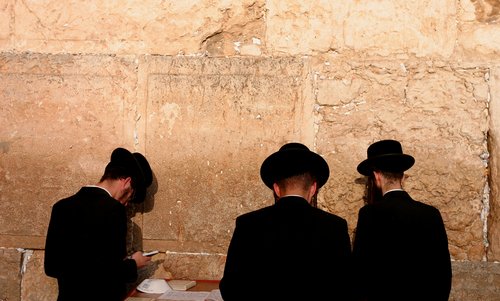
Last night at the Western Wall there were throngs of people from all walks of Jewish life crowding the Western Wall plaza, greeting one another in joy at the reunion as well as sadness for the occasion. The picture to the left of this text was taken from a website about Tisha B'Av at the Western Wall - we didn't take any pictures but this will give you a sense of what it was like. I pushed my way into the women's section where I found rows of women sitting quietly on the ground, reading out of prayerbooks. A few were standing, and toward the front the women were standing shoulder to shoulder, trying to get close to the wall. Few people spoke and they kept their voices low so as not to distract the men. Some prayed ferverently and many held small children or pushed strollers full of babies. As I understand it (and I'm not surprised) this subdued quietnes was vastly different from Daniel's experience on the other side of the mechitsa, and I hope that he is writing about that so that you can learn about what that's like, too. To me, the somberness of the women's withdrawn and self-reflective prayer fit the mood of the holiday well. Refraining from speech and singing seems to go along with refraining from food, to me, as an activity that inspires sadness, that creates (artifically?) a sense of mourning. And certainly sitting the floor, near women who shook their tsedakah boxes and asked for money in lowered voices, added to the gloom of the holiday. Regardless of the appropriatness of sadness to Tisha B'Av though, I nevertheless struggle with its relevance for me.
One of the interns at Daniel's program who led the service last night spoke a bit about the significance of the holiday to him as someone who has made aliyah. He spoke of how in the past Tisha B'Av was about a hopeless, weak people searching for a superhero who would take all of their problems away, and how it might seem irrelevant in an Israel in which sovreignty has been renewed through the hard work of actual people, rather than super-people. But he said he continued to find significance in the holiday because of a rabbinic belief that the destruction of the Second Temple occurred because of senseless hatred. He says that Tisha B'Av is a reminder to him that Israel has a long way to go to reach its goals of being a moral Jewish society, and that it is also a reminder that Israel is not indistructable and senseless hatred is a serious threat still today. (Correct me if I'm wrong Daniel, would you agree that this is what he said?)
I'm not sure I'm comfortable with his characterization of non-Zionist Jews as weak and relying upon some superhero figure to save the day, and I don't think I'm comfortable with his characterization of Zionism as a movement of men acting as superheros, either. But at least I appreciate that he has come to an interpretation that is meaningful to the here and now, that makes sense to him in his own interpretation of modern history and what it is to be a Jew today, when the best that I can come up with, really, is that all tragedies (inc. the destruction of the Second Temple) should be mourned, and that a day of mourning is a healthy pause in a life of celebration. Niether of these answers do I find fulfilling.
Traditionally, Tisha b'Av is commemorated as that tragic day that marks the beginning of golus, an exile of Jews from the land of Israel, physically, and also a spiritual exile of Jews away from G-d. Not only do I find it hard to relate to because we are no longer exiled from Israel - here I am, journaling in Jerusalem, but I also find it hard to relate to because frankly, I love being "in golus" - I love living in America and don't feel that I am living there out of some kind of restriction but out of my own desire to be there. On the other hand, I often tend to think of prayers about Jerusalem and Israel in a figurative way. When I pray facing the Western Wall, when I say the word Israel in a prayer, when I hope we'll be in Jerusalem next year for Pesach, it is not this Israel, this Jerusalem, this Western Wall, that I am praying about. It is something else entirely, I think. It is a prayer for a Jerusalem, an Israel, a Western Wall that is perfect, that is spiritual, that is good, that doesn't really exist but maybe someday could or someday has. It is a fiction, really, that I take part in. A fiction that Jews believed in for thousands of years, that Israel was a holier place than any other, that if Jews returned there they would be better and purer. Perhaps for me, the Israel of prayers and heaven are equivalent places, and the Israel of the Middle East, while it may be the historical place to which those prayers refer, is not at all what I am praying about. Does this make sense? I'm not sure it does and I'm sorry for rambling and for being so confusing. But I guess what I'm trying to say is that regardless of the current political, physical reality that the state of Israel exists, and even despite my own being in Jerusalem, at the Western Wall, on Tisha B'Av, when I am praying and fasting and hoping on Tisha B'Av I am still hoping for the end of some kind of golus from some kind of Israel - some kind of redemption to a higher, better plane, a world of more goodness, more meaning, and more light.
This year, like last year, I am haunted by the image of the destruction of the Second Temple. And this year in particular I am thinking about the feelings expressed in Lamentations that G-d has not abandoned the Jewish people but has become their enemy. What a terrifying notion. Daniel's teacher today said that this is traditionally considered to be better than abandonment - that G-d's anger is better than G-d's indifference. This is an idea that I can understand, but after reading the anguish of the book of Lamentations, I'm not sure that it is one that I accept. Lamentations describes such horrible things - the beautiful faces of the priests, once so pure and white and soft, are blackened and charred from the destruction - and then goes on to attribute this go G-d, G-dself. Not to the Romans, not to historical or political circumstances, but to the divine being that the People of Israel refers to as their parent.
It is just about time to break the fast and so I must bring this incoherence to an end, but allow me one last word which is to say that I am troubled by so many things about this holiday but perhaps the meaning in the fast has been for me, this year, in the knowledge that I am in a relationship with G-d, whatever G-d is, and with the Jewish community (whatever it is) and I fast to take an action to maintain that connection - I fill myself with G-d, try to understand what it means for G-d to have an active role in the world, and for that active role to be destruction, and I mourn for that possibility, because who knows, that is certainly a possibility. But I break the fast because I believe that while G-d may be something with the power for evil, I cannot go on unless I believe that G-d is at least probably something with, above all, the power for good.
I hope you've had meaningful Tisha B-Avs, too, and I'm sorry to have bored you with mine...

OK, I'm going to eat now, catch ya later!

Tisha B'Av.

.תשע באב

Last night, Tisha B'Av started. I've never commemorated this day before this year, so what I've been learning so far (which has been a lot) has all been new. In brief, Tisha B'Av (literally, the ninth day of the month of Av) commemorates certain catastrophes in Jewish history. Classically, Tisha B'Av recounts the following five events:

1. The return of the spies from the land of Israel with disparaging news
2. The destruction of the First Temple in 586 BCE
3. The destruction of the Second Temple in 70 CE
4. The defeat of the Bar Kochba Revolt as marked by the fall of Betar in 135 CE
5. The leveling of Jerusalem in 136 CE

Additionally, tradition holds that the following events also occurred on this date:

6. Expulsion from England in 1290
7. Expulsion from Spain in 1492
8. Liquidation of the Warsaw Ghetto in 1942
9. Disengagement from Gaza in 2005

Basically, Tisha B'Av is a mourning day in the calendar that's set aside to commemorate these historical tragedies (or perceived tragedies). The day is traditionally a strict fast day in addition to being a day of mourning. This year, I decided to observe the traditional fast to see if I would find significance. What follows are an account of what we've done with the HUC community to mark Tisha B'Av and my thoughts on the day.

Tisha B'Av started at the end of Shabbat yesterday. (Interesting fact: The Jewish calendar is "rigged" so that Tisha B'Av cannot ever coincide with the Sabbath (and Yom Kippur cannot ever abut a Sabbath).) Jessica and I joined the HUC students in a creative service planned and led by three of our summer interns. During the service, we supplemented the regular evening service with a version of the reading of the book of Lamentations; we had five experiences (including a traditional chanting) correlating to the five chapters of the book. I thought the service was quite good, and it helped highlight some issues of what Tisha B'Av means to us today.

Haim talked about Tisha B'Av in relation to the state of Israel. The primary brunt of the day is focused on the destruction of Jerusalem ... but Jerusalem stands with Jewish protection today, so why mourn its loss? However, with the power to protect itself comes the responsibility of also protecting others. Haim suggests that Israel is not living up to its potential and obligation as a "light unto the nations" and that significant moral reform is necessary in the Jewish state. Perhaps we will continue to mourn until we can be the example we strive to be.

Additionally, Dan suggests that the "senseless hatred" (שנאת חינם) that is considered in the Talmud to be the cause of the destruction of the Second Temple still exists in Jerusalem today and therefore, we still have Tisha B'Av-related work to do even if we're not trying to restore a Third Temple. The fact that some Reform Jews stereotype, prejudge, and condemn some orthodox-looking Jews and vice versa is evidence of the "senseless hatred" that needs to be overcome before we can abandon this period of national mourning.

After the service, Rabbi Wilfond (Gingy) led the majority of us to the Kotel and led us in some brief text studies along the way. We arrived at the Kotel at around 10:40, and it was packed. The mechitza (the wall between the men's and women's sides) was extended into the courtyard to make sure that men and women wouldn't be lamenting side-by-side. As I walked through the men's section, I saw several groups of orthodox(?) Jews sitting in circles and reading from Lamentations, rocking with the power of the text. Sometimes, individuals (including children) were reading the text on their own, and some people had their heads buried in their arms, sobbing against the Western Wall. Of course, beggars abounded but for once, no one asked me to wrap tefillin ... that's not something traditionally done on Tisha B'Av until the day is almost over. It was bizarre seeing so many people sitting down at the Wall and reading from the same text (not necessarily praying), and I definitely felt voyeuristic as my entire goal was to observe rather than to participate. Still, it was a worthy experience as going to the Kotel is apparently a huge part of Tisha B'Av around here. As we were leaving the Old City (11:15-11:45), we passed streams of hundreds and hundreds of people all heading to the Western Wall. It was unbelievable. I had no idea of the magnitude of this day which goes largely unmentioned in Reform communities in the States.

This morning, after a Tisha B'Av-related Hebrew class, we had a lecture on the reactions of different religious groups in Israel to Tisha B'Av, a text study on some original sources on the day and its mourning and fasting practices, and a standard (Reform) Tisha B'Av afternoon service. Jessica and I went shopping for a few items this afternoon, and though there were several closed stores, more was open than I expected. Apparently, in Israel, Tisha B'Av is not a nationally-recognized day off. To compensate for those who wish to take off, many Israeli employers provide "choice days," which can be taken at any time during the year; many Israelis use one of these days on Tisha B'Av.

After shopping, Jessica and I read through the book of Lamentations to see what the big deal is. It's really a powerful text. I won't go into some of the worst details here because they're really horrific. Suffice to say, the destruction of Jerusalem as recounted by Jeremiah was a tragic and unbelievably difficult experience for the Jewish people to endure.

Now, my thoughts on the matter.

I don't mourn the loss of Jerusalem or the loss of the Second Temple. I don't mourn the failure of the Bar Kochba revolt. And even as I admit the tragic nature of these events in their time, I don't think I could ever be moved to sobbing about them. They are natural parts of the development of modern Judaism, and we have grown from them into a spiritually stronger, more morally driven people (in my opinion). In other words, we've gotten over it.

Jim, one of my fellow classmates, made an astute comment during our text study today. Mourning is a process that one goes through when one is exceedingly sad in order to bear and overcome the sadness. On Tisha B'Av, it seems that we are encouraged to induce mourning in order to become sad. It'd be one thing if I were sad already about these tragedies, but I'm not. So why should I recognize Tisha B'Av as a day of mourning when I don't need to overcome my sadness.

Of course, I grant that some communities and individuals may indeed feel that sadness over loss and therefore look to Tisha B'Av as a necessary release of that anger and frustration. (Better to read in Lamentations "Persecute and destroy [my enemies] in anger from under the heavens of the LORD" than to actually seek any physical retribution.) For these individuals and communities, I can recognize the value of the commemorative day. For me, though, the value is harder to come by.

On the one hand, Tisha B'Av seems like it should most naturally reflect the tragedy of the Holocaust. To my reckoning, the Holocaust is a catastrophe to modern Judaism as much as, if not more than, the destruction of the Temples and the expulsion from Spain were to their respective communities. We have a visceral need to wrestle with the Holocaust, to release our grief and seek understanding. And we have a day for that. Historically, some argued against the establishment of Holocaust Memorial Day (in 1951 in Israel), citing Tisha B'Av as the appropriate day of mourning for the Shoah. And, in fact, many Haredim don't celebrate Yom Hashoah since it's a creation of the modern national state (and not a true "religious festival").

But for me, Yom Hashoah is a very real, very powerful day of memorial and testament to the events of the Holocaust, and I fully intend to continue to commemorate it. So, what do I do with Tisha B'Av? I'm not in mourning, I don't want a Third Temple, and I don't feel that it's healthy to dwell on these events of destruction in the past.

Perhaps for me, Tisha B'Av is a memorial day like the American Memorial Day. That is, on Memorial Day, I honor the deaths of soldiers from America's past, but I don't have a visceral connection to it. If I were closer to people who served in the military, I'm sure it'd be different; likewise, if I were closer to the traditions of the Western Wall, I might feel more association with Tisha B'Av. I understand that it's important to mark the tragedies of Jewish history, and I definitely don't think that we need a whole day for every single one of them (because there are a lot). But, there's a lot that can be gained to, once a year, thinking especially about, say, the expulsion from England or the Warsaw Ghetto Uprising. I do think that that's meaningful, and I value the Jewish calendar's flexibility in providing that to me.

So, as a modern Reform Jew, I don't feel the connection to Tisha B'Av that I believe many of my Orthodox fellows feel. Nevertheless, I respect the place that the day has in our tradition, and I will continue to explore my relationship to it. Will I fast in the upcoming years? As of now, my answer is no ... but I'm fully open to the possibility that my perspective will change. One of the reasons I've taken so much time with this post is so that I may come back and read it next year to see how my views have changed. And, of course, I invite the comments of any readers who have insights on this issue. Again, I'm only thinking about this topic for the first time, so any other perspectives are highly welcome.

And ultimately, I hope that the issues that Haim and Dan raise can be taken seriously in the near future so that we can overcome the "senseless hatred" that is the cause of so much destruction and maybe one day do away with the need for a national day of mourning altogether.

Saturday, August 2, 2008

Our right to defend the Land of Israel?

?זכותנו להגן את ארץ ישראל

As I mentioned in my last post, we had our second biblical archeology "field trip" on Thursday, and this time we really started getting into the history (and non-history) of the bible. We focused on Jerusalem and talked a lot about the state of Jerusalem before the Hebrews inhabited the land of Israel and whether and how King David made Jerusalem the capital of the Israelite kingdom.

One of Professor Joel Duman's main points is that it's extremely difficult if not impossible to verify the existence of David and Solomon's "United Kingdom" and even the biblical account of David's siege of Jerusalem is nonsensical language (to such an extent that the author of Chronicles has to reword it). [One version of] our national myth holds that Jerusalem was a powerful Canaanite stronghold (neither the tribe of Judah nor the tribe of Benjamin could take it) that fell to the warrior King David, who selected the site as an independent capital of a newly-united Israel and Judah. There's no archaeological evidence to dispute that account, but neither is there any evidence to support it - and the prevailing notion (from various angles) is that the biblical account is biased and Jerusalem-centric.

On our tours around Jerusalem, then, we had a chance to view firsthand some of the archaeological sites that were the sources for some corroborating and complicated historical evidence. It was fascinating to see the remains of a millennia-old home and to walk through the water tunnels that were so important in Jerusalem's history. At the end of the day, though, we were asked: Does being here make it any more important to you? Does standing along the ramparts of the area that used to be the outer wall of Jerusalem make its previous existence more meaningful? And how much does it affect your theology that historical evidence is hard-pressed to verify everything in the bible (though some accounts are supported with startling accuracy).

To me, I think it's very interesting to learn about ancient Israel and stand in the same place where those lessons originally took place ... but I don't think it affects my theology too much. However, that's not because I'm discounting history but rather because I never really counted history in to begin with. I'm much more concerned with Now than with a mythical Then ... and the Now is just as real whether you base it on a historical, spiritual, or mythical understanding of origins. That is, I feel a connection with other Jews because ... well, because I feel a connection with other Jews. That connection isn't based on a shared history but rather on a mutually-participated-in relationship. Of course, I believe that a place like the Western Wall (or a synagogue or a library, etc.) can facilitate that relationship and draw me closer to other Jews, but the significance of the Kotel to me isn't that it was the outer wall of the Temple but rather that Jews have hallowed it over the centuries and my participation in that hallowing is a performance of my relationship with those Jews.

All that having been said, history is very important to many people here, and I do feel it's important to address and attempt to understand. Do I believe that, based on a historical series of events, the existence of a Jewish state of Israel is justified? I do, and I point to anti-Semitism culminating in the Holocaust as the primary historical justification for a legal Jewish sanctuary. Do I also believe that, based on a historical series of events, some Jews in Israel have abused their political independence to perpetuate violence on the previous inhabitants of the land (as well as non-physical violence and oppression of all kinds, some of which I've already written about in this blog)? I do, and I point to the miserable condition of many Palestinians (and the strongarming of the religious right in this country) as the primary justification for a necessity of reform.

Now, I like to try to have all my ducks lined up in a row before getting into a conversation about the state and State of the Jewish people today. Are we having a theological/ethical conversation, or are we having a historical/political conversation? It frustrates me when people hastily conflate the two. And here's a perfect case in point.

This morning, I attended Moreshet Yisrael, a Conservative congregation in Jerusalem that mostly serves American Conservative Jews. At first, I didn't like the service because it was what I have come to associate with "standard Conservative." The hazzan would mumble through prayers that most people mumbled to themselves with a page number being announced every once in a while. Not my way to pray. However, after the first part of the service, a woman led us through prayers, and she sang loudly, clearly, and with the rest of the congregation. I loved it. The Torah service was great (the leader had an incredible voice), and the Haftarah was meaningful. And then we got to the sermon.

Rabbi Adam Frank highlighted a very forceful part of this week's Torah portion (Masei). In particular, he focused on these verses:

In the plains of Moab by the Jordan at Jericho, the Lord spoke to Moses, saying: Speak to the Israelites, and say to them: When you cross over the Jordan into the land of Canaan, you shall drive out all the inhabitants of the land from before you, destroy all their figured stones, destroy all their cast images, and demolish all their high places. You shall take possession of the land and settle in it, for I have given you the land to possess. You shall apportion the land by lot according to your clans; to a large one you shall give a large inheritance, and to a small one you shall give a small inheritance; the inheritance shall belong to the person on whom the lot falls; according to your ancestral tribes you shall inherit. But if you do not drive out the inhabitants of the land from before you, then those whom you let remain shall be as barbs in your eyes and thorns in your sides; they shall trouble you in the land where you are settling. And I will do to you as I thought to do to them (Numbers 33:50-56).

Now, nestled snugly and minimally in Rabbi Frank's sermon was the message that Israel has failed in its responsibility to provide for its Arab citizens (never did he use the word "inhabitants" or "residents" when talking about due rights). He did say that certain inequalities need to be addressed by the Israeli government ... but the rest of the sermon focused on the bolded selections above.

More or less, Rabbi Frank affirmed that since God told Moses and the Children of Israel to take the land and destroy anything and anyone who was in the way, then Israel has a right to exist today and to defend itself from its "Enemy." Anything that Israel does to protect its children, its women, its seniors (I'm using the rabbi's language here) is justified because God gave us this land, and if we don't protect it, our Enemy will continue to "trouble" us with attacks. Therefore, we have to remain vigilant in destroying those who would destroy us so that we may remain safe. He quotes Rashi, and claims that he is both prophetic and brilliant in his treatment of Num 33:53: "You shall vacate it of its inhabitants, and then you shall ' settle in it.' Only then will you be able to survive there, but if you do not do this, you will be unable to survive there." According to Rabbi Frank, Rashi knew 1000 years ago that if we don't fight to protect ourselves, we won't be able to live in this land.

Now, naturally, I disagree. Violence begets violence. That's a short and simple sentence, but there's not much that you can add on to it. Is someone being violent to you? If you're violent back, it will beget violence. If you want peace, you need to be peaceful. Eradicating your enemies is not only wrong, but it's ineffective. Not to be crass, but if the Nazis couldn't eliminate the Jews of Europe, what makes anyone believe that we can win the "War on Terror" by killing all the terrorists?

Aside from this point (which is my strongest and yet hardest for most people to understand), there's also the fact that Rabbi Frank is mixing history and theology in a way I believe to be unjustified. He's claiming the Numbers text as historical justification for our being in the land of Israel (which, by the way, is defined geographically ambiguously in this very portion), but simply reading Numbers as history doesn't cut it - not for me, and not for a majority of Jewish tradition.

For example, look at this part of the same parsha:

But anyone who strikes another with an iron object, and death ensues, is a murderer; the murderer shall be put to death. Or anyone who strikes another with a stone in hand that could cause death, and death ensues, is a murderer; the murderer shall be put to death. Or anyone who strikes another with a weapon of wood in hand that could cause death, and death ensues, is a murderer; the murderer shall be put to death. The avenger of blood is the one who shall put the murderer to death; when they meet, the avenger of blood shall execute the sentence. Likewise, if someone pushes another from hatred, or hurls something at another, lying in wait, and death ensues, or in enmity strikes another with the hand, and death ensues, then the one who struck the blow shall be put to death; that person is a murderer; the avenger of blood shall put the murderer to death when they meet. ... These things shall be a statute and ordinance for you throughout your generations wherever you live (Numbers 35:16-21, 29).

Just as the earlier verses appear clearly to enumerate God's wish that the People of Israel annihilate their enemies in the land of Israel, so too do these verses seem to advocate for capital punishment for murderers. However, in the Talmud, so many restrictions are added on to the topic that capital punishment is virtually impossible. This article explains clearly and succinctly the thought processes behind the rabbis' treatment of the death penalty; I'll quote only a few particularly apt points here:

"It is ruled that two witnesses are required to testify not only that they witnessed the act for which the criminal has been charged but that they had warned him beforehand that if he carried out the act he would be executed, and he had to accept the warning, stating his willingness to commit the act despite his awareness of its consequences. The criminal's own confession is not accepted as evidence. Moreover, circumstantial evidence is not admitted."

"Who would commit a murder in the presence of two witnesses when these had solemnly warned him that if he persisted they would testify against him to have him executed for his crime?"

"A Sanhedrin that puts a man to death once in seven years is called destructive. Rabbi Eliezer ben Azariah says: even once in seventy years. Rabbi Akiba and Rabbi Tarfon say: had we been in the Sanhedrin none would ever have been put to death. Rabban Simeon ben Gamaliel says: they would have multiplied shedders of blood in Israel" (Misnah Makkot 1:10).

This clearly shows that traditionally, these verses of Masei, which are "a statute and ordinance for you throughout your generations wherever you live," are considered inappropriate for decent human relations and are therefore curtailed from ever being practiced.

Therefore, Rabbi Frank's quoting Rashi about dispossessing the original inhabitants of the Land of Israel just doesn't justify imposing the death penalty on Israel's enemies. I believe that the Torah is a guide in every sense and can shed light on mysteries of history ... but it is not a history book as we have come to be accustomed to them. It cannot be relied upon as a proof-text for our self-governance in this land, and it certainly shouldn't be cited in defense of life-taking violence.

So, I suppose all I have to say in conclusion is that I'm looking forward to the opportunity when I'll have a chance to write a sermon about Masei.

Friday, July 25, 2008

American and World Reform Judaism.

.יהדות רפורמית אמריקנית ועולמית

I want to start by posing a question inspired by an email I received: Why do some (most?) congregations charge (non-members) for High Holiday tickets? I'm sure there's some sort of "economic reality" that synagogues have to face, but the entire idea is distasteful to me.

The reason I bring up this point is that I recently received an email from an old list that I'm on advertising High Holiday ticket prices to "young people" in the D.C. area. While several places let students in for free, others require a ticket purchased at a "discounted" price of $18-200. Let's say I'm an unaffiliated 28-year-old in the DC area. I'm certainly not going to pay a dime to go to services, to my options for free services include:

Adat Reyim (Conservative)
Beth Torah (Reform)
Farbrangen (Independent)
Kehila Chadasha with Am Kolel (Havuah/Renewal/Reconstructionist)
Temple Sinai (Reform)
University of Maryland Hillel (Reform, Conservative, Orthodox)
and three Orthodox/Traditional services

Now granted, that's an enormous panoply of options compared to Roanoke (which has two congregations), but of the 56 options available in the area, it's sad that less than 1/4 are free. (And that's if you're under 35!)

One thing I don't know is whether this is a common phenomenon or one unique to American Judaism. I suspect that this is more of an American approach to High Holiday service attendance, though I can't back that up with anything more than a hunch. If it's true, though, then it serves as a sign of American Judaism's unique way of doing things and also reflects a certain amount of privilege and wealth not available to other communities.

Which leads me into my next topic: World Reform Judaism. On Wednesday afternoon, we had a chance to meet with Rabbi Uri Regev, the leader of the World Union for Progressive Judaism (WUPJ) (which is headquartered in Jerusalem ... in the same complex as HUC!). Rabbi Regev, a graduate from and later director of the Israeli Rabbinic program at HUC, shared with us the accomplishments of the World Union, largely in the Former Soviet Union (FSU) and in South America. Where the WUPJ has not had significant impact is in North America. Many of the Jewish communities there feel secure and insulated from the rest of the Jewish world, and Rabbi Regev believes that a mutual partnership and enrichment must take place between American and non-American Jews, a relationship that should be built with Israel as its heart.

Now, I'm all for the expansion of horizons of Americans' understanding of Judaism beyond the boundaries of our country. My trip to Israel on Hillel's "Winter Israel: Peoplehood and Pluralism" trip exposed me to members of Jewish communities in ten different countries and opened my eyes to the complexities and richness of (at least parts of) world Jewry. Some time ago, I overheard someone make a comment about how all Jews have something in common: Going to Hebrew School once or twice a week to become a Bar or Bat Mitzvah. My immediate reaction was, "Of course all Jews have something in common ... but it's not the religious school model that you grew up with!" She was referring, I believe, to American Jews, but her concept of Judaism defaulted to the familiar. Of course, upon reflection, she would have known that Jews outside America follow a diverse array of educational systems, but the gut feeling was that "all" Jews live in the United States.

If we can change that basic perspective, we can open our minds and hearts to other communities so much easier. I don't know very much about American Jewry's involvement in the movement to move Russian Jews from Russia to Israel, but I understand that the outpouring of support was significant. Something "clicked" with American Jews about their fellows across the world, and the result was a tremendous amount of support.

Now, don't get me wrong: I'm not trying to squeeze aid out of the American Jewish community to go toward improving the lot of poor Jews across the globe; not at all. What I'm suggesting is that, given a recognition of a common bond, people can be drawn together from across vast distances. The strengthening of our Jewish community can only serve to make us more world-conscious and therefore more likely to speak out and act against injustices around the world. If my home congregation had a sister congregation in Rio de Janeiro, for example, I might have been taught something of Brazilian life and culture in Sunday School. Perhaps I would have had a chance to go on a Youth Group exchange of some sort to see how Jewish youth live there. And today, perhaps I would have enough interest in my sister community to know that Brazil is facing an oil workers' strike that is still in negotiations.

However, what I'm less sure about is the second part of Rabbi Regev's message, that Israel has to be at the center of our world Jewish identity. Now, at this point in my Year in Israel, I'm willing to give him the benefit of the doubt. I don't know very much about Israel and the religious climate here (I've been here such a short amount of time, relatively speaking), and I don't fully understand the impact Israel has on the Jewish world at large. I believe that it is entirely possible that Israel should be central to a global understanding of the Jewish community, but this is an issue I still have to explore for myself. How much should Israel be my home away from home, and how much should it trump my thoughts about and support to communities in Eastern Europe, South America, and other places? This is a topic I'm sure I'll be returning to.

It's also a topic touched upon by someone else we met with on Wednesday. Iri Kassel, the executive director of the Israel Movement for Progressive Judaism (IMPJ), shared several stories with us that communicated the state of Progressive Judaism (a term used to describe non-traditional alternatives to Orthodoxy) in Israel. To summarize, the IMPJ is growing in strength and influence but very, very slowly. There are 24 progressive congregations in Israel, and the IMPJ has programs in 80 schools. Last year, the IMPJ sponsored 85 "Bat Mitzvah is not Just a Party" programs that sought to bring meaning to girls' Bat Mitzvahs since in Israel, generally, a girl doesn't actually do anything or receive any recognition as a Jewish adult (but still receives a big party with lots of presents and delicious food). There's also a one-year Mechina program for students who have graduated from high school and who are delaying their full term of military service for a year. This program seeks to prepare the young men and women to fluent in the values and moral dilemmas of military service.

These are all very exciting programs, but there is a lot of work to be done before Progressive Judaism is recognized as a viable religious community and spiritual expression. For example, there are currently 3,000 orthodox rabbis getting paid by the state; 0 progressive rabbis have that privilege. However, there's a case in the Israeli Supreme Court right now that will hopefully result in the state paying a Reform (woman!) rabbi just like an orthodox counterpart. Recently, the IMPJ received four (worn-down but standing) buildings from the government, and that's a victory of precedence that will hopefully be replicated in the future.

Naturally, I believe that Progressive Judaism is a vibrant and fulfilling means of spiritual and communal expression, and it hurts to see it degraded, sometimes violently, in the Jewish state. Nevertheless, I'm inspired by the work that IMPJ is doing, and I fully support it. I don't know what I can do aside from talk the talk, however. Even when asked what we can do to help, Mr. Kassel could only suggest that we visit the Progressive synagogues in Israel, make relationships with the communities, and if possible, bring Americans to visit them in the future. Not exactly a concrete answer ... but on the other hand, I can also see the importance to Israelis for Israelis to make this happen. It's one thing when an American rabbi says to an Israeli "Reform Judaism is beautiful!" It's another thing entirely when an Israeli (who was more than likely raised either observant or secular) tells her friends and colleagues about the importance of Progressive observance in her life. I certainly hope that the IMPJ continues to make significant strides, and I'm here to lend support if I can!

It's interesting that, the day after meeting with the IMPJ, we had our first "tiyul" (trip) in Jerusalem. We walked (a lot!) around different parts of the city and explored texts that highlight the significance of Jerusalem in Jewish tradition and observance. The tour brought us closer and closer to the Kotel, and as we drew near, we discussed the significance that gaining the Western Wall in 1967 had for the secular soldiers that fought for it. We talked about the changing character of the Wall and how only since 1969/1970 or so has it been controlled by the orthodox - prior to that, men and women prayed together (and the space was much smaller). Overall, we discussed how Jerusalem belongs to all Jews, not just the orthodox, and this is reflected in poetry and songs from Israeli society and history.

Many of my colleagues have expressed extreme difficulty relating to the Western Wall. I believe that a significant part of their unease (and mine) is the oppressive weight of the orthodox always on alert for a bare shoulder or uncovered head. It's a shame that they have declared the Wall theirs when clearly it's not, and it's a challenge for myself and, I believe, for progressive and Reform Jews in general not to let them "get away with it." To me (and I'll talk more about this another time, I'm sure), the Western Wall represents a unity of the Jewish people, but recently (very recently in the scope of Jewish history), it has become a symbol of division.

And perhaps as Progressive Judaism "catches on" and people start recognizing the value of spiritual and communal exploration outside orthodoxy, the observant community will have no choice but to become partners rather than overseers. Next year in Jerusalem.

Wednesday, July 9, 2008

Jerusalem: City of Hills.

.ירושליים: עיר הרים

I have now been in Israel for 48 hours and have been spending the past two days meeting and starting to get to know my classmates and the place where we'll all be living for the next eleven months.

Things started out slowly as I got four hours of sleep on Monday night, thus precipitating a two-hour morning nap and delaying the start of my day. So the first thing I did in Jerusalem was make my way to HUC (with walking directions provided by my apartment's previous tenant) for registration and campus tour. I finally had a chance to meet some of the administrators who have been emailing me for the past several months, and they were both extremely helpful. Helen gave me an orientation packet, which I read in the library until the 11:00 campus tour. After the tour, I went to a nearby bank to secure some cash and then went to meet Nancy, HUC's closest staffperson to a "dean of students." She and I had a lovely conversation, and I was off!

On the way to HUC, I had been fairly focused on walking directions and therefore didn't pay too much attention to my surroundings. Once I was free of commitments until 6:00, I decided to do some exploring. First, I went to get my passport photos made for HUC. (I got 6 for 20 shekels (~$6.15) whereas my one US passport picture cost me $15.00.) Upon checking my map, I found that I was near Ben Yehuda St., so I decided to go there to see if I could find an adapter for my laptop (so I could have enough power to make these precious posts!). And then, for the fourth time in my life, I was on Ben Yehuda Street.

I suppose that, since I've been to this place more times than any other in Israel, it should have been a familiar feeling - and in a way, it was. However, the majority of my emotion was of concern for finding an electronics store and surprise to find out how long Ben Yehuda actually is! There was so much delicious food that I had to remind myself several times that I was no longer on vacation and unhealthy eating habits were checked at the cruise-ship door. I did, in fact, find an electronics store and purchased my adapter for a cool 30 shekels. Upon checking my map (twice, for I started out walking the wrong direction), I found that my apartment is virtually around the corner from Ben Yehuda Street! That will make for a convenient fact at some point soon, I'm sure.

After unwinding a bit in the apartment, I went to a dinner organized to celebrate the birthday of one of my classmates-to-be. When I arrived exactly on time at 6:00, there were three other people there. By the time we left for the restaurant at 6:35, there were over thirty people! Apparently, a vast majority of HUC students that were in the area came to this dinner, and the excitement from our class to get to know one another demonstrated by this behavior gives me a strong positive feeling about the rest of the year.

We went to a restaurant called Colony, and I ordered some penne. It was pretty expensive (55 shekels ($17) after tip), but it was fairly good. More important was the atmosphere of friendliness around the table. Several people have mentioned the "honeymoon period" that we're all in, and of course there's a certain degree of truth to that. However, I've had some solid conversations (all beginning with name, place of origin, track of study, and destination after Israel) with some people, and overall I'm very excited to be about to learn alongside these fellow students!

After dinner, we had a short up-and-down tour of Emek Refaim, which is a hip street with a lot of restaurants in a fairly chic neighborhood. As I understand it, most people then went to get drinks, but I was still pretty tired from my lack of sleep, and there was plenty for me to do at home, so I bid everyone good night.

As I walked home, I began to realize that even if I don't get to the gym as often as I hope to this year, I should still be getting a fair amount of exercise. Jerusalem is very hilly! I was definitely feeling the burn walking uphill all the way home, though I took a detour when I saw that the grocery store was still open. "The time has come," I told myself, "to do some real Israeli shopping."

I basically picked up the essentials, not ready to commit to a lot of food before I know how much I'll be eating at home and what Israeli foods I find most attractive. Mostly, I picked up fresh produce, bread, and the like. Then I waited in line.

Now, I certainly can't say if this is characteristic of an Israeli shopping experience, but this is what happened: I changed aisles because I found a shorter line, and I saw that the person in front of me was loading groceries already onto the belt as the person in front of him was checking out. I was really trying to pay attention so that I wouldn't make a fool of myself when I was checking out. I noticed that, when the time came for the person in front of me to check his groceries out, he went to the bags to prepare to bag them himself. (Mark that, Daniel.)

Then, he sent his teenage son to get some milk. And the woman at the check-out waited for him! They just stood there, silently, not moving until the son got back. Once the son arrived, the check-out lady left. Just walked away without saying a word. I could tell that the Israeli man was confused (so it wasn't just me!), and she finally came back with some trash bag-sized grocery bags which he didn't want. Just an unnecessary waste of time, that's all.

Then, the check-out woman asked if they wanted to buy some nuts (which, I believe, were a featured special). They decided to get some and finally began to check out. They had left their cart in front of the belt, empty, while the man was bagging groceries, so I thought they were going to abandon it like all the rest. Once I thought the son had gone back for his last piece of candy (he stepped out of line to get forgotten items three times), I moved my cart forward to start unloading groceries. Then, they decided to get their cart, and urged me out of the way to do so.

So, I start loading my groceries, and the check-out woman starts running them through! I thought you were supposed to load ahead of time... Guess not. So, I held my groceries in my hand until she had rung the last one, and then I started loading. "Is this yours?" she asked the man of my salad dressing. "לא שלי (No, mine)," I told her. Yeesh!

I, too, was pressured about the nuts but politely refused. She asked (I think) if I had a membership card, and I told her I didn't. "Should I buy one?" I asked in Hebrew. "No, are you a tourist?" I told her in English that I just moved here "for a year" (in Hebrew), and she told me (I think) that the card is only for people קבוע, that is, steady or consistent. Maybe it's a credit card (like J.C. Penny's) or maybe it's like a Kroger card. Perhaps once I dust off my Hebrew and get back into ulpan, I'll be able to find out.

So that brings us to today. This morning, I slept in until 9:00, enjoyed a fine breakfast of cereal and orange juice, completed some work around the house, ate an early lunch, and headed to HUC at 12:30 for a tour of the Old City. The first part of the tour was slow as we stopped in one place and then most everyone got hummus while I and three other people who weren't hungry haggled for merchandise. (Or, more accurately, while two of my classmates tried to secure a tapestry for a reasonable price while I and another classmate looked on. In the end, after an hour of back and forth, coming and going, the classmate who really wanted the tapestry got it for less than her original asking price.)

Then, however, we went to the Western Wall, the only remaining architecture of any part of the Second Temple. We decided only to stay for twenty minutes, and the men and the women had to separate. The men and I headed to the enormous men's "half" and went straight to the naturally covered section that I didn't even know existed. It was sort of like a cave full of orthodox Jews, most of whom were praying, studying, or just hanging out. There were books like a library and in an alcove, a teacher was reading from the Talmud to a group of attentive students (some who looked like "black-hatters" and some who looked like "secular Israelis"). His preaching was impassioned, and I only caught a few words. We walked around, some of us took pictures, and we tried to drink in the experience. I definitely didn't feel compelled to pray. We leafed through some of the prayerbooks that were there and felt significantly different from those who would read those books regularly.

This experience at the Wall was both positive and negative for me. On the one hand, I was feeling the familiar discomfort with separation of genders that traditional observance demands, and I was slightly uncomfortable at being in a sea of Jews with whom I didn't feel a strong connection. On the other hand, I felt much closer to the other HUC men who were with me. We continued to make jokes about our privileged manhood in order to ease the tension of the practice. We talked of an alleged incident where HUC had a prayer service with men and women in the plaza outside the Western Wall that incited considerable distress and press. We commented on the differences between our learning styles and the rabbi-preacher who was imparting knowledge to his students. And so on. Before we left, we said a shehechianu (a blessing said after a new occasion), and I felt enormously positive about this Jewish affirmation. We were students preparing to be rabbis, and we had as much right as anyone else to explore our Jewish identity at the Wall. Although the experience was strange, it was very powerful and affirming.

I expect that this won't be the last time I feel this way in Jerusalem. Already I've experienced both excitement and disappointment in Israelis when I've told them I'm studying to be a Reform rabbi - and I've only been here two days! Perhaps we can conclude as my day (outside of the apartment) did: at the mall.

Just outside the Old City is a brand new outdoor mall called Mamilla. Most of the storefronts are in English, yet (according to our HUC summer Israel intern) Israeli's don't see anything non-Israeli about the setup. Perfume, shoes, clothes, and food are all being sold outside the Old City, a fact that can't be ignored when one sees the numbers on the walls. Apparently, one cannot destroy parts of Jerusalem above a certain age, so to build a mall where Mamilla stands, the walls had to be catalogued, taken down, and re-erected in exactly the same way. So, as one is shopping for new cologne, one is also walking through painstakingly preserved centuries-old architecture.

So it remains possible, yea, probable that the ancient and the modern can meet constructively. One of my missions for the year is to learn how to play a role in that combination positively and effectively. Any suggestions?