Last year, I commemorated Tisha b'Av by attending a Reconstructionist congregation's commemoration in Amherst, Massachussetts. We sat on the floor (a traditional mourning practice) in a circle, and read together Eicha (the Book of Lamentations). Lamentations is a powerful, horrifying account of the destruction of the Second Temple in which people are starving, bereft of their dignity and their very lives, and social turmoil erupts such that the whole people is in a state of crisis. The people of Israel have lost their sovreignty, the priests have lost their power to interact with G-d, and, most disturbing, the people have no food and are fainting, are dying. A woman cooks her own dead child so that she can have something to eat.
Before last year, Tisha b'Av was a holiday I simply did not commemorate at all - a holiday I overlooked. It happens in the summer, when kids are out of Sunday School, families are on vacation, etc. and it is easy to forget all about it on long summer weeks when you are not keeping track of anything other than how much sunscreen you need to wear. So last summer, when I decided to try to understand this strange holiday I'd heard of but didn't know anything about, I was not prepared for the horror and deep sadness I was to feel - the sense of loss, fear, and because of the personal nature of the narrative of Lamentations, the sense of personal connection I would gain to the text.
I wasn't sure what to expect from this year's commemoration. Truth be told I'd forgotten that Tisha b'Av would even fall while I was in Jerusalem, and had certainly not thought of the implications of commemorating the destruction of the Second Temple in the very city where it once stood, never mind the implications of mourning th loss of Israel's sovreignty in a the sovreign state of modern Israel.
Although Sunday will ordinarily be a school day for me, today I had no class because of Tisha b'Av. Last night, Daniel and I went to HUC for an evening service and then went to the Western Wall, and today I joined him at HUC for a lecture on the meaning of Tisha b'Av in Israel, followed by a text study and an afternoon service. This afternoon we walked around a bit, did some shopping, and returned home to read Lamentations together and then to reflect a bit about the holiday (Daniel is sitting next to me writing in the blog at the same time that I am ). We are both fasting today, and will break the fast tonight at HUC.
I am unsure how to approach this reflective excercise as there are so many things I've thought about today and want to share. I guess I want to start with the question of why we need Tisha B'Av and what it does or does not accomplish. Why do we need to impose mourning on ourselves? I struggle quite a bit with this question. When there is no reason for me to be sad, it is sort of arbitrary as nothing has happened to me personally so there is no reason to mourn, why should I go through the actions of mourning and induce a greif I would not otherwise feel? Is this healthy? Does it make sense?
I think perhaps an answer to this question has to do with the difference between the personal and the communal. In my own personal experience I have no reason to mourn. But I am more than my own person. As a member of the Jewish people I am part of a collective and communal experience and memory. Collective memory is not intuitive, it is learned. It is induced. It is something that you actually have to work at, I think. So that it may not be natural for me to be sad today, but if I plug myself in to the sadness of the community then it is a different kind of sadness that may not feel natural, may in fact feel a bit like play-acting, but is nevertheless real...maybe
And maybe we need institutionalized days for grief, as people. Maybe Tisha B'Av is a vehicle to allow us to feel grief so that we can feel greater joy on holidays that express joy. Or it is a vehicle for us to reflect on and express fears and concerns that we otherwise try not to think about. If I thought about death and destruction every day all day long, it would be hard for me to live in a meaningful way. But on the other hand if I never set aside time to think about death and destruction, my life would similarly not be meaningful, as I wouldn't recognize it's value and the limits of my own mortality. Tisha B'av allows us to think for a moment about not only personal mortality, but national mortality - about what makes nations fall and whole peoples experience destruction. It is imperative that nations and peoples think about their own mortality in order that they better understand their imperative to be good for as long as they are privileged to have sovreignty or to be in existance.
I am no theologan and no rabbinical student. I am writing as a Jew who is trying to understand the commemoration and whether it feels like it belongs to her, and how. These comments may not be all that sophisticated, but they are the concerns of someone who has been refraining from food and drinking little water all day because she wants to connect to something - to G-d, to Jewish history and peoplehood, perhaps to herself as well. To bring forth and summon her own dark and sad places and examine them in the light of this August day and acknowledge that destruction, anguish, and sadness exist also, and give them their due.
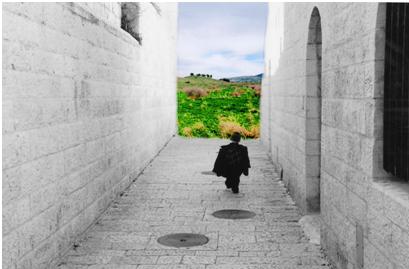
Last night at the Western Wall there were throngs of people from all walks of Jewish life crowding the Western Wall plaza, greeting one another in joy at the reunion as well as sadness for the occasion. The picture to the left of this text was taken from a website about Tisha B'Av at the Western Wall - we didn't take any pictures but this will give you a sense of what it was like. I pushed
 my way into the women's section where I found rows of women sitting quietly on the ground, reading out of prayerbooks. A few were standing, and toward the front the women were standing shoulder to shoulder, trying to get close to the wall. Few people spoke and they kept their voices low so as not to distract the men. Some prayed ferverently and many held small children or pushed strollers full of babies. As I understand it (and I'm not surprised) this subdued quietnes was vastly different from Daniel's experience on the other side of the mechitsa, and I hope that he is writing about that so that you can learn about what that's like, too. To me, the somberness of the women's withdrawn and self-reflective prayer fit the mood of the holiday well. Refraining from speech and singing seems to go along with refraining from food, to me, as an activity that inspires sadness, that creates (artifically?) a sense of mourning. And certainly sitting the floor, near women who shook their tsedakah boxes and asked for money in lowered voices, added to the gloom of the holiday. Regardless of the appropriatness of sadness to Tisha B'Av though, I nevertheless struggle with its relevance for me.
One of the interns at Daniel's program who led the service last night spoke a bit about the significance of the holiday to him as someone who has made aliyah. He spoke of how in the past Tisha B'Av was about a hopeless, weak people searching for a superhero who would take all of their problems away, and how it might seem irrelevant in an Israel in which sovreignty has been renewed through the hard work of actual people, rather than super-people. But he said he continued to find significance in the holiday because of a rabbinic belief that the destruction of the Second Temple occurred because of senseless hatred. He says that Tisha B'Av is a reminder to him that Israel has a long way to go to reach its goals of being a moral Jewish society, and that it is also a reminder that Israel is not indistructable and senseless hatred is a serious threat still today. (Correct me if I'm wrong Daniel, would you agree that this is what he said?)
I'm not sure I'm comfortable with his characterization of non-Zionist Jews as weak and relying upon some superhero figure to save the day, and I don't think I'm comfortable with his characterization of Zionism as a movement of men acting as superheros, either. But at least I appreciate that he has come to an interpretation that is meaningful to the here and now, that makes sense to him in his own interpretation of modern history and what it is to be a Jew today, when the best that I can come up with, really, is that all tragedies (inc. the destruction of the Second Temple) should be mourned, and that a day of mourning is a healthy pause in a life of celebration. Niether of these answers do I find fulfilling.
Traditionally, Tisha b'Av is commemorated as that tragic day that marks the beginning of golus, an exile of Jews from the land of Israel, physically, and also a spiritual exile of Jews away from G-d. Not only do I find it hard to relate to because we are no longer exiled from Israel - here I am, journaling in Jerusalem, but I also find it hard to relate to because frankly, I love being "in golus" - I love living in America and don't feel that I am living there out of some kind of restriction but out of my own desire to be there. On the other hand, I often tend to think of prayers about Jerusalem and Israel in a figurative way. When I pray facing the Western Wall, when I say the word Israel in a prayer, when I hope we'll be in Jerusalem next year for Pesach, it is not this Israel, this Jerusalem, this Western Wall, that I am praying about. It is something else entirely, I think. It is a prayer for a Jerusalem, an Israel, a Western Wall that is perfect, that is spiritual, that is good, that doesn't really exist but maybe someday could or someday has. It is a fiction, really, that I take part in. A fiction that Jews believed in for thousands of years, that Israel was a holier place than any other, that if Jews returned there they would be better and purer. Perhaps for me, the Israel of prayers and heaven are equivalent places, and the Israel of the Middle East, while it may be the historical place to which those prayers refer, is not at all what I am praying about. Does this make sense? I'm not sure it does and I'm sorry for rambling and for being so confusing. But I guess what I'm trying to say is that regardless of the current political, physical reality that the state of Israel exists, and even despite my own being in Jerusalem, at the Western Wall, on Tisha B'Av, when I am praying and fasting and hoping on Tisha B'Av I am still hoping for the end of some kind of golus from some kind of Israel - some kind of redemption to a higher, better plane, a world of more goodness, more meaning, and more light.
This year, like last year, I am haunted by the image of the destruction of the Second Temple. And this year in particular I am thinking about the feelings expressed in Lamentations that G-d has not abandoned the Jewish people but has become their enemy. What a terrifying notion. Daniel's teacher today said that this is traditionally considered to be better than abandonment - that G-d's anger is better than G-d's indifference. This is an idea that I can understand, but after reading the anguish of the book of Lamentations, I'm not sure that it is one that I accept. Lamentations describes such horrible things - the beautiful faces of the priests, once so pure and white and soft, are blackened and charred from the destruction - and then goes on to attribute this go G-d, G-dself. Not to the Romans, not to historical or political circumstances, but to the divine being that the People of Israel refers to as their parent.
It is just about time to break the fast and so I must bring this incoherence to an end, but allow me one last word which is to say that I am troubled by so many things about this holiday but perhaps the meaning in the fast has been for me, this year, in the knowledge that I am in a relationship with G-d, whatever G-d is, and with the Jewish community (whatever it is) and I fast to take an action to maintain that connection - I fill myself with G-d, try to understand what it means for G-d to have an active role in the world, and for that active role to be destruction, and I mourn for that possibility, because who knows, that is certainly a possibility. But I break the fast because I believe that while G-d may be something with the power for evil, I cannot go on unless I believe that G-d is at least probably something with, above all, the power for good.
I hope you've had meaningful Tisha B-Avs, too, and I'm sorry to have bored you with mine...
OK, I'm going to eat now, catch ya later!