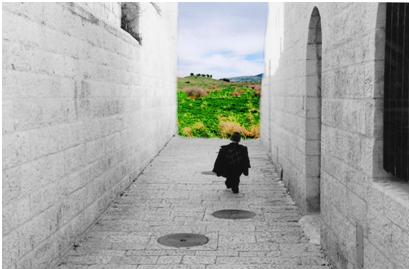
Tonight for services we visited a much-spoken-of shul called Shirah Chadasha. It's run by an Orthodox community who push the bounds of Orthodoxy with regard to gendered restrictions - most notably, women lead the kabbalat Shabbat services.
We met our friends at the front entrance and walked into the building together. When we arrived at the sanctuary Amanda and I went into the women's section and Daniel and Jon into the men's section. Amanda and I were greeted warmly and ushered into seats. All around us were women, some wearing pants but most wearing long skirts and long-sleeved shirts with high necklines. Several of the women were wearing head coverings. The women smiled at one another in greeting, but mostly were otherwise intense in prayer. Unlike in other traditional prayer environments I've experienced, the women were praying audibly, confidently, reading the words and chanting the melodies aloud. Their voices were solid but delicate, and the music of the prayers filled the modest room. The men sat on the other side of the room, on the other side of the mechitza which was a flimsy white chiffon curtain. They seemed like ghosts clouded, obscured, and distant, praying in partnership with the women, like mirror images, like echoes of our words and motions. There was something beautiful in the separation and the sameness, in seeing one another and yet being apart. And the white of the mechitza made the men seem somehow like the Sabbath bride. I found myself feeling strangely attracted to the mechitza, strangely inspired by it, while nevertheless repulsed by the notion of sex-segregated worship.
The music was beautiful. Melody followed melody, each intertwining with improvised harmonies from both sides of the curtain, as though the men and women were reaching accross to one another, defying and celebrating their separation. The beauty of the voices - and they really were quite talented singers -moved me, and though I had come to the services in order to say I had been to this synagogue, in order to experience a new cultural curiosity, and certainly not in order to pray, I found myself praying.
I did not expect to like Shira Chadasha - I was predisposed to think that any place that separates by sex was not a place in which I would comfortably be able to pray, because it is a place that perpetuates social injusitice and inequality. Although my feelings at Shira Chadasha directly contradicted my sense of disapproval of sex-segregated prayer, I am still not convinced that Shira Chadasha is doing enough - often people speak of this synagogue as "so progressive for Orothox", as really unusual, as making great strides. And before I visited I was frustrated with this idea, because they were still separating by sexes, and so they simply weren't doing enough. I felt this way and I still feel this way. And yet...I also really enjoyed services this evening, found them meaningful, perhaps, because of the beauty of coming together through separation, of separating to find one another in sound and voices, because of the eerie, holy sensation of seeing another through a veil, of the transformation of the familiar, of the community created by breaking the whole into halves. And so, I am torn about Shira Chadasha. I disapprove, and I am moved.
Showing posts with label gender separation. Show all posts
Showing posts with label gender separation. Show all posts
Saturday, April 4, 2009

Tuesday, October 7, 2008
Ottava Rima
For this, I really must apologize - this poetry writing is pretty hard and I know the following is ridiculous. This is another poem written to help me study for the GRE literature in English exam.
Ottava Rima consists of 8 line stanzas usually in iambic pentameter rhyming abababcc. Originally used for heroic themes, it also became popular in the mock epic form. I have written a very short, poor quality, mock epic about a reverse mechitsa, which is supposed to be making fun of the idea that it is better for men and women to be separated - not sure if this was successful at all so I thought I'd summarize what I was trying to do up front.
Separation: A Mock Epic
Once upon an evil time that’s past
There was a sanctuary made of stone
Together there the folks would pray and fast
Although the women could not pray alone
A problem which to them seemed large and vast
For their sweet voices sounded like foul groans
When joined with prayer that came from mouths of men
A sound they never have to hear again
The women cried that they were quite concerned
They felt as though in prayer they were distracted
Because instead of heaven their thoughts turned
To the strong tall men to whom they were attracted
And wondered if their advances would be spurned
They desired to see a change, reform enacted
They wished to solve this problem and they prayed
This soul-deep longing heavy on them weighed
But lo! There was a woman young and pure
With muscles taut as wire round her bones
Who cried that co-ed prayer she’d not endure
She did not wish to hear the manly moans
By members of a sex that was impure
By virtue of their cruel Y chromosomes
Who were anchored to the world of everyday
Who could not their spirits lift and fly away
She built a wall between them strong and wide
Of quite strong cardboard sealed with Elmer’s glue
Stepped back from her work and said with pride
Girls, I think we’ve got some prayer to do!
The women laughed with smiles that spread wide
While praying, swaying, chanting Torah too
They sang and read and prayed and taught and learned
Together the other sex they scoffed and spurned
A separation keeps the deep-voiced and the low
Still today in that far of sainted land
Where women are in charge, as well you know
From mingling with the high-voiced and the grand
The men must ask and women must bestow
Permission to eat, pray, or sit, or stand
The land is just its ways are all of peace
The righteous live and joy will never cease
Ottava Rima consists of 8 line stanzas usually in iambic pentameter rhyming abababcc. Originally used for heroic themes, it also became popular in the mock epic form. I have written a very short, poor quality, mock epic about a reverse mechitsa, which is supposed to be making fun of the idea that it is better for men and women to be separated - not sure if this was successful at all so I thought I'd summarize what I was trying to do up front.
Separation: A Mock Epic
Once upon an evil time that’s past
There was a sanctuary made of stone
Together there the folks would pray and fast
Although the women could not pray alone
A problem which to them seemed large and vast
For their sweet voices sounded like foul groans
When joined with prayer that came from mouths of men
A sound they never have to hear again
The women cried that they were quite concerned
They felt as though in prayer they were distracted
Because instead of heaven their thoughts turned
To the strong tall men to whom they were attracted
And wondered if their advances would be spurned
They desired to see a change, reform enacted
They wished to solve this problem and they prayed
This soul-deep longing heavy on them weighed
But lo! There was a woman young and pure
With muscles taut as wire round her bones
Who cried that co-ed prayer she’d not endure
She did not wish to hear the manly moans
By members of a sex that was impure
By virtue of their cruel Y chromosomes
Who were anchored to the world of everyday
Who could not their spirits lift and fly away
She built a wall between them strong and wide
Of quite strong cardboard sealed with Elmer’s glue
Stepped back from her work and said with pride
Girls, I think we’ve got some prayer to do!
The women laughed with smiles that spread wide
While praying, swaying, chanting Torah too
They sang and read and prayed and taught and learned
Together the other sex they scoffed and spurned
A separation keeps the deep-voiced and the low
Still today in that far of sainted land
Where women are in charge, as well you know
From mingling with the high-voiced and the grand
The men must ask and women must bestow
Permission to eat, pray, or sit, or stand
The land is just its ways are all of peace
The righteous live and joy will never cease
Sunday, September 14, 2008
A Few Updates
I just got back from a short, yet productive, meeting with Yehuda Stolov, the head of the Interfaith Encounter Association, an organization for which I plan on volunteering a few hours a week. We began by introducing ourselves to each other briefly, and then discussing what kinds of tasks I'd be willing to do. We came up with three possible tasks for the year: helping with fundraising, sorting and keeping track of e-mail addresses, and translating encounter groups' reports from Hebrew into English. The last of these is the most interesting to me but probably the least helpful to them as right now Yehuda does this task himself and is probably more qualified for the task. But hopefully I'll get to do some of it as it would certainly be good Hebrew practice for me! Really, I didn't expect this volunteering to be particularly interesting, but I believe in and am excited about the organization and wanted to help out in some small way that fit with what I imagine will be my busy schedule this year. In addition to volunteering, I will also be taking part in an interfaith encounter group. Yehuda told me that there are three groups that would be good for me in Jerusalem and that while each received identical training they are all quite different because of the people who are in the groups. One is located on Mt. Scopus, at Hebrew University, and is composed entirely of students. One meets around the corner from where we live and is for young professionals. The third (least convenient for me to meet with in terms of location but perhaps the most interesting?) is composed of five young Jews from Jerusalem and five young Palestinians from Hebron, a city in the West Bank. It meets in Jerusalem once a week. None of these groups is meeting during the summer, so I do have a little while to think about which group(s) I'll be a part of - any of them I think would be a great experience.
A bit about the Interfaith Encounter Association, because I think they are a truly inspiring group. Yehuda told me that the organization was founded seven years ago, when a few participants of other interfaith dialogue groups decided to form a new model because they felt that the old model wasn't working. According to Yehuda, the old model only encouraged participation by those few individuals who had already begun some work in interfaith studies. It mostly consisted of lectures or panels with passive listeners, which has its benefits as the group can control what kind of information is presented, but is ineffective if the goal is to have people get to know each other and lose their fears of one another. IEA was formed to encourage larger numbers of people from all walks of life to participate in an interactive and open form of dialogue. The group is only focused on religious issues and takes no political stances, nor does it have political conversations. They believe that religion can be a solution to conflicts and not only a cause, and that through coming together to talk about religion, members of diverse groups can lose their fear of one another and see themselves in the other. IEA's goal is to be a social movement involving thousands of groups accross the country, and to change the social fabric of Israel in a grassroots way by getting people to simply talk to one another. Seven years ago, IEA consisted of two interfaith dialogue groups, now it consists of something like 23 groups and thousands of active members. Some of its projects include weekend retreats, School Coexistance Projects that bring together Palestinian and Israeli school groups to talk about neutral issues (one group was recently educated on dental care, for instance), Womens Interfaith Encounter groups, three Youth Interfaith Encounter groups, and a Middle East Abrahamic Forum including groups from Egypt, the Palestinian Authority, Iran, Jordan, Turkey, and Israel. IEA has been recognized by UNESCO as an actor of the global movement for a culture of peace, a United Nations initiative. In 2006, IEA received the Immortal Chaplains Foundation's 2006 Prize for Humanity.
Flipping through the reports of various IEA events, I read about a Hannukah/Eid Al Adha party at a member's house, Palestinian and Israeli fifth graders doing a road clean-up together, a mother's day celebration where women from various groups came together to do programs on cooking, cosmetics, and sports, and art, a meeting of Christian, Muslim, and Druze women to discuss the issue of young marraige age, an evening of folklore and theater in a diverse community, meetings and presentations in churches, mosques, synagogues, and a Druze worship house, a meeting on the importance of dialogue led by a social worker and a psychologist, a bazaar at a community center where underprivileged people could come and get what they might need for an upcoming holiday, a conversation comparing and contrasting foods eaten by different groups, a discussion of holy day practices, a discussion of how different individuals relate to the idea of identity, what sounds like an intense discussion on predestination, conversion, sin, redemption, and asking forgiveness from G-d in Islam and Judaism, reading Hebrew and Arabic translations of Martin Luther King, Jr. together, an interfaith meeting of healthcare workers to discuss the influence of interpreters in healthcare settings, and the list goes on and on and on and on. In 2007, IEA held a total of 120 programs comprised of 96 inter-religious study sessions in the general program, 20 in the Women’s Program, and 4 in
the Young Adults program. The IEA website is quite informative, so if you want to learn more, you should definately check it out.
-------------------------
Yesterday, Daniel and I had some friends over for creme brulee french toast (made out of the challah which I've come to enjoy baking on Fridays) after Shabbat services. We played games, chatted, and had a great time. In the evening, we went to an HUC Havdalah event, a magical way to invite the week to begin again after the slow and lazy sigh of Shabbat.
----------------------
On Friday evening, Daniel and I went to the Jerusalem Great Synagogue, an Orthodox synagogue right around the corner from our apartment. It is a huge and impressive building. The foyer is home to an exhibit of artistic mezzuzot, which Daniel and I browsed eagerly as we nervously watched other people out of the corner of our eyes to figure out where we should go for services. Eventually we made our way up a grand flight of stairs, and parted as I headed further up, to the women's balcony. On the way, I walked next to an old lady with pleasantly crinkled leathery skin and smiling eyes, whose head was covered with a brown kercheif as though she were plucked out of a film about East European Jewish life in the 1800's. She said to me in Hebrew "A lot of stairs", and I smiled at her and walked up them slowly with her, just to be sure she made it to the top safely.
At the top, I sat next to a row of women with small children who chattered and cooed throughout the service, which would have been beautiful music to listen to had not the woman on the other side of me insisted on shushing the children almost constantly and chastizing their mothers for bringing them to shul if they were going to make so much noise. Everyone was very nice to me and there was a sense of community up there in the women's balcony. Not very many people seemed to be praying, but everyone seemed to be having a good time.
I had trouble following the prayers in the prayerbook - the chazzan faced the ark and prayed ferverently in an Ashkenazi accented Hebrew - but the prayer was nevertheless beautiful. The chazzan's voice was operetic and soulful, powerful, warm, and pointed, and it carried throughout the high-ceilinged, grand sanctuary. One of the most noticable features of the synagogue was its stained glass windows, tall, large, detailed, and glimmeringly colorful in the setting sun of Shabbat evening.
---------------------
On Thursday night, we had our accross the hall neighbors over for dinner. I arrived home from ulpan a bit early and began cooking and cleaning as soon as I got home. Mom, you would have been impressed to find me on my hands and knees cleaning the floor. I even dusted! (for those of you who don't know, I am an incredibly messy person, so this was no small feat). We made vegetarian quiche stuffed with parsnips, red pepper, parsely, and squash, steamed broccolli, oven roasted potatoes, and red lentil soup. Everything smelled delicious and we were very proud of ourselves when at 6:30 we sat down on the couch and waited for our guests to arrive, any minute. Any minute turned into a half hour, and we didn't know what to do - should we knock on their door? Wait longer? Should we assume they had forgotten and eat dinner? A half hour is a long time... Finally Daniel knocked on their door... three separate times.... and we waited some more. At 7:10 our neighbors arrived, flowers in hand. We think maybe the timing was a cultural difference we weren't prepared for, and our only question is, if they invite us over would it be uncouth for us to show up on time?
Our neighbors are Hebrew speakers whose English is not as good as our Hebrew, so the conversation was entirely in Hebrew. Thank goodness that they like to talk, because we can both understand much more than we can say. It was a lovely evening full of stories and laughter. We heard about their experiences in the army, how they met, about their children and grandchildren, their family histories, and more. We talked about literature and language, about food, and quite a bit about religion. They are very interesting, intellectual, warm, and patient people and we are excited at the possibility of growing close to them - and improving our Hebrew through interacting with them!
--------------------
Otherwise, things here have been quiet. Jerusalem is cooling down a bit - today there were clouds in the sky and the air was cool and calm until the afternoon - so much so that I may need to rethink my wardrobe in the upcoming weeks. Today I walked home from IEA in the afternoon and arrived home flushed from the heat, but the sun is setting now and the cool breeze from the window is pleasant and soothing. We haven't used the window fans in a few days.
I've been working on a presentation that I have to give on Thursday to my literature class about Amos Oz, and I imagine that it will be the primary concern of my week - devising questions to ask the class about the section we will read, looking up pertinent words, and reiterating to myself that I won't compleltely embarass myself when I try to speak Hebrew in front of the class with at least some semblance of an air of authority.
--------------------------
Daniel and I have noticed that while we love our blog, as it is a way for us to record, express, and process our experiences here in Isreal, it is in some ways a false way of keeping in touch because we don't have the opportunity to hear about all of your adventures. So, in your free time and when you get a chance, please send us e-mails, facebook messages, comments, phone calls, or whatever, and let us know how you are. We miss all of you so much.
A bit about the Interfaith Encounter Association, because I think they are a truly inspiring group. Yehuda told me that the organization was founded seven years ago, when a few participants of other interfaith dialogue groups decided to form a new model because they felt that the old model wasn't working. According to Yehuda, the old model only encouraged participation by those few individuals who had already begun some work in interfaith studies. It mostly consisted of lectures or panels with passive listeners, which has its benefits as the group can control what kind of information is presented, but is ineffective if the goal is to have people get to know each other and lose their fears of one another. IEA was formed to encourage larger numbers of people from all walks of life to participate in an interactive and open form of dialogue. The group is only focused on religious issues and takes no political stances, nor does it have political conversations. They believe that religion can be a solution to conflicts and not only a cause, and that through coming together to talk about religion, members of diverse groups can lose their fear of one another and see themselves in the other. IEA's goal is to be a social movement involving thousands of groups accross the country, and to change the social fabric of Israel in a grassroots way by getting people to simply talk to one another. Seven years ago, IEA consisted of two interfaith dialogue groups, now it consists of something like 23 groups and thousands of active members. Some of its projects include weekend retreats, School Coexistance Projects that bring together Palestinian and Israeli school groups to talk about neutral issues (one group was recently educated on dental care, for instance), Womens Interfaith Encounter groups, three Youth Interfaith Encounter groups, and a Middle East Abrahamic Forum including groups from Egypt, the Palestinian Authority, Iran, Jordan, Turkey, and Israel. IEA has been recognized by UNESCO as an actor of the global movement for a culture of peace, a United Nations initiative. In 2006, IEA received the Immortal Chaplains Foundation's 2006 Prize for Humanity.
Flipping through the reports of various IEA events, I read about a Hannukah/Eid Al Adha party at a member's house, Palestinian and Israeli fifth graders doing a road clean-up together, a mother's day celebration where women from various groups came together to do programs on cooking, cosmetics, and sports, and art, a meeting of Christian, Muslim, and Druze women to discuss the issue of young marraige age, an evening of folklore and theater in a diverse community, meetings and presentations in churches, mosques, synagogues, and a Druze worship house, a meeting on the importance of dialogue led by a social worker and a psychologist, a bazaar at a community center where underprivileged people could come and get what they might need for an upcoming holiday, a conversation comparing and contrasting foods eaten by different groups, a discussion of holy day practices, a discussion of how different individuals relate to the idea of identity, what sounds like an intense discussion on predestination, conversion, sin, redemption, and asking forgiveness from G-d in Islam and Judaism, reading Hebrew and Arabic translations of Martin Luther King, Jr. together, an interfaith meeting of healthcare workers to discuss the influence of interpreters in healthcare settings, and the list goes on and on and on and on. In 2007, IEA held a total of 120 programs comprised of 96 inter-religious study sessions in the general program, 20 in the Women’s Program, and 4 in
the Young Adults program. The IEA website is quite informative, so if you want to learn more, you should definately check it out.
-------------------------
Yesterday, Daniel and I had some friends over for creme brulee french toast (made out of the challah which I've come to enjoy baking on Fridays) after Shabbat services. We played games, chatted, and had a great time. In the evening, we went to an HUC Havdalah event, a magical way to invite the week to begin again after the slow and lazy sigh of Shabbat.
----------------------
On Friday evening, Daniel and I went to the Jerusalem Great Synagogue, an Orthodox synagogue right around the corner from our apartment. It is a huge and impressive building. The foyer is home to an exhibit of artistic mezzuzot, which Daniel and I browsed eagerly as we nervously watched other people out of the corner of our eyes to figure out where we should go for services. Eventually we made our way up a grand flight of stairs, and parted as I headed further up, to the women's balcony. On the way, I walked next to an old lady with pleasantly crinkled leathery skin and smiling eyes, whose head was covered with a brown kercheif as though she were plucked out of a film about East European Jewish life in the 1800's. She said to me in Hebrew "A lot of stairs", and I smiled at her and walked up them slowly with her, just to be sure she made it to the top safely.
At the top, I sat next to a row of women with small children who chattered and cooed throughout the service, which would have been beautiful music to listen to had not the woman on the other side of me insisted on shushing the children almost constantly and chastizing their mothers for bringing them to shul if they were going to make so much noise. Everyone was very nice to me and there was a sense of community up there in the women's balcony. Not very many people seemed to be praying, but everyone seemed to be having a good time.
I had trouble following the prayers in the prayerbook - the chazzan faced the ark and prayed ferverently in an Ashkenazi accented Hebrew - but the prayer was nevertheless beautiful. The chazzan's voice was operetic and soulful, powerful, warm, and pointed, and it carried throughout the high-ceilinged, grand sanctuary. One of the most noticable features of the synagogue was its stained glass windows, tall, large, detailed, and glimmeringly colorful in the setting sun of Shabbat evening.
---------------------
On Thursday night, we had our accross the hall neighbors over for dinner. I arrived home from ulpan a bit early and began cooking and cleaning as soon as I got home. Mom, you would have been impressed to find me on my hands and knees cleaning the floor. I even dusted! (for those of you who don't know, I am an incredibly messy person, so this was no small feat). We made vegetarian quiche stuffed with parsnips, red pepper, parsely, and squash, steamed broccolli, oven roasted potatoes, and red lentil soup. Everything smelled delicious and we were very proud of ourselves when at 6:30 we sat down on the couch and waited for our guests to arrive, any minute. Any minute turned into a half hour, and we didn't know what to do - should we knock on their door? Wait longer? Should we assume they had forgotten and eat dinner? A half hour is a long time... Finally Daniel knocked on their door... three separate times.... and we waited some more. At 7:10 our neighbors arrived, flowers in hand. We think maybe the timing was a cultural difference we weren't prepared for, and our only question is, if they invite us over would it be uncouth for us to show up on time?
Our neighbors are Hebrew speakers whose English is not as good as our Hebrew, so the conversation was entirely in Hebrew. Thank goodness that they like to talk, because we can both understand much more than we can say. It was a lovely evening full of stories and laughter. We heard about their experiences in the army, how they met, about their children and grandchildren, their family histories, and more. We talked about literature and language, about food, and quite a bit about religion. They are very interesting, intellectual, warm, and patient people and we are excited at the possibility of growing close to them - and improving our Hebrew through interacting with them!
--------------------
Otherwise, things here have been quiet. Jerusalem is cooling down a bit - today there were clouds in the sky and the air was cool and calm until the afternoon - so much so that I may need to rethink my wardrobe in the upcoming weeks. Today I walked home from IEA in the afternoon and arrived home flushed from the heat, but the sun is setting now and the cool breeze from the window is pleasant and soothing. We haven't used the window fans in a few days.
I've been working on a presentation that I have to give on Thursday to my literature class about Amos Oz, and I imagine that it will be the primary concern of my week - devising questions to ask the class about the section we will read, looking up pertinent words, and reiterating to myself that I won't compleltely embarass myself when I try to speak Hebrew in front of the class with at least some semblance of an air of authority.
--------------------------
Daniel and I have noticed that while we love our blog, as it is a way for us to record, express, and process our experiences here in Isreal, it is in some ways a false way of keeping in touch because we don't have the opportunity to hear about all of your adventures. So, in your free time and when you get a chance, please send us e-mails, facebook messages, comments, phone calls, or whatever, and let us know how you are. We miss all of you so much.
Subscribe to:
Posts (Atom)