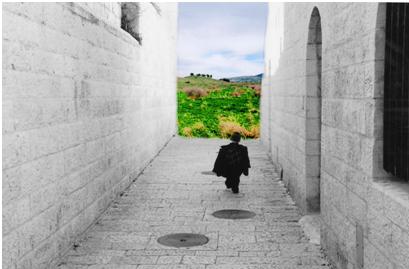
Well, I've completed all of my coursework for the semester, taken my last exam, and I only have a few days left to explore Jerusalem, gather my belongings, and fly to the other Promised Land - the "goldine medina."
In the meantime, it was with bittersweet feelings that I approached this Shabbat, wanting it to be perfect and memorable, but knowing that some of the most beautiful Shabbats of the year were already behind me. Sometimes I find self-reflexivity to be an emotionally painful task - being so aware of the last-ness of the Shabbat, I tried so hard to impress upon myself every detail of it, but knowing that the details fade quickly and that by the end of the day the sharpness of the image of its beginning will already have begun to wane in my mind's eye. It is with this in mind that I write of my final Jerusalem Shabbat, trying to preserve the important bits for just a while longer.
A friend of mine, Rebecca, had made plans with me for Friday to cook together and invite friends to my apartment. What started as a small gathering grew into the largest assembly of assorted individuals I've hosted in our apartment - the 15 bodies took up every seat that could possibly have been squished into the living room.
Knowing that we were expecting the large crowd, I began preparing for their visit as soon as I arrived home from my Hebrew exam. I started with a frenzy of cleaning - sweeping, scrubbing, putting-away, and interspersed these activities with putting sliced, spiced beets in the oven and braiding the challah. My friends Corrinna and Andrew arrived early to drop off a watermelon at the apartment and I enlisted their help in cleaning off plastic chairs, chopping vegetables, and even washing dishes. You know you have good friends when they'll do your dishes for you!
While we were cooking I received a phone call from my friend and neighbor Amy, telling me that at the corner between our apartment buildings, where an organization often leaves used books for passers-by to browse and take, there were stacks and stacks of Yiddish books. Corrinna and I left Andrew to watch after the challah in the oven and we ran down to the book drop-off area. Corinna picked up a copy of Ethan Frome in Hebrew, among other gems, and I found an astonishing wealth of Yiddish texts to choose from. I may not be able to carry all of the books that I took back to the US, but for now I have several Yiddish journals dating from 1943 to 1961, most of them issues of Yiddishe Kultur or Di Tzukunft (the Future) as well as a 1938 copy of David Pinsky's travelogue of a trip to Israel from the summer of 1932 to the sumer of 1936, published in Warsaw, a 1966 copy of Nachum Sutzkever's Personalities and Folk, published in Jerusalem, a 1996 copy of "Human Salad" by Joseph Hayblum, which was published in Israel with the assistance of the Mutlicultural Program of the Department of the Secretary of State of Canada, and a 1986 printing of "Tear and Smile" a collection of poetry and songs by David Shav-Artza, published in Israel. I'm very excited about all of this, though it would take me forever to read even one of these books.
By the time Rebecca arrived at 3:30 pm, two veggie dishes were complete, the challah was in the oven, and the apartment was on the verge of cleanliness. Then the real work began. On a 98 degree afternoon, we kept the oven and stovetop going for hours, our hands never free from work and our feet aching from it. We made guacamole with sliced vegetables, mujedra, oven-roasted potatoes, lentil soup, chocolate cake, apple appricot tart, cole slaw, and more. We rearranged the furniture into a 15-person circle, put out the Shabbat candles and wine, and waited for the guests to arrive.
The dinner was definitely a success - there was plenty of food and a lot of conversation. The guests were an interesting mix between those traveling to Jerusalem for the summer, or just for a quick vacation, and those who are here for a year or more, some older and some younger, some Jewish and some not, and I was surprised how willing people were to get to know new people. I was very sorry, though, to say goodbye to Paola at the end of the night, as I don't think we'll see each other again before we leave. I am so grateful to have had her friendship this year, and I do hope that one day I'll go to Italy to visit her!
The last remaining guests helped me clean a bit, though there's still some cleaning work to do, and pretty late at night. I woke up and dressed for services at Har El. It was a small congregation - a bar mitzvah with a tremendous voice read from the Torah, and I was given an aliyah during which Rabbi Ada blessed me and wished me a safe journey and that I should consider Har El my home in Israel.
In the afternoon, Atar Katz (my neighbor) took me on a tiyyul around Jerusalem, to catch some sights I had not yet seen. He was born in Jerusalem and has lived here is whole life, and his mind is filled with stories of Jerusalem's history. As we drived around the city he told me story after story (this was my real Hebrew final exam!) of ancient history, the building of the state, of the people and events that happened in this city with its layers and layers of pasts and cultures. We drove up to Mt. Scopus, driving on the road where the 1948 Mt. Scopus bus attack occurred, and stopped at an overlook to see East Jerusalem and the desert beyond, reaching toward the Dead Sea. Mr. Katz gave me a geography lesson, using the knuckles of his hand to represent the grooves of the valleys and mountains of Jerusalem. According to Mr. Katz, Mt. Scopus gets its name because it was the mountain from which the priests used to watch the sky to determine if the stars were out and the holiday had begun, lighting a bonfire that would signal to other watchmen to light their bonfires on other mountains so the word could travel that it was time for the holdiay to begin. We then drove to the Mt. of Olives, where 150,000 Jewish bodies lie in graves, awaiting the coming of the Messiah and the resurrection of the Jews. Ancient and modern tombstones alike form the necropolis. Mr. Katz told me a story that when the Messiah comes, there will be two bridges from the Mt. of Olives to the Temple Mount - one made out of iron and the other out of paper. Those who lack faith will take the safer-looking iron bridge, and it will break and they will fall, returning to death. The faithful will take the paper bridge, which will lead them to the Temple Mount. Mr. Katz pointed out to me the Seven Arches Hotel (formerly the Intercontinental Hotel) which, he says, we can see from our balcony. The hotel was constructed during Jordanian rule over East Jerusalem along a road that he built in violation of the 1949 Armistice agreement accross the cemetary, destroying thousands of graves, some dating back to the First Temple period.
We drove down to the bottom of the Mt. of Olives (the Kidron Valley) to see Absolom's Pillar, traditionally believed to be the tomb of Absalom, son of King David. It's archetectural style shows Greek influence, and it is now believed that it may have been the tomb of Temple priest Zachariah, the father of John the Baptist.
We drove past the Dung Gate and through the city to Talpiyot, a neighborhood in southeast Jerusalem. Mr. Katz pointed out Machane Allenby, the former British army camp, and told me stories of the British conquest of Jerusalem. He also showed me the former home of the British High Commissioner to Jerusalem, now the headquarters of the UN in Jerusalem.
Mr. Katz and I walked through a park to see the remains of a Herodian aqueduct, where a hole showing the ancient ducts is situated on a mosaic map showing its ancient route.
It was a whirlwind tour of about two and a half hours, after which I took a long nap, and woke in time to write this post before going to play some board games with friends who leave Jerusalem tomorrow, heading home to the US.
Showing posts with label Shabbat. Show all posts
Showing posts with label Shabbat. Show all posts
Saturday, June 27, 2009

Thursday, April 16, 2009
FSU Journal Day 4
Day 4
In the morning after breakfast Daniel and I planned for the Kabbalat Shabbat service we would be leading in the evening and took some time to rest. At 1:00 PM we met Mattvey, the youth group coordinator, and Emma, and walked with them to a restaurant for lunch. Mattvey is a chef – he graduated from a two year cooking degree program and works as a chef though his hobby is working with computers. With Emma’s help, we talked to Mattvey for a long time about a number of different subjects – it started off as a light conversation about cooking, life, movies, etc., but eventually became a very serious and informative talk. We learned that there is a lot of tension between Chabad and the progressive community. This is something we had learned about Chabad in the FSU generally – ((incidentally if you want to read a good summary of contemporary Jewish culture in Moscow there is a terrifically useful chapter in it in David Shneer and Caryn Aviv’s work New Jews: The End of the Jewish Diaspora)) Matvey told us that Chabad claims it has the only legitimate form of Judaism and it does so in a noninclusive way – the Chabad Rabbi sad that a Jew married to a non-Jew is as toxic as a person with AIDS. 80% of the Jewish community in Lipetsk is intermarried and the progressive community welcomes non-Jewish family and friends as members of the community. Chabad has more money, government recognition, and international clout, while the progressive community here is more or less on its own. Chabad meets in a beautiful new synagogue and the progressive community in a small room in an office building, though the Chabad community is only a few years old and the progressive community was founded fifteen years ago.
We asked how much Jewish history the community knows and found that they know very little, and that the Holocaust is barely taught in public school. Certainly the Jews here are more aware of Holocaust history than are their non-Jewish counterparts, but that knowledge seems limited, and knowledge of Jewish history outside of the Holocaust is all but nonexistent.
Daniel and Mattvey talked at length about whether one needs to follow commandments to be a Jew. Mattvey argued against the Chabad model and Daniel mostly agreed with him that Jew should not feel obliged to follow all of the commandments in order to consider themselves Jewish. Moreover, he encouraged Matvey not to think of himself as practicing Judaism as defined by Orthodoxy incorrectly, but instead to think of himself as practicing progressive Judaism correctly.
We asked Mattvey if he wants to stay in Lipetsk or move away and he said he wants to stay – he can have a good job and a good life here. He told us that people are always thinking that life is bad in Lipetsk and would be better in Israel but Mattvey thinks that life here is good - he feels connected to the Jewish community here and has economic opportunities as a chef that might not be available to him elsewhere. He also feels connected to Jews around the world because he has family and friends in Israel, France, England, Belarus, and Ukraine. He has done training as a youth group leader and has gone to Jewish camps, so he has connections with Jews throughout Russia and the FSU. But ultimately Lipetsk is his home and where he wants to be.
After lunch we took a bus to a run down office building, and in a small room about the size of the living room in our Jerusalem apartment, we found the home of the progressive community. Apparently they used to be in a larger space but recently downsized because of the economic crisis.
We were visiting for a youth group meeting – about six youth groupers sat round a table and we were to answer their questions about Judaism, American Jewish life, and ourselves. They started by asking about youth group in America, and we answered their questions about its structure and size. Very quickly, though, Olga pushed the conversation toward how these Jews learned that they were Jewish (and when) and what this means for them. The stories were incredible and really beyond my expectations. Several of these teenagers had spent most of their childhoods not knowing that they were Jews. One boy, Zachar, learned that he was Jewish two years ago. His grandmother lives in Israel and when he was growing up his parents told him that his grandmother was in Australia. One day two years ago Zachar’s parents were talking about Israel and Zachar asked why they were talking about this subject. They revealed to him that his grandmother was actually in Israel and that the family was Jewish. He didn’t get involved in the Jewish community right away, but when he learned about MASA, Naaleh, and other such programs he went to Olga to ask her to be a reference for him, so that he can leave Lipetsk for Israel. As he was preparing by learning Hebrew, he realized that the Jews were just normal people and that he liked them, and he became involved with the youth group. Almost everyone in the room had similar stories – they learned that they were Jews recently and got involved in order to go on an Israel program. If it weren’t for these programs they wouldn’t have pursued their Jewish identities at all, but now they are active and learning and leading their lives as Jews. Only one of the students, Katya, had been involved in the Jewish community since she was little. She said that her mother has always had Jewish friends, but she doesn’t think she is really Jewish. She’s been a member of the community since she was seven and it is a major part of her life. When she was little she used to play Jewish songs on the keyboard for the community.
We asked if everyone wants to leave the community and Olga told us that most young people do not want to stay in Russia. I asked if this was sad for the community and she said that the goal of the community is to teach and foster Judaism and as long as the kids stay Jewish she considers it a success wherever they are. Many go to Israel, but a large percent do stay in Russia. The reasons that they want to go to Israel became progressively more clear to us as the conversation wore on. The Lipetsk economy is not good, and Israel offers a way out. Also the education in Israel is better. We gave them opportunities to ask us questions and Zachar asked Daniel how long he had been in Israel. “Did you serve in the US army then?” he asked. Mattvey explained to Zachar trhat in the US military service is not required and Zachar explained to us that many boys try to get to Israel because the conditions in the Israeli are much better than the Russian army, so they escape the Russian army and go into the Israeli one. We learned that Russian young men are drafted into the Russian army which has extreme hazing practices including beating, rapes, and death. Insufficient supplies, poor pay, and absence of proper training are only a few of the problems that make the Russian army such a terrifying possibility for Zachar and boys like him. Many young Russians escape from the draft through bribery and influence. They go to college to postpone the draft and after college they run away or pay money so they won’t have to go. Those who do go to the army are already disadvantaged – they don’t have the money for bribery. So it’s easy to understand why making aliyah seems like an attractive option.
Daniel asked what the students like about being Jewish and they said it has to do with the sense of community. People here would do anything for each other and are a family. They also said that being Jewish is interesting. Russians are very invested in conformity, but in the Jewish community it is possible to ask questions, talk about interesting and unusual subjects and learn new things. This makes Jews more interesting to these youths than are other people.
The youth group meeting was a surprising and really incredible conversation in which we began to understand what being Jewish means here. We later learned that other groups did not face similar stories of people discovering their Jewishness and wanting to make aliyah, and these stories might be more prevalent in Lipetsk than elsewhere – it’s hard to tell. Olga learned that she was Jewish fifteen years ago, and knew nothing about what that meant. She founded the Jewish community originally just so that Jewish people could meet each other and see other Jews. But the community came to realize that nothing would really happen for them if they couldn’t teach the children. Then Olga began to study Judaism. She has a degree in social work, but her office is lined with other certificates as well. She graduated from the Melton Institute of Jewish Education at Hebrew University, took part in a JCC leadership training institute in Vilna, wrote two award winning programs for her community, and much more. Single-handedly she teaches whoever wants to know what it means to be Jewish and sends the young people on Israel trips so that they can learn more. She is strong and even a bit bossy but is also incredibly talented and knowledgeable – she is a guitar player and songwriter, she is a leader of prayer, a teacher, and administrator, and a fundraiser. And she is a much loved matriarch who has built the community all by herself.
The kids thanked us warmly for our visit but I don’t think they learned nearly as much from us as we did from them – I will be thinking long and hard about them and what it means for them to be Jewish in Lipetsk.
After the youth group meeting, we had a few minutes to prepare a bit for Kabbalat Shabbat services. In the meantime, community members started coming in casually, bearing bowls of food, looking at pictures from Pesach on Olga’s older-looking computer, talking, and laughing. They pushed the tables to the side and set up rows of chairs facing an ark in which a Torah, donated by a congregation in Brooklyn, NY, rests.
Daniel, Emma, and I sat in front and before we began the service we introduced ourselves in more detail than the previous evening and everyone asked a lot of questions – how long are we in Israel, where are we from, what do we do, etc. They were interested that I study Yiddish alongside English literature at university as those things seemed drastically different to them. They asked if my family speaks Hebrew or Yiddish and where I learned the languages.
We began the service. Olga usually leads the services each week and so they know some but not all of the tunes and prayers but they were eager to participate and to sing along where they could. I led most of the music, and Daniel gave a short drash (translated by Emma) about the Torah portion and the congregation listened carefully, nodding their heads to confirm their understanding. After services, as we folded our talitot, the congregation pulled out the tables and chairs and laid the table with food they had brought – salads, fish, vegetables, a latke-like patty made out of matzoh, etc. We sat down to partake of the feast.
We sat at one end of the table and Olga sat at the head. Across the table she called to Emma “What do they do on Shabbat? Do they have food at synagogue?” and the conversation proceeded – questions from Olga and our responses, with comments from around the table and frequent urges for Emma to take a rest and eat and let another English speaker translate a bit. The conversation quickly moved from questions about our Shabbat to questions about our families – are our brothers and sisters all Jewish? Are they Chabad or Reform? This led into a heated conversation about Chabad, which is constantly insulting the community and challenging their sense of authenticity. Olga often hears complaints about Chabad from her community members but she tries to smooth things over because she wants the Jewish community to be able to present a united front. It’s hard enough to be Jewish in Lipetsk without internal problems – Russians do not like people who are different. Chabad has official relationshops with the government, has a whole beautiful building, but not enough congregants to fill it, and everyone we spoke to seems to feel that the community would be better off with no rabbi than with a Chabad rabbi who competes for their members. Of course we did not speak with any members of the Chabad synagogue, who I’m sure have a different opinion. Nevertheless, it is clear that Chabad is imposing its own views about Judaism on a community that is uncomfortable with them.
We paused our conversation a bit in order to do some singing – in Russian with Olga playing the guitar. They sang a song about Jewish eyes which are filled with tears of joy and sadness – you know Jews anywhere because of their eyes. We heard a song about the “rights of Jewish women” which was called “I will marry Jewish.” In it the women say that it is better to find a Jewish man because he will treat them well –he won’t spend his money and time on alcohol, if he is out late it is because he is working, etc. I’m not sure how well a song like this about Jewish superiority would go over in the US but in a country where “Jew” is still somewhat of a slur, I could see why promoting positive self image is so important.
After singing we again became the focus of conversation. They asked us how we were chosen to go to Russia and we explained a bit about the FSU project and how we are a part of a larger group sent throughout the FSU and had requested to go to Russia because Daniel’s family is originally from there. They asked a question about how we were able to pay for the trip during the financial crisis and as Katya translated she said that everyone is always thinking about and worrying about the crisis. I explained our fundraising activity and they seemed please that our communities were so willing to send us to the FSU and to think that it was a worthy project. As the evening wore on, the conversation drifted to Yiddish. They told me that here only a few older people know Yiddish and the language is dying out. They are very sorry that the young people don’t know any Yiddish and the older people have no one to talk to. Not only did they want to talk about my chosen profession, they seemed especially eager to talk to Daniel in his Rabbinical role. People asked him questions as a rabbinical authority – one woman asked when she should commemorate yartzheit for her grandfather who passed away in the Holocaust – she doesn’t know where or when. Someone else had questions about brit milah. Daniel answered all of these questions adeptly and patiently. I took on a cantorial role, I suppose, in that they asked me to sing some songs for them. I sang a few songs in Yiddish that were easy to learn and these seemed to be appreciated and enjoyed. One congregant told me that I should become a professional singer. In fact, the community veritably flooded us with compliments though they insisted that these were not compliments but truths. They told us that we were the first rabbinical students who they felt really communicated why they had come. They appreciated our enthusiasm and they said that they believe that Daniel is a very special, wise person who will be a natural fit as a rabbi. They told us we should consider ourselves to be part of their community – honorary members who are always welcome to return, and gave us a gift of postcards of Liptesk that we can take back with us.
Soon it was time to leave and we hugged and kissed everyone and tore ourselves away from our new friends in order to pack our bags and catch the train to Moscow. In the hotel as we were packing, Daniel and I discussed that we were able to be so successful because of Emma, who made it possible for us to understand and communicate so fluidly.
On the train we stayed up late, playing cards and joking with Emma.
FSU Journal Day 5
Day 5
The train ride was much more pleasant this time, as it was just the three of us and we knew what to expect. We stayed up late playing cards and munching on matzah and cheese. It was past midnight when we settled down and went to bed. I woke up early in the morning to see out the window rows and rows of dimly lit trees hovering majestically over the snow-dusted ground. I watched the scenery go by for a while – a cluster of large, high-ceilinged homes near agricultural fields, and then trees and trees and trees. Finally, I allowed myself to go back to sleep, waking up a few hours later to the music that signifies the ten-minute warning to arrival. We hastily put on our shoes, threw our playing cards and matzah into our backpacks and left the train.
We went straight to the hotel to freshen up a bit and from there to the center for progressive Judaism for Shabbat morning services. On the shared van on the way to the progressive Judaism center, Emma asked Daniel where Passover comes from – whether he thinks the historic roots are economic, cultural, political, etc. Daniel gave her a learned answer (he’s getting very rabbinical these days) and a conversation proceeded about different fasts in different religions and about the symbols that different religions use to remind them of core ideas or beliefs. Without objects, it’s hard to imagine what a religion would be. We talked about the prohibition on graven images and why this might have existed – does seeing a picture of G-d so influence the way we think about G-d that it is hard to imagine G-d any other way than according to the depictions? And is this a bad thing? Emma said that it seemed to her that Christians have more objects and symbols than Jews – they have different kinds of fasts that seem to happen more often, they have icons, pussy willows (what Russians use instead of palms for Palm Sunday), crosses, etc. We reminded her of all the objects, ritual and otherwise, that Jews do have, and how they are used to remind us of Judaism’s ideals, but are also in and of themselves powerful because they create the boundaries between holiday and not-holiday. We know it is Passover because there is matzah and a seder plate- if there was no matzah or seder plate but on one day everyone thought about freedom , would it still be Passover? Anyway, it was an interesting conversation and I mostly made note of it because I thought it was interesting to hear people “ask the rabbi” questions about Judaism and religion and to see how well Daniel responded to the responsibility of being the question-answerer.
Services at the progressive Judaism center were quite nice. About 30 people were in the congregation, but we are told that the number is often much higher and people are probably just a little Jew-ed out after their Passover seders. The progressive community in Moscow boasts two rabbis, Sasha and Leonid, and a cantor. This is particularly impressive as there are only six progressive rabbis serving the whole Former Soviet Union area. The congregation itself is quite knowledgeable – one congregant read the Torah, another did the blessings, and all the Machon students were in the congregation as well. The rabbis called me and Daniel up to the Torah for aliyot, which was very nice. The tunes were familiar and aside from the drash in Russian, it was not unlike attending a Reform service in Israel or the US.
After services were over, we went to the oneg hall, where they served different kinds of fish, caviar, matzah, wine, cheese, and dried fruit. We had a little snack and while we were eating several congregants introduced themselves to us. Some spoke a little Hebrew to us, others spoke English. One man in particular had quite good English and we asked him questions about what Jewish life was like during the Soviet Union. He told us that he always knew that he was Jewish but he never knew what it meant to be Jewish, that is until recently. Our conversation was cut a bit short because he had to run off to the Hebrew class that Leonid was teaching, so Daniel and I went up to the Rabbis’ offices to check our e-mail and rest a bit before our next activity.
Emma, who had gone home for the morning, came to the office to join us and we sat in the kitchen with her to have a cup of tea. People kept coming in and out, chatting with us and preparing for various activities. That night they were hosting a deaf seder with an expected turnout of something like thirty deaf Jews, and that afternoon there was to be a youth group Havdalah service. Leonid and a youth group student came to join us as we joked around. We learned a bit about Emma’s curriculum. For the first year of translation school her major assignments involve memorizing passages from her textbook and reciting them – her marks are based largely on pronunciation. We spent a lot of time making fun of the passages she has to recite – “oh I think it is going to rain, let me fetch my umbrella. I’m glad I remembered to wear my mackintosh today.”
Eventually we left the office to go to the Red Square and visit the State Historical Museum. The museum was opened in 1894 by Tsar Alexander III and its lavish decorations include a ceiling paiting depicting a family tree of the Russian monarchs from Olga of Kiev (890-969) to Alexander III (1845-1894). It charts the history of Russia from ancient tribal beginnings through to the Romanov tsars of the 19th century. All of the exhibits were written in Russian, but Emma guided us through much of it and from whatever knowledge we had of Russian history we were able to decipher some of the rest. I was certainly impressed not only here but throughout Russia at the centrality of Peter the Great in the retelling of Russian History. He seems to be the watershed marker between traditional and European Russia.
When we left the museum we intended to go into St. Basils Cathedral, but found that we were too late. Instead we visited the Kazan Cathedral, and went inside during a service. Inside, the church was filled with people holding pussy willows to be blessed for Palm Sunday. The choir sang solemn hymns as we wandered around the building, glancing at women with their heads covered by scarves lighting candles at the altars of saints. At one point, Emma motioned to us that we should stand against the wall, and several priests walked by in a procession, burning incense as they walked. The Kazan Cathedral was originally erected as a shrine in the early 1630’s to mark the city’s liberation from the Poles during the Time of Troubles. It was destroyed by a fire in 1632 and the Tsar ordered the church to be rebuilt with brick. The church was renovated many times until it is now not known how the church originally appeared. In 1936, when the government was preparing the Red Square as a site for military parades, Stalin ordered that all churches in the Red Square should be destroyed, and the cathedral was demolished. After the fall of the Soviet Union, the Kazan Cathedral was the first church to be completely rebuild after having been destroyed by the Communists. The restoration was completed in 1993, and now church services are conducted in the cathedral regularly.
We went to dinner in a coffee shop and eventually we were met by the progressive Jewish youth group with whom we were going to do Havdalah. We sat and chatted while waiting for the sun to set, and then we took to the streets. The youth group has a program once a month in which they bring students to different landmarks of the Jewish history of Moscow, explain the significance of the place, and then have Havdalah. This week, they went to the place where the Jewish Anti-Fascist Committee held their first rally. There, we read a plaque that told of the committee in Russian, and in Yiddish said the word “gedenk” which means “remember.” The Jewish Antifascist Committee was a Soviet Jewish Organization that operated from 1942 to 1948. Its goal was to call on the Jews of the world, and in particular on American Jewry, to join the struggle against Nazi Germany by supporting Soviet war efforts. The committee was also one of the first institutions to document the atrocities of the Holocaust. It was chaired by Solomon Mikhoels, the popular actopr and director of the Moscow Jewish State Theater. The committee was also considered to be the central representative body of the Jews in the Soviet Union. It had its own newspaper in Yiddish, Eynikeyt (Unity) in which some of the most popular Yiddish writers published. It was dissolved by the Soviet authorities in November 1948 and most of its leaders were executed.
After hearing this sobering story, we walked across the street to a park featuring a giant statue of Freidrich Engels, and stood in a circle for Havdalah. The tune, written by Debbie Friedman, reminded me of how small the world really is. At the end of the Havdalah service, everyone dipped their pinkies into the wine cup and dabbed the wine on their temples. Daniel and I asked Emma what was going on and she was very surprised that we didn’t know. She said it’s a superstition that the wine will grant you luck wherever you place it – if you put it on your temples it will make you smart, if you touch your chest it will bring you much love, if you touch your lips it will make you eloquent, etc. I don’t know where this comes from, but I kind of like it – maybe we should bring it to NFTY or something.
After Havdalah, Emma’s friend invited us back to his apartment for some tea. In all there were seven of us: Emma and her friend, me and Daniel, Leonid and two youth group kids. The friend’s apartment was beautiful – an old building with a painting on the ceiling of the foyer. His dad is a sculptor, and there were photographs of his sculptures on the wall (he does big public monuments). The friend (whose name I don’t remember, sorry) is a very talented photographer, and his art was hanging on the walls as well – they were really terrific. He is now attending an art school, but is thinking about leaving to go into audio production for theater.
Our conversation at the friend’s apartment began with Emma asking me to recount a brief history of Yiddish for her. I thought it was fun that she addressed me with a Yiddish-professor-to-be question, just like she addressed Daniel with rabbi-to-be questions. I explained a bit about the history of Yiddish and she asked whether one might say that Yiddish was more a dialect than a language. This led to a long discussion about the boundaries between dialects and languages: is AAVE a dialect or a language? How about Ukranian? We talked about how people who speak dialects are seen as speaking their language incorrectly, whereas people speaking other languages are seen as speaking their own language correctly – so language is a title of respect. This was a very interesting conversation and everyone was involved in it, commenting on different dialects they know and how different they are from Russian, or how similar, and how people respond to accents that deviate from the normative Moscow Russian. The conversation about language and about Yiddish went on for some time, before we moved to another topic – we asked the students to tell us a bit about how history is thought about in Russia – how do people remember the USSR? They told us that many people are nostalgic for the USSR and hope that it will come back. If you were not a dissident, the USSR promised security that people no longer feel. Also, people tend to remember the good things about the past and forget the bad, which leads them to yearn for a past that was not as perfect as they remember. Obviously Jewish life was not better under the USSR, but apparently some things were better, and we cannot discount that under the USSR there were some stellar accomplishments, and that in contrast to the Russian Empire, the people felt more empowered and in control. Emma’s friend quoted Putin to us, saying, “If you don’t want the USSR to come back, you have no heart, but if you do want the USSR to come back, you have no mind.” People wanting the USSR to come back can also be a problem because many people blame its collapse on the Jews. The government encourages teachers in school not to paint the Soviet Union as something good that they want to return to, and in order to make the USSR seem ‘bad’ they must make the Russian Empire seem, by way of contrast ‘good’ – which causes some problems too. What I found most interesting about this conversation is not only does Russia have no history of democracy, but they aren’t really practicing it today. They have a very low voter turn out and most people just assume that Putin will be their leader and want it that way, as he is seen as strong – one could go as far as to say that they are electing a dictator. A few days later, Jordan asked us if we felt, while we were in Russia, as though the Cold War was still going in – between the visas we needed to get there and the streets named after Lenin, there was something very Cold War-ish about the experience. I am reminded of history classes when we were urged to consider that when historians break time into chunks in order to study it – be it decades or centuries or the reign of a king – the differences between these blocks of time did not emerge suddenly on New Year’s eve of the next time block, but evolved. Maybe Russia is still moving into its next stage, just like 1980’s fashions lingered regrettably long into the 90’s. (OK a bad analogy but you see my point)
Emma asked us whether our experiences in Russia matched our expectations. She told us that she had met another group of Americans, from Atlanta GA, who had unrealistic expectations about Russia and were very surprised. They expected that Russia was very rural and were anticipating seeing bears walking on the streets of Moscow. They thought Russians drink all the time and don’t have access to modern amenities. We told Emma that our experiences weren’t far from our expectations, but we also told her that, not unlike a trip to Israel, we had come to Eastern Europe with the hope and expectation that we would feel some kind of personal connection to the land of our ancestors. And maybe we did, actually, feel that connection. Emma thought this was strange as we aren’t Russian speakers, my family did not come from Russia proper (to the best of my knowledge), and even if our family had come from Moscow itself it would have been generations and generations ago. It didn’t even occur to her that we might have been feeling this nostalgic connection to a Jewish homeland here in Russia, and to me her not thinking about it is as interesting as our thinking about it.
In any case, after tea at the friend’s house we returned to the hotel to sleep in real beds for the night.
Saturday, April 4, 2009
Shira Chadasha
Tonight for services we visited a much-spoken-of shul called Shirah Chadasha. It's run by an Orthodox community who push the bounds of Orthodoxy with regard to gendered restrictions - most notably, women lead the kabbalat Shabbat services.
We met our friends at the front entrance and walked into the building together. When we arrived at the sanctuary Amanda and I went into the women's section and Daniel and Jon into the men's section. Amanda and I were greeted warmly and ushered into seats. All around us were women, some wearing pants but most wearing long skirts and long-sleeved shirts with high necklines. Several of the women were wearing head coverings. The women smiled at one another in greeting, but mostly were otherwise intense in prayer. Unlike in other traditional prayer environments I've experienced, the women were praying audibly, confidently, reading the words and chanting the melodies aloud. Their voices were solid but delicate, and the music of the prayers filled the modest room. The men sat on the other side of the room, on the other side of the mechitza which was a flimsy white chiffon curtain. They seemed like ghosts clouded, obscured, and distant, praying in partnership with the women, like mirror images, like echoes of our words and motions. There was something beautiful in the separation and the sameness, in seeing one another and yet being apart. And the white of the mechitza made the men seem somehow like the Sabbath bride. I found myself feeling strangely attracted to the mechitza, strangely inspired by it, while nevertheless repulsed by the notion of sex-segregated worship.
The music was beautiful. Melody followed melody, each intertwining with improvised harmonies from both sides of the curtain, as though the men and women were reaching accross to one another, defying and celebrating their separation. The beauty of the voices - and they really were quite talented singers -moved me, and though I had come to the services in order to say I had been to this synagogue, in order to experience a new cultural curiosity, and certainly not in order to pray, I found myself praying.
I did not expect to like Shira Chadasha - I was predisposed to think that any place that separates by sex was not a place in which I would comfortably be able to pray, because it is a place that perpetuates social injusitice and inequality. Although my feelings at Shira Chadasha directly contradicted my sense of disapproval of sex-segregated prayer, I am still not convinced that Shira Chadasha is doing enough - often people speak of this synagogue as "so progressive for Orothox", as really unusual, as making great strides. And before I visited I was frustrated with this idea, because they were still separating by sexes, and so they simply weren't doing enough. I felt this way and I still feel this way. And yet...I also really enjoyed services this evening, found them meaningful, perhaps, because of the beauty of coming together through separation, of separating to find one another in sound and voices, because of the eerie, holy sensation of seeing another through a veil, of the transformation of the familiar, of the community created by breaking the whole into halves. And so, I am torn about Shira Chadasha. I disapprove, and I am moved.
Saturday, March 21, 2009
Sabbath joy.
.עונג שבת
Friday-Saturday is the best part of our week here in Israel. Jessica and I always try to do something special on Shabbat, usually with friends. Today, we decided to spend the whole day in the house (like a non-sick sick day!), and it's been delightful so far. Last night, though, was so much more eventful - a real Shabbat experience!
A program at my school has connected me with one of the Israeli rabbinical students, and though it's taken a long time, we finally managed to find a Shabbat to spend together. She lives in Tzur Hadassah, a "sleeper" town most of whose residents work in surrounding cities. Once a month, members of her community travel to an Elwyn community, which cares for Israeli special needs adults. We agreed to travel with my classmates to meet her at Elwyn and then return with them to Tzur Hadassah for services in their small Reform congregation and dinner.
Jessica and I met Leslie and Ari at 3:30 on Friday afternoon to start this journey. Right away, we met Asher, who is a cab driver that Leslie has befriended (and apparently the only cab driver the pair of them has taken to Elwyn that doesn't consistently get lost). Of course he didn't turn the meter on, and a price wasn't discussed until we arrived at our destination. During the time between leaving and arriving, we became acquainted with this rather eccentric Israeli man. He likes singing, Jerusalem, and Leslie. ;-) Although Leslie insisted that we didn't have time, Asher pulled over to buy her some water, and he insisted that next month, he would shave and join Ari and Leslie for their song-leading at Elwyn. He was very friendly and funny, but his flirtation with crossing boundaries was a bit off-putting.
When we arrived at Elwyn, Leslie told us that she had simply met Asher when she really needed a cab once, and he's been a great resource ever since. She's called him to pick friends up from the airport, and he's their standard transportation to Elwyn. She's even met his family as a Shabbat guest. So, he may have been a bit overmuch in some ways, but he seems to be just a jokester and overall, a pleasant fellow.
Waiting for us at Elwyn were Myra (the Israeli HUC student) and another member of the Tzur Hadassah community. They took us inside, and Jessica and I were surprised to be greeted enthusiastically by a room full of special needs adults. As the six of us visitors walked in, several of the residents darted to the door to shake our hands and wish us a Shabbat shalom. We made our way upstairs to the main room, which was apparently more full than usual. As Leslie and Ari set up, Jessica and I stayed by the main entrance to the room, and from there, we greeted residents as they arrived (most in wheelchairs).
Each resident wished us a Shabbat shalom and wanted to know who we were. Many were immediately insistent on hearing our names, and after we told them who they were, they went about their business. It was obvious that today was a very special day - not only was it Shabbat, but it was the Shabbat with the special visitors.
After waiting for everyone to arrive, Myra introduced Shabbat by saying that this was a special week with special guests (including Jessica and myself). We then spent the next half-hour singing Shabbat songs. The residents knew all the songs and sang and danced with enormous smiles. Never have I seen so much unabashed joy in one place - these men and women were openly ecstatic, and Jessica and I couldn't stop from smiling. A few residents near us engaged us in brief conversations and seemed excited to have visitors nearby. Myra invited Jessica and me to lead the Kiddush, so we went into the center of the room for the last five minutes or so. We were surrounded by the joy of these special needs adults, and it was a radiant experience.
Of course, it was also a difficult one. While I had a very positive experience there, I'm sure that continuing to work or volunteer at such a place would be very draining, especially since most of the time is not so specially wonderful as our short Shabbat visit. I don't know what life is like there all of the time, but I can only assume that the ecstasy of our Shabbat visit was fairly special. Still, witnessing the potential happiness that can manifest un-self-consciously on an adults face was an impactful experience, and I'm blessed to have been able to be present for that.
After leaving Elwyn, we rode in Myra's car to Tzur Hadassah. The view was beautiful as we traveled through secondary roads in the Judean Hills. When we arrived, I noticed that people here live in houses (not apartments) and that the community is mostly residential. There are elementary schools but not junior or senior high schools, and I didn't see any businesses or stores. The view was beautiful, though I came to learn that Tzur Hadassah, which is entirely walled-in, is 300 meters from the Green Line - so Shabbat walks are always to the north or west.
The Reform congregation of Tzur Hadassah meets in the Reform preschool trailer (which is part of a collection of preschool trailers). Although the congregation has recently been one of a handful of Reform congregations to receive a building from the government (where such buildings are relatively easy for new Orthodox congregations to attain), many months and thousands of dollars are still required to connect it to electricity and sewage. So, for the time being, Shabbat services are conducted on folding chairs among pictures of bible stories and spring festivals.
The service was "standard Israeli Reform" for the most part. Ari and Leslie led the songs, and the rabbi of the congregation, Ofer Sabath Beit-Halachmi, gave a d'var Torah about contributing to the empty Pesach seder tables of needy members of the Tzur Hadassah community. Although the congregation was small, the service was full, and the several children there (including a young woman who goes to the Army this Wednesday) proved that there is definitely a future for Reform Judaism in the town.
After services, we traveled back to Myra's house for a delicious vegetarian Shabbat dinner. We met her husband, Gilad, as well as Ofer's wife, Rabbi Rachel Sabath Beit-Halachmi, and two visitors from Holland. We met Ofer's and Rachel's daughter Tehillah and Myra's and Gilad's two sons and two daughters. It was a full dinner table, and Jessica and I immensely enjoyed the entire evening. I had a conversation with Myra's oldest daughter, Yael, about school, Progressive Judaism, and the weather in Israel, and I played Ratatouille War with 5-year-old Tehillah. I learned about Jewish life in Holland and Reform life in Tzur Hadassah. Rachel and I had a great conversation wherein I found that she's friends with some of our professors from UVA and is usually a teacher (on maternity leave) at HUC. It was really a very lovely evening, and Jessica and I hope to be able to go back before the end of the year.
Ofer (can't even call him Rabbi Beit-Halachmi because that applies to him and his wife!) drove Jessica and me home, and we heard his perspective on living in cities vs. the country, issues of race in Israel, and the touching story of how he met his wife. And when we got home, it was still just after 10:00, so we had had a full night and could still watch an episode of The West Wing before bed!
Although this was a unique Shabbat experience, it represents the specialness that Shabbat holds in our week during this year in Israel. I've really come to treasure our one day of rest, and I absolutely intend to keep the spirit alive when we move to New York next year.
And speaking of next year, it's really sneaking up on us! Next week, Jessica is joining my class on a Wed-Sat trip to the Negev desert, which I'm really looking forward to. A week and a half after we return, Jessica and I fly to Moscow to participate in the FSU Pesach Project! After Passover break, I have four weeks of class, a week of exams, a weekend of packing, and then I head back to the States. I'm not trying to rush the end of the year by any stretch of the imagination - on the contrary, I'm startled by how quickly it seems like it will be over, and I'm trying to appreciate each day for what it can bring! Still, I'm excited about the summer - I've accepted the position of Community Educator at Genesis, a program run through Brandeis University in Boston. And, of course, I'm looking forward to moving to New York and starting a new adventure.
All in good time, though. For now, I'm going to enjoy the rest of Shabbat ... before celebrating a friend's birthday with Contra Dancing! Shabbat shalom!
Monday, February 16, 2009
My Vacation, so far...
Being on vacation has allowed me to spend time on all manner of occupations, interesting and boring. I've spent hours listening to poetry at poetryfoundation.org, reading about kabbalah, klezmer, and other things that don't start with k, cleaning the apartment in anticipation of my parents' arrival, etc, etc, etc.
On Friday, I made good use of my free time by accompanying my friends Jessica and Nikki (both Rabbinical students) to Tel Aviv, where they wanted to visit a crafts market and look for talitot. The weather was gorgeous, and we took our time strolling among the hair ties, gadgets, hand-knit finger puppets, and Judaica before we visited an artist who does exquisite hand-painted silk table runners, challah covers, and talitot. Jessica and Nikki each ordered a custom designed tallit that I'm sure will be absolutely stunning. After lunch, we went for a stroll on the beach. Amazing. I ended the day with a table full of Shabbat dinner guests, where the food was flavorful and the conversation diverse, and together with these friends I watched evening stretch into night.

I'm not much of a believer in Valentines Day - it reminds me of high school when how loved you were was judged by the number of times the student council interrupted your classes to bring you balloons with heart shaped notes attached, or how many bouquets of flowers you hauled around with you from homeroom to gym to math class. But Daniel and I managed a magnificent Valentines Day, conveniently timed to coincide with Shabbat. We went to services, played several rounds of Spit (Daniel, of course, was the winner), ate baked apples, drew funny creatures with crayons, and spelled "Happy Valentines Day" out while playing hangman. We spent the afternoon getting our pictures taken by a photographer friend - it was terrific fun walking around the city posing in front of walls, bushes, and graffiti. We've only seen a few of the end products, but they are quite lovely.


We arrived home in just enough time to call our families and wish them happy V-days before we went out to dinner with friends and invited them back to our apartment for Settlers of Catan. My evening ended with a phone call to a dear friend in America, and I crawled into bed long after Daniel was already sound asleep. All of this makes me rethink my dislike for a day set aside to remind us how much love we are so blessed to enjoy - wholly, unabashedly, and (unlike the high school memories above) uncompetitively.

Yesterday I joined Daniel's class on a history-centered field trip to Tzippori. Tzippori, also known by the Greek Sepphoris, is about an hour and a half away from Jerusalem, is in the central Galilee region. I am excited to tell you all about it but please bear with me as I don't remember everything and this is, after all, a description of Daniel's history class and not mine, so my knowledge of the time period is quite lacking.
A brief history: The town, now mostly ruins, dates back to the Hellenistic era, and was the administrative capital of the Galilee region under the Roman Empire in the mid-first century BCE. Earlier names for the city include Eirnopolis (city of peace) and Diocaesarea (The Emperor is G-d). By the second century, Tzippori (Like a bird - probably because it is at the top of a hill) was a center of Jewish life. The Sanhedrin (legal body) headed by Rabbi Yehuda HaNasi was located in Tzippori at the beginning of the third century, during which time Jews made up a majority of the population. A Roman pagan population existed alongside the Jewish population of Tzippori, and because of this Tzippori is often used in the Talmud when examples are needed of the interaction between Jews and non-Jews in the public sphere. In 363 Tzippori was destroyed by an earthquake, but it was rebuild soon thereafter. Under Byzantine rule, the Christain community of Tzippori grew, and under Arab rule, the city declined in importance. Arab and Islamic dynasties continued to control the city, with a brief interlude during the Crusades, up until its conquest by Israel in the war of 1948. Throughout this period of time, the city was known by the Arabicized name of the Greek original: Saffuriya. During the 1948 war, Israel captured Tzippori and most settlers fled toward Lebanon. Those who remained or returned from refugee camps were later expelled, and many settled in nearby Nazareth. In 1949 immigrants from Morocco and Tunisia, later joined by Rumanian immigrants, formed a moshav at Tzippori.

Our first stop in Tzippori was the acropolis, which had been the center of town - the marketplace. From there, we walked to the theater, where we discussed the character of theater and how it is represented in rabbinic sources. Theater in the late Roman period in Tzippori was not a presentation of the classics: Sophocles, Aristophones, etc., but was instead a place where accessible commentaries on life in Tzippori were staged: largely mimes and satires. This allowed for an airing of tensions and in particular a representation of stereotypes and discomforts with Jewish practices, particularly as theatergoers were more often Roman than Jewish. Aphitheaters, such as the Coloseum in Rome or the performance space at Caesarea were the site of more large-scale and much more violent activities: here the gladiators would fight large animals or one another for their lives. The Talmud views this as morally repugnant, but nevertheless permits Jews to go to the amphitheaters. Famously, when the gladiators faught, the emporer would signal whether the gladiator would be allowed to live or die, and he would make that assessment based on the cheers of the crowd. Thus, a Jew was allowed to go to the amphitheater in order that, by his cheers, he might be able to save a life. In addition, a Jew could go to the amphitheater to witness the death of another Jew, in order that his wife would not be bound in her marraige and would be able to remarry.

We visited a Roman villa which contains a beautiful mosaic floor, dating from the 3rd century and depicting Roman cults. In one part of the frame is the face of a woman who has been dubbed the "Mona Lisa of the Galilee." The seats would have been arranged in a u-shape around the mosaic, and people would have eaten, drank, and reclined in front of the mosaic which pictures Dionysus, Pan, and other figures drinking. Following the Roman villa, we visited the site of another mosaic, located in a building that was erected at the beginning of the 5th century over the ruins of buildings from the Roman period and was in use until the end of the Byzantine period. Inside the building is an almost-intact mosaic depiction of celebration for the rise of the water level of the Nile river. Although Egypt was far away from Tzipori, the Nile, a constant source of water for a desert nation, was legendary as a symbol of wealth, prosperity, and plenty. Also in the building are mosaic depictions of a variety of hunting scenes, including one of Amazon women hunting.


It was at this point that we broke into partners for a text study (I studied with Daniel). We studied the following text, found in the Talmud in Avodah Zarah 16b,17a:
The rabbis have taught: When Rabbi Eleazor was about to be imprisoned on account of sectarianism, he was brought to the [Roman] court to be tried. The judge said to him, "Does a man of your age busy yourself with such things?" He answered, "The j/Judge is just towards me." The judge thought that Eleazor was speaking of him [the judge]; but he thought upon his Father in heaven. Then the judge said to him, "Since you think I am just, then you are acquitted." Now when Eleazor came home his disciples presented themselves to him to console him, but he would not be consoled. Then Rabbi Akiva said to him, "Permit me to tell you something of what you have taught me." He answered, "Say on." Then said Rabbi Akiva, "Perchance you have once given an ear to heresy, which pleased you, and for that account you have been arrested for heresy." Eleazor replied, "Akiva, you have reminded me! I was once walking in the upper streets of Sepphoris; there I met with one of the disciples of Jesus the Nazarene, Jacob of Kfar Sechanya, who said to me, 'It is found in your Law (Duet. 23:19), Thou shalt not bring the hire of a whore. . . into the house of. . . thy God. What may be done with it? May a latrine for the High Priest be built out of such gifts?' And I answered him nothing. He said to me, 'Thus has Jesus the Nazarene taught me, For the hire of a whore has she gathered them, and unto the hire of a harlot they shall return.' (Micah 1:7) From the place of filth they come, and unto the place of filth they shall go.' This explanation pleased me, and on this account I have been arrested for heresy, since I transgressed the scripture, Remove your way far from her (i.e., heresy). (Proverbs 5:8)
What we saw as happening here was that Rabbi Eliezar asked his followers what he could have done to displease G-d such that G-d would allow him to have been accused of sectarianism. Rabbi Akiva answers him that perhaps he had once been pleased by an interpretation that came from a non-Jewish source, and this explains his arrest, which Rabbi Eliezar confirms to be the case. Thus, even appreciating and enjoying the interpretations of a non-Jewish source, whether one practices them or not, is enough of a problem for G-d to allow Rabbi Eliezar to be arrested. Moreover, the interpretation that Rabbi Eliezar enjoys parallels his own story: according to Jesus, money earned through prostitution can be used to build the latrine of the high priest, because it comes from filth and so it can be used, if in a demeaning way. Although the source of the money is tainted, the end product is not tainted. Rabbi Eliezar comes to realize that if the source of something (an interpretation, money, etc) is improper (whether by prostitution or by sectarianism), the ending result (the interpretation, the latrine, etc) cannot be good, even if the same interpretation or latrine could have been produced in the exact same way by a proper source. The source of things matters. This story shows the extent to which the Rabbis were afraid of neighboring cultures, in part because they were so similar to one another - both drawing from the same sources and interpreting them in similar ways - that it was hard to maintain boundaries and not to be influenced by the other. In this sense, although Tsippori was a fairly diverse society, home to Romans, Christians, and Jews, the Rabbis were very concerned about the idea that their followers could value the intellectual products of other cultures, and in this passage they solidify Rabbinic authority by declaring that even if the Rabbis and the Christians were to arrive at the same idea, nevertheless adopting the idea from a Christian source would be inappropriate. We had to assume that the Rabbis would only be so fearful if this kind of exchange of ideas between Jews and non-Jews was actually happening, and often.
Our final stop in Tzippori was a synagogue. It is believed that there were once about 18 synagogues in Tzippori, but only one has thus far been excavated. It is a long, narrow building measuring 8x21 meters, and, curiously, not directed toward Jerusalem. We spent some time studying the mosaic on the floor of the synagogue, which contains depictions of the binding of Isaac, lions, Temple objects, and at the center a Zodiac wheel surrounded by representations of the four seasons. This is an interesting juxtaposition of traditional Jewish and Roman symbols, and was a fitting end to our discussion about Jewish fears about and practices of incorporating non-Jewish ideas into their lives and worldviews. We prayed mincha together in the synagogue before returning to the bus to head back to Jerusalem.

On the way to Jerusalem we stopped in Beit Shemesh, a small city just outside Jerusalem, where we had dinner at a terrific restaurant called Tavlin (Spice). It's a vegetarian restaurant with flavorful food made with locally grown spices. Adjacent to the restaurant is a giant spice store with every type and combination of spice imaginable. Daniel and I bought two kinds of granola, two blends of spices for rice, and one blend of spices for soup. We are very excited to get cooking!

In a few days Mom and Dad will be here and I can't wait! I'm sure I'll be writing about my adventures with them soon.
In the meantime, for those who don't know, my exciting news is that I have been accepted to the Jewish Theological Seminary's PhD program in Jewish Literature. I'm still waiting to hear from other schols before I decide if this is where I want to go, but I am terrifically excited and relieved to know that there's a school out there who is willing to admit me.
Saturday, January 17, 2009
A Lovely Shabbat in the Midst of Hard Times
Earlier in the week I was feeling pretty lonely without Daniel here, but things are picking up, and people have been incredibly generous and nice in spending time with me. Last night after services at the synagogue around the corner from our apartment, I went to the home of an HUC couple for dinner and we chatted well into the night. This morning I went to services and the cantor invited me to his home for lunch, since he saw that I was alone. I had a lovely afternoon with the cantor and his wife, his parents, a lovely woman from the synagogue, and the cantor's bright and energetic toddler. The cantor made aliyah several years ago, and his family is all from the New York/ New Jersey area, so it was so warm and wonderful to hear the familiar accents. The cantor's wife is from Northern Virginia, and so I was able to chat about both of my homelands at one table! It was very nice.
The cantor asked me to sing in the synagogue choir for the commemoration of the birthday of the synagogue, so I'm going to be practicing for that. It's so nice that people are so eager to make me feel as though I belong. I really love this synagogue and in many ways it reminds me of CBI in Charlottesville - a small close knit community with a lot of things happening, people committed to their Judaism and to one another... If you're ever in Jerusalem, you should check out Har El. http://www.kbyonline.org/har-el/
---
Over the course of this Shabbat I've finally been able to understand a little bit about what it means that this country is at war. A few days ago an air raid siren went off in Jerusalem by accident while I was in class at Hebrew University, and the teacher told us that she was sure there was nothing to worry about. Class went on as usual and I didn't think much of it - I assumed that it had really been a police siren and I had been mistaking it for something more serious. However, last night at services during her sermon the rabbi spoke about hearing the siren, and trying to get all of the preschoolers out of the building and into the nearby bomb shelter (I later overheard a conversation where the cantor said that they should build a bomb shelter in the basement of the shul because if there was an emergency there's no way that they could get all of the kids to safety on time as things are). She talked about how scared the kids were, and how hard it was to see them so scared, and spoke of how this was only a taste of what children are experiencing in the south - on both sides of the conflict. The ferverency of the prayers for peace this week were almost palpable and when we prayed for the safety of the soldiers in the army, at least five pairs of parents and grandparents mentioned their loved ones who are in Gaza by name before we recited the prayer. Until now I had not really sensed how the conflict was affecting people here, as it is not disrupting the daily flow of life. But what must it be for so many people to go on with their lives knowing that their children or grandchildren are fighting not far away? On the other hand, last night at dinner I was speaking to some friends about the conflict and we remarked on how few Israeli casualties have resulted from this conflict as compared to Paelstinian casualties... Some say that Israel was right to start the conflict, but that now it has gone too far. Some say it should never have happened in the first place. Some say that it has been very successful so far and that when civilians are being used as human shields, perhaps it is moral to kill them in order to execute the aims of the war. I don't know what to think... I just keep reading the news and hoping that a lasting peace will come, and soon.
Tuesday, December 23, 2008
Observe and remember.
.שמור וזכור
[Originally written for my HUC blog but appearing here first!]
[Also published on the Reform Movement's blog!]
Chag urim sameach - happy Festival of Lights!
For the past two months, four classmates and I have been participating in Rav Siach, an interdenominational discussion group for rabbinical students through a pluralistic education center in Jerusalem. We meet every Tuesday night for two and a half hours, and we discuss and debate issues like commandedness, the role of the rabbi, and denominational distinctions. There are about a dozen participants with three facilitators, and participants come from Reform, Conservative, Reconstructionist, “orthodox,” and non-denominational backgrounds.
One of the most intense components of Rav Siach has been our recent Shabbaton, which began when we departed from Jerusalem at 7:15 am on Friday morning for the Arbel. The Arbel is a plateau overlooking Lake Kinneret, Sfat, Tiberias, and the coastal plain. From so high up, one can see for miles in any direction, and the views were simply stunning.

Rav Siach participants at the Arbel.
The wife of one of our facilitators is a tour guide in the Arbel, and she led us through paths down the side of the Arbel and around the face of the cliff. We rested in the abandoned caves that had been inhabited by the last remnants of the Hasmonean Dynasty that had gained control of the land of Israel following the events commemorated by Hanukkah, and we read the historical account of their eventual defeat in these very hills. Afterward, we climbed back up the cliff, gripping iron handholds and stealing final glimpses of the plains and hills laid out before us. When we reached the top, we ate our packed lunches and headed to the hostel/conference center where we’d be spending the night.
The actual hours of Shabbat were fascinating on many levels. First of all, there were a number of interesting lessons offered by our peers. Some of the topics included a comparison of the parsha with a selection from Homer’s Odyssey, Reform Responsa (religious/legal decisions in the Reform movement), and the recent ruling in the Conservative movement to allow for the ordination of openly gay rabbis. We walked on Saturday afternoon to the Kinneret Cemetery, where several influential figures in early Israeli history, including the poet Rachel, the songwriter Naomi Shemer, and the Zionist labor leader Berl Katznelson are buried. And, of course, the food was plentiful and terrific!
Two particular events especially defined the scope and depth of the Shabbaton for me. The first occurred on Friday night, when we walked to our assigned room to pray together. Upon arrival, we discovered that the light was off, and to turn it on would be a violation of the rules of Shabbat in the eyes of our observant participants. As this value isn’t part of my own Shabbat practice, I thought I could fix the situation by simply turning on the light in the room. I knew that it was unacceptable to ask someone to turn a light on for you, so I quickly walked to the room and flipped the switch on without saying a word. What followed was a wholly unique experience.
Immediately, the group had transformed. Everyone was in shock. What had I done? Although I didn’t know this at the time, it’s additionally not allowed for one who observes strict laws of Shabbat to make use of the result of a fellow Jew’s breaking those laws. In other words, though I had tried to make the room suitable for our use, I had actually made it entirely unkosher.
I’ve come head-to-head with halacha before, but this was the first time that I had really affected people that I cared about. Words were exchanged, apologies were made, and discussion ensued. This certainly serves of an example of the principle that being told something doesn’t make up for experiencing it firsthand. Never before had I felt so much access to the world of halacha as when I entered that world and shattered it for others. It was a painful lesson but an important one, and certainly the most important to me over the course of the Shabbaton.
On the other side of the spectrum, the spiritual high for me came on Shabbat morning. Our non-denominational rabbinical student led us in meditative morning blessings, and the combination of singing and silence launched me into a spiritual experience. While our voices had been in debate and discussion, not until this moment were they in harmony. I felt our small community coalesce into a praying body, and I was proud and delighted to be a part of it.
In my eyes, the Shabbaton was a terrific success and showed that pluralistic Shabbat experiences may not be easy but they can absolutely be transformative. Many of the Rav Siach participants felt a renewed interest in such programs, and I believe that we’re all better equipped to lead and learn in such environments in the future. While I’m disappointed that our official group will be coming to a close in a few weeks, I look forward to continuing my relationship with these future colleagues and continuing to learn from them for years to come.
Saturday, November 22, 2008
Christmas Shopping and other Jerusalem Tales
It was a brisk Shabbes mid-morning when I traipsed down to the Jaffa gate to meet Corinna, Debbie, Gavin, and Paola, my friends from Hebrew University, to do some Christmas shopping in the Arab quarter of the Old City. We first found a restaurant on a side street that was blaring American oldies music, and sat down to a not-very-good meal, joked with the waitor, and swapped stories. We then proceeded through the narrow stone streets to look at icons, Christmas cards, plants, and candles. We wandered into a store selling festive table runners and were greeted by a giant saxaphone playing plastic Santa Claus, with which we of course posed for photos. The very nice lady at the store suggested that we go to the bazaar being held in a nearby clinic, the proceeds of which are going to a charity to give healthcare and food to poor Arab families. The women at the bazaar were very pleased to see us (especially Paola, who speaks Arabic), and we were excited to be there as they were selling familiar Christmas ornaments; wreaths, ribbons, snowmen printed on paper napkins, etc. They were also selling non-Christmas items, so I picked up some zaatar and a plastic plant. We each sampled some excellent quince jam, and made quite a few purchases. We continued on our way through stall after stall of brightly colored clothing, religious souvenirs of all sorts, fruit, vegetable, and bread vendors, etc. Eventually, Debbie and Paola parted from us, and we went on to visit Matteo, our friend from ulpan who is, as you may recall from previous posts, a Francescan friar. (Have I written about him before?)
At the front gate to the Church of the Flagellation, we asked the gatekeeper to call in and tell Matteo that his friends were here to visit. We were shown in to a room marked "private," where we sat on old couches in a somewhat stark, stone parlor, to wait for Matteo to meet us. He was very pleased to see us, and we visited for a very long time. He took us inside to what I suppose is the friars' living room - a large room full of sofas and chairs, with today's newspapers sprawled accross the coffee tables, and religious parephenalia behind glass cases on the walls. While Matteo went to fetch us some soda, Gavin peeked through a glass case to gawk at an illuminated manuscript, and I stood in front of a case containing a Torah and a scroll in Phoenician characters. When Matteo returned we sat and chatted for a while, mostly about our lives, our families, etc. After quite a while in that room, we went up to the roof to enjoy the terrific view of the old city and really all of Jerusalem. We could see Hebrew University, the Brigham Young campus, countless churches, mosques, and synagogues, and in the foreground we could see the Dome of the Rock quite closeby. On the roof we discussed religion, and when Matteo saw one of his instructors below, he called down and introduced us by saying that we were having a meeting of the religions: Jewish, Baptist, and Catholic. It was a bit chilly on the roof, so we went downstairs where Matteo showed us the classroom where he studies (he is writing his dissertation on the meaning of the word "fulfilled" in the Gospel According to Matthew when Jesus says that he has not come to negate the commandments of the Torah, but to fulfill them. Before we left, Matteo showed us the chapels at the Church (the parts that are open to the public), saying that he didn't want us to have come to the Church of the Flagellation without seeing what there is to see there. He explained to us that the place where the church is built is now known not to have been the historical site of the flagellation, as the stones have Roman games carved in to them that date to after 135 CE. The chapels were nevertheless quite interesting, and the stained glass windows fabulous. Matteo says that the preists celebrate mass twice a day, morning and evening, and he pointed to the window of a smaller chapel where the priests can go to celebrate mass if for some reason they missed the early morning mass (6:30 AM). We left with warm regards and promises of another visit soon.
It was a lovely Shabbat - how was yours?
Monday, October 13, 2008
Rolling around Jerusalem.
.גילגול מסביב לירשלים
First, an authorial note. Jessica and Daniel will be co-authoring this post for maximum recollection and enjoyment.
Although a number of things have happened to us in the past few days including a dinner with friends, a lovely walk to the shuk to see all of the lulav vendors, and classes (Daniel) and studying/working on grad school applications (Jessica), what we really wanted to write about was this amazing adventure we had thanks to our friendly and generous across the hall neighbors. You may recall that we invited Mr. and Mrs. Katz over for dinner several weeks ago, and we were delighted that they accepted our invitation. A couple weeks ago, they invited us on a tiyul (trip) and asked us where we wanted to go. We put the ball back in their court, telling them that we'd be excited to see anything they wanted us to see. So, this past Friday afternoon, Mr. Katz invited us over to discuss the plan he had created for us.
We traversed the long distance between our apartments and were warmly welcomed into their beautiful living room, decorated in deep reds, with dark wooden furniture and many paintings on the wall that we later learned were created by Mrs. Katz's late brother. To explain where we would be traveling, Mr. Katz picked up his Tanach (Bible) and asked us, "Do you know the Book of Samuel?" He then proceeded to recount some stories from Samuel's life, Tanach in hand, in order to set the stage for our upcoming trip. Daniel couldn't believe it: This entirely secular man was detailing "history" from the bible and preparing us to explore the sites he described! He told us about the Philistines' capture of the ark, the birth and passing of Samuel, and a few tales about Samson. He concluded by saying that we'd be exploring some of the locations mentioned in these stories along with, hopefully, some of their children and grandchildren. "We'll be ready by 10:00," we assured them and went back to our apartment, excited about the next day's adventures.
Although Jessica suspected that the actual time of departure was to be 9:30, Daniel assured her that she was absolutely mistaken, and at 9:30, when Mr. Katz rang the doorbell, Jessica ran to the door in her pajamas and embarassedly asked for ten minutes to get ready. Daniel and Jessica hurriedly threw on some clothes, grabbed a camera, and knocked on the Katzes' door. When Mr. Katz opened the door, he gave what can only be described as a grandfatherly chuckle before ushering us into the elevator to descend to our journey.
Apparently, Mr. Katz had already parked the car out front and loaded it with our lunch supplies (stay tuned...). The four of us started driving, and shortly we were outside of the city. We chatted, hesitantly at first, in Hebrew about a variety of topics, and this banter became freer as the trip progressed and became one of the highlights of the entire day. Before long, Mr. Katz pointed to an old spire on top of a high hill and identified it as Nebi Samuel. And less than ten minutes after that, we had arrived at that very spot which had seemed to distant only a few minutes earlier.
From the parking lot, Nebi Samuel didn't seem like such an exciting place. There were no touristy things like gift shops or signs in English, and the whole area seemed a little run down - a tiny Yeshiva building to one side, and no guests aside from ourselves. Daniel approached a sign that described the history of the building, and Mr. Katz read it to us, though frankly it was hard for me to understand all of the Hebrew.
Just after Mr. Katz finished reading the sign to us, we were joined by Noam, their youngest son, and Noam's daughter Talia, along with Noam's friend and former boss. The seven of us walked up to the building on the hill and that's when we realized why the Katzes had brought us here. From 900 meters above sea level, we could see everything in the Judean hills and beyond. From the West Bank to the Mediterranean Sea, Israel lay before us like a picture book waiting to be pored over. Borrowing Noam's professional binoculars, we were able to make out villages, towns, and cities miles away. We climbed to the top of the crusader-era building and found ourselves higher than anything else in the area. Noam's intimate knowledge of the countryside gave a deeper understanding to what we were seeing as he was able to point out Jerusalem, Bethlehem, Tel Aviv, Ramallah, and the locations of certain historical events (like a key battle in the Maccabean revolt). It was truly an incredible vantage point!
We walked around the building slowly, as Mr. Katz pointed out features of the building itself - below us a stone house with a roof that had fallen in, and above us a tower (which we would later climb). We made our way into the belly of the building, which is today a synagogue, and which contains what is believed to be the grave of Samuel. Jessica descended by herself into the women's section, which was about the size of a closet, while Daniel explored the much more interesting men's section. Jessica later joined him in the men's section, as there was no one present to tell her otherwise. In the men's section, we saw not only the alleged tomb of Samuel but also several books and tables that would normally be found in a synagogue and beit midrash. Perhaps a bit more startling was the sign that read (roughly), "Anyone who talks during the Shmoneh Esrei or the Kaddish will never get out of hell." This, in addition to the bumper sticker we had seen on the ground level warning against boys and girls touching each other, gave a distinct impression as to what group of people considered this their place.
From the top of the tower we gazed out at Israel, admiring its hills that jutted up like waves on a stormy sea. The Katzes' other son, Yair, and his son, whose name we can't recall, had joined us by this point, and we really felt like we were part of a family outing. It wasn't too long before we climbed down from the tower and returned to the car to continue to our next location.
Mr. Katz was following his children, and as we drove, he pointed out to us notable locations while describing the history of the roads, the trees, even the very countryside. For example, the Katzes explained to us that in first few months of their military service as young adults (they met in the army), their role was to plant trees - the very trees we drove past. It was fascinating to hear his long view of the history of the place - unfortunately, his story-telling distracted from his driving, and we got slightly off course. After calling one of his sons, Mr. Katz believed himself to be on track, but when we pulled in front of the fish store, it seemed at least plausible that we had gotten ourselves a little lost. Regardless, we walked around the fish store, which was itself an adventure - tropical fish of all sizes swam in a multitude of tanks, and we poked around, smiling broadly at the brightly striped and oddly marked varieties. Once Mr. Katz had reconnected via cell phone with his kids, we continued on our way.
Our next stop was a French monastery, which was surrounded by gorgeous trees and beautiful flowers. We learned that the sisters spend much of their time studying, baking, and making ceramic pottery and figures (though it wasn't clear what the brothers' schedules include). We looked through the wine and cheese shops (it was, after all, a French monastery!) and continued to the chapel. The walls were covered with beautiful scenes from Christian history, and the books included the New Testament in several languages as well as other volumes about Israel and Christianity. All the wile, we chatted with Yair, who is a computer programmer, and admired what Jessica's dad would call the foil-age.
We continued down the road a bit to a spot that Noam recommended for our picnic - the British Park. Mr. Katz drove his car practically into the picnic area itself, to the chagrin of his sons, and began unpacking shopping bag after shopping bag full of food. It was a laughable amount of food - he offered us whole peppers, carrots, and cucumbers, pitas, different vegetable-filled pastries, cookies, honey cake, hummus, tehina, crackers, dried fruit... Each time he opened something new his sons protested that they'd had enough and he responded "What do you care if I open it? You don't have to eat it." Whole cans and bags of food remained uneaten and our bellies were satisfyingly round as we sat around the table enjoying the beautiful day. Noam, who apparently goes for a walk and a picnic every Shabbat, was equipped with a portable gas stove, on which he prepared a sweet tea-like drink that he called "Louisa," which he apparently grows fresh in his garden. Later, he also prepared and served strong, sweet coffee. The kids used the fire from the stove to light a small campfire nearby and all of the adults watched as they kindled dry leaves and sticks.
We very much enjoyed conversing with the Katzes and their sons, and before we called it a day, Noam wanted to hike up the hill a bit with his daughter. We accompanied them and talked to Noam (in English!) about his life as the former ambassador to Nigeria. Turns out he's lived for many years in Nigera, Ghana, Rwanda, and a few other African countries - his three children, he says, are "more African than Israeli." He's moved back to Israel to give his youngest daughter an opportunity to get to know and appreciate Israel and Israeli culture, but he doesn't expect to remain here long. His wife wants to go to Europe, so he may serve there next, but soon he wants to head to central Asia (Uzbekistan) to start a new chapter of diplomacy. It was so interesting hearing this diplomat describe life in northern Africa and to hear ever so briefly his perspective on international relations there.
By the time we returned with Noam and Talia, Yair and his son had already left. We bid farewell to Noam and piled back into the Katzes' car, which Mr. Katz extracted from the park and drove away. On our way back, our conversations continued. We drove through Beit Shemesh, which had been built from nothing over the past fifty years. Mr. Katz pointed to a newer area that had once been home to new immigrants from Middle Eastern countries - Mr. Katz was involved in teaching them and helping them to adjust to life in Israel. We stopped at an overlook, where Mr. Katz showed us that we were at the site where the story of Samson had occurred. We took pictures of him and Daniel, Jessica and Mrs. Katz, and we continued on our way, down the beautiful narrow hilly roads. Every few minutes Mr. Katz would sigh "how beautiful!"
The drive back to Jerusalem was gorgeous and took us through parts of the city that we had never visited before. For the first time, we were able to see "regular" parts of Israel (even Jerusalem), where people go out on Shabbat and lead lives that aren't regulated by religion. We drove through the suburbs, where people have actual houses, and were able to imagine living in Jerusalem without the congestion of King George Street. Not only was the drive beautiful, but it was also educational and eye-opening.
Once we were heading back into town, it took us a surprisingly short amount of time to get back to our neck of the woods. The Katzes continued to point out items of interest even though we may have passed them a hunded times since moving in. We parked the car behind our apartment building, helped unload the several bags of leftover food, and walked back to the apartment with the Katzes.
When we were back on our comfortable fifth floor, we wished the Katzes good-bye from inside their apartment. They told us they had had a wonderful time and were glad that we had come with them - they even hinted at a next time! Mr. Katz had bought each of us a small jar of honey (for a sweet new year!) from the French monastery, and he also showed us the small ceramic sheep he had bought himself - apparently, he collects them. We finally bid our last good-bye and returned to our apartment.
Overall, the entire trip was absolutely lovely. It was wonderful to join this family, to spend Shabbat in a meaningful secular manner with kind and generous people who were interested in sharing their life stories with us. We ate delicious food, shared good jokes, and saw some breath-taking sights. We learned, taught, and explored together, making this definitely one of the richest, most unique Shabbats we've had since we've arrived. We both very much look forward to the "next time" that Mr. Katz alluded to, and we hope that we've made some good friends in these elderly neighbors whom we just thought it would be fun to invite to dinner. See what a good quiche can accomplish?
PS If you'd like to see pictures from this trip, as well as other experiences we've had here in Israel, check out our new online album here!
Sunday, July 20, 2008
The second sabbath.
.השבת השנית
Now, where were we? As yes, Shabbat.
On Friday, after a Q&A session with current HUC students out of their year in Israel and a quiet afternoon, we returned to HUC for a pre-Shabbat program. There, Rabbi Naamah Kelman, the former director of our program, led a workshop on the meaning of Shabbat. We broke into pairs and examined (or at least aspired to examine) six places where Shabbat is mentioned in the Torah. My partner and I focused on several aspects of the texts we were studying:
1. Genesis 2:2, we read that God rested מכל-מלאכתו אשר עשה (from all the work that God did), while in Genesis 2:3, after God blesses the seventh day, we read that God sanctified it because God rested מכל-מלאכתו אשר-ברא אלוהים לעשות (from all the work that God created to do). One explanation my partner and I generated is that not only did God cease from laboring but God also ceased from designing more labor to complete. In other words, to fully embrace the sanctity of Shabbat means not only to cease from work but also to stem the flood of work-related thoughts and impulses that distract us from appreciating creation, which is by its nature
good.
2. We also compared the commandment to remember the Sabbath in the Ten Commandments and the reminder to observe the Sabbath in Deuteronomy's retelling of the Ten Commandments. The second iteration of the commandment includes a requirement that all of one's servants are also to rest, for we are to remember that we were slaves in Egypt. My partner and I discussed (though not exhaustively) the process of specification that has taken place over the course of the Torah. First, Shabbat was an undiluted fact, then it became something that we were commanded to recognize, and then it became something whose recognition required a certain set of dos and don'ts. Although I use the language "Shabbat became..." what's more likely is that we changed and required more instruction in how to live in harmony with the sanctity of Shabbat. Today, it's harder than ever as we are constantly bombarded with distractions, so our study of the meaning of Shabbat takes on a more urgent tone than in generations past.
Therefore, we expanded our groups and shared what we'd like Shabbat to be for us this year. My answer was that I wanted (A) to find a way to recognize Shabbat by not doing schoolwork, (B) to explore meaningful opportunities of becoming better acquainted with people and places, and finally (C) to take advantage of the panoply of Jewish observances in Jerusalem and them time I have to sample them. Most future Shabbats are going to require me to work, probably at Shabbat services, so I want to take advantage of the chance to be led through Shabbat rather than the other way around. Additionally, to many rabbis, Shabbat services are extremely important moments of interaction with a Jewish community; I think it's important for me to find out what services mean to me. I didn't go to services last year while working at City Year, and though I missed what had become a weekly ritual for me, I nevertheless didn't feel a slackening of my Jewish identity. So the question remains: How important are Shabbat services, and in what way? I hope to find some answers (as there are, no doubt, many) to that question and to be prepared to help others find answers for themselves as well.
Naturally, this discussion led into a kabbalat Shabbat service, which was populated mostly by members of our class and guests. I've been to a small number of services this year (and I've written about them here before), but I continue to love and appreciate the beauty and strength of our HUC student congregation. Not since the "good ole days" of Hillel have I looked forward to services so much, and I'm endlessly grateful that I am part of a community again in which I feel I can pray.
After services, we were provided dinner (though sadly, we shouldn't come to expect such royal treatment!). The food was fantastic, but the song session that proceeded it eclipsed the meal entirely. Most of the class made it to their feet and found themselves dancing in place at one time or another. We had several song leaders who were all inspirational with their ruach and their guitars. When I returned home that night, the notes were still humming in my mind.
And the beat goes on...! Saturday morning services were also at HUC, this time with the entire community of HUC regulars and guests. Cantor Tamar Havilio (head of the School of Sacred Music here) and Rabbi Michael Marmur (director of HUC Jerusalem) led services beautifully and inspirationally. Rabbi Marmur's d'var focused on the relationships between קרב (battle) and קורבן (offering) and מלחמה (war) and לחם (bread) and the ability and necessity to "convert" one to the other.
After kiddush, I came home to eat lunch and take care of some paperwork and laundry (all the while wondering if I was exhibiting the true meaning of Shabbat!), and at 6:30, I went to a potluck dinner at the apartment of some of my classmates. They're on the bottom floor of the building and have access to a patio area which was big enough for all 40 guests that attended the event! There was excellent food (including delicious vegetarian chili), and I had several enjoyable conversations. After it got dark, we got into a circle and had a havdalah service (again with the beautiful singing!). It was an excellent evening, and I definitely look forward to the next one!
That havdalah, as Jaclyn pointed out, separated not only Shabbat from the rest of the week but also our pre-HUC lives from our in- and post-HUC lives, for as of today (Sunday), we are officially in school. (As such, we had an introductory biblical archeology lecture today as well as our first Hebrew lesson, about which I will likely write tomorrow or Tuesday.) Orientation is over, and it's time to get cracking on all that "learning" they have in store for us. But I'm really quite excited. I'm excited to be learning Hebrew again, and I'm excited to be in a community of people who are also excited to be here. Let's roll!
Subscribe to:
Posts (Atom)