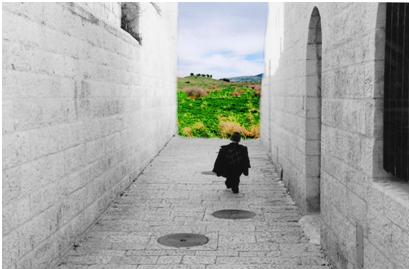
This morning I attended a terrific literature class in which we watched a film by Amir Goren called "66 Was a Good Year for Tourism" and discussed snippets from a novel by Yitzchak Goren that tells a counternarrative to Israeli European-ness by portraying the lives of a family of Sephardic Jews one summer in Alexandria as remembered by a man who now lives in Israel. Our conversation centered around building identity in multiple places, the meaning of nostalgia, and as per the theme of the course itself, on masculinity as defined by these texts. Anyway, I very much enjoyed the Goren texts and encourage you to check them out if you have a chance.
I skipped the rest of my classes because my friend Nicole and her amiable husband Joe were in town and wanted to meet me for lunch. Together with Nicole and Joe I enjoyed the pleasant if a bit overwhelming summer sun as we strolled to the shuk to buy bread, hummus, vegetables, and halva, and then went back to my apartment to eat our plentiful lunch. It was such a pleasure to see both of them, and I am very much looking forward to spending time with them in New York. It's very exciting to feel that good friendships can be picked up again after so long - the conversation came easily and comfortably, and I think we all had a lovely time.
After an afternoon of Hebrew homework (most of it should have been completed long ago, but I keep putting it off), and reading a book I'm very much enjoying, I went to see a performance of the drama club at Har El synagogue. As I suspected, the performance reminded me a bit of the plays that my grandfather used to participate in with his retirement community, only this was in a less comfortable performance space, was ostensibly a more serious play, and was of course in a language that I don't know very well...
The play was called Dreyfus, by Jean-Claude Grumber. I think it was originally written in French and then translted into Hebrew, but as the characters are in 1930's Vilna I suppose they are meant to be speaking in Hebrew (and the non-Jews in Polish?) so language was a bit confusing.
The premise of the show is that a group of amateur actors in Vilna stage a play about Dreyfus, and the actors don't find the theme relevant to their own situation. It is a comedy, in part, as they perform poorly and a frustrated director corrects their follies, but it is also a tragedy as the actors do not heed the warning inherrent in the Dreyfus story, claiming that nothing of the sort could happen in Poland. They stress the differences between Eastern and Western Jews, don't relate to the notion of Zionism, etc. In the end, two anti-Semitic non-Jews enter the playhouse and start harassing an actor, threatening to cut of his beard, etc. The actors gather their courage and, brandishing fake swords from their costumes, they get rid of the agressors. Ultimately, though, they don dark coats, carry suitcases, the lights grow dim, and serious faced they stand together while the sound of a train echoes in the performance space.
I don't know what I think of this play. It was replete with silly and hysterical women, and with notions of Polish Jews being naive and comic. At one point an actor suggests that the Dreyfus play would be better with some catchy music, and she starts humming "If I Were a Rich Man" a gross anachronism and a symbol for the way that Jews today resort to pop culture to invoke a sense of history... But on the other hand, it was a play that mixed the seriousness of the history (if mitigated by the anti-Semites speaking Hebrew and not acting very violently) with the humanity and humor of everyday life in what is perhaps a more genuine representation of the past than one that looks at the whole long history of East European Jewry as inevitably and bleakly leading to destruction, a sad and downtrodden people without resilience of spirit or the will to creat and enjoy beauty and life.
I slipped out of the synagogue as fast as could be possible when most people in the sanctuary were walking very slowly with canes and we were all heading to the same exit. When I got to my apartment I knocked on the neighbors' door to invite them to have dinner with me Tuesday night - I keep meaning to do something with them before I leave but forgetting, so I'm very proud of myself for setting a date. They made me promise I wouldn't go to too much trouble to cook for them, so I'll have to think about what to make. Suggestions?
Showing posts with label friends. Show all posts
Showing posts with label friends. Show all posts
Sunday, June 14, 2009

Wednesday, June 10, 2009
Busy-ness
These past Daniel-less weeks have been a whirlwind of activity - goodbye dinners, spending time with friends, writing papers, etc.
Tonight I said goodbye to some of our closest friends of our Year in Israel by going with to see a community theater production (in English) of Oklahoma. It was a pretty good show - the singing was terrific although the dancing left much to be desired. Ultimately I was left with a strong sense of pride for America, a kind of nostalgia for good-old-American patriotism as represented by Rogers and Hammerstein. Although the play did not end in the singing of Hatikvah, as did 1776 (see my post on the Zionistic ending to that play), the notes in the program answer the question "Why Oklahoma in Israel?" in an interesting way:
"It strikes me that makes the show particume that there are many similarities between the fledgling state (Oklahoma joined the Union in 1907) and our own country. Both reflect a microcosm of conflicting interests, loyalties, sectors, and traditions joining together to form a new polity. Bit it is another, subtler, common theme that makes the show particularly appropriate for the Israeli stage. Bridging the often conflcting interests of the formers and the cowmen is Oklahoma's peddler, Ali Hakim. Despite being labeled as a Syrian (in Lynn Riggs' play, Green Grow the Lilacs, which served as the basis for Oklahoma!) or Persian (as adapted by Oscar Hammerstein II), Hakim is ostensibly Jewish, as were most ofthe peddlers in the western territories at the time. In fact, the role was created by Joseph Buloff, a star of the Yiddish stage, and his Jewish inflection was the subject of considerable critical discusion at the time. Does that make Oklahoma! a Jewish play? Not really, but iot does reflect the overwhelming influence that Jewish immigrants and their descendants had on the American musical theater."
I'm not sure that the most important point is that the 'Jewish' peddler represents Jewish influence on the American stage, as the character, a hypersexualized, irresponsible, money/business focused outsider is a conglomeration of negative stereotypes, likeable though he may be as a comic character. His Jewish character, not unlike the women who are treated as objects to be bought and sold, won and owned, are the creations of the 1943 American imagination of Jews, and performing the play in Israel, with Jews performing all of the roles and sitting in the audience, truly changes the meaning of the play and places Jews as the insiders, the active characters, and the athletic, macho heroes - truly a feit suiting the Zionist spirit.
As today was my last day of Yiddish class, and as we've been reading some poetry in class lately, I decided to end this post by translating a Manni Leib poem for you:
To the Non-Jewish Poet
An heir of Shakespeare, of shepherds and knights,
So good and fine for you, non-Jewish poet!
The earth is yours, where your uncle pig trots:
She gives him feed and gives your muse sustenance.
You sit like a bird on your branch and twitter,
And all the wild space answers you:
From you see the satieatedness, the breadth of the cities,
The complete serenity of satiated spirits.
And here am I, unwanted, a poet of the Jews,
Growing with weeds upon not-our world
Of grandfathers - tired wanderers with dusty beards -
That nourish themselves from books and markets;
And melodically I sing in a strange world the tears
Of wandering in a desert under foreign stars.
And one more for good measure (sorry about my poor translation skills, but at least this gives you the rough idea, though you are missing the patterns of the sounds). Here is one by David Hofstein:
In a Winter Evening
In a winder evening in Russian fields...
Where can one be lonlier, where can one be lonlier?
An old horse, a creaking sled,
A snowcovered dirt road - and I am in the middle
Behind, in the only corner of the paleness,
Smouldering stripes of sun's light still extinguish themselves sadly.
Ahead, a white desert spreads out
And far ahead a few houses are scattered -
There sleeps a hamlet, sunk down in the snow...
A few paths lead to the Jewish home.
A house, like all the others, but with larger windows,
And among the children there I am the oldest.
And narrow is my little world, and small is my circle:
Once in two weeks I go from the hamlet to the village.
And longing in silence for fields an for the vast wideness,
For many roads and paths, covered by snowdrifts...
And I cary in my heart the hidden pain
Of seeds that wait and wait to be sewn...
In winter evenings in Russian fields...
Where can one be lonlier, where can one be lonlier?...
Tonight I said goodbye to some of our closest friends of our Year in Israel by going with to see a community theater production (in English) of Oklahoma. It was a pretty good show - the singing was terrific although the dancing left much to be desired. Ultimately I was left with a strong sense of pride for America, a kind of nostalgia for good-old-American patriotism as represented by Rogers and Hammerstein. Although the play did not end in the singing of Hatikvah, as did 1776 (see my post on the Zionistic ending to that play), the notes in the program answer the question "Why Oklahoma in Israel?" in an interesting way:
"It strikes me that makes the show particume that there are many similarities between the fledgling state (Oklahoma joined the Union in 1907) and our own country. Both reflect a microcosm of conflicting interests, loyalties, sectors, and traditions joining together to form a new polity. Bit it is another, subtler, common theme that makes the show particularly appropriate for the Israeli stage. Bridging the often conflcting interests of the formers and the cowmen is Oklahoma's peddler, Ali Hakim. Despite being labeled as a Syrian (in Lynn Riggs' play, Green Grow the Lilacs, which served as the basis for Oklahoma!) or Persian (as adapted by Oscar Hammerstein II), Hakim is ostensibly Jewish, as were most ofthe peddlers in the western territories at the time. In fact, the role was created by Joseph Buloff, a star of the Yiddish stage, and his Jewish inflection was the subject of considerable critical discusion at the time. Does that make Oklahoma! a Jewish play? Not really, but iot does reflect the overwhelming influence that Jewish immigrants and their descendants had on the American musical theater."
I'm not sure that the most important point is that the 'Jewish' peddler represents Jewish influence on the American stage, as the character, a hypersexualized, irresponsible, money/business focused outsider is a conglomeration of negative stereotypes, likeable though he may be as a comic character. His Jewish character, not unlike the women who are treated as objects to be bought and sold, won and owned, are the creations of the 1943 American imagination of Jews, and performing the play in Israel, with Jews performing all of the roles and sitting in the audience, truly changes the meaning of the play and places Jews as the insiders, the active characters, and the athletic, macho heroes - truly a feit suiting the Zionist spirit.
As today was my last day of Yiddish class, and as we've been reading some poetry in class lately, I decided to end this post by translating a Manni Leib poem for you:
To the Non-Jewish Poet
An heir of Shakespeare, of shepherds and knights,
So good and fine for you, non-Jewish poet!
The earth is yours, where your uncle pig trots:
She gives him feed and gives your muse sustenance.
You sit like a bird on your branch and twitter,
And all the wild space answers you:
From you see the satieatedness, the breadth of the cities,
The complete serenity of satiated spirits.
And here am I, unwanted, a poet of the Jews,
Growing with weeds upon not-our world
Of grandfathers - tired wanderers with dusty beards -
That nourish themselves from books and markets;
And melodically I sing in a strange world the tears
Of wandering in a desert under foreign stars.
And one more for good measure (sorry about my poor translation skills, but at least this gives you the rough idea, though you are missing the patterns of the sounds). Here is one by David Hofstein:
In a Winter Evening
In a winder evening in Russian fields...
Where can one be lonlier, where can one be lonlier?
An old horse, a creaking sled,
A snowcovered dirt road - and I am in the middle
Behind, in the only corner of the paleness,
Smouldering stripes of sun's light still extinguish themselves sadly.
Ahead, a white desert spreads out
And far ahead a few houses are scattered -
There sleeps a hamlet, sunk down in the snow...
A few paths lead to the Jewish home.
A house, like all the others, but with larger windows,
And among the children there I am the oldest.
And narrow is my little world, and small is my circle:
Once in two weeks I go from the hamlet to the village.
And longing in silence for fields an for the vast wideness,
For many roads and paths, covered by snowdrifts...
And I cary in my heart the hidden pain
Of seeds that wait and wait to be sewn...
In winter evenings in Russian fields...
Where can one be lonlier, where can one be lonlier?...
Wednesday, April 29, 2009
Yom Ha'Atzmaut
We have just finished commemorating what many consider the high holidays of the secular Israeli calendar - Yom HaShoah is the remembrance day for victims of the Holocaust, Yom HaZikaron is the remembrance day for fallen soldiers and victims of terror, and the day after Yom HaZikaron, Israelis celebrate Yom HaAtzmaut, Independance Day.
Our commemoration of Yom HaZikaron/Yom HaAtzmaut began the day before the holidays, when we attended a dress rehearsal for the national event to commemorate the ending of Yom Hazikaron and the beginning of Yom HaAtzmaut. It was a huge affair - we arrived at Mt. Herzl hours in advance to take our seats amidst an excited crowd. Much of the ceremony consisted of soldiers marching impressively carrying various flags, as well as a long torch-lighting ceremony in which people from different sectors of Israeli society lit torches to represent the 12 tribes of Israel, and a host of dancers. We took many pictures and have posted them online - please take a look! (Incidentally, the other photos in the album are from a game-show themed event that Daniel planned for HUC)
I spent the morning of Yom HaZikaron with the preschool, and aside from the kids standing still when a siren sounded through the city to signal a moment of silence, the atmosphere was celebratory in preparation for Independance Day - the kids left the preschool early so they could nap well in order to stay up to see the fireworks. My favorite conversation of the morning linked the celebration of Israel's independance with a discussion of how independant the preschoolers are becoming - some can even go to the bathroom by themselves!
We spent the afternoon at an orientation for the Encounter program we're attending tomorrow and Friday - you'll for sure be reading about this in a few days, but suffice it to say, for now, that we will be participating in a program in which we will have an opportunity to hear Palestinian perspectives on Israeli politics and on peace.
In the evening, beginning around 9pm, we heard the fireworks and scuttled out of our apartment. Walking toward the noise and music, we ran into a woman that we know from the Israeli Reform congregation we frequent, and we spoke to her about Independance Day and how it was different in her childhood, when Jerusalem was a small town and you could see the fireworks from anywhere. She was very eager to tell us about different options for the evening, from singing Israeli songs in a small group to dancing in the streets with a hipper crowd.
As we approached the corner of King George and Ben Yehuda we stumbled upon streets blocked off and filled bustling throngs of celebrants, music blasting, kids blowing horns and squirting silly string, vendors selling candied apples, ice cream, and corn on the cob. The festival atmosphere stretched on for whole city blocks, and we wandered around, snapping pictures, eating dessert, and watching fireworks. Eventually we met up with some HUC friends and made our way to the town hall, where we watched and tried to participate in a massive Israeli dancing event - you'll definately want to check out the video we posted on our photo webpage - it was quite a thing.
Today we went to the park for a picnic, having been told that a barbecue in the park is the Independance Day thing to do. While waiting for our friends to arrive, we watched military planes fly overhead, displaying their prowess. People here pack elaborate picnics, kind of like tailgating parties in the US, and it was fun to fit in. We had our own feast, as Paola (my Italian friend from Hebrew U) baked a pie that was to die for! We had a lovely afternoon under the very hot sun.
I don't have anything profound to say about the experience, I just wanted to give you a taste of what we've been doing over the past few busy days. Happy Independance Day!
Our commemoration of Yom HaZikaron/Yom HaAtzmaut began the day before the holidays, when we attended a dress rehearsal for the national event to commemorate the ending of Yom Hazikaron and the beginning of Yom HaAtzmaut. It was a huge affair - we arrived at Mt. Herzl hours in advance to take our seats amidst an excited crowd. Much of the ceremony consisted of soldiers marching impressively carrying various flags, as well as a long torch-lighting ceremony in which people from different sectors of Israeli society lit torches to represent the 12 tribes of Israel, and a host of dancers. We took many pictures and have posted them online - please take a look! (Incidentally, the other photos in the album are from a game-show themed event that Daniel planned for HUC)
I spent the morning of Yom HaZikaron with the preschool, and aside from the kids standing still when a siren sounded through the city to signal a moment of silence, the atmosphere was celebratory in preparation for Independance Day - the kids left the preschool early so they could nap well in order to stay up to see the fireworks. My favorite conversation of the morning linked the celebration of Israel's independance with a discussion of how independant the preschoolers are becoming - some can even go to the bathroom by themselves!
We spent the afternoon at an orientation for the Encounter program we're attending tomorrow and Friday - you'll for sure be reading about this in a few days, but suffice it to say, for now, that we will be participating in a program in which we will have an opportunity to hear Palestinian perspectives on Israeli politics and on peace.
In the evening, beginning around 9pm, we heard the fireworks and scuttled out of our apartment. Walking toward the noise and music, we ran into a woman that we know from the Israeli Reform congregation we frequent, and we spoke to her about Independance Day and how it was different in her childhood, when Jerusalem was a small town and you could see the fireworks from anywhere. She was very eager to tell us about different options for the evening, from singing Israeli songs in a small group to dancing in the streets with a hipper crowd.
As we approached the corner of King George and Ben Yehuda we stumbled upon streets blocked off and filled bustling throngs of celebrants, music blasting, kids blowing horns and squirting silly string, vendors selling candied apples, ice cream, and corn on the cob. The festival atmosphere stretched on for whole city blocks, and we wandered around, snapping pictures, eating dessert, and watching fireworks. Eventually we met up with some HUC friends and made our way to the town hall, where we watched and tried to participate in a massive Israeli dancing event - you'll definately want to check out the video we posted on our photo webpage - it was quite a thing.
Today we went to the park for a picnic, having been told that a barbecue in the park is the Independance Day thing to do. While waiting for our friends to arrive, we watched military planes fly overhead, displaying their prowess. People here pack elaborate picnics, kind of like tailgating parties in the US, and it was fun to fit in. We had our own feast, as Paola (my Italian friend from Hebrew U) baked a pie that was to die for! We had a lovely afternoon under the very hot sun.
I don't have anything profound to say about the experience, I just wanted to give you a taste of what we've been doing over the past few busy days. Happy Independance Day!
Monday, February 16, 2009
My Vacation, so far...
Being on vacation has allowed me to spend time on all manner of occupations, interesting and boring. I've spent hours listening to poetry at poetryfoundation.org, reading about kabbalah, klezmer, and other things that don't start with k, cleaning the apartment in anticipation of my parents' arrival, etc, etc, etc.
On Friday, I made good use of my free time by accompanying my friends Jessica and Nikki (both Rabbinical students) to Tel Aviv, where they wanted to visit a crafts market and look for talitot. The weather was gorgeous, and we took our time strolling among the hair ties, gadgets, hand-knit finger puppets, and Judaica before we visited an artist who does exquisite hand-painted silk table runners, challah covers, and talitot. Jessica and Nikki each ordered a custom designed tallit that I'm sure will be absolutely stunning. After lunch, we went for a stroll on the beach. Amazing. I ended the day with a table full of Shabbat dinner guests, where the food was flavorful and the conversation diverse, and together with these friends I watched evening stretch into night.

I'm not much of a believer in Valentines Day - it reminds me of high school when how loved you were was judged by the number of times the student council interrupted your classes to bring you balloons with heart shaped notes attached, or how many bouquets of flowers you hauled around with you from homeroom to gym to math class. But Daniel and I managed a magnificent Valentines Day, conveniently timed to coincide with Shabbat. We went to services, played several rounds of Spit (Daniel, of course, was the winner), ate baked apples, drew funny creatures with crayons, and spelled "Happy Valentines Day" out while playing hangman. We spent the afternoon getting our pictures taken by a photographer friend - it was terrific fun walking around the city posing in front of walls, bushes, and graffiti. We've only seen a few of the end products, but they are quite lovely.


We arrived home in just enough time to call our families and wish them happy V-days before we went out to dinner with friends and invited them back to our apartment for Settlers of Catan. My evening ended with a phone call to a dear friend in America, and I crawled into bed long after Daniel was already sound asleep. All of this makes me rethink my dislike for a day set aside to remind us how much love we are so blessed to enjoy - wholly, unabashedly, and (unlike the high school memories above) uncompetitively.

Yesterday I joined Daniel's class on a history-centered field trip to Tzippori. Tzippori, also known by the Greek Sepphoris, is about an hour and a half away from Jerusalem, is in the central Galilee region. I am excited to tell you all about it but please bear with me as I don't remember everything and this is, after all, a description of Daniel's history class and not mine, so my knowledge of the time period is quite lacking.
A brief history: The town, now mostly ruins, dates back to the Hellenistic era, and was the administrative capital of the Galilee region under the Roman Empire in the mid-first century BCE. Earlier names for the city include Eirnopolis (city of peace) and Diocaesarea (The Emperor is G-d). By the second century, Tzippori (Like a bird - probably because it is at the top of a hill) was a center of Jewish life. The Sanhedrin (legal body) headed by Rabbi Yehuda HaNasi was located in Tzippori at the beginning of the third century, during which time Jews made up a majority of the population. A Roman pagan population existed alongside the Jewish population of Tzippori, and because of this Tzippori is often used in the Talmud when examples are needed of the interaction between Jews and non-Jews in the public sphere. In 363 Tzippori was destroyed by an earthquake, but it was rebuild soon thereafter. Under Byzantine rule, the Christain community of Tzippori grew, and under Arab rule, the city declined in importance. Arab and Islamic dynasties continued to control the city, with a brief interlude during the Crusades, up until its conquest by Israel in the war of 1948. Throughout this period of time, the city was known by the Arabicized name of the Greek original: Saffuriya. During the 1948 war, Israel captured Tzippori and most settlers fled toward Lebanon. Those who remained or returned from refugee camps were later expelled, and many settled in nearby Nazareth. In 1949 immigrants from Morocco and Tunisia, later joined by Rumanian immigrants, formed a moshav at Tzippori.

Our first stop in Tzippori was the acropolis, which had been the center of town - the marketplace. From there, we walked to the theater, where we discussed the character of theater and how it is represented in rabbinic sources. Theater in the late Roman period in Tzippori was not a presentation of the classics: Sophocles, Aristophones, etc., but was instead a place where accessible commentaries on life in Tzippori were staged: largely mimes and satires. This allowed for an airing of tensions and in particular a representation of stereotypes and discomforts with Jewish practices, particularly as theatergoers were more often Roman than Jewish. Aphitheaters, such as the Coloseum in Rome or the performance space at Caesarea were the site of more large-scale and much more violent activities: here the gladiators would fight large animals or one another for their lives. The Talmud views this as morally repugnant, but nevertheless permits Jews to go to the amphitheaters. Famously, when the gladiators faught, the emporer would signal whether the gladiator would be allowed to live or die, and he would make that assessment based on the cheers of the crowd. Thus, a Jew was allowed to go to the amphitheater in order that, by his cheers, he might be able to save a life. In addition, a Jew could go to the amphitheater to witness the death of another Jew, in order that his wife would not be bound in her marraige and would be able to remarry.

We visited a Roman villa which contains a beautiful mosaic floor, dating from the 3rd century and depicting Roman cults. In one part of the frame is the face of a woman who has been dubbed the "Mona Lisa of the Galilee." The seats would have been arranged in a u-shape around the mosaic, and people would have eaten, drank, and reclined in front of the mosaic which pictures Dionysus, Pan, and other figures drinking. Following the Roman villa, we visited the site of another mosaic, located in a building that was erected at the beginning of the 5th century over the ruins of buildings from the Roman period and was in use until the end of the Byzantine period. Inside the building is an almost-intact mosaic depiction of celebration for the rise of the water level of the Nile river. Although Egypt was far away from Tzipori, the Nile, a constant source of water for a desert nation, was legendary as a symbol of wealth, prosperity, and plenty. Also in the building are mosaic depictions of a variety of hunting scenes, including one of Amazon women hunting.


It was at this point that we broke into partners for a text study (I studied with Daniel). We studied the following text, found in the Talmud in Avodah Zarah 16b,17a:
The rabbis have taught: When Rabbi Eleazor was about to be imprisoned on account of sectarianism, he was brought to the [Roman] court to be tried. The judge said to him, "Does a man of your age busy yourself with such things?" He answered, "The j/Judge is just towards me." The judge thought that Eleazor was speaking of him [the judge]; but he thought upon his Father in heaven. Then the judge said to him, "Since you think I am just, then you are acquitted." Now when Eleazor came home his disciples presented themselves to him to console him, but he would not be consoled. Then Rabbi Akiva said to him, "Permit me to tell you something of what you have taught me." He answered, "Say on." Then said Rabbi Akiva, "Perchance you have once given an ear to heresy, which pleased you, and for that account you have been arrested for heresy." Eleazor replied, "Akiva, you have reminded me! I was once walking in the upper streets of Sepphoris; there I met with one of the disciples of Jesus the Nazarene, Jacob of Kfar Sechanya, who said to me, 'It is found in your Law (Duet. 23:19), Thou shalt not bring the hire of a whore. . . into the house of. . . thy God. What may be done with it? May a latrine for the High Priest be built out of such gifts?' And I answered him nothing. He said to me, 'Thus has Jesus the Nazarene taught me, For the hire of a whore has she gathered them, and unto the hire of a harlot they shall return.' (Micah 1:7) From the place of filth they come, and unto the place of filth they shall go.' This explanation pleased me, and on this account I have been arrested for heresy, since I transgressed the scripture, Remove your way far from her (i.e., heresy). (Proverbs 5:8)
What we saw as happening here was that Rabbi Eliezar asked his followers what he could have done to displease G-d such that G-d would allow him to have been accused of sectarianism. Rabbi Akiva answers him that perhaps he had once been pleased by an interpretation that came from a non-Jewish source, and this explains his arrest, which Rabbi Eliezar confirms to be the case. Thus, even appreciating and enjoying the interpretations of a non-Jewish source, whether one practices them or not, is enough of a problem for G-d to allow Rabbi Eliezar to be arrested. Moreover, the interpretation that Rabbi Eliezar enjoys parallels his own story: according to Jesus, money earned through prostitution can be used to build the latrine of the high priest, because it comes from filth and so it can be used, if in a demeaning way. Although the source of the money is tainted, the end product is not tainted. Rabbi Eliezar comes to realize that if the source of something (an interpretation, money, etc) is improper (whether by prostitution or by sectarianism), the ending result (the interpretation, the latrine, etc) cannot be good, even if the same interpretation or latrine could have been produced in the exact same way by a proper source. The source of things matters. This story shows the extent to which the Rabbis were afraid of neighboring cultures, in part because they were so similar to one another - both drawing from the same sources and interpreting them in similar ways - that it was hard to maintain boundaries and not to be influenced by the other. In this sense, although Tsippori was a fairly diverse society, home to Romans, Christians, and Jews, the Rabbis were very concerned about the idea that their followers could value the intellectual products of other cultures, and in this passage they solidify Rabbinic authority by declaring that even if the Rabbis and the Christians were to arrive at the same idea, nevertheless adopting the idea from a Christian source would be inappropriate. We had to assume that the Rabbis would only be so fearful if this kind of exchange of ideas between Jews and non-Jews was actually happening, and often.
Our final stop in Tzippori was a synagogue. It is believed that there were once about 18 synagogues in Tzippori, but only one has thus far been excavated. It is a long, narrow building measuring 8x21 meters, and, curiously, not directed toward Jerusalem. We spent some time studying the mosaic on the floor of the synagogue, which contains depictions of the binding of Isaac, lions, Temple objects, and at the center a Zodiac wheel surrounded by representations of the four seasons. This is an interesting juxtaposition of traditional Jewish and Roman symbols, and was a fitting end to our discussion about Jewish fears about and practices of incorporating non-Jewish ideas into their lives and worldviews. We prayed mincha together in the synagogue before returning to the bus to head back to Jerusalem.

On the way to Jerusalem we stopped in Beit Shemesh, a small city just outside Jerusalem, where we had dinner at a terrific restaurant called Tavlin (Spice). It's a vegetarian restaurant with flavorful food made with locally grown spices. Adjacent to the restaurant is a giant spice store with every type and combination of spice imaginable. Daniel and I bought two kinds of granola, two blends of spices for rice, and one blend of spices for soup. We are very excited to get cooking!

In a few days Mom and Dad will be here and I can't wait! I'm sure I'll be writing about my adventures with them soon.
In the meantime, for those who don't know, my exciting news is that I have been accepted to the Jewish Theological Seminary's PhD program in Jewish Literature. I'm still waiting to hear from other schols before I decide if this is where I want to go, but I am terrifically excited and relieved to know that there's a school out there who is willing to admit me.
On Friday, I made good use of my free time by accompanying my friends Jessica and Nikki (both Rabbinical students) to Tel Aviv, where they wanted to visit a crafts market and look for talitot. The weather was gorgeous, and we took our time strolling among the hair ties, gadgets, hand-knit finger puppets, and Judaica before we visited an artist who does exquisite hand-painted silk table runners, challah covers, and talitot. Jessica and Nikki each ordered a custom designed tallit that I'm sure will be absolutely stunning. After lunch, we went for a stroll on the beach. Amazing. I ended the day with a table full of Shabbat dinner guests, where the food was flavorful and the conversation diverse, and together with these friends I watched evening stretch into night.

I'm not much of a believer in Valentines Day - it reminds me of high school when how loved you were was judged by the number of times the student council interrupted your classes to bring you balloons with heart shaped notes attached, or how many bouquets of flowers you hauled around with you from homeroom to gym to math class. But Daniel and I managed a magnificent Valentines Day, conveniently timed to coincide with Shabbat. We went to services, played several rounds of Spit (Daniel, of course, was the winner), ate baked apples, drew funny creatures with crayons, and spelled "Happy Valentines Day" out while playing hangman. We spent the afternoon getting our pictures taken by a photographer friend - it was terrific fun walking around the city posing in front of walls, bushes, and graffiti. We've only seen a few of the end products, but they are quite lovely.


We arrived home in just enough time to call our families and wish them happy V-days before we went out to dinner with friends and invited them back to our apartment for Settlers of Catan. My evening ended with a phone call to a dear friend in America, and I crawled into bed long after Daniel was already sound asleep. All of this makes me rethink my dislike for a day set aside to remind us how much love we are so blessed to enjoy - wholly, unabashedly, and (unlike the high school memories above) uncompetitively.

Yesterday I joined Daniel's class on a history-centered field trip to Tzippori. Tzippori, also known by the Greek Sepphoris, is about an hour and a half away from Jerusalem, is in the central Galilee region. I am excited to tell you all about it but please bear with me as I don't remember everything and this is, after all, a description of Daniel's history class and not mine, so my knowledge of the time period is quite lacking.
A brief history: The town, now mostly ruins, dates back to the Hellenistic era, and was the administrative capital of the Galilee region under the Roman Empire in the mid-first century BCE. Earlier names for the city include Eirnopolis (city of peace) and Diocaesarea (The Emperor is G-d). By the second century, Tzippori (Like a bird - probably because it is at the top of a hill) was a center of Jewish life. The Sanhedrin (legal body) headed by Rabbi Yehuda HaNasi was located in Tzippori at the beginning of the third century, during which time Jews made up a majority of the population. A Roman pagan population existed alongside the Jewish population of Tzippori, and because of this Tzippori is often used in the Talmud when examples are needed of the interaction between Jews and non-Jews in the public sphere. In 363 Tzippori was destroyed by an earthquake, but it was rebuild soon thereafter. Under Byzantine rule, the Christain community of Tzippori grew, and under Arab rule, the city declined in importance. Arab and Islamic dynasties continued to control the city, with a brief interlude during the Crusades, up until its conquest by Israel in the war of 1948. Throughout this period of time, the city was known by the Arabicized name of the Greek original: Saffuriya. During the 1948 war, Israel captured Tzippori and most settlers fled toward Lebanon. Those who remained or returned from refugee camps were later expelled, and many settled in nearby Nazareth. In 1949 immigrants from Morocco and Tunisia, later joined by Rumanian immigrants, formed a moshav at Tzippori.

Our first stop in Tzippori was the acropolis, which had been the center of town - the marketplace. From there, we walked to the theater, where we discussed the character of theater and how it is represented in rabbinic sources. Theater in the late Roman period in Tzippori was not a presentation of the classics: Sophocles, Aristophones, etc., but was instead a place where accessible commentaries on life in Tzippori were staged: largely mimes and satires. This allowed for an airing of tensions and in particular a representation of stereotypes and discomforts with Jewish practices, particularly as theatergoers were more often Roman than Jewish. Aphitheaters, such as the Coloseum in Rome or the performance space at Caesarea were the site of more large-scale and much more violent activities: here the gladiators would fight large animals or one another for their lives. The Talmud views this as morally repugnant, but nevertheless permits Jews to go to the amphitheaters. Famously, when the gladiators faught, the emporer would signal whether the gladiator would be allowed to live or die, and he would make that assessment based on the cheers of the crowd. Thus, a Jew was allowed to go to the amphitheater in order that, by his cheers, he might be able to save a life. In addition, a Jew could go to the amphitheater to witness the death of another Jew, in order that his wife would not be bound in her marraige and would be able to remarry.

We visited a Roman villa which contains a beautiful mosaic floor, dating from the 3rd century and depicting Roman cults. In one part of the frame is the face of a woman who has been dubbed the "Mona Lisa of the Galilee." The seats would have been arranged in a u-shape around the mosaic, and people would have eaten, drank, and reclined in front of the mosaic which pictures Dionysus, Pan, and other figures drinking. Following the Roman villa, we visited the site of another mosaic, located in a building that was erected at the beginning of the 5th century over the ruins of buildings from the Roman period and was in use until the end of the Byzantine period. Inside the building is an almost-intact mosaic depiction of celebration for the rise of the water level of the Nile river. Although Egypt was far away from Tzipori, the Nile, a constant source of water for a desert nation, was legendary as a symbol of wealth, prosperity, and plenty. Also in the building are mosaic depictions of a variety of hunting scenes, including one of Amazon women hunting.


It was at this point that we broke into partners for a text study (I studied with Daniel). We studied the following text, found in the Talmud in Avodah Zarah 16b,17a:
The rabbis have taught: When Rabbi Eleazor was about to be imprisoned on account of sectarianism, he was brought to the [Roman] court to be tried. The judge said to him, "Does a man of your age busy yourself with such things?" He answered, "The j/Judge is just towards me." The judge thought that Eleazor was speaking of him [the judge]; but he thought upon his Father in heaven. Then the judge said to him, "Since you think I am just, then you are acquitted." Now when Eleazor came home his disciples presented themselves to him to console him, but he would not be consoled. Then Rabbi Akiva said to him, "Permit me to tell you something of what you have taught me." He answered, "Say on." Then said Rabbi Akiva, "Perchance you have once given an ear to heresy, which pleased you, and for that account you have been arrested for heresy." Eleazor replied, "Akiva, you have reminded me! I was once walking in the upper streets of Sepphoris; there I met with one of the disciples of Jesus the Nazarene, Jacob of Kfar Sechanya, who said to me, 'It is found in your Law (Duet. 23:19), Thou shalt not bring the hire of a whore. . . into the house of. . . thy God. What may be done with it? May a latrine for the High Priest be built out of such gifts?' And I answered him nothing. He said to me, 'Thus has Jesus the Nazarene taught me, For the hire of a whore has she gathered them, and unto the hire of a harlot they shall return.' (Micah 1:7) From the place of filth they come, and unto the place of filth they shall go.' This explanation pleased me, and on this account I have been arrested for heresy, since I transgressed the scripture, Remove your way far from her (i.e., heresy). (Proverbs 5:8)
What we saw as happening here was that Rabbi Eliezar asked his followers what he could have done to displease G-d such that G-d would allow him to have been accused of sectarianism. Rabbi Akiva answers him that perhaps he had once been pleased by an interpretation that came from a non-Jewish source, and this explains his arrest, which Rabbi Eliezar confirms to be the case. Thus, even appreciating and enjoying the interpretations of a non-Jewish source, whether one practices them or not, is enough of a problem for G-d to allow Rabbi Eliezar to be arrested. Moreover, the interpretation that Rabbi Eliezar enjoys parallels his own story: according to Jesus, money earned through prostitution can be used to build the latrine of the high priest, because it comes from filth and so it can be used, if in a demeaning way. Although the source of the money is tainted, the end product is not tainted. Rabbi Eliezar comes to realize that if the source of something (an interpretation, money, etc) is improper (whether by prostitution or by sectarianism), the ending result (the interpretation, the latrine, etc) cannot be good, even if the same interpretation or latrine could have been produced in the exact same way by a proper source. The source of things matters. This story shows the extent to which the Rabbis were afraid of neighboring cultures, in part because they were so similar to one another - both drawing from the same sources and interpreting them in similar ways - that it was hard to maintain boundaries and not to be influenced by the other. In this sense, although Tsippori was a fairly diverse society, home to Romans, Christians, and Jews, the Rabbis were very concerned about the idea that their followers could value the intellectual products of other cultures, and in this passage they solidify Rabbinic authority by declaring that even if the Rabbis and the Christians were to arrive at the same idea, nevertheless adopting the idea from a Christian source would be inappropriate. We had to assume that the Rabbis would only be so fearful if this kind of exchange of ideas between Jews and non-Jews was actually happening, and often.
Our final stop in Tzippori was a synagogue. It is believed that there were once about 18 synagogues in Tzippori, but only one has thus far been excavated. It is a long, narrow building measuring 8x21 meters, and, curiously, not directed toward Jerusalem. We spent some time studying the mosaic on the floor of the synagogue, which contains depictions of the binding of Isaac, lions, Temple objects, and at the center a Zodiac wheel surrounded by representations of the four seasons. This is an interesting juxtaposition of traditional Jewish and Roman symbols, and was a fitting end to our discussion about Jewish fears about and practices of incorporating non-Jewish ideas into their lives and worldviews. We prayed mincha together in the synagogue before returning to the bus to head back to Jerusalem.

On the way to Jerusalem we stopped in Beit Shemesh, a small city just outside Jerusalem, where we had dinner at a terrific restaurant called Tavlin (Spice). It's a vegetarian restaurant with flavorful food made with locally grown spices. Adjacent to the restaurant is a giant spice store with every type and combination of spice imaginable. Daniel and I bought two kinds of granola, two blends of spices for rice, and one blend of spices for soup. We are very excited to get cooking!

In a few days Mom and Dad will be here and I can't wait! I'm sure I'll be writing about my adventures with them soon.
In the meantime, for those who don't know, my exciting news is that I have been accepted to the Jewish Theological Seminary's PhD program in Jewish Literature. I'm still waiting to hear from other schols before I decide if this is where I want to go, but I am terrifically excited and relieved to know that there's a school out there who is willing to admit me.
Tuesday, December 30, 2008
A Great Miracle Happened Here


In the days before Hannukah began, I scrambled around the city in search of gifts for Daniel, wandering into the nooks and crannies of the city center to find just the right doodads and treasures - small enough that they can be taken in a suitcase back to the land of the free and the home of the brave, but fun, exciting, and useful nonetheless. I found myself in pottery stores, clothing stores, art stores, and Judaica stores, and the only department store in the city center, browsing through the Channukah sales and noting the disquieting lack of Christmas music in late December. My purchases made, I squirreled them away in the corner of the apartment, ready for the holiday to begin.
Daniel and I didn't expect much from Channukah in Israel, figuring that it wouldn't be a big to-do without the counterpart of Christmas as a motivator for families who didn't want their children to be left out. And, in fact, the 'holiday season' was considerably less pronounced here than it is in the States. Nevertheless it was charming and meaningful in surprising ways.
My only really Israeli experiences of Channukah included eating sufganiot that were being sold at every corner, enjoying the Hannukah decorations at Hebrew University, and attending a preschool Channukah party where kids wore hats with candles on them and danced for their grinning parents. I enjoyed much of the holiday in the warmth of our apartment.
 The above picture is of the preschool Hannukah party. No, those aren't Indian hats, they are candle hats.
The above picture is of a Channukah decoration at Hebrew University.
The week that Channukah began, winter cold also began in earnest. Rainy days were followed by sunless days with puddles remaining on the slippery Jerusalem stone. We're trying not to use too much energy, so without the space heaters on, we were roaming about our apartment in layer upon layer of sweatshirts and blankets, sipping tea for warmth. Daniel is in finals season and has been scrambling to reasearch for papers and study for tests. And what a relief that in the midst of all of this, we were able to light candles together every night, singing the prayers with our arms about each other, and watching the candles dance before the misted window pane. Each evening we gave each other a different present, and now we are both enjoying our gifts: warm winter gear, candy, clothing, games, Judaica, etc. For the eighth night of Channukah Daniel bought me a little statuette of a whippet, which has been sitting in the window of the Judaica store around the corner and which I have been waving to every day as I come home from school. He wished that the storekeeper spoke English so that he could have inquired, "How much is that doggie in the window?" Unfortunately, it was a missed opportunity.


Two pictures of Channukah gifts: left: the doggie formerly in the window; right: pictionary and candy
On Friday, Daniel and I went to the apartment of some friends of mine from Hebrew University for a post-Christmas (I suppose Boxing Day) brunch. We baked a lemon poppyseed cake to bring to the apartment, and we ate terrific food - homemade biscuits, apple crumble, fritata, etc. The conversation was intense and informative, as we spent most of the time talking about religion to these students from all over the world who had converged in Jerusalem to study that very topic. We learned about the significance of place in Christianity (asking about whether Bethlehem was significant religiously to those who had traveled there for the holiday), about relics in the Catholic church, and a number of other interesting topics. The atmosphere was warm and the company was good. It's nice to spend time with non-HUC friends for a change.
That evening, on the Channukah evening that coincinded with Shabbat, we were welcomed into the apartment of some HUC students for Kabbalat Shabbat services. Sprawled out on couches, chairs, and pillows, Daniel's class prayed together, sang together, and demonstrated how close they have grown to each other this semester. It felt like a strong and loving community, and when we shared instances of light and darkness in our lives, in keeping with the theme of Channukah, I was impressed by the willingness of these students to open up to one another. I think it is terrific that these future Rabbis, Cantors, and Educators are becoming such fast friends, and I think that will be a strong asset to the Reform community for years to come.
On Shabbat afternoon, Daniel and I hosted his Hebrew class for lunch. We baked bagels, challah, and more lemon poppyseed cake, and in honor of the occasion, on Friday afternoon we went to a restaurant around the corner from our apartment that, on Fridays, turns into a place to buy Shabbat food. Trays and trays of prepared meals were spread throughout the room, and people would simply point and order the food, which was sold at a remarkably low price in order that families will have good food for the holiday. We bought a few salads and a mixed vegetable dish, and were very pleased. We'll probably go there again.
Having Daniel's class over was great. For one of his Channukah presents, Daniel had received Pictionary in Hebrew, and so we played a round with Daniel's class, searching through our Hebrew English dictionaries when we didn't know what the words meant. It was a great vocabulary building excercise, and a lot of fun!
My Channukah Miracle, I suppose, was that I discovered that a teacher at Daniel's school used to be my cantor when I was 11 years old. She has since changed her name and so I assumed that she was not the same person, but I recently learned that she was the selfsame cantor that I so admired as a young girl. This was a very emotional discovery for me, largely because I am a very emotional person, but also because this cantor was very important to me as a child - she really inspired me to become interested in Judaism and I think about her and her influence on me all of the time, so it was a tremendous surprise to learn that all this time I've been interacting with her, playing with her son at the preschool, etc., only now to find out that she is the cantor of my youth. It was an enthusiastic 'reunion' when I told her!
We're sad that the holiday was over, b
 ut we have a lot to look forward to in the upcoming week- HUC's New Years prom, our New Year's Day pot-luck dinner, a visit from Daniel's home synagogue, seeing people on the UVA Birthright trip, etc. We'll be busy for the next few days!
Monday, November 24, 2008
Notes on New Friends
I was sitting down to eat lunch by myself today when my new friend Gavin asked if he could join me. We had a long and lovely conversation before he left to go to the library and I continued where I was, reading a book about Yiddish literature.
Later in the day, I was reading the self-same book elsewhere when a girl from my Yiddish class asked if she could join me. Her name is Anka and as it turns out she is also a non-native Hebrew speaker who is here on a one-year program. She is a junior studying Judaica at her home university in Russia, and is here for the year, studying Yiddish language and literature. Her Hebrew seems to be about on my level. I hope we'll develop a friendship.
In Yiddish class we theoretically take turns reading, but the teacher usually calls on the same few people who seem the most capable of reading, and I've never been asked to do it before. Today, the teacher called on me - he'd forgotten my name, but he was very nice about asking me to read. I was terribly embarassed - I can't read as well as everyone else because the characters are still foreign to me even after all these years of studying them. But everyone was very patient, and the teacher made a comment about how I knew to pronounce certain difficult words correctly, and no one said anything negative at all. It's nice that the class is supportive, but frankly I hope he doesn't ask me to read again, because I did feel more than a little shy about it.
People were nice today. One of the kids in my Historiography class kept making faces at me when the teacher said something boring and asked if I was OK when I coughed during class - this is exciting because it's the first time that anyone in that class has really acknowledged that I exist - they mostly have their own friends and no one in the class has ever spoken to me before. What else was nice was that my Hebrew teacher, Batya, was returning our essays today and asked if she could keep mine for an extra day because she wants to show it to my other Hebrew teacher, as she thought it was really good. We had to write biographies, and mine was on Grace Paley - as a side note if you've never read Grace Paley don't waste any more time with this blog, go out and get yourself a copy of her short stories or her poems and be quick about it! What else was nice was that I rode the bus home with a friend from my Yiddish Lit class - so that means that today I had at least one positive interaction in every class! That makes today officially a good day. Now I need to start thinking about paper topics, do a little homework, etc. The other exciting news is that it seems that I may be volunteering at the preschool around the corner from our apartment a few hours a week - I'm going to the preschool next week to discuss it. That would be excellent, as I have a little too much free time, and I miss working with kids.
Sorry this was a bit of a boring post. More interesting things will follow in the next few days, even if I have to make them up. :)
Later in the day, I was reading the self-same book elsewhere when a girl from my Yiddish class asked if she could join me. Her name is Anka and as it turns out she is also a non-native Hebrew speaker who is here on a one-year program. She is a junior studying Judaica at her home university in Russia, and is here for the year, studying Yiddish language and literature. Her Hebrew seems to be about on my level. I hope we'll develop a friendship.
In Yiddish class we theoretically take turns reading, but the teacher usually calls on the same few people who seem the most capable of reading, and I've never been asked to do it before. Today, the teacher called on me - he'd forgotten my name, but he was very nice about asking me to read. I was terribly embarassed - I can't read as well as everyone else because the characters are still foreign to me even after all these years of studying them. But everyone was very patient, and the teacher made a comment about how I knew to pronounce certain difficult words correctly, and no one said anything negative at all. It's nice that the class is supportive, but frankly I hope he doesn't ask me to read again, because I did feel more than a little shy about it.
People were nice today. One of the kids in my Historiography class kept making faces at me when the teacher said something boring and asked if I was OK when I coughed during class - this is exciting because it's the first time that anyone in that class has really acknowledged that I exist - they mostly have their own friends and no one in the class has ever spoken to me before. What else was nice was that my Hebrew teacher, Batya, was returning our essays today and asked if she could keep mine for an extra day because she wants to show it to my other Hebrew teacher, as she thought it was really good. We had to write biographies, and mine was on Grace Paley - as a side note if you've never read Grace Paley don't waste any more time with this blog, go out and get yourself a copy of her short stories or her poems and be quick about it! What else was nice was that I rode the bus home with a friend from my Yiddish Lit class - so that means that today I had at least one positive interaction in every class! That makes today officially a good day. Now I need to start thinking about paper topics, do a little homework, etc. The other exciting news is that it seems that I may be volunteering at the preschool around the corner from our apartment a few hours a week - I'm going to the preschool next week to discuss it. That would be excellent, as I have a little too much free time, and I miss working with kids.
Sorry this was a bit of a boring post. More interesting things will follow in the next few days, even if I have to make them up. :)
Sunday, October 26, 2008
Church in Hebrew
A long time ago Paola invited us to join her at church, and we finally decided to take her up on the offer. Together with Corinna, a William and Mary graduate who is getting her masters at Rothberg, we went to a church service held in the former Italian embassy. From the street, you wouldn't be able to tell that a religious service was going on there at all - it is a peaceful, quiet looking building, a whitewashed, two-story establishment set back from the street with a stone driveway in front, and protected by a decorative iron gate. Inside, the room where services were held was very modest - white walls, rows of chairs, a small wooden cross hanging on the far wall. The priests walked in, clothed in white robes, and filed into rows and bowed together gracefully, like a dance. Then, the service began. It sounded uncannily like a Jewish service - because it was in Hebrew. Some of it was entirely the same as a Jewish service, except with different tunes - the psalms, the parsha. And some of it (the New Testament in Hebrew) for instance, was not. It was strange to hear liturgical Hebrew and to realize that it wasn't Jewish. I think it forced me to think about what makes a service Jewish to me. Is Hebrew really necessary to make the service Jewish? It is, after all, just a language and can be used for secular purposes (as in Modern Israel) and even for Christian liturgical purposes (as in the services we attended this evening), so why do Jews pray in Hebrew? It also highlited how similar Catholicism and Judaism really are to each other, at least in a practical if not in a theological way. The service felt very much like a Jewish one - the formality of it, the treating of holy objects like royalty, the singing, and, of course, the Hebrew. At the same time, it also pointed out that some differences between Catholicism and Judaism are so huge that even translating the Catholic ceremony into the Jewish language could not make it seem Jewish - for instance transubstantiation, which I find to be absolutely beautiful and powerful, did not feel any more Jewish for its being in Hebrew. Though I do have to say that something about the transformative power of the prayers, and the participatory way that congregants held up their hands, reminded me a little of Havdalah. We witnessed a pre-baptism ceremony, and I found myself strangely uncomfortable during it. The woman in the process of conversion seemed to be a Jewish Israeli, and there was something symbolically powerful to me to see a Jew in Israel converting to Catholicism - after hundreds of years of Jews converting in order to save their own lives, it seemed shocking and disappointing to see someone do it by choice - I can't explain why I felt that way and I know that it was wrong to feel that way, rather than to be joyful for someone who has discovered the life path that suits them, but honestly I did feel strange about the whole thing. And I felt a little stranger when I saw the tears in Paola's eyes, and knew that she found the woman's conversion to be such a cause for joy. Irrationally and uncontrollably, I felt a sense of loss. I didn't feel any more comfortable when a woman who I was talking to afterward said to me, "wouldn't it be funny if you came to Jerusalem, and converted to Catholicism after all" - no, I don't think it would be funny. I think Catholicism is rich and beautiful and I have so much respect for it, but for me, personally, it would be tragic to convert.
After services we went out to a terrific dinner and had a fun and cheerful conversation. It was good to see Paola after what feels like an eternity, and I am getting increasingly excited about going back to class. Paola taught me the Italian word for 'nerd' - "seciona," and she called me a "seciona" for my excitement about classes, but in reality I know that she shares the feeling. Just one more week!
After services we went out to a terrific dinner and had a fun and cheerful conversation. It was good to see Paola after what feels like an eternity, and I am getting increasingly excited about going back to class. Paola taught me the Italian word for 'nerd' - "seciona," and she called me a "seciona" for my excitement about classes, but in reality I know that she shares the feeling. Just one more week!
Subscribe to:
Posts (Atom)