Well, I've completed all of my coursework for the semester, taken my last exam, and I only have a few days left to explore Jerusalem, gather my belongings, and fly to the other Promised Land - the "goldine medina."
In the meantime, it was with bittersweet feelings that I approached this Shabbat, wanting it to be perfect and memorable, but knowing that some of the most beautiful Shabbats of the year were already behind me. Sometimes I find self-reflexivity to be an emotionally painful task - being so aware of the last-ness of the Shabbat, I tried so hard to impress upon myself every detail of it, but knowing that the details fade quickly and that by the end of the day the sharpness of the image of its beginning will already have begun to wane in my mind's eye. It is with this in mind that I write of my final Jerusalem Shabbat, trying to preserve the important bits for just a while longer.
A friend of mine, Rebecca, had made plans with me for Friday to cook together and invite friends to my apartment. What started as a small gathering grew into the largest assembly of assorted individuals I've hosted in our apartment - the 15 bodies took up every seat that could possibly have been squished into the living room.
Knowing that we were expecting the large crowd, I began preparing for their visit as soon as I arrived home from my Hebrew exam. I started with a frenzy of cleaning - sweeping, scrubbing, putting-away, and interspersed these activities with putting sliced, spiced beets in the oven and braiding the challah. My friends Corrinna and Andrew arrived early to drop off a watermelon at the apartment and I enlisted their help in cleaning off plastic chairs, chopping vegetables, and even washing dishes. You know you have good friends when they'll do your dishes for you!
While we were cooking I received a phone call from my friend and neighbor Amy, telling me that at the corner between our apartment buildings, where an organization often leaves used books for passers-by to browse and take, there were stacks and stacks of Yiddish books. Corrinna and I left Andrew to watch after the challah in the oven and we ran down to the book drop-off area. Corinna picked up a copy of Ethan Frome in Hebrew, among other gems, and I found an astonishing wealth of Yiddish texts to choose from. I may not be able to carry all of the books that I took back to the US, but for now I have several Yiddish journals dating from 1943 to 1961, most of them issues of Yiddishe Kultur or Di Tzukunft (the Future) as well as a 1938 copy of David Pinsky's travelogue of a trip to Israel from the summer of 1932 to the sumer of 1936, published in Warsaw, a 1966 copy of Nachum Sutzkever's Personalities and Folk, published in Jerusalem, a 1996 copy of "Human Salad" by Joseph Hayblum, which was published in Israel with the assistance of the Mutlicultural Program of the Department of the Secretary of State of Canada, and a 1986 printing of "Tear and Smile" a collection of poetry and songs by David Shav-Artza, published in Israel. I'm very excited about all of this, though it would take me forever to read even one of these books.
By the time Rebecca arrived at 3:30 pm, two veggie dishes were complete, the challah was in the oven, and the apartment was on the verge of cleanliness. Then the real work began. On a 98 degree afternoon, we kept the oven and stovetop going for hours, our hands never free from work and our feet aching from it. We made guacamole with sliced vegetables, mujedra, oven-roasted potatoes, lentil soup, chocolate cake, apple appricot tart, cole slaw, and more. We rearranged the furniture into a 15-person circle, put out the Shabbat candles and wine, and waited for the guests to arrive.
The dinner was definitely a success - there was plenty of food and a lot of conversation. The guests were an interesting mix between those traveling to Jerusalem for the summer, or just for a quick vacation, and those who are here for a year or more, some older and some younger, some Jewish and some not, and I was surprised how willing people were to get to know new people. I was very sorry, though, to say goodbye to Paola at the end of the night, as I don't think we'll see each other again before we leave. I am so grateful to have had her friendship this year, and I do hope that one day I'll go to Italy to visit her!
The last remaining guests helped me clean a bit, though there's still some cleaning work to do, and pretty late at night. I woke up and dressed for services at Har El. It was a small congregation - a bar mitzvah with a tremendous voice read from the Torah, and I was given an aliyah during which Rabbi Ada blessed me and wished me a safe journey and that I should consider Har El my home in Israel.
In the afternoon, Atar Katz (my neighbor) took me on a tiyyul around Jerusalem, to catch some sights I had not yet seen. He was born in Jerusalem and has lived here is whole life, and his mind is filled with stories of Jerusalem's history. As we drived around the city he told me story after story (this was my real Hebrew final exam!) of ancient history, the building of the state, of the people and events that happened in this city with its layers and layers of pasts and cultures. We drove up to Mt. Scopus, driving on the road where the 1948 Mt. Scopus bus attack occurred, and stopped at an overlook to see East Jerusalem and the desert beyond, reaching toward the Dead Sea. Mr. Katz gave me a geography lesson, using the knuckles of his hand to represent the grooves of the valleys and mountains of Jerusalem. According to Mr. Katz, Mt. Scopus gets its name because it was the mountain from which the priests used to watch the sky to determine if the stars were out and the holiday had begun, lighting a bonfire that would signal to other watchmen to light their bonfires on other mountains so the word could travel that it was time for the holdiay to begin. We then drove to the Mt. of Olives, where 150,000 Jewish bodies lie in graves, awaiting the coming of the Messiah and the resurrection of the Jews. Ancient and modern tombstones alike form the necropolis. Mr. Katz told me a story that when the Messiah comes, there will be two bridges from the Mt. of Olives to the Temple Mount - one made out of iron and the other out of paper. Those who lack faith will take the safer-looking iron bridge, and it will break and they will fall, returning to death. The faithful will take the paper bridge, which will lead them to the Temple Mount. Mr. Katz pointed out to me the Seven Arches Hotel (formerly the Intercontinental Hotel) which, he says, we can see from our balcony. The hotel was constructed during Jordanian rule over East Jerusalem along a road that he built in violation of the 1949 Armistice agreement accross the cemetary, destroying thousands of graves, some dating back to the First Temple period.
We drove down to the bottom of the Mt. of Olives (the Kidron Valley) to see Absolom's Pillar, traditionally believed to be the tomb of Absalom, son of King David. It's archetectural style shows Greek influence, and it is now believed that it may have been the tomb of Temple priest Zachariah, the father of John the Baptist.
We drove past the Dung Gate and through the city to Talpiyot, a neighborhood in southeast Jerusalem. Mr. Katz pointed out Machane Allenby, the former British army camp, and told me stories of the British conquest of Jerusalem. He also showed me the former home of the British High Commissioner to Jerusalem, now the headquarters of the UN in Jerusalem.
Mr. Katz and I walked through a park to see the remains of a Herodian aqueduct, where a hole showing the ancient ducts is situated on a mosaic map showing its ancient route.
It was a whirlwind tour of about two and a half hours, after which I took a long nap, and woke in time to write this post before going to play some board games with friends who leave Jerusalem tomorrow, heading home to the US.
Showing posts with label field trip. Show all posts
Showing posts with label field trip. Show all posts
Saturday, June 27, 2009

Monday, February 16, 2009
My Vacation, so far...
Being on vacation has allowed me to spend time on all manner of occupations, interesting and boring. I've spent hours listening to poetry at poetryfoundation.org, reading about kabbalah, klezmer, and other things that don't start with k, cleaning the apartment in anticipation of my parents' arrival, etc, etc, etc.
On Friday, I made good use of my free time by accompanying my friends Jessica and Nikki (both Rabbinical students) to Tel Aviv, where they wanted to visit a crafts market and look for talitot. The weather was gorgeous, and we took our time strolling among the hair ties, gadgets, hand-knit finger puppets, and Judaica before we visited an artist who does exquisite hand-painted silk table runners, challah covers, and talitot. Jessica and Nikki each ordered a custom designed tallit that I'm sure will be absolutely stunning. After lunch, we went for a stroll on the beach. Amazing. I ended the day with a table full of Shabbat dinner guests, where the food was flavorful and the conversation diverse, and together with these friends I watched evening stretch into night.

I'm not much of a believer in Valentines Day - it reminds me of high school when how loved you were was judged by the number of times the student council interrupted your classes to bring you balloons with heart shaped notes attached, or how many bouquets of flowers you hauled around with you from homeroom to gym to math class. But Daniel and I managed a magnificent Valentines Day, conveniently timed to coincide with Shabbat. We went to services, played several rounds of Spit (Daniel, of course, was the winner), ate baked apples, drew funny creatures with crayons, and spelled "Happy Valentines Day" out while playing hangman. We spent the afternoon getting our pictures taken by a photographer friend - it was terrific fun walking around the city posing in front of walls, bushes, and graffiti. We've only seen a few of the end products, but they are quite lovely.


We arrived home in just enough time to call our families and wish them happy V-days before we went out to dinner with friends and invited them back to our apartment for Settlers of Catan. My evening ended with a phone call to a dear friend in America, and I crawled into bed long after Daniel was already sound asleep. All of this makes me rethink my dislike for a day set aside to remind us how much love we are so blessed to enjoy - wholly, unabashedly, and (unlike the high school memories above) uncompetitively.

Yesterday I joined Daniel's class on a history-centered field trip to Tzippori. Tzippori, also known by the Greek Sepphoris, is about an hour and a half away from Jerusalem, is in the central Galilee region. I am excited to tell you all about it but please bear with me as I don't remember everything and this is, after all, a description of Daniel's history class and not mine, so my knowledge of the time period is quite lacking.
A brief history: The town, now mostly ruins, dates back to the Hellenistic era, and was the administrative capital of the Galilee region under the Roman Empire in the mid-first century BCE. Earlier names for the city include Eirnopolis (city of peace) and Diocaesarea (The Emperor is G-d). By the second century, Tzippori (Like a bird - probably because it is at the top of a hill) was a center of Jewish life. The Sanhedrin (legal body) headed by Rabbi Yehuda HaNasi was located in Tzippori at the beginning of the third century, during which time Jews made up a majority of the population. A Roman pagan population existed alongside the Jewish population of Tzippori, and because of this Tzippori is often used in the Talmud when examples are needed of the interaction between Jews and non-Jews in the public sphere. In 363 Tzippori was destroyed by an earthquake, but it was rebuild soon thereafter. Under Byzantine rule, the Christain community of Tzippori grew, and under Arab rule, the city declined in importance. Arab and Islamic dynasties continued to control the city, with a brief interlude during the Crusades, up until its conquest by Israel in the war of 1948. Throughout this period of time, the city was known by the Arabicized name of the Greek original: Saffuriya. During the 1948 war, Israel captured Tzippori and most settlers fled toward Lebanon. Those who remained or returned from refugee camps were later expelled, and many settled in nearby Nazareth. In 1949 immigrants from Morocco and Tunisia, later joined by Rumanian immigrants, formed a moshav at Tzippori.

Our first stop in Tzippori was the acropolis, which had been the center of town - the marketplace. From there, we walked to the theater, where we discussed the character of theater and how it is represented in rabbinic sources. Theater in the late Roman period in Tzippori was not a presentation of the classics: Sophocles, Aristophones, etc., but was instead a place where accessible commentaries on life in Tzippori were staged: largely mimes and satires. This allowed for an airing of tensions and in particular a representation of stereotypes and discomforts with Jewish practices, particularly as theatergoers were more often Roman than Jewish. Aphitheaters, such as the Coloseum in Rome or the performance space at Caesarea were the site of more large-scale and much more violent activities: here the gladiators would fight large animals or one another for their lives. The Talmud views this as morally repugnant, but nevertheless permits Jews to go to the amphitheaters. Famously, when the gladiators faught, the emporer would signal whether the gladiator would be allowed to live or die, and he would make that assessment based on the cheers of the crowd. Thus, a Jew was allowed to go to the amphitheater in order that, by his cheers, he might be able to save a life. In addition, a Jew could go to the amphitheater to witness the death of another Jew, in order that his wife would not be bound in her marraige and would be able to remarry.

We visited a Roman villa which contains a beautiful mosaic floor, dating from the 3rd century and depicting Roman cults. In one part of the frame is the face of a woman who has been dubbed the "Mona Lisa of the Galilee." The seats would have been arranged in a u-shape around the mosaic, and people would have eaten, drank, and reclined in front of the mosaic which pictures Dionysus, Pan, and other figures drinking. Following the Roman villa, we visited the site of another mosaic, located in a building that was erected at the beginning of the 5th century over the ruins of buildings from the Roman period and was in use until the end of the Byzantine period. Inside the building is an almost-intact mosaic depiction of celebration for the rise of the water level of the Nile river. Although Egypt was far away from Tzipori, the Nile, a constant source of water for a desert nation, was legendary as a symbol of wealth, prosperity, and plenty. Also in the building are mosaic depictions of a variety of hunting scenes, including one of Amazon women hunting.


It was at this point that we broke into partners for a text study (I studied with Daniel). We studied the following text, found in the Talmud in Avodah Zarah 16b,17a:
The rabbis have taught: When Rabbi Eleazor was about to be imprisoned on account of sectarianism, he was brought to the [Roman] court to be tried. The judge said to him, "Does a man of your age busy yourself with such things?" He answered, "The j/Judge is just towards me." The judge thought that Eleazor was speaking of him [the judge]; but he thought upon his Father in heaven. Then the judge said to him, "Since you think I am just, then you are acquitted." Now when Eleazor came home his disciples presented themselves to him to console him, but he would not be consoled. Then Rabbi Akiva said to him, "Permit me to tell you something of what you have taught me." He answered, "Say on." Then said Rabbi Akiva, "Perchance you have once given an ear to heresy, which pleased you, and for that account you have been arrested for heresy." Eleazor replied, "Akiva, you have reminded me! I was once walking in the upper streets of Sepphoris; there I met with one of the disciples of Jesus the Nazarene, Jacob of Kfar Sechanya, who said to me, 'It is found in your Law (Duet. 23:19), Thou shalt not bring the hire of a whore. . . into the house of. . . thy God. What may be done with it? May a latrine for the High Priest be built out of such gifts?' And I answered him nothing. He said to me, 'Thus has Jesus the Nazarene taught me, For the hire of a whore has she gathered them, and unto the hire of a harlot they shall return.' (Micah 1:7) From the place of filth they come, and unto the place of filth they shall go.' This explanation pleased me, and on this account I have been arrested for heresy, since I transgressed the scripture, Remove your way far from her (i.e., heresy). (Proverbs 5:8)
What we saw as happening here was that Rabbi Eliezar asked his followers what he could have done to displease G-d such that G-d would allow him to have been accused of sectarianism. Rabbi Akiva answers him that perhaps he had once been pleased by an interpretation that came from a non-Jewish source, and this explains his arrest, which Rabbi Eliezar confirms to be the case. Thus, even appreciating and enjoying the interpretations of a non-Jewish source, whether one practices them or not, is enough of a problem for G-d to allow Rabbi Eliezar to be arrested. Moreover, the interpretation that Rabbi Eliezar enjoys parallels his own story: according to Jesus, money earned through prostitution can be used to build the latrine of the high priest, because it comes from filth and so it can be used, if in a demeaning way. Although the source of the money is tainted, the end product is not tainted. Rabbi Eliezar comes to realize that if the source of something (an interpretation, money, etc) is improper (whether by prostitution or by sectarianism), the ending result (the interpretation, the latrine, etc) cannot be good, even if the same interpretation or latrine could have been produced in the exact same way by a proper source. The source of things matters. This story shows the extent to which the Rabbis were afraid of neighboring cultures, in part because they were so similar to one another - both drawing from the same sources and interpreting them in similar ways - that it was hard to maintain boundaries and not to be influenced by the other. In this sense, although Tsippori was a fairly diverse society, home to Romans, Christians, and Jews, the Rabbis were very concerned about the idea that their followers could value the intellectual products of other cultures, and in this passage they solidify Rabbinic authority by declaring that even if the Rabbis and the Christians were to arrive at the same idea, nevertheless adopting the idea from a Christian source would be inappropriate. We had to assume that the Rabbis would only be so fearful if this kind of exchange of ideas between Jews and non-Jews was actually happening, and often.
Our final stop in Tzippori was a synagogue. It is believed that there were once about 18 synagogues in Tzippori, but only one has thus far been excavated. It is a long, narrow building measuring 8x21 meters, and, curiously, not directed toward Jerusalem. We spent some time studying the mosaic on the floor of the synagogue, which contains depictions of the binding of Isaac, lions, Temple objects, and at the center a Zodiac wheel surrounded by representations of the four seasons. This is an interesting juxtaposition of traditional Jewish and Roman symbols, and was a fitting end to our discussion about Jewish fears about and practices of incorporating non-Jewish ideas into their lives and worldviews. We prayed mincha together in the synagogue before returning to the bus to head back to Jerusalem.

On the way to Jerusalem we stopped in Beit Shemesh, a small city just outside Jerusalem, where we had dinner at a terrific restaurant called Tavlin (Spice). It's a vegetarian restaurant with flavorful food made with locally grown spices. Adjacent to the restaurant is a giant spice store with every type and combination of spice imaginable. Daniel and I bought two kinds of granola, two blends of spices for rice, and one blend of spices for soup. We are very excited to get cooking!

In a few days Mom and Dad will be here and I can't wait! I'm sure I'll be writing about my adventures with them soon.
In the meantime, for those who don't know, my exciting news is that I have been accepted to the Jewish Theological Seminary's PhD program in Jewish Literature. I'm still waiting to hear from other schols before I decide if this is where I want to go, but I am terrifically excited and relieved to know that there's a school out there who is willing to admit me.
Monday, September 8, 2008
Field Trip to Mt. Herzl
When we learned that we were to have a field trip today and that we were leaving from a coffee shop near to the campus, Paola and I arranged to meet before class to have breakfast at the coffee shop. It was lovely - I had tea with fresh mint and a piece of carrot cake, and Paola had a pastry with custard inside and a cup of coffee. We chatted for a bit and Francios, another student in our class, joined us as he finished his breakfast. We mostly talked about coffee shops - how they are different in America than Italy and France. In Italy, apparently, most people either sit and chat in coffee shops, or because most people drink espresso, they don't take their coffee to go but instead down it in one gulp before they continue on their way. So, there is nothing like in America where people walk around with their Starbucks cups to go. Apparently that does exist in France, but not with the same frequency as in America. Apparently in France still most people who get coffee do it in a social way to sit and linger, but in France it costs money to sit at an ice cream shop or a coffee shop, and the prices vary depending on where you want to sit. Francios says his favorite coffee shop in the whole world is in Venice. Incidentally the most interesting thing about the conversation, I think, was that it was all in Hebrew. I never cease to be proud that I can understand and participate in conversations in Hebrew.
The class piled onto a bus that took us to Mt. Herzl, a national cemetary on top of a hill where Theodore Herzl is buried, as well as several prime ministers, Zionist leaders and hundreds of soldiers who fell in the line of duty. Our first stop was to the Herzl museum (http://www.herzl.org/), which is a relatively new museum (I think built in 2007??). It is an interactive multimedia production that explains Theodore Herzl's life and Zionist vision. The exhibit is almost entirely in videos, and the videos were in Hebrew for us, so I'm not sure that I caught everything. The exhibit began in a room that is meant to look like Paris in the late 19th century. On one screen is a reenactment of the Dreyfus trial. When it concludes, another scene plays on the screen on the opposite side of the room. Here, a student acts out the role of Herzl, but his director (or stage manager?) doesn't think he is doing a good job and decides to tell him about Herzl's life and work in order that he can better act out the role. This conceit continues throughout the museum as it shifts between an actor trying to connect to Herzl and information about Herzl himself. In one room, we sat in between large plastic people in an audience in front of a grandiose stage at what was supposed to be the Basil Conference. In another room, we were in the auditorium for this actor's final performance. Also housed at the museum are Herzl's writing desk and a recreated version of his parlor room, as well as many of his personal affects. Although I didn't understand everything that was said, it seemed that the museum went through a sort of basic outline of Herzl's life in an aggrandizing way, using the words "dream" and "vision" quite often. It ended with a bit about Israel today and how Herzl's vision has come to pass, that despite all of the hardships that Israel has faced its existance is a triumph. So it wasn't exactly a neutral and non-ideological museum, but I thought for what it was it was quite well done.
A bit about Herzl in case you don't know - but as usual I am no expert and am not sure I understood everything that was told to me in Hebrew, so it's best to check with a book or some other more reliable resource if you really want to know something about him. The following is a summary of what I remember with some aid of the website of the Herzl museum: Herzl was born in 1860 in Budapest, Hungary to well-to-do parents who took part in the Enlightenment that was sweeping Europe at the time. His parents did not maintain traditional Jewish practice in the home, but Herzl and his father attended synagogue on Shabbat and the festivals, and Herzl had a bar mitzvah. In 1878 Herzl and his family moved to Vienna where Herzl attended the University of Vienna and became a doctor of law. There he experienced anti-Semitism in his fraternity and noted an atmosphere of increasing adherence to German nationalism and an increasing exclision of Jewish students from opportunities and student life. He practiced law for a short while before deciding instead to pursue a career in writing. He became a newspaper correspondant in Paris for a Vienna-based newspaper and in 1894 Herzl attended the trial of Alfred Dreyfus, a Jewish officer in the French army who was unjustly accused of treason. The anti-Semitic atmosphere that Herzl experienced in France, in which the Jew was increasingly becoming a symbol of corruption, immorality, and greed, strongly influenced him in the writing of his first book, Der Judenstaat (the Jewish State), which was published in 1896. In the book, which was in it's time quite controversial, Herzl wrote that the only way to solve the problem of anti-Semitism toward the Jews was for the Jew to have their own state. He had come to believe that Jews could not simply dispel anti-Semitism by becoming like their non-Jewish neighbors and that Emancipation had not succeeded in ending hatred of the Jews. Herzl also asserted that despite their scatterdness throughout the world, the Jews constituted one nation (language that mirrored the nationalistic sentiments of other 'nations' at the time). In contrast with other Zionists, Herzl believed it was important to gain legal recognition of the rights of the Jewish people in Israel before settling there. He contacted world leaders and philanthropists and worked to gain diplomatic ties and to receive a charter, which was granted by the Turkish Sultan. In 1897 Herzl convened the first Zionist Congress in Basel and in the same year he began the first Zionist newspaper, Die Welt, in Vienna. At the sixth Zionist Congress in 1903, Herzl proposed that the Jews settle and build a Jewish state in Uganda, but as this proposal threatened to split the Zionist community in two, he declared that this would merely be a temporary solution. Herzl passed away in 1904. In 1949 his body was reinterred on Mt. Herzl in Jerusalem, as he had requested that when a Jewish state existed in Israel, he wished to be buried there.
When we left the museum, our to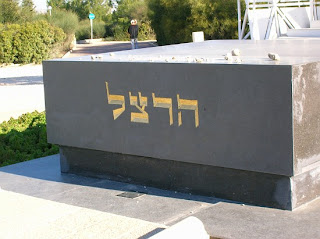 ur guide led us to Herzl's grave, which is a black square tombstone at the highest point on Mt. Herzl where the four letter's of Herzl's name in Hebrew are engraved starkly in gold against the black gravestone. We talked about the simplicity of the grave and how it is more important to remember the person, in Jewish tradition, than to memorialize with an elaborate grave.
 ur guide led us to Herzl's grave, which is a black square tombstone at the highest point on Mt. Herzl where the four letter's of Herzl's name in Hebrew are engraved starkly in gold against the black gravestone. We talked about the simplicity of the grave and how it is more important to remember the person, in Jewish tradition, than to memorialize with an elaborate grave.
From there, we visited the graves of a number of important people, including Jabotinsky, a right wing revisionist Zionist leader, Golda Meir, the fourth prime minister of Israel, and Levi Eshkol, the third prime minister of Israel. Each of these tombstones is simple, a black tombstone much smaller than that of Herzl that has the name of the dignitary, and other important information, but nothing ostentatious.
The grave of Yitzhak Rabin is somewhat different. Because Yitzhak Rabin was the only prime minister ever ass asinated, and his assasination was such a powerful moment in Israeli history, his grave is marked by a larger and more dramatic monument. It is a semicircle of two parts - a black and a white. The semicircle symbolizes that Rabin did not live the length of his natural life, and the black and white in opposition to one another, with a space in between them, show the controversy and the atmosphere of disagreement in Israeli society that led to and followed his death.
 asinated, and his assasination was such a powerful moment in Israeli history, his grave is marked by a larger and more dramatic monument. It is a semicircle of two parts - a black and a white. The semicircle symbolizes that Rabin did not live the length of his natural life, and the black and white in opposition to one another, with a space in between them, show the controversy and the atmosphere of disagreement in Israeli society that led to and followed his death.
We also visited the grave of Hannah Senesh, a Hungarian born Jew living in Palestine during the Second World War who was trained by the British military to parachute into Yugoslavia to help save the Jews of Hungary. She was arrested at the Hungarian border, imprisoned and tortured, and was executed by a firing squad. At her grave we sang a poem of hers, Halika l'Caesaria (Eli Eli), which his a very well know and oft-sung song.
We visited the graves of many soldiers, including those who perished in the Second Lebanon war. There was a group of soldiers also visiting the graves, and this struck me as very powerful - what must it be like as a soldier to visit the graves of soldiers, knowing that you might be buried in one yourself? We asked our teacher about it - what the soldiers were told and why they went, and she told us that soldiers in the Israeli army, especially in the past and less so now, consider it an honor to die fighting for their country, and that really these visits to grave sights were at least once considered motivational - that soldiers would want to fight and to be a part of the community of heroes, both living and dead, who fought for their country. Nevertheless, it felt deeply tragic to look from the photos that were placed on the graves of falen soldiers to the faces of living soliders with bowed heads mourning for the fallen and perhaps thinking of what might befall them as well.
We visited a memorial to the soldiers who faught in the War for Independance who were Holocaust survivors, many of them without surviving families. The tour guide told us that many of the bodies went unrecognized and are in graves without names because there was no one left who knew the names of these soliders. The monument looks like a deep hole, but the inside is shaped so that it also looks like an upside down house, because these soldiers' homes had been destroyed. It also looks like it could be a tunnel to Yad VaShem, the Holocaust Memorial that is closely connected to Mt. Herzl, and it demonstrates that these soldiers (and the establishment of Israel) are deeply connected to the events of the Holocaust.
We also visited a memorial to victims of terror, which included the names of all of the victims of terror since the establishment of the State of Israel.
Incidentally, as we walked from site to site, I overheard a Jewish student speaking to a Palestinian student about all of this - the Palestinian student had never heard of most of the figures whose graves we were visiting and did not know the history of Zionism at all, or really why Jews had come to Israel in the first place. I appreciated the mutually respectful conversation I overheard and was very proud that our class had created a safe space for such a conversation to occur, but I also think that this lack of knowledge (which I'm sure is absolutely reciprocated by Israeli lack of knowledge of Palestinian history/perspectives) illustrates the deep and tragic divides in Israeli society.
In sum it was definately an educational trip and it was nice to get out of the classroom and go somewhere. And, wonder of wonders, we returned in time to practice prepositions for an hour before ulpan let out!
Subscribe to:
Posts (Atom)