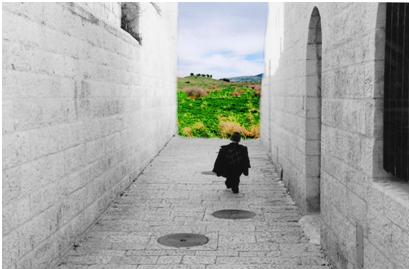
Day 4
In the morning after breakfast Daniel and I planned for the Kabbalat Shabbat service we would be leading in the evening and took some time to rest. At 1:00 PM we met Mattvey, the youth group coordinator, and Emma, and walked with them to a restaurant for lunch. Mattvey is a chef – he graduated from a two year cooking degree program and works as a chef though his hobby is working with computers. With Emma’s help, we talked to Mattvey for a long time about a number of different subjects – it started off as a light conversation about cooking, life, movies, etc., but eventually became a very serious and informative talk. We learned that there is a lot of tension between Chabad and the progressive community. This is something we had learned about Chabad in the FSU generally – ((incidentally if you want to read a good summary of contemporary Jewish culture in Moscow there is a terrifically useful chapter in it in David Shneer and Caryn Aviv’s work New Jews: The End of the Jewish Diaspora)) Matvey told us that Chabad claims it has the only legitimate form of Judaism and it does so in a noninclusive way – the Chabad Rabbi sad that a Jew married to a non-Jew is as toxic as a person with AIDS. 80% of the Jewish community in Lipetsk is intermarried and the progressive community welcomes non-Jewish family and friends as members of the community. Chabad has more money, government recognition, and international clout, while the progressive community here is more or less on its own. Chabad meets in a beautiful new synagogue and the progressive community in a small room in an office building, though the Chabad community is only a few years old and the progressive community was founded fifteen years ago.
We asked how much Jewish history the community knows and found that they know very little, and that the Holocaust is barely taught in public school. Certainly the Jews here are more aware of Holocaust history than are their non-Jewish counterparts, but that knowledge seems limited, and knowledge of Jewish history outside of the Holocaust is all but nonexistent.
Daniel and Mattvey talked at length about whether one needs to follow commandments to be a Jew. Mattvey argued against the Chabad model and Daniel mostly agreed with him that Jew should not feel obliged to follow all of the commandments in order to consider themselves Jewish. Moreover, he encouraged Matvey not to think of himself as practicing Judaism as defined by Orthodoxy incorrectly, but instead to think of himself as practicing progressive Judaism correctly.
We asked Mattvey if he wants to stay in Lipetsk or move away and he said he wants to stay – he can have a good job and a good life here. He told us that people are always thinking that life is bad in Lipetsk and would be better in Israel but Mattvey thinks that life here is good - he feels connected to the Jewish community here and has economic opportunities as a chef that might not be available to him elsewhere. He also feels connected to Jews around the world because he has family and friends in Israel, France, England, Belarus, and Ukraine. He has done training as a youth group leader and has gone to Jewish camps, so he has connections with Jews throughout Russia and the FSU. But ultimately Lipetsk is his home and where he wants to be.
After lunch we took a bus to a run down office building, and in a small room about the size of the living room in our Jerusalem apartment, we found the home of the progressive community. Apparently they used to be in a larger space but recently downsized because of the economic crisis.
We were visiting for a youth group meeting – about six youth groupers sat round a table and we were to answer their questions about Judaism, American Jewish life, and ourselves. They started by asking about youth group in America, and we answered their questions about its structure and size. Very quickly, though, Olga pushed the conversation toward how these Jews learned that they were Jewish (and when) and what this means for them. The stories were incredible and really beyond my expectations. Several of these teenagers had spent most of their childhoods not knowing that they were Jews. One boy, Zachar, learned that he was Jewish two years ago. His grandmother lives in Israel and when he was growing up his parents told him that his grandmother was in Australia. One day two years ago Zachar’s parents were talking about Israel and Zachar asked why they were talking about this subject. They revealed to him that his grandmother was actually in Israel and that the family was Jewish. He didn’t get involved in the Jewish community right away, but when he learned about MASA, Naaleh, and other such programs he went to Olga to ask her to be a reference for him, so that he can leave Lipetsk for Israel. As he was preparing by learning Hebrew, he realized that the Jews were just normal people and that he liked them, and he became involved with the youth group. Almost everyone in the room had similar stories – they learned that they were Jews recently and got involved in order to go on an Israel program. If it weren’t for these programs they wouldn’t have pursued their Jewish identities at all, but now they are active and learning and leading their lives as Jews. Only one of the students, Katya, had been involved in the Jewish community since she was little. She said that her mother has always had Jewish friends, but she doesn’t think she is really Jewish. She’s been a member of the community since she was seven and it is a major part of her life. When she was little she used to play Jewish songs on the keyboard for the community.
We asked if everyone wants to leave the community and Olga told us that most young people do not want to stay in Russia. I asked if this was sad for the community and she said that the goal of the community is to teach and foster Judaism and as long as the kids stay Jewish she considers it a success wherever they are. Many go to Israel, but a large percent do stay in Russia. The reasons that they want to go to Israel became progressively more clear to us as the conversation wore on. The Lipetsk economy is not good, and Israel offers a way out. Also the education in Israel is better. We gave them opportunities to ask us questions and Zachar asked Daniel how long he had been in Israel. “Did you serve in the US army then?” he asked. Mattvey explained to Zachar trhat in the US military service is not required and Zachar explained to us that many boys try to get to Israel because the conditions in the Israeli are much better than the Russian army, so they escape the Russian army and go into the Israeli one. We learned that Russian young men are drafted into the Russian army which has extreme hazing practices including beating, rapes, and death. Insufficient supplies, poor pay, and absence of proper training are only a few of the problems that make the Russian army such a terrifying possibility for Zachar and boys like him. Many young Russians escape from the draft through bribery and influence. They go to college to postpone the draft and after college they run away or pay money so they won’t have to go. Those who do go to the army are already disadvantaged – they don’t have the money for bribery. So it’s easy to understand why making aliyah seems like an attractive option.
Daniel asked what the students like about being Jewish and they said it has to do with the sense of community. People here would do anything for each other and are a family. They also said that being Jewish is interesting. Russians are very invested in conformity, but in the Jewish community it is possible to ask questions, talk about interesting and unusual subjects and learn new things. This makes Jews more interesting to these youths than are other people.
The youth group meeting was a surprising and really incredible conversation in which we began to understand what being Jewish means here. We later learned that other groups did not face similar stories of people discovering their Jewishness and wanting to make aliyah, and these stories might be more prevalent in Lipetsk than elsewhere – it’s hard to tell. Olga learned that she was Jewish fifteen years ago, and knew nothing about what that meant. She founded the Jewish community originally just so that Jewish people could meet each other and see other Jews. But the community came to realize that nothing would really happen for them if they couldn’t teach the children. Then Olga began to study Judaism. She has a degree in social work, but her office is lined with other certificates as well. She graduated from the Melton Institute of Jewish Education at Hebrew University, took part in a JCC leadership training institute in Vilna, wrote two award winning programs for her community, and much more. Single-handedly she teaches whoever wants to know what it means to be Jewish and sends the young people on Israel trips so that they can learn more. She is strong and even a bit bossy but is also incredibly talented and knowledgeable – she is a guitar player and songwriter, she is a leader of prayer, a teacher, and administrator, and a fundraiser. And she is a much loved matriarch who has built the community all by herself.
The kids thanked us warmly for our visit but I don’t think they learned nearly as much from us as we did from them – I will be thinking long and hard about them and what it means for them to be Jewish in Lipetsk.
After the youth group meeting, we had a few minutes to prepare a bit for Kabbalat Shabbat services. In the meantime, community members started coming in casually, bearing bowls of food, looking at pictures from Pesach on Olga’s older-looking computer, talking, and laughing. They pushed the tables to the side and set up rows of chairs facing an ark in which a Torah, donated by a congregation in Brooklyn, NY, rests.
Daniel, Emma, and I sat in front and before we began the service we introduced ourselves in more detail than the previous evening and everyone asked a lot of questions – how long are we in Israel, where are we from, what do we do, etc. They were interested that I study Yiddish alongside English literature at university as those things seemed drastically different to them. They asked if my family speaks Hebrew or Yiddish and where I learned the languages.
We began the service. Olga usually leads the services each week and so they know some but not all of the tunes and prayers but they were eager to participate and to sing along where they could. I led most of the music, and Daniel gave a short drash (translated by Emma) about the Torah portion and the congregation listened carefully, nodding their heads to confirm their understanding. After services, as we folded our talitot, the congregation pulled out the tables and chairs and laid the table with food they had brought – salads, fish, vegetables, a latke-like patty made out of matzoh, etc. We sat down to partake of the feast.
We sat at one end of the table and Olga sat at the head. Across the table she called to Emma “What do they do on Shabbat? Do they have food at synagogue?” and the conversation proceeded – questions from Olga and our responses, with comments from around the table and frequent urges for Emma to take a rest and eat and let another English speaker translate a bit. The conversation quickly moved from questions about our Shabbat to questions about our families – are our brothers and sisters all Jewish? Are they Chabad or Reform? This led into a heated conversation about Chabad, which is constantly insulting the community and challenging their sense of authenticity. Olga often hears complaints about Chabad from her community members but she tries to smooth things over because she wants the Jewish community to be able to present a united front. It’s hard enough to be Jewish in Lipetsk without internal problems – Russians do not like people who are different. Chabad has official relationshops with the government, has a whole beautiful building, but not enough congregants to fill it, and everyone we spoke to seems to feel that the community would be better off with no rabbi than with a Chabad rabbi who competes for their members. Of course we did not speak with any members of the Chabad synagogue, who I’m sure have a different opinion. Nevertheless, it is clear that Chabad is imposing its own views about Judaism on a community that is uncomfortable with them.
We paused our conversation a bit in order to do some singing – in Russian with Olga playing the guitar. They sang a song about Jewish eyes which are filled with tears of joy and sadness – you know Jews anywhere because of their eyes. We heard a song about the “rights of Jewish women” which was called “I will marry Jewish.” In it the women say that it is better to find a Jewish man because he will treat them well –he won’t spend his money and time on alcohol, if he is out late it is because he is working, etc. I’m not sure how well a song like this about Jewish superiority would go over in the US but in a country where “Jew” is still somewhat of a slur, I could see why promoting positive self image is so important.
After singing we again became the focus of conversation. They asked us how we were chosen to go to Russia and we explained a bit about the FSU project and how we are a part of a larger group sent throughout the FSU and had requested to go to Russia because Daniel’s family is originally from there. They asked a question about how we were able to pay for the trip during the financial crisis and as Katya translated she said that everyone is always thinking about and worrying about the crisis. I explained our fundraising activity and they seemed please that our communities were so willing to send us to the FSU and to think that it was a worthy project. As the evening wore on, the conversation drifted to Yiddish. They told me that here only a few older people know Yiddish and the language is dying out. They are very sorry that the young people don’t know any Yiddish and the older people have no one to talk to. Not only did they want to talk about my chosen profession, they seemed especially eager to talk to Daniel in his Rabbinical role. People asked him questions as a rabbinical authority – one woman asked when she should commemorate yartzheit for her grandfather who passed away in the Holocaust – she doesn’t know where or when. Someone else had questions about brit milah. Daniel answered all of these questions adeptly and patiently. I took on a cantorial role, I suppose, in that they asked me to sing some songs for them. I sang a few songs in Yiddish that were easy to learn and these seemed to be appreciated and enjoyed. One congregant told me that I should become a professional singer. In fact, the community veritably flooded us with compliments though they insisted that these were not compliments but truths. They told us that we were the first rabbinical students who they felt really communicated why they had come. They appreciated our enthusiasm and they said that they believe that Daniel is a very special, wise person who will be a natural fit as a rabbi. They told us we should consider ourselves to be part of their community – honorary members who are always welcome to return, and gave us a gift of postcards of Liptesk that we can take back with us.
Soon it was time to leave and we hugged and kissed everyone and tore ourselves away from our new friends in order to pack our bags and catch the train to Moscow. In the hotel as we were packing, Daniel and I discussed that we were able to be so successful because of Emma, who made it possible for us to understand and communicate so fluidly.
On the train we stayed up late, playing cards and joking with Emma.
Showing posts with label Jewish identity. Show all posts
Showing posts with label Jewish identity. Show all posts
Thursday, April 16, 2009

Friday, April 3, 2009
1776 - or 1948
Last night Daniel and I went with a group of HUC students to see a production of 1776 by a Jerusalem English-speaking amateur theater company. The production was pretty decent for community theater and of course the HUC cantors who took part in it were terrific, but one of the most interesting moments of the whole show happened at the very end, after the bows and the applause, when John Adams, Thomas Jefferson, Benjamen Franklin, and a host of others stood lined up on the stage and the director stepped forward to address the audience. She explained that while 1776 is a story about America, the sacrifices made in the name of democracy and freedom are close to the hearts of us all because of the sacrifices made in the establishment of our own country, Israel. She recognized an audience member who had been an Israeli spy in Lebanon and had been improsoned for years as a result of her work. Then, a tearful John Adams continued in making the connections betwene the pursuit of liberty in colonial America and Jews in Israel fighting for their own land and an escape to anti-Semitism. He asked the audience to rise, and a group of people with American accents were led by English-speakers in American colonial garb in the singing of HaTikvah. The sentimental nationalism was a bit much for me, but afterwards, several of us exclaimed about that moment and how we'd like to write term papers on American Jewish Israeli immigrant identity - how they expressed their American-ness as Jews living in Israel, and how they expressed their Jewishness and Israeliness through and by connecting it to American mythology surrounding the founding fathers. It was all very... interesting.
Thursday, December 25, 2008
In the world of Haredim.
.בעולם חרדים
Yesterday, the men of our class went on a guided tour of Meah Shearim, an ultra-orthodox neighborhood in Jerusalem. Our guide was an ex-Haredi (ultra-Orthodox) who leads a group of HUC students every year through the neighborhood. I've been in Haredi areas before, but I'd never been into the heart of Meah Shearim. It was intense!
The buildings were close together, and the streets were narrow. The two hundred year old neighborhood is home to a number of different Haredi communities whose differences run deep and heavy, yet to an outsider, all Haredim look the "same." Some are easier to spot than others, but the differences between the groups seem so arbitrary and minor (as they often stem simply from which rabbi the community follows) that lumping all ultra-orthodox Jews into a single group is tempting.
Despite the presence of a multitude of different prayer spaces, one large synagogue sits at the heart of the neighborhood next to the community mikveh (ritual bath). Men (and a few women) were walking around, and none of them gave us a hard time, though all of them visibly noticed our unusual presence. As we passed a heder (school), I heard the call and response teaching of classical texts in Hebrew and Yiddish that I've only seen in a movie before - it was incredible to witness instruction like that actually going on.
Posters in Hebrew were displayed everywhere. One that says "Modest dress required" had been scribbled out, though others declaiming that association with the modern world is forbidden were left untouched.
When we left Meah Shearim and moved into the Yeminite orthodox neighborhood, our guide was visibly relieved. He knew that there wouldn't be any danger of being harrassed in this more moderate neighborhood. We got a chance to see the actual street Meah Shearim (which is not part of the neighborhood), which serves as a kind of main street in this orthodox part of town. Shops carrying stacks of black kipot, portraits of famous rabbis, and tchochkes for tourists sat next to jewlery stores, groceries, and restaurants. This was orthodox life, and I was a visitor.
I composed a journal entry for my Israel seminar class about the experience - that entry is copied below. I've been learning a lot about orthodoxy recently, and I wish I could repeat all the information I've absorbed, but there just isn't room for that on this blog or in my schedule. Suffice it to say that I understand the Jewish spectrum much better now, and I am sure I'll be a better rabbi for it.
To the modern Jew, one’s Jewish identity is formed in the context of the surrounding world. Of course, this process is not new to Judaism, but before competing (i.e., non-religious) models of identity came into being during the Enlightenment, being Jewish was a relatively binary enterprise. In today’s world, Jews take into account history, society, politics, economy, etc. when framing self-identities, and Jewish communities are built with all of these factors in mind. Although contemporary ultra-orthodox (Haredi) communities do not entirely avoid every aspect of modern life, these communities are built on the foundations of non-integration. Thus, stepping into Meah Shearim was like moving into a different world.
At first, I felt that the buildings and people surrounding us were like any other Haredi homes and people in Jerusalem that I pass every day. Yet, our guide, Avraham, assured us that the rules were different here. His edginess betrayed a significant discomfort with leading us through the Haredi neighborhood, and he shared with us that there was a possibility that we would be harassed. If we appeared disrespectful or if we had had women in our group of men, Avraham indicated that the chances of our being disturbed would have been much higher. However, their disturbing us would come as a result of our disturbing them.
This particular notion is what captured my attention more than any other during the tour. Meah Shearim is not a standard example of self-segregation; rather, the neighborhood represents boundaries wherein the very rules of identity are changed. The modern world is an intruder here, and non-Haredi people who live here are by no means part of the community. Differences between individual communities are vast, yet a shared house of assembly, a shared mikveh, shared soup kitchens, etc. reflect a sense of defined community. Though not everyone in a state agrees, they share a capital and all use the same buses; here, too, individuals from different sub-sects of the community share space within their world while maintaining individual differences.
At the heart of this community is a particular and exclusive model of Jewish identity. Within Meah Shearim, there is no such thing as tradition. There is no such thing as orthodoxy. There is no such thing as religious creativity. Judaism is and the residents’ lives are Jewish. Whereas “traditionalists live in a situation of modernity, surrounded by competing alternatives in life,” there are no competing alternatives here. Residents of Meah Shearim refer to themselves as Yidn, Jews - aside from them and people like them, there are no other Jews: “Jews who [live] like the goyim [are] also goyim.” Although Haredi Jews outside of these physical boundaries are obligated “to be set apart from mainstream culture and remain steeped in Jewish texts and ways,” inside the neighborhood, life simply goes on. Men study, many of them work, friendships and competing ideologies play out, and life progresses--as they see it--normally.
In the early months of my living in Israel, I came to notice within myself a striking aversion to those who represented themselves as Haredi. I felt automatically judged, excluded, and belittled. In recent months, I’ve made a concerted effort to try to overcome my prejudices about Haredi people, though I remain a long way from success. However, while walking through Meah Shearim, I was extremely surprised not to find similar feelings of alienation and accused inferiority. Although Avraham’s presence represented an obvious crossover between the worlds, my relationship with this new Haredi “land” was as of visiting a foreign country. These Haredim were not judging me - they were entirely dismissing me.
My reaction to that philosophy is, naturally, complex. On the one hand, I felt less angry about the rifts between our communities than I often feel with regard to Haredi Jews. Yet on the other, I was made to feel that these rifts don’t exist because the communities in no way whatsoever overlap. Martin Buber teaches that to hate someone is to come close to an I-Thou relationship and to be unable to enter it and is therefore better than complete apathy and dismissal, from which there is no proximity whatsoever to an I-Thou relationship. Following from this, it’s better to argue with a Haredi person about Jewish identity than to be entirely dismissed by one. In the latter case, the overall community is entirely shattered, and to pick up the pieces requires a commitment to see one another from both sides. Since the inhabitants of Meah Shearim for the most part refuse to see the outside world, their community will remain entirely separate.
A part of me feels a sadness about this separation, while a part of me recognizes that it is the natural outgrowth of a particular model of understanding Jewish identity. These Jews, unlike others who deliberately spit directly in the face of the modern world, live their lives as anyone else, with different but recognizable problems and successes. Would I bring a tour group to Meah Shearim? Certainly not. Would I include it in a list of Jewish communities? Probably. Would I seek out the opportunity to dialogue with a Haredi person about Jewish identity? Absolutely. Our worlds may appear separated, but in physical reality, the proximity cannot be denied, and I believe that over time, this community will have to work out a way to understand and relate to the rest of the world without having to shut it out entirely. When they do, I hope that other Jewish communities, though perhaps not easily or peacefully, will be prepared to engage Haredim and challenge their notions of Jewish identity so that we can continue the struggle towards building a multifaceted yet unified Jewish community.
Yesterday, the men of our class went on a guided tour of Meah Shearim, an ultra-orthodox neighborhood in Jerusalem. Our guide was an ex-Haredi (ultra-Orthodox) who leads a group of HUC students every year through the neighborhood. I've been in Haredi areas before, but I'd never been into the heart of Meah Shearim. It was intense!
The buildings were close together, and the streets were narrow. The two hundred year old neighborhood is home to a number of different Haredi communities whose differences run deep and heavy, yet to an outsider, all Haredim look the "same." Some are easier to spot than others, but the differences between the groups seem so arbitrary and minor (as they often stem simply from which rabbi the community follows) that lumping all ultra-orthodox Jews into a single group is tempting.
Despite the presence of a multitude of different prayer spaces, one large synagogue sits at the heart of the neighborhood next to the community mikveh (ritual bath). Men (and a few women) were walking around, and none of them gave us a hard time, though all of them visibly noticed our unusual presence. As we passed a heder (school), I heard the call and response teaching of classical texts in Hebrew and Yiddish that I've only seen in a movie before - it was incredible to witness instruction like that actually going on.
Posters in Hebrew were displayed everywhere. One that says "Modest dress required" had been scribbled out, though others declaiming that association with the modern world is forbidden were left untouched.
When we left Meah Shearim and moved into the Yeminite orthodox neighborhood, our guide was visibly relieved. He knew that there wouldn't be any danger of being harrassed in this more moderate neighborhood. We got a chance to see the actual street Meah Shearim (which is not part of the neighborhood), which serves as a kind of main street in this orthodox part of town. Shops carrying stacks of black kipot, portraits of famous rabbis, and tchochkes for tourists sat next to jewlery stores, groceries, and restaurants. This was orthodox life, and I was a visitor.
I composed a journal entry for my Israel seminar class about the experience - that entry is copied below. I've been learning a lot about orthodoxy recently, and I wish I could repeat all the information I've absorbed, but there just isn't room for that on this blog or in my schedule. Suffice it to say that I understand the Jewish spectrum much better now, and I am sure I'll be a better rabbi for it.
To the modern Jew, one’s Jewish identity is formed in the context of the surrounding world. Of course, this process is not new to Judaism, but before competing (i.e., non-religious) models of identity came into being during the Enlightenment, being Jewish was a relatively binary enterprise. In today’s world, Jews take into account history, society, politics, economy, etc. when framing self-identities, and Jewish communities are built with all of these factors in mind. Although contemporary ultra-orthodox (Haredi) communities do not entirely avoid every aspect of modern life, these communities are built on the foundations of non-integration. Thus, stepping into Meah Shearim was like moving into a different world.
At first, I felt that the buildings and people surrounding us were like any other Haredi homes and people in Jerusalem that I pass every day. Yet, our guide, Avraham, assured us that the rules were different here. His edginess betrayed a significant discomfort with leading us through the Haredi neighborhood, and he shared with us that there was a possibility that we would be harassed. If we appeared disrespectful or if we had had women in our group of men, Avraham indicated that the chances of our being disturbed would have been much higher. However, their disturbing us would come as a result of our disturbing them.
This particular notion is what captured my attention more than any other during the tour. Meah Shearim is not a standard example of self-segregation; rather, the neighborhood represents boundaries wherein the very rules of identity are changed. The modern world is an intruder here, and non-Haredi people who live here are by no means part of the community. Differences between individual communities are vast, yet a shared house of assembly, a shared mikveh, shared soup kitchens, etc. reflect a sense of defined community. Though not everyone in a state agrees, they share a capital and all use the same buses; here, too, individuals from different sub-sects of the community share space within their world while maintaining individual differences.
At the heart of this community is a particular and exclusive model of Jewish identity. Within Meah Shearim, there is no such thing as tradition. There is no such thing as orthodoxy. There is no such thing as religious creativity. Judaism is and the residents’ lives are Jewish. Whereas “traditionalists live in a situation of modernity, surrounded by competing alternatives in life,” there are no competing alternatives here. Residents of Meah Shearim refer to themselves as Yidn, Jews - aside from them and people like them, there are no other Jews: “Jews who [live] like the goyim [are] also goyim.” Although Haredi Jews outside of these physical boundaries are obligated “to be set apart from mainstream culture and remain steeped in Jewish texts and ways,” inside the neighborhood, life simply goes on. Men study, many of them work, friendships and competing ideologies play out, and life progresses--as they see it--normally.
In the early months of my living in Israel, I came to notice within myself a striking aversion to those who represented themselves as Haredi. I felt automatically judged, excluded, and belittled. In recent months, I’ve made a concerted effort to try to overcome my prejudices about Haredi people, though I remain a long way from success. However, while walking through Meah Shearim, I was extremely surprised not to find similar feelings of alienation and accused inferiority. Although Avraham’s presence represented an obvious crossover between the worlds, my relationship with this new Haredi “land” was as of visiting a foreign country. These Haredim were not judging me - they were entirely dismissing me.
My reaction to that philosophy is, naturally, complex. On the one hand, I felt less angry about the rifts between our communities than I often feel with regard to Haredi Jews. Yet on the other, I was made to feel that these rifts don’t exist because the communities in no way whatsoever overlap. Martin Buber teaches that to hate someone is to come close to an I-Thou relationship and to be unable to enter it and is therefore better than complete apathy and dismissal, from which there is no proximity whatsoever to an I-Thou relationship. Following from this, it’s better to argue with a Haredi person about Jewish identity than to be entirely dismissed by one. In the latter case, the overall community is entirely shattered, and to pick up the pieces requires a commitment to see one another from both sides. Since the inhabitants of Meah Shearim for the most part refuse to see the outside world, their community will remain entirely separate.
A part of me feels a sadness about this separation, while a part of me recognizes that it is the natural outgrowth of a particular model of understanding Jewish identity. These Jews, unlike others who deliberately spit directly in the face of the modern world, live their lives as anyone else, with different but recognizable problems and successes. Would I bring a tour group to Meah Shearim? Certainly not. Would I include it in a list of Jewish communities? Probably. Would I seek out the opportunity to dialogue with a Haredi person about Jewish identity? Absolutely. Our worlds may appear separated, but in physical reality, the proximity cannot be denied, and I believe that over time, this community will have to work out a way to understand and relate to the rest of the world without having to shut it out entirely. When they do, I hope that other Jewish communities, though perhaps not easily or peacefully, will be prepared to engage Haredim and challenge their notions of Jewish identity so that we can continue the struggle towards building a multifaceted yet unified Jewish community.
Tuesday, November 11, 2008
Enabling Jews in the Former Soviet Union to Celebrate Passover
This Passover, Daniel and I will be participating in an exciting project that will strengthen Jewish identity in the Former Soviet Union. This April, we will be traveling, along with twenty-five rabbinical, cantorial, and education students from Hebrew Union College – Jewish Institute of Religion (HUC-JIR), to the Former Soviet Union (FSU).
In partnership with the World Union for Progressive Judaism, which unites and supports Reform congregations worldwide, we are happy to announce our Seventh Annual FSU Pesach Project. The mission of our trip is to provide meaningful Passover celebrations for thousands of underserved Jews in the region.
While there has been an abundance of Jewish philanthropy and development in the FSU since the 1990s, there are still only six progressive rabbis to serve over one hundred Jewish communities during Passover. Our student delegations will be traveling to more than twenty communities throughout Russia, Ukraine and Belarus in order to lead Passover seders, conduct educational programming, create relationships with Jews of all ages, and strengthen the Jewish identity of these diverse communities.
The cost of participation for each delegate is $2,000, which includes: travel expenses, educational materials, Passover supplies for all the participants, as well as, donations to each community, which will enable them to continue observing Passover in the years to come. Supporting this project is an important way to recognize the profound importance of celebrating the Jewish story of liberation in a
place where freedom from oppression is a very real, and recent, experience. Any amount you can contribute will make a huge difference in offsetting the costs of participation.
Tax-deductible donations* can be made online or via USPS:
• Online: www.pesachproject.com. Be sure to mark my name in the "Comments"
• By mail: HUC-JIR / Attn: Diane Bongard / 3101 Clifton Avenue / Cincinnati, OH 45220. Mark "FSU Pesach Project" along with one of our names in the memo line.
If you have any questions regarding this exciting project, please comment or e-mail us at Jessica.Kirzner@gmail.com and Daniel.A.Crane@gmail.com.
In partnership with the World Union for Progressive Judaism, which unites and supports Reform congregations worldwide, we are happy to announce our Seventh Annual FSU Pesach Project. The mission of our trip is to provide meaningful Passover celebrations for thousands of underserved Jews in the region.
While there has been an abundance of Jewish philanthropy and development in the FSU since the 1990s, there are still only six progressive rabbis to serve over one hundred Jewish communities during Passover. Our student delegations will be traveling to more than twenty communities throughout Russia, Ukraine and Belarus in order to lead Passover seders, conduct educational programming, create relationships with Jews of all ages, and strengthen the Jewish identity of these diverse communities.
The cost of participation for each delegate is $2,000, which includes: travel expenses, educational materials, Passover supplies for all the participants, as well as, donations to each community, which will enable them to continue observing Passover in the years to come. Supporting this project is an important way to recognize the profound importance of celebrating the Jewish story of liberation in a
place where freedom from oppression is a very real, and recent, experience. Any amount you can contribute will make a huge difference in offsetting the costs of participation.
Tax-deductible donations* can be made online or via USPS:
• Online: www.pesachproject.com. Be sure to mark my name in the "Comments"
• By mail: HUC-JIR / Attn: Diane Bongard / 3101 Clifton Avenue / Cincinnati, OH 45220. Mark "FSU Pesach Project" along with one of our names in the memo line.
If you have any questions regarding this exciting project, please comment or e-mail us at Jessica.Kirzner@gmail.com and Daniel.A.Crane@gmail.com.
Wednesday, September 10, 2008
The value of being Jewish.
.ערך קיום יהודי
Jessica briefly mentioned in her previous post that she was instructed to get a letter from an American rabbi attesting to her Jewishness in order to receive a student visa. The whole notion is absurd because one doesn't need to be Jewish to be a student in Israel, and the fact that it would even come up is troubling and frustrating to Jessica and me. That the officer at the Ministry of the Interior would even think to ask for such confirmation (even in error) belies the gross neglect of religious freedom in this country. Sure, if Reform Judaism is treated as a separate faith (as suggested by Rabbi Yisrael Rozen), we could have equal rights, but so long as we claim Judaism as our own, progressive Jews in Israel will continue to face religious and legal barriers that fly in the face of Deuteronomy 16:20's invective, "צדק צדק תרדף" (Justice, justice shall you pursue).
This is because, if the Ministry really wanted to push the matter (which I don't expect), the authority of the American rabbi that Jessica finds would have to be examined. Perhaps Jessica's pedigree would be up for discussion. Of course, Jessica is unquestionably Jewish even by the most orthodox standards, but someone who (A) didn't have a rabbi, (B) didn't have a Jewish mother, or (C) wasn't Jewish would certainly have a hard time receiving this visa! I can't believe that even here this letter is required, but that it's asked for is indicative of a pro-Jewish bias that exists in Israel to such a large degree that it can't even be seen.
And what's it based on? Israel was founded as a Jewish country and has been struggling with that title for the past sixty years. People have been asking, "What does it mean to be Jewish?" for a very long time, but I doubt the question is often raised of, "What's the value of us being Jewish?" If a magic genie gave me the option of making Israel a true model of civil liberty, a bastion of peace in the region, an anti-war advocate, and a democracy that values the voices of the few and seeks to bring peace and security to the whole but lose its Jewish identity, I don't know what I would do. Is being Jewish so important that I would choose it over an automatic guarantee of ethics?
On the one hand, I believe that Judaism is a gateway to ethical living and that the Torah is a medium through which we can gain wisdom and Truth. On the other hand, I don't believe that Judaism and the Torah are unique in these roles but rather are specifically efficacious and beneficial to those who identify with them. Why are there Jews? I don't know. But I believe that it's good for the Jewish people for us to be Jewish, and insofar as the Jewish people has a strong track record of "getting it right" in terms of ethics and spirituality, I'm proud to espouse the values of my religion. Yet being Jewish is neither necessary nor sufficient to being ethical, and if ethics are my ultimate priority (and my support of Judaism is a support of unification and ethical living among and outside of our people), should not ethics (or, religiously speaking, perhaps even "pure" spirituality?) outweigh Jewish identity?
I don't know.
Take the example I laid out during Wexner Post 3 about giving money to the questionably Jewish organization that I believed in. Why does Judaism have to enter into the equation at all? We might cede that Jews have a tendency to be more likely to be involved in social action/progress than a non-Jew (though I'm far from claiming that as an existential truth), but nevertheless, I would never feel comfortable making such a decision based on religion alone.
And yet, I also struggle with the notion that not only Israel's orthodox Judaism has an obvious, occasionally unjust bias towards Jewish identity. Also our very own movement has struggled and continues to struggle with this concept, as do I. Take marriage between Jews and non-Jews as an example of assumptive priority of Jewish identity. As of right now, the "official" position of the Reform Movement is as follows:
"The Central Conference of American Rabbis, recalling its stand adopted in 1909 that mixed marriage is contrary to the Jewish tradition and should be discouraged, now declares its opposition to participation by its members in any ceremony which solemnizes a mixed marriage. The Central Conference of American Rabbis recognized that historically its members have held and continue to hold divergent interpretations of Jewish tradition.
In order to keep open every channel in Judaism and Kelal Yisra-el [the Jewish People] for those who have already entered into mixed marriage, the CCAR calls upon its members:
1. To assist fully in educating children of such mixed marriage as Jews;
2. To provide the opportunity for conversion of the non-Jewish spouse; and
3. To encourage a creative and consistent cultivation of involvement in the Jewish community and the synagogue."
However, a statement given by CCAR president Harry Danziger in 2006 at the CCAR convention complicates the Reform movement's stance:
"I look back thirty-three years to the Atlanta convention of 1973, called by some the Battle of Peachtree. There after years of debate and too often acrimony, a ten line resolution was passed opposing officiation at intermarriages. Pamphlets and articles attacking one side or the other abounded. There were even threats of a split in the Conference as there had been before over Zionism.
Five years later, in 1978, Alex Schindler, zichrono livracha, proposed a comprehensive outreach program through which we turned our attention, not only to weddings – the beginning of a new household – but to outcomes – the nature of the family thus created.
In 1983, there were passionate divisions in this Conference over the proposed resolution on children of intermarriage, what has been termed “the patrilineal” resolution. The debate was intense. At the end, we broke new ground in response to new realities, and we proclaimed that, for us, the gender of the Jewish parents would not be the determinant of who is a Jew. Most of us came to live by it. Some still question it. That is part of who we are.
Move forward yet another eleven years. In 1994, in Philadelphia, I was invited to be part of a major program at the convention. Two rabbis and two lay leaders spoke. I was invited to speak on why and how I do in fact officiate at intermarriages. And the president of the Conference at that time, Shim Maslin, who deserves great credit for that program, was a leading proponent of the 1973 resolution. Beit Hillel – They studied and listened to the views of the other side.
This week we have workshops and programs that deal with how we respond to intermarriage, how we engage and involve, yes, and honor, the non-Jewish partner who lives as a Jew albeit without conversion – what some of us call a ger toshav – what I sometimes call a “common law Jew”. The official position may continue to be a ten line resolution in Atlanta, but the practice has become a consensus that there is more than one respectable way to deal with those issues."
So, in combining these two sources, we find that the Reform movement "officially" discourages interfaith marriages and, in the case of an interfaith marriage, encourages the raising of Jewish children, participation in the Jewish community, and the conversion of the non-Jewish spouse. Individual rabbis (including the president of the CCAR) may (and many do) disagree with any of these points and act according to their conscience. So there's an internal struggle in the movement about whether it's of existential value to marry a Jew.
What seems to be agreed upon is that a rabbi should encourage participation in a Jewish community and, ideally, the raising of Jewish children. A point of contention is whether a non-Jewish spouse should be encouraged to convert. Rabbi Richard Address, who was at the Wexner institute last month, told me that sometimes he's had non-Jewish members of his community angry because--in their perception--Rabbi Address was pushing them to convert; and he's also had members of his community angry because--in their perception--Rabbi Address wasn't pushing them enough to convert. Even on a personal level, this is a tricky situation.
But my question is: If a couple is raising their children Jewish and participating in the Jewish community, what value is there to the community for the non-Jewish partner to convert to Judaism? Obviously, if a person discovers a personal meaning in converting to Judaism, she should follow her convictions on whether to convert. But communally, what statement are we making by saying that, all other factors being equal, Jew A is more valuable to us than non-Jew B?
I can't ignore the fact that a Jewish identity is neither sufficient nor necessary for active participation in Jewish family or communal life. Nor can I ignore the fact that Jewish identity makes that participation significantly more accessible (or that an active non-Jewish identity can disrupt a family's Jewish participation). So, is emphasis on conversion a numbers game? "Sure, we agree that a non-Jew can raise Jewish children, but since a Jew is more likely to do so, we want as many Jews raising children as we can."
But that brings us right back to the original question (and please forgive me for traveling in circles; if it's not clear, this forum is largely an opportunity for me to work through complex issues) - Why be Jewish in the first place? Israel, the Jewish state, has done some terrible things. Jews all over the world act immorally and non-Jews act morally. What's the big deal?
Let's cut to the chase: I think that there is a big deal, but I can't back that up. I don't know where the feeling comes from, but I recognize that Jewish history is full of innovation and ethical progress that is worthy of praise. I also recognize that the Jewish community is like a family, and there's no necessary reason to be born into a family; one is simply a part of a family and inherently loves it. So, I suppose I have a blind love for the Jewish people and want to see us live morally and progressively in as many ways as possible.
Does that justify the following caveat in the HUC rabbinical school application?
"In addition to the above requirements, please note that applicants and their spouses, partners, fiancés or fiancées must be Jewish by birth or conversion."
In other words, if I admit to having a non-Jewish girlfriend, I won't be admitted into HUC.
Now, this statement doesn't define Judaism, nor was it ever mentioned during my entire application process. I have heard of students omitting the fact that they have non-Jewish partners and getting into HUC regardless (though as I understand, it generally doesn't happen that someone graduates from HUC with a non-Jewish partner). Nevertheless, the statement is there: Rabbis should have Jewish partners.
This is a topic I discussed with some Wexner Fellows in Stowe. Does a rabbi need to have a non-Jewish partner?
On the one hand, a congregational rabbi is meant to be a leader and example in the Jewish community. There are many Jews, one of my Wexner colleagues included, who would expect a rabbi's partner to participate fully in all congregational activities and have a strong Jewish identity that can be shared with the community. The rabbi's should be a model of a strong Jewish family, and the rabbi should be able to have an uncompromisingly Jewish household to raise children and welcome guests.
On the other hand, if I were talking about anyone else, I would continue to repeat that all those things can happen in an interfaith marriage. A non-Jewish partner can contribute to the Jewish community, participate in a Jewish household, and raise Jewish children. We often stress that rabbis are just like everyone else ... only with more specific knowledge about Jewish topics ... so why should the household of a rabbi be any different? If anything, a rabbi would be virtually guaranteed to have a Jewish household regardless of the religion (or non-religion) of the rabbi's partner, so a rabbi, in a way, could be given even more leniency to cohabitate with whomever she desires.
Furthermore, not all rabbis are communal leaders. Some rabbis become professors, work in Hillel, serve with non-profit organizations, teach at day schools, etc. Are we saying that a Jewish professor has to be married to a Jew if the word "rabbi" comes before (or after) the word "doctor" in his title?
Moreover, as I've mentioned, being Jewish doesn't necessitate that someone is going to be involved in a Jewish community. A rabbi could have a Jewish partner who is entirely disengaged from the Jewish community. If we are looking for Jewish engagement, perhaps there should be a "participation test" for the rabbinical school applicant's partner rather than a "religion test."
Ultimately, the question is: Are we comfortable with playing a numbers game with people's family lives? Are we comfortable saying that, because it is more likely that a Jew will raise a Jewish family, we should encourage Jew-Jew partnerships? I might be able to make that statement if I believed that being Jewish was an existentially superior state than being a non-Jew. I believe that being Jewish is special and unique and wonderful and should be promoted and supported. I believe that being Christian/Muslim/Buddhist/Sikh/Agnostic/Humanist/Unitarian/Alternative/Druid/Tribal/Hindu/Etc. is special and unique and wonderful and should be promoted and supported. I believe, ultimately, that being moral and promoting peace is the greatest value to be promoted and supported and that our focus should be on creating welcoming communities that foster positive interpersonal relations on all levels - familial, communal, and inter-communal.
It's a tough call, whether Jews should have a mission to promote Judaism. As a future rabbi (and according to my own beliefs), I say that Judaism should be supported and that it's generally a good thing for people (especially Jews) to involve themselves in a Jewish community. But, if someone is fulfilled by participating in another community and is going to work to bring peace to the world, I can only offer my blessings and wish them peace.
Jessica briefly mentioned in her previous post that she was instructed to get a letter from an American rabbi attesting to her Jewishness in order to receive a student visa. The whole notion is absurd because one doesn't need to be Jewish to be a student in Israel, and the fact that it would even come up is troubling and frustrating to Jessica and me. That the officer at the Ministry of the Interior would even think to ask for such confirmation (even in error) belies the gross neglect of religious freedom in this country. Sure, if Reform Judaism is treated as a separate faith (as suggested by Rabbi Yisrael Rozen), we could have equal rights, but so long as we claim Judaism as our own, progressive Jews in Israel will continue to face religious and legal barriers that fly in the face of Deuteronomy 16:20's invective, "צדק צדק תרדף" (Justice, justice shall you pursue).
This is because, if the Ministry really wanted to push the matter (which I don't expect), the authority of the American rabbi that Jessica finds would have to be examined. Perhaps Jessica's pedigree would be up for discussion. Of course, Jessica is unquestionably Jewish even by the most orthodox standards, but someone who (A) didn't have a rabbi, (B) didn't have a Jewish mother, or (C) wasn't Jewish would certainly have a hard time receiving this visa! I can't believe that even here this letter is required, but that it's asked for is indicative of a pro-Jewish bias that exists in Israel to such a large degree that it can't even be seen.
And what's it based on? Israel was founded as a Jewish country and has been struggling with that title for the past sixty years. People have been asking, "What does it mean to be Jewish?" for a very long time, but I doubt the question is often raised of, "What's the value of us being Jewish?" If a magic genie gave me the option of making Israel a true model of civil liberty, a bastion of peace in the region, an anti-war advocate, and a democracy that values the voices of the few and seeks to bring peace and security to the whole but lose its Jewish identity, I don't know what I would do. Is being Jewish so important that I would choose it over an automatic guarantee of ethics?
On the one hand, I believe that Judaism is a gateway to ethical living and that the Torah is a medium through which we can gain wisdom and Truth. On the other hand, I don't believe that Judaism and the Torah are unique in these roles but rather are specifically efficacious and beneficial to those who identify with them. Why are there Jews? I don't know. But I believe that it's good for the Jewish people for us to be Jewish, and insofar as the Jewish people has a strong track record of "getting it right" in terms of ethics and spirituality, I'm proud to espouse the values of my religion. Yet being Jewish is neither necessary nor sufficient to being ethical, and if ethics are my ultimate priority (and my support of Judaism is a support of unification and ethical living among and outside of our people), should not ethics (or, religiously speaking, perhaps even "pure" spirituality?) outweigh Jewish identity?
I don't know.
Take the example I laid out during Wexner Post 3 about giving money to the questionably Jewish organization that I believed in. Why does Judaism have to enter into the equation at all? We might cede that Jews have a tendency to be more likely to be involved in social action/progress than a non-Jew (though I'm far from claiming that as an existential truth), but nevertheless, I would never feel comfortable making such a decision based on religion alone.
And yet, I also struggle with the notion that not only Israel's orthodox Judaism has an obvious, occasionally unjust bias towards Jewish identity. Also our very own movement has struggled and continues to struggle with this concept, as do I. Take marriage between Jews and non-Jews as an example of assumptive priority of Jewish identity. As of right now, the "official" position of the Reform Movement is as follows:
"The Central Conference of American Rabbis, recalling its stand adopted in 1909 that mixed marriage is contrary to the Jewish tradition and should be discouraged, now declares its opposition to participation by its members in any ceremony which solemnizes a mixed marriage. The Central Conference of American Rabbis recognized that historically its members have held and continue to hold divergent interpretations of Jewish tradition.
In order to keep open every channel in Judaism and Kelal Yisra-el [the Jewish People] for those who have already entered into mixed marriage, the CCAR calls upon its members:
1. To assist fully in educating children of such mixed marriage as Jews;
2. To provide the opportunity for conversion of the non-Jewish spouse; and
3. To encourage a creative and consistent cultivation of involvement in the Jewish community and the synagogue."
However, a statement given by CCAR president Harry Danziger in 2006 at the CCAR convention complicates the Reform movement's stance:
"I look back thirty-three years to the Atlanta convention of 1973, called by some the Battle of Peachtree. There after years of debate and too often acrimony, a ten line resolution was passed opposing officiation at intermarriages. Pamphlets and articles attacking one side or the other abounded. There were even threats of a split in the Conference as there had been before over Zionism.
Five years later, in 1978, Alex Schindler, zichrono livracha, proposed a comprehensive outreach program through which we turned our attention, not only to weddings – the beginning of a new household – but to outcomes – the nature of the family thus created.
In 1983, there were passionate divisions in this Conference over the proposed resolution on children of intermarriage, what has been termed “the patrilineal” resolution. The debate was intense. At the end, we broke new ground in response to new realities, and we proclaimed that, for us, the gender of the Jewish parents would not be the determinant of who is a Jew. Most of us came to live by it. Some still question it. That is part of who we are.
Move forward yet another eleven years. In 1994, in Philadelphia, I was invited to be part of a major program at the convention. Two rabbis and two lay leaders spoke. I was invited to speak on why and how I do in fact officiate at intermarriages. And the president of the Conference at that time, Shim Maslin, who deserves great credit for that program, was a leading proponent of the 1973 resolution. Beit Hillel – They studied and listened to the views of the other side.
This week we have workshops and programs that deal with how we respond to intermarriage, how we engage and involve, yes, and honor, the non-Jewish partner who lives as a Jew albeit without conversion – what some of us call a ger toshav – what I sometimes call a “common law Jew”. The official position may continue to be a ten line resolution in Atlanta, but the practice has become a consensus that there is more than one respectable way to deal with those issues."
So, in combining these two sources, we find that the Reform movement "officially" discourages interfaith marriages and, in the case of an interfaith marriage, encourages the raising of Jewish children, participation in the Jewish community, and the conversion of the non-Jewish spouse. Individual rabbis (including the president of the CCAR) may (and many do) disagree with any of these points and act according to their conscience. So there's an internal struggle in the movement about whether it's of existential value to marry a Jew.
What seems to be agreed upon is that a rabbi should encourage participation in a Jewish community and, ideally, the raising of Jewish children. A point of contention is whether a non-Jewish spouse should be encouraged to convert. Rabbi Richard Address, who was at the Wexner institute last month, told me that sometimes he's had non-Jewish members of his community angry because--in their perception--Rabbi Address was pushing them to convert; and he's also had members of his community angry because--in their perception--Rabbi Address wasn't pushing them enough to convert. Even on a personal level, this is a tricky situation.
But my question is: If a couple is raising their children Jewish and participating in the Jewish community, what value is there to the community for the non-Jewish partner to convert to Judaism? Obviously, if a person discovers a personal meaning in converting to Judaism, she should follow her convictions on whether to convert. But communally, what statement are we making by saying that, all other factors being equal, Jew A is more valuable to us than non-Jew B?
I can't ignore the fact that a Jewish identity is neither sufficient nor necessary for active participation in Jewish family or communal life. Nor can I ignore the fact that Jewish identity makes that participation significantly more accessible (or that an active non-Jewish identity can disrupt a family's Jewish participation). So, is emphasis on conversion a numbers game? "Sure, we agree that a non-Jew can raise Jewish children, but since a Jew is more likely to do so, we want as many Jews raising children as we can."
But that brings us right back to the original question (and please forgive me for traveling in circles; if it's not clear, this forum is largely an opportunity for me to work through complex issues) - Why be Jewish in the first place? Israel, the Jewish state, has done some terrible things. Jews all over the world act immorally and non-Jews act morally. What's the big deal?
Let's cut to the chase: I think that there is a big deal, but I can't back that up. I don't know where the feeling comes from, but I recognize that Jewish history is full of innovation and ethical progress that is worthy of praise. I also recognize that the Jewish community is like a family, and there's no necessary reason to be born into a family; one is simply a part of a family and inherently loves it. So, I suppose I have a blind love for the Jewish people and want to see us live morally and progressively in as many ways as possible.
Does that justify the following caveat in the HUC rabbinical school application?
"In addition to the above requirements, please note that applicants and their spouses, partners, fiancés or fiancées must be Jewish by birth or conversion."
In other words, if I admit to having a non-Jewish girlfriend, I won't be admitted into HUC.
Now, this statement doesn't define Judaism, nor was it ever mentioned during my entire application process. I have heard of students omitting the fact that they have non-Jewish partners and getting into HUC regardless (though as I understand, it generally doesn't happen that someone graduates from HUC with a non-Jewish partner). Nevertheless, the statement is there: Rabbis should have Jewish partners.
This is a topic I discussed with some Wexner Fellows in Stowe. Does a rabbi need to have a non-Jewish partner?
On the one hand, a congregational rabbi is meant to be a leader and example in the Jewish community. There are many Jews, one of my Wexner colleagues included, who would expect a rabbi's partner to participate fully in all congregational activities and have a strong Jewish identity that can be shared with the community. The rabbi's should be a model of a strong Jewish family, and the rabbi should be able to have an uncompromisingly Jewish household to raise children and welcome guests.
On the other hand, if I were talking about anyone else, I would continue to repeat that all those things can happen in an interfaith marriage. A non-Jewish partner can contribute to the Jewish community, participate in a Jewish household, and raise Jewish children. We often stress that rabbis are just like everyone else ... only with more specific knowledge about Jewish topics ... so why should the household of a rabbi be any different? If anything, a rabbi would be virtually guaranteed to have a Jewish household regardless of the religion (or non-religion) of the rabbi's partner, so a rabbi, in a way, could be given even more leniency to cohabitate with whomever she desires.
Furthermore, not all rabbis are communal leaders. Some rabbis become professors, work in Hillel, serve with non-profit organizations, teach at day schools, etc. Are we saying that a Jewish professor has to be married to a Jew if the word "rabbi" comes before (or after) the word "doctor" in his title?
Moreover, as I've mentioned, being Jewish doesn't necessitate that someone is going to be involved in a Jewish community. A rabbi could have a Jewish partner who is entirely disengaged from the Jewish community. If we are looking for Jewish engagement, perhaps there should be a "participation test" for the rabbinical school applicant's partner rather than a "religion test."
Ultimately, the question is: Are we comfortable with playing a numbers game with people's family lives? Are we comfortable saying that, because it is more likely that a Jew will raise a Jewish family, we should encourage Jew-Jew partnerships? I might be able to make that statement if I believed that being Jewish was an existentially superior state than being a non-Jew. I believe that being Jewish is special and unique and wonderful and should be promoted and supported. I believe that being Christian/Muslim/Buddhist/Sikh/Agnostic/Humanist/Unitarian/Alternative/Druid/Tribal/Hindu/Etc. is special and unique and wonderful and should be promoted and supported. I believe, ultimately, that being moral and promoting peace is the greatest value to be promoted and supported and that our focus should be on creating welcoming communities that foster positive interpersonal relations on all levels - familial, communal, and inter-communal.
It's a tough call, whether Jews should have a mission to promote Judaism. As a future rabbi (and according to my own beliefs), I say that Judaism should be supported and that it's generally a good thing for people (especially Jews) to involve themselves in a Jewish community. But, if someone is fulfilled by participating in another community and is going to work to bring peace to the world, I can only offer my blessings and wish them peace.
Sunday, August 31, 2008
Wexner Summer Institute, Part 3
.מכון ווקסנר קיץ, החלק השלישי
What follows is a series of thoughts that would normally probably not appear side-by-side. However, one of the greatest values I found at the Wexner institutes was the juxtaposition of topics and people in such a way to generate new and engaging thoughts. Although this post can't possibly reflect all that I learned at the Institute, it'll serve as a good start.
Let's get the ball rolling with an announcement: I will be officiating at my brother Josh's wedding.
I was honored and touched that he asked me before I left for Israel, but I had to think about whether I would accept the honor for about a month. My reservations focused mostly on my extreme lack of knowledge and my uncertainty about the "appropriateness" of my overstepping the bounds of my student-hood and serving in the capacity of a religious leader. At the Institute, I spoke to a rabbinical student at JTS who had recently officiated at his sister's wedding, and in talking to him, I came to realize that I wouldn't be serving so much as a rabbi as a brother in this capacity. In addition, at the Institute I heard several mentions of non-rabbis performing at wedding ceremonies, and I learned that traditionally, weddings have never needed a rabbi. On top of that, this ceremony isn't going to be a traditional Jewish wedding, so my rabbi-hood (or lack thereof) really shouldn't play into it. There's still the bit about my lack of knowledge, but the Wexner Fellow I spoke to shared with me the process of reflection he went through with his sister and her fiance, and I took heart from hearing about someone else going through a similar process. And, of course, I've promised to begin my studies immediately in order to be able to help Josh and Sheri create the most meaningful ceremony we can, and as such, I have a meeting with a rabbi at HUC about this very topic tomorrow afternoon!
Not everything I took away from the Institute was so personal, but I did engage in a number of internal reflections. For example, I spent much of the week being acutely aware of my status as a Reform Jew. Growing up, there were only Reform and Conservative Jews, and what that mostly meant to me was that a few students in my Sunday School class would have Bar and Bat Mitzvahs at the Temple while the rest would have their ceremonies at the Synagogue (in longer and, in my opinion, more boring services). When I immersed myself in the study of Judaism and religion at UVA, I relished in wading through the world of theological and historical Judaism ... but practically speaking, Jewish life was basically Reform, Conservative, or "Cultural." As I increased my involvement in Hillel, I became more "broad" in my thinking (while remaining Reform in my practice), and largely I focused on engaging the "Cultural" Jews in "Cultural" ways. At City Year, my Jewish experience was largely either virtually secular youth programming or deep, significant text study with my chevruta partner, Josh. Once I entered HUC, I was once again dropped into a world of Reform ... but a world that seemed to be surrounded by orthodoxy.
That's a hasty and broad portrayal of the views of Judaism throughout my life, but a common theme that I recall is a two-group system. In Roanoke, it was Reform/Conservative; in Hillel, it was Engaged/Cultural (not fair, I know, but that's how I felt a lot of the time); in Washington, it was spiritual/secular; and in Jerusalem, it's been Reform/Orthodox. During most of those periods, including a lot of my time here at HUC, I'd been more practically aware of what Reform isn't rather than what it is (though since a stimulating conversation with Jessica's parents in Toronto, I've had thoughts of "positive Reform identity" simmering on the back burner). However, that was different at the institute.
As I struggled to remember who was from what program, I also strived to learn from what perspectives my fellow Fellows were approaching various topics. And in juxtaposition with them (and in delayed response to a conversation I had with Ari, one of the Fellows in my class, in Jerusalem before the institute), I began to identify very strongly with the Reform movement. Now, don't get me wrong: I've always (or at least often) felt "very Reform," and I've always been a supporter of most if not all of the Union for Reform Judaism's policies and platforms. I've thought about what it means to be Reform, and I've had opportunities to explore in small ways the differences between Reform Judaism and other movements. But when I was sitting in a circle with 18 non-Reform Jews (and 1 HUC classmate), all of whom were people from whom I wanted to learn, I felt that I stood out as Reform. Since many Jews identify as post- or non-denominational though still "progressive," I believe most of the views about liberal Judaism are represented by Reform Jews. And there I was, at least in self-perception, the walking label of liberal Judaism.
And I didn't feel at all uncomfortable with this. On the contrary, I was proud to be representing my movement in this atmosphere of dialogue and progress. The particularism of that pride waned over the week, but I never entirely lost the feeling of being one of the Reform Jews, especially as I sat at the HUC table that was convened for one of the meals to talk about HUC things.
So, what did that do for my Reform identity? As we proceed, I'll write more about pluralism and my thoughts and interactions with different streams of Judaism; in conjunction with my exploration of other perspectives, I by default continued to define my own position. I talked last post about reading the Pittsburg Platform of 1885 and how I felt a certain identity with my movement in ways I hadn't felt before. On the other hand, the bonds I made with rabbinic students at JTS and American Jewish University, Yeshiva University, Hebrew College, and Yeshivat Chovevei Torah and students in other programs as well extended my communal identity and made my Reform more inclusive. I'm not entirely sure what all this means yet, but I hope that by the time I become a "real" rabbi in the Reform movement, I'll have a much better idea of how I feel about being a member of this specific community in relation, conjunction, and cooperation with members of other specific communities.
Now, of course, I say "specific communities," but I'm also talking about a larger "Jewish community," and in a major way, our institute about Jewish Family was dealing with the question "What is a Jewish Community?" Some corollary questions that came up in conversation were "Who is a Jew?" and "Why does it matter?"
Here's what I would say before the institute: No one can determine someone else's identity. If I identify as Jewish, no one has the authority to tell me that I'm not. (The same goes for gender, sexual orientation, and other classifications as well.) However, my ability to be a part of a community, by definition, requires the cooperation of other members of that community. So, a person says to me, "I believe that Christ is the messiah, I go to church every Sunday, my family doesn't identify as Jewish, and I have no intention of participating in Jewish life. However, my mother was Jewish, so I identify as Jewish as well." I can't tell that person that she's not Jewish, but I can inform her that (A) there are Jews out there who will (erringly, in my opinion) tell her flatly that she's not Jewish and (B) were she to seek acceptance as a member of the Jewish Community, she would not be successful. End of story (especially since extreme hypotheticals rarely reflect reality).
Now, I still largely believe that one's identity is one's own and that participation in a community is communal; however, I have a better appreciation for alternate points of view, and that appreciation came about through a series of discussions that touched on some of the following topics.
Let's move out of the realm of hypothetical and into the realm of actual. In Israel, a Jew can immigrate and become a citizen of the country; they are considered Jewish if at least one grandparent was Jewish. This Judaism is determined by documentation such as birth, Bar/Bat Mitzvah, marriage, or death certificates or affirmation by a rabbi. However, to get married in Israel, one must have an official Orthodox wedding. Official Orthodox weddings cannot happen between the following couples:
Let's say Lev, a Jew, marries Elizabeth, who has a Conservative conversion, and they have a daughter, Sarah. Sarah has two Jewish grandparents (Avi's parents) and therefore successfully makes aliyah. Now, she wants to marry Tomer, an Israeli Jew, and they're willing to have an Orthodox ceremony in Israel (instead of flying to Crete or someplace and coming back for a non-binding wedding ceremony in Israel). So, they go to apply for a marriage license.
When asked to supply affirmation of her Jewishness, Sarah may be asked to produce documentation that her mother is Jewish (which is the traditional halachic/legal definition of Jewishness). Although Sarah was "Jewish enough" to make aliyah under the Law of Return, her mother's conversion certificate isn't sufficient to grant her status as a Jew in the eyes of the rabbinic courts, despite having lived her entire life as a Jew. Now, she and Tomer cannot get married in the State of Israel unless Sarah undergoes an orthodox conversion or they leave the country and receive a foreign marriage license that will be retroactively recognized by the state.
In this instance, Sarah's Judaism is being defined for her and it has real legal implications on her life. I don't know to what degree situations like Sarah's would be enforced in Israel, but conversion, marriage, and divorce are hot topic issues in Israel as there is no separation between religion and state here.
So, getting back to our original question, what right does the rabbinic court have to tell Sarah that she is or isn't Jewish? If they were to follow my philosophy, they'd say, "Okay, so you're not orthodox; we wouldn't recommend trying to fit in to an orthodox community. However, since you identify as Jewish, that's good enough for us. Have a happy marriage!" Although I'm a fan of the separation of religious and legal matters, if Israel is determined to erase that boundary, I believe that they should have a more pluralistic/accepting approach to Judaism. Take the most liberal definitions of Judaism, the ones that include the most Jews and therefore strengthen most of the "Jewish community," and implement them on a broad scale.
A modern orthodox Fellow with whom I was discussing this topic more or less agrees with that assessment (and actually brought it up as a recommendation in our conversation). However, he pushed me to consider further examples where relying on someone's self-identity as Jewish (or on a community's inclusion of someone as a Jewish) may not be so simple. Some complicating examples:
Let's say I'm working with a Jewish non-profit organization that distributes grants to smaller Jewish organizations. An independent chavurah (prayer group) in my city has jointly participated in the Save Darfur campaign of a local synagogue and, inspired, is starting its own grassroots movement. Using college connections, this chavurah is going to undergo a relay bike-a-thon across the entire state and post interviews with state residents about the Darfur situation on YouTube. This chavurah is asking my non-profit for a start-up grant to buy bicycles and a digital recorder.
Background: the chavurah meets once monthly and doesn't include Hebrew in their meetings. They largely follow the Quaker meeting style of sitting in silence and combine it with yoga and meditations. Each meeting, a different member gives a short ethical "sermon," which is followed by discussion at a coffee shop over lunch. The founding members of the chavurah identify as Jewish, and several of their Jewish friends attend. However, a majority of the participants in the monthly meeting do not identify as Jewish.
Now, let's say that I and my colleagues really like the program idea and want to give the group money. However, our charter insists that we support only Jewish programs in order to create solidarity and strengthen support within Jewish communities. So the question is: Is the chavurah a Jewish group?
Let's say we deny them funds because they're not a Jewish group. Are we then stipulating methods of prayer as a definition of Jewishness? Or simply a majority of participants? Would an interfaith-friendly Humanistic congregation face the same fate?
Let's say we grant them funds, agreeing that they are a Jewish group. Are we then affirming that Jewish identity is good enough to be a Jewish group? "Jewish" ethics? Would a Messianic Jewish congregation be accorded the same status?
Here's a second example.
Let's say I'm a rabbi with a Reform congregation. A couple with a 12-year-old son approaches me to say they'd like their son to have a Bar Mitzvah in the sanctuary. The wife and husband don't pay dues to the Temple, they haven't participated in a Jewish event as long as I've been around, and the son hasn't received a religious education. Both parents and the son identify as Jewish; however, none are willing to commit to religious education for the son. They all feel that it's important to mark the son's 13th birthday, to commemorate his ascent into adulthood in the Jewish community (that, who knows?, he may someday participate in), but the demands on the son's time are too great for him to learn a Torah portion and read the prayers. What do I do?
They all identify as Jewish, they've expressed at least a theoretical future interest in Jewish communal life, and they are looking to me to help them commemorate what they feel to be a significant Jewish moment in an otherwise non-Jewish lifestyle.
Let's say I tell them that a true Jewish adult values learning, and therefore the son should make time for his studies. What does that say about the parents' Jewish identities?
Let's say I tell them that, since they haven't needed the Jewish community until now, they should have their own private Bar Mitzvah and continue to live a life of private Judaism. Does that mean I don't want to welcome them into my community?
Let's say I grant the request and offer blessings and commemoration from the bima. Does that send a message to the rest of the congregation that I don't value Jewish education?
The underlying question in these two scenarios is: What is the basis of inclusion in a Jewish community? Is it Jewish identity, singular or popular? Is it monetary contribution? Attendance of services/events? Adherence to tradition? Participation in education? Following a code of ethics?
Prior to the Wexner institute, my answers to these questions would be pretty broad. Largely, inclusion in a Jewish community is experiential. I feel something different about interacting with Jews than non-Jews - there's something special there for me. Perhaps I'd have to apply the same gut reaction to the examples above. Do I connect to the individuals involved as Jews? And are they also seeking inclusion in my Jewish community?
After the Wexner institute, I don't think I have any more specific answers, but I do have in my toolbox a helpful concept: Family. Jews are a family. According to our story, we all descend from Abraham. According to history, Judaism descends from a group of people that achieved a certain amount of national success and identity in Canaan and maintained that identity for thousands of years across the entire globe.
Just like a human-relations family, you can't pick who's related to you. I may not like my cousin (hypothetical here), but I "have" to love him because he's in my family. Just because I disagree with many orthodox points of view doesn't mean I can reject them entirely - we're all still members of this family. Members of a family fight, and they also support one another. They celebrate with each other even if they disagree, and sometimes they get irrationally angry when they wouldn't feel that way with someone outside of the family. The members of my family, like it or not, are related to me, and I have an inescapable bond with them for better or for worse.
And this idea is quite novel to me and really very deep. As pointed out to us by Rabbi Greenberg, this notion of Jewish family isn't just an existential reality but is the method of redemption established by God. God creates the world, and all is good. Then, things start to go wrong as soon as a family is created. Things get worse, and God destroys the world. God makes a covenant with Noah and says, "Okay, I get it, the world's not perfect. Just please try to adhere to some basic rules." Still things continue to go wrong, so God, instead of relying on a covenant with the entire world, turns to one family: Abraham's. God's covenant with Abraham is a unique outlook on the world that says that the instrument of salvation is not through obedience or divine intervention or transcendence or scientific progress but rather through family relationships. As Abraham's family grows, its struggles and developments will create something new and holy in the world. Sometimes it will be beautiful, and sometimes it will be murderous. But in the end, it will be bound by love, and in emulation of that binding love of the Children of Abraham, the world will be able to see past the things that separate people and recognize our responsibility of automatic devotion to one another as Children of Adam.
Of course, this outlook (like all outlooks) has a certain number of complications to it. A major one that was brought up in my conversations at the institute is that of universalism vs. particularism. That is, do I believe that there is something unique and holy about the Jewish family from which the rest of the world would do good to learn? My answer, as always, is complex and unstable.
On the one hand, I believe in a universal good. If one were to sum up ethics in a single statement, it could be, "Do not violate." However, to understand that sentence in all its myriad particulars is a daunting task, and a system by means of which people can order their lives ethically can be extremely helpful. Thus, I believe that the words of Torah are, existentially, holy and through studying them in community, one can touch truth in such a way that one's behavior is shaped in an ethical direction. The Jewish family has produced, protected, and championed a tradition of ethical action and evolution.
However, there are traditional Jewish texts that scream immorality, and I believe it's important to follow our instincts in interpreting the original statement of "Do not violate" in our search for a meaningful interpretation of Torah. For example, in this week's Torah portion (Re'eh), we read:
If anyone secretly entices you—even if it is your brother, your father’s son or your mother’s son, or your own son or daughter, or the wife you embrace, or your most intimate friend—saying, ‘Let us go and worship other gods’, ... you must not yield to or heed any such persons. Show them no pity or compassion and do not shield them. But you shall surely kill them; your own hand shall be first against them to execute them, and afterwards the hand of all the people. Stone them to death for trying to turn you away from the Lord your God, who brought you out of the land of Egypt, out of the house of slavery. Then all Israel shall hear and be afraid, and never again do any such wickedness (Deuteronomy 13: 6, 8-11).
Now, of course, the Jewish notion of idolatry is complex and ultimate, but whether we're talking about enticement away from recognizing God's singularity, encouraging conversion away from Judaism, propagandizing into nationalism, or preaching of immorality, I nevertheless believe that "show them no pity or compassion ... your own hand shall be the first to execute [your own son or daughter]" must be interpreted in a non-literal way because the literal translation absolutely transgresses the precept of "Do not violate."
But how do I know that it transgresses that precept if traditional Jewish texts aren't telling me? Well, the easy answer is that Jewish texts are telling me, and I surely could find Jewish texts to support my view. This becomes particularly evident with rabbis who want to give a sermon on a particular topic and go researching texts that will support their view. But, look more basically: How did the original authors of those Jewish texts (assuming they're identifiable) come up with the interpretations that they did? I could be wrong, but my assumption is that they were acting according to basic moral principles that guide our everyday life.
So, back to the question: What's so great about the Jewish family? The answer: I don't know. Perhaps it's merely historical/factual: In history, the Jews have done a lot of good things and continue to do a lot of good things, so we must have gotten something right. Of course, I also believe that not just the Jews but also the Christians, Muslims, Hindus, Sikhs, etc. also got a lot right. Perhaps what we've got, though, is a practical approach to peace:
Family. Christianity is focused on God as an instrument of salvation. Judaism is focused on our family. A universalizing of the Jewish message could therefore read: Cherish the human family, despite our differences, and we'll be able to love one another like the Jews do. Maybe it's not a perfectly thought-out conclusion, but I think it's pretty good. The model of family is an excellent paradigm of human interrelations, and our ability to recognize one another as true family members is essential to being able to spread peace throughout the world.
Easy, right? Maybe in thought but certainly not in practice. And the Jewish family still hasn't gotten it totally right. Jews continue to fight, disagree, and be separated from one another. We often talk about Jewish communities since agreeing about the Jewish Community is too difficult. This Wexner institute enormously helped me out personally in this field by getting me to challenge myself and my notions of pluralism. By trying to see "Judaism" through the eyes of a Jew of a different perspective, my own view was broadened.
To me, halacha (Jewish law) is not the literal word of God since to me, God is not a conscious actor in the world and therefore couldn't have told us, in language, what to do. I do believe that words of God exist but are more broad that halacha allows. We read in Genesis, "God said let there be light, and there was light." That is, everything in the world is a Word of God. In Hebrew, דבר means both "thing" and "word." They're the same. So claiming that the Talmud is the Word of God and that the New Testament or I am not is too exclusionary.
However, after conversations at Wexner, I can further shade my understanding. Just because halacha does not represent the entire corpus of God's words does not mean that they aren't holy. I believe that those who adhere to them should be concerned with constant re-examination in the light of ethical review (see the Conservative movement), but I can't say that living by halacha is not a good starting point.
And therefore, I allow that for many, Judaism is not just thought-based but also action-based. To many Orthodox Jews, Judaism does imply a necessary set of ethical and theological standards, but one must also act in a certain way to be Jewish. (For the purposes of this conversation, let's assume that an Orthodox Jew is defining herself and not trying to determine someone else's level of Jewish commitment or peoplehood.) Thus, if I'm Orthodox, believing in God and keeping kosher are identical.
This leads me to thoughts I've been having about pluralism. Generally, I have thought of pluralism as being a worldview - to be pluralistic is to accept that what I believe is true without making a judgement one way or another on whether what you believe is true (and leaving room for both of us to be right even if we're in contradiction). However, I now recognize another dimension of pluralism, at least within the context of Judaism: Pluralism of practice.
It was my experience at Hillel that, whenever we wanted to plan something "religious" for the entire community, we'd survey the most observant students and make sure that everything adhered to their standards. Over the years, I became somewhat frustrated by never being able to express the strong Reform identity that I mentioned way back at the beginning of this post. "Why can't we be pluralistic about this?" I'd wonder. "Why always be monolithic in our practical approach?"
Fast forward to the Wexner institute, where pluralism is the name of the game (though never actually mentioned officially). I found that the programs and dialogues were very pluralistic and sought to address challenges of building a welcoming and broad Jewish community. In talking with an Orthodox Fellow, I realized that this was a form of the same process I had experienced at Hillel but in the opposite direction.
Pluralism of practice leans to the right; pluralism of thought leans to the left.
At the institute, was that there wasn't an attempt to achieve pluralism of practice. Services were all separated, the food was strictly kosher, and we didn't have the institute over Shabbat. All practical considerations were handled deftly and in advance so that we could get to the meat of the pluralistic discussion.
However, the essentially practical elements of Judaism were excluded from our institute.
On the one hand, I loved the conversations, and I know that they were mind-stretching to us all, the most observant among us more than most. Yet, I feel a certain sense of guilt at having had everything "my way." In a sense, I was very at ease talking about interfaith marriages, homosexuality, conversions, and rational religion, but there were others who were forced into silence on these issues. If we were in an Orthodox service, perhaps I, too, would be forced into silence, and I would better have been able to appreciate the perspective of some of my fellow Fellows.
I'm not sure what this means for my life other than that I have a more nuanced appreciation for the practical challenges of pluralism. I will definitely keep this thought alive, though, and I may seek to address it at a future institute.
As is obvious, I learned a tremendous amount at the institute, and I deeply appreciated the opportunity to engage in serious critical thinking. Perhaps more than anything else, I learned so much about orthodox Judaism, orthodox outlooks on pluralism, challenges in the modern orthodox world, etc. To be honest, it was exactly what I needed. Yes, stories about the "Modesty Squad" still set my blood aboil, but I love my orthodox friends as family, and I hope that one day I can relate even to ultra-orthodox Jews in such a way that, though I disagree with them, I also love them (and vice versa). The Wexner institute, though imperfect, was a small-scale model of positive pluralistic thinking that hopefully will be translated into action. I very much look forward to future institutes and, moreso, to building a stronger Jewish family that reaches out to all of our fellow Children of Adam.
What follows is a series of thoughts that would normally probably not appear side-by-side. However, one of the greatest values I found at the Wexner institutes was the juxtaposition of topics and people in such a way to generate new and engaging thoughts. Although this post can't possibly reflect all that I learned at the Institute, it'll serve as a good start.
Let's get the ball rolling with an announcement: I will be officiating at my brother Josh's wedding.
I was honored and touched that he asked me before I left for Israel, but I had to think about whether I would accept the honor for about a month. My reservations focused mostly on my extreme lack of knowledge and my uncertainty about the "appropriateness" of my overstepping the bounds of my student-hood and serving in the capacity of a religious leader. At the Institute, I spoke to a rabbinical student at JTS who had recently officiated at his sister's wedding, and in talking to him, I came to realize that I wouldn't be serving so much as a rabbi as a brother in this capacity. In addition, at the Institute I heard several mentions of non-rabbis performing at wedding ceremonies, and I learned that traditionally, weddings have never needed a rabbi. On top of that, this ceremony isn't going to be a traditional Jewish wedding, so my rabbi-hood (or lack thereof) really shouldn't play into it. There's still the bit about my lack of knowledge, but the Wexner Fellow I spoke to shared with me the process of reflection he went through with his sister and her fiance, and I took heart from hearing about someone else going through a similar process. And, of course, I've promised to begin my studies immediately in order to be able to help Josh and Sheri create the most meaningful ceremony we can, and as such, I have a meeting with a rabbi at HUC about this very topic tomorrow afternoon!
Not everything I took away from the Institute was so personal, but I did engage in a number of internal reflections. For example, I spent much of the week being acutely aware of my status as a Reform Jew. Growing up, there were only Reform and Conservative Jews, and what that mostly meant to me was that a few students in my Sunday School class would have Bar and Bat Mitzvahs at the Temple while the rest would have their ceremonies at the Synagogue (in longer and, in my opinion, more boring services). When I immersed myself in the study of Judaism and religion at UVA, I relished in wading through the world of theological and historical Judaism ... but practically speaking, Jewish life was basically Reform, Conservative, or "Cultural." As I increased my involvement in Hillel, I became more "broad" in my thinking (while remaining Reform in my practice), and largely I focused on engaging the "Cultural" Jews in "Cultural" ways. At City Year, my Jewish experience was largely either virtually secular youth programming or deep, significant text study with my chevruta partner, Josh. Once I entered HUC, I was once again dropped into a world of Reform ... but a world that seemed to be surrounded by orthodoxy.
That's a hasty and broad portrayal of the views of Judaism throughout my life, but a common theme that I recall is a two-group system. In Roanoke, it was Reform/Conservative; in Hillel, it was Engaged/Cultural (not fair, I know, but that's how I felt a lot of the time); in Washington, it was spiritual/secular; and in Jerusalem, it's been Reform/Orthodox. During most of those periods, including a lot of my time here at HUC, I'd been more practically aware of what Reform isn't rather than what it is (though since a stimulating conversation with Jessica's parents in Toronto, I've had thoughts of "positive Reform identity" simmering on the back burner). However, that was different at the institute.
As I struggled to remember who was from what program, I also strived to learn from what perspectives my fellow Fellows were approaching various topics. And in juxtaposition with them (and in delayed response to a conversation I had with Ari, one of the Fellows in my class, in Jerusalem before the institute), I began to identify very strongly with the Reform movement. Now, don't get me wrong: I've always (or at least often) felt "very Reform," and I've always been a supporter of most if not all of the Union for Reform Judaism's policies and platforms. I've thought about what it means to be Reform, and I've had opportunities to explore in small ways the differences between Reform Judaism and other movements. But when I was sitting in a circle with 18 non-Reform Jews (and 1 HUC classmate), all of whom were people from whom I wanted to learn, I felt that I stood out as Reform. Since many Jews identify as post- or non-denominational though still "progressive," I believe most of the views about liberal Judaism are represented by Reform Jews. And there I was, at least in self-perception, the walking label of liberal Judaism.
And I didn't feel at all uncomfortable with this. On the contrary, I was proud to be representing my movement in this atmosphere of dialogue and progress. The particularism of that pride waned over the week, but I never entirely lost the feeling of being one of the Reform Jews, especially as I sat at the HUC table that was convened for one of the meals to talk about HUC things.
So, what did that do for my Reform identity? As we proceed, I'll write more about pluralism and my thoughts and interactions with different streams of Judaism; in conjunction with my exploration of other perspectives, I by default continued to define my own position. I talked last post about reading the Pittsburg Platform of 1885 and how I felt a certain identity with my movement in ways I hadn't felt before. On the other hand, the bonds I made with rabbinic students at JTS and American Jewish University, Yeshiva University, Hebrew College, and Yeshivat Chovevei Torah and students in other programs as well extended my communal identity and made my Reform more inclusive. I'm not entirely sure what all this means yet, but I hope that by the time I become a "real" rabbi in the Reform movement, I'll have a much better idea of how I feel about being a member of this specific community in relation, conjunction, and cooperation with members of other specific communities.
Now, of course, I say "specific communities," but I'm also talking about a larger "Jewish community," and in a major way, our institute about Jewish Family was dealing with the question "What is a Jewish Community?" Some corollary questions that came up in conversation were "Who is a Jew?" and "Why does it matter?"
Here's what I would say before the institute: No one can determine someone else's identity. If I identify as Jewish, no one has the authority to tell me that I'm not. (The same goes for gender, sexual orientation, and other classifications as well.) However, my ability to be a part of a community, by definition, requires the cooperation of other members of that community. So, a person says to me, "I believe that Christ is the messiah, I go to church every Sunday, my family doesn't identify as Jewish, and I have no intention of participating in Jewish life. However, my mother was Jewish, so I identify as Jewish as well." I can't tell that person that she's not Jewish, but I can inform her that (A) there are Jews out there who will (erringly, in my opinion) tell her flatly that she's not Jewish and (B) were she to seek acceptance as a member of the Jewish Community, she would not be successful. End of story (especially since extreme hypotheticals rarely reflect reality).
Now, I still largely believe that one's identity is one's own and that participation in a community is communal; however, I have a better appreciation for alternate points of view, and that appreciation came about through a series of discussions that touched on some of the following topics.
Let's move out of the realm of hypothetical and into the realm of actual. In Israel, a Jew can immigrate and become a citizen of the country; they are considered Jewish if at least one grandparent was Jewish. This Judaism is determined by documentation such as birth, Bar/Bat Mitzvah, marriage, or death certificates or affirmation by a rabbi. However, to get married in Israel, one must have an official Orthodox wedding. Official Orthodox weddings cannot happen between the following couples:
- Jew/non-Jew
- Kohen/divorcee, child of non-Jewish father, offspring of non-recognized marriage, a widow who performed chalitza, a widow who converted
- Man/man
- Woman/woman
- Mamzer/non-mamzer
Let's say Lev, a Jew, marries Elizabeth, who has a Conservative conversion, and they have a daughter, Sarah. Sarah has two Jewish grandparents (Avi's parents) and therefore successfully makes aliyah. Now, she wants to marry Tomer, an Israeli Jew, and they're willing to have an Orthodox ceremony in Israel (instead of flying to Crete or someplace and coming back for a non-binding wedding ceremony in Israel). So, they go to apply for a marriage license.
When asked to supply affirmation of her Jewishness, Sarah may be asked to produce documentation that her mother is Jewish (which is the traditional halachic/legal definition of Jewishness). Although Sarah was "Jewish enough" to make aliyah under the Law of Return, her mother's conversion certificate isn't sufficient to grant her status as a Jew in the eyes of the rabbinic courts, despite having lived her entire life as a Jew. Now, she and Tomer cannot get married in the State of Israel unless Sarah undergoes an orthodox conversion or they leave the country and receive a foreign marriage license that will be retroactively recognized by the state.
In this instance, Sarah's Judaism is being defined for her and it has real legal implications on her life. I don't know to what degree situations like Sarah's would be enforced in Israel, but conversion, marriage, and divorce are hot topic issues in Israel as there is no separation between religion and state here.
So, getting back to our original question, what right does the rabbinic court have to tell Sarah that she is or isn't Jewish? If they were to follow my philosophy, they'd say, "Okay, so you're not orthodox; we wouldn't recommend trying to fit in to an orthodox community. However, since you identify as Jewish, that's good enough for us. Have a happy marriage!" Although I'm a fan of the separation of religious and legal matters, if Israel is determined to erase that boundary, I believe that they should have a more pluralistic/accepting approach to Judaism. Take the most liberal definitions of Judaism, the ones that include the most Jews and therefore strengthen most of the "Jewish community," and implement them on a broad scale.
A modern orthodox Fellow with whom I was discussing this topic more or less agrees with that assessment (and actually brought it up as a recommendation in our conversation). However, he pushed me to consider further examples where relying on someone's self-identity as Jewish (or on a community's inclusion of someone as a Jewish) may not be so simple. Some complicating examples:
Let's say I'm working with a Jewish non-profit organization that distributes grants to smaller Jewish organizations. An independent chavurah (prayer group) in my city has jointly participated in the Save Darfur campaign of a local synagogue and, inspired, is starting its own grassroots movement. Using college connections, this chavurah is going to undergo a relay bike-a-thon across the entire state and post interviews with state residents about the Darfur situation on YouTube. This chavurah is asking my non-profit for a start-up grant to buy bicycles and a digital recorder.
Background: the chavurah meets once monthly and doesn't include Hebrew in their meetings. They largely follow the Quaker meeting style of sitting in silence and combine it with yoga and meditations. Each meeting, a different member gives a short ethical "sermon," which is followed by discussion at a coffee shop over lunch. The founding members of the chavurah identify as Jewish, and several of their Jewish friends attend. However, a majority of the participants in the monthly meeting do not identify as Jewish.
Now, let's say that I and my colleagues really like the program idea and want to give the group money. However, our charter insists that we support only Jewish programs in order to create solidarity and strengthen support within Jewish communities. So the question is: Is the chavurah a Jewish group?
Let's say we deny them funds because they're not a Jewish group. Are we then stipulating methods of prayer as a definition of Jewishness? Or simply a majority of participants? Would an interfaith-friendly Humanistic congregation face the same fate?
Let's say we grant them funds, agreeing that they are a Jewish group. Are we then affirming that Jewish identity is good enough to be a Jewish group? "Jewish" ethics? Would a Messianic Jewish congregation be accorded the same status?
Here's a second example.
Let's say I'm a rabbi with a Reform congregation. A couple with a 12-year-old son approaches me to say they'd like their son to have a Bar Mitzvah in the sanctuary. The wife and husband don't pay dues to the Temple, they haven't participated in a Jewish event as long as I've been around, and the son hasn't received a religious education. Both parents and the son identify as Jewish; however, none are willing to commit to religious education for the son. They all feel that it's important to mark the son's 13th birthday, to commemorate his ascent into adulthood in the Jewish community (that, who knows?, he may someday participate in), but the demands on the son's time are too great for him to learn a Torah portion and read the prayers. What do I do?
They all identify as Jewish, they've expressed at least a theoretical future interest in Jewish communal life, and they are looking to me to help them commemorate what they feel to be a significant Jewish moment in an otherwise non-Jewish lifestyle.
Let's say I tell them that a true Jewish adult values learning, and therefore the son should make time for his studies. What does that say about the parents' Jewish identities?
Let's say I tell them that, since they haven't needed the Jewish community until now, they should have their own private Bar Mitzvah and continue to live a life of private Judaism. Does that mean I don't want to welcome them into my community?
Let's say I grant the request and offer blessings and commemoration from the bima. Does that send a message to the rest of the congregation that I don't value Jewish education?
The underlying question in these two scenarios is: What is the basis of inclusion in a Jewish community? Is it Jewish identity, singular or popular? Is it monetary contribution? Attendance of services/events? Adherence to tradition? Participation in education? Following a code of ethics?
Prior to the Wexner institute, my answers to these questions would be pretty broad. Largely, inclusion in a Jewish community is experiential. I feel something different about interacting with Jews than non-Jews - there's something special there for me. Perhaps I'd have to apply the same gut reaction to the examples above. Do I connect to the individuals involved as Jews? And are they also seeking inclusion in my Jewish community?
After the Wexner institute, I don't think I have any more specific answers, but I do have in my toolbox a helpful concept: Family. Jews are a family. According to our story, we all descend from Abraham. According to history, Judaism descends from a group of people that achieved a certain amount of national success and identity in Canaan and maintained that identity for thousands of years across the entire globe.
Just like a human-relations family, you can't pick who's related to you. I may not like my cousin (hypothetical here), but I "have" to love him because he's in my family. Just because I disagree with many orthodox points of view doesn't mean I can reject them entirely - we're all still members of this family. Members of a family fight, and they also support one another. They celebrate with each other even if they disagree, and sometimes they get irrationally angry when they wouldn't feel that way with someone outside of the family. The members of my family, like it or not, are related to me, and I have an inescapable bond with them for better or for worse.
And this idea is quite novel to me and really very deep. As pointed out to us by Rabbi Greenberg, this notion of Jewish family isn't just an existential reality but is the method of redemption established by God. God creates the world, and all is good. Then, things start to go wrong as soon as a family is created. Things get worse, and God destroys the world. God makes a covenant with Noah and says, "Okay, I get it, the world's not perfect. Just please try to adhere to some basic rules." Still things continue to go wrong, so God, instead of relying on a covenant with the entire world, turns to one family: Abraham's. God's covenant with Abraham is a unique outlook on the world that says that the instrument of salvation is not through obedience or divine intervention or transcendence or scientific progress but rather through family relationships. As Abraham's family grows, its struggles and developments will create something new and holy in the world. Sometimes it will be beautiful, and sometimes it will be murderous. But in the end, it will be bound by love, and in emulation of that binding love of the Children of Abraham, the world will be able to see past the things that separate people and recognize our responsibility of automatic devotion to one another as Children of Adam.
Of course, this outlook (like all outlooks) has a certain number of complications to it. A major one that was brought up in my conversations at the institute is that of universalism vs. particularism. That is, do I believe that there is something unique and holy about the Jewish family from which the rest of the world would do good to learn? My answer, as always, is complex and unstable.
On the one hand, I believe in a universal good. If one were to sum up ethics in a single statement, it could be, "Do not violate." However, to understand that sentence in all its myriad particulars is a daunting task, and a system by means of which people can order their lives ethically can be extremely helpful. Thus, I believe that the words of Torah are, existentially, holy and through studying them in community, one can touch truth in such a way that one's behavior is shaped in an ethical direction. The Jewish family has produced, protected, and championed a tradition of ethical action and evolution.
However, there are traditional Jewish texts that scream immorality, and I believe it's important to follow our instincts in interpreting the original statement of "Do not violate" in our search for a meaningful interpretation of Torah. For example, in this week's Torah portion (Re'eh), we read:
If anyone secretly entices you—even if it is your brother, your father’s son or your mother’s son, or your own son or daughter, or the wife you embrace, or your most intimate friend—saying, ‘Let us go and worship other gods’, ... you must not yield to or heed any such persons. Show them no pity or compassion and do not shield them. But you shall surely kill them; your own hand shall be first against them to execute them, and afterwards the hand of all the people. Stone them to death for trying to turn you away from the Lord your God, who brought you out of the land of Egypt, out of the house of slavery. Then all Israel shall hear and be afraid, and never again do any such wickedness (Deuteronomy 13: 6, 8-11).
Now, of course, the Jewish notion of idolatry is complex and ultimate, but whether we're talking about enticement away from recognizing God's singularity, encouraging conversion away from Judaism, propagandizing into nationalism, or preaching of immorality, I nevertheless believe that "show them no pity or compassion ... your own hand shall be the first to execute [your own son or daughter]" must be interpreted in a non-literal way because the literal translation absolutely transgresses the precept of "Do not violate."
But how do I know that it transgresses that precept if traditional Jewish texts aren't telling me? Well, the easy answer is that Jewish texts are telling me, and I surely could find Jewish texts to support my view. This becomes particularly evident with rabbis who want to give a sermon on a particular topic and go researching texts that will support their view. But, look more basically: How did the original authors of those Jewish texts (assuming they're identifiable) come up with the interpretations that they did? I could be wrong, but my assumption is that they were acting according to basic moral principles that guide our everyday life.
So, back to the question: What's so great about the Jewish family? The answer: I don't know. Perhaps it's merely historical/factual: In history, the Jews have done a lot of good things and continue to do a lot of good things, so we must have gotten something right. Of course, I also believe that not just the Jews but also the Christians, Muslims, Hindus, Sikhs, etc. also got a lot right. Perhaps what we've got, though, is a practical approach to peace:
Family. Christianity is focused on God as an instrument of salvation. Judaism is focused on our family. A universalizing of the Jewish message could therefore read: Cherish the human family, despite our differences, and we'll be able to love one another like the Jews do. Maybe it's not a perfectly thought-out conclusion, but I think it's pretty good. The model of family is an excellent paradigm of human interrelations, and our ability to recognize one another as true family members is essential to being able to spread peace throughout the world.
Easy, right? Maybe in thought but certainly not in practice. And the Jewish family still hasn't gotten it totally right. Jews continue to fight, disagree, and be separated from one another. We often talk about Jewish communities since agreeing about the Jewish Community is too difficult. This Wexner institute enormously helped me out personally in this field by getting me to challenge myself and my notions of pluralism. By trying to see "Judaism" through the eyes of a Jew of a different perspective, my own view was broadened.
To me, halacha (Jewish law) is not the literal word of God since to me, God is not a conscious actor in the world and therefore couldn't have told us, in language, what to do. I do believe that words of God exist but are more broad that halacha allows. We read in Genesis, "God said let there be light, and there was light." That is, everything in the world is a Word of God. In Hebrew, דבר means both "thing" and "word." They're the same. So claiming that the Talmud is the Word of God and that the New Testament or I am not is too exclusionary.
However, after conversations at Wexner, I can further shade my understanding. Just because halacha does not represent the entire corpus of God's words does not mean that they aren't holy. I believe that those who adhere to them should be concerned with constant re-examination in the light of ethical review (see the Conservative movement), but I can't say that living by halacha is not a good starting point.
And therefore, I allow that for many, Judaism is not just thought-based but also action-based. To many Orthodox Jews, Judaism does imply a necessary set of ethical and theological standards, but one must also act in a certain way to be Jewish. (For the purposes of this conversation, let's assume that an Orthodox Jew is defining herself and not trying to determine someone else's level of Jewish commitment or peoplehood.) Thus, if I'm Orthodox, believing in God and keeping kosher are identical.
This leads me to thoughts I've been having about pluralism. Generally, I have thought of pluralism as being a worldview - to be pluralistic is to accept that what I believe is true without making a judgement one way or another on whether what you believe is true (and leaving room for both of us to be right even if we're in contradiction). However, I now recognize another dimension of pluralism, at least within the context of Judaism: Pluralism of practice.
It was my experience at Hillel that, whenever we wanted to plan something "religious" for the entire community, we'd survey the most observant students and make sure that everything adhered to their standards. Over the years, I became somewhat frustrated by never being able to express the strong Reform identity that I mentioned way back at the beginning of this post. "Why can't we be pluralistic about this?" I'd wonder. "Why always be monolithic in our practical approach?"
Fast forward to the Wexner institute, where pluralism is the name of the game (though never actually mentioned officially). I found that the programs and dialogues were very pluralistic and sought to address challenges of building a welcoming and broad Jewish community. In talking with an Orthodox Fellow, I realized that this was a form of the same process I had experienced at Hillel but in the opposite direction.
Pluralism of practice leans to the right; pluralism of thought leans to the left.
At the institute, was that there wasn't an attempt to achieve pluralism of practice. Services were all separated, the food was strictly kosher, and we didn't have the institute over Shabbat. All practical considerations were handled deftly and in advance so that we could get to the meat of the pluralistic discussion.
However, the essentially practical elements of Judaism were excluded from our institute.
On the one hand, I loved the conversations, and I know that they were mind-stretching to us all, the most observant among us more than most. Yet, I feel a certain sense of guilt at having had everything "my way." In a sense, I was very at ease talking about interfaith marriages, homosexuality, conversions, and rational religion, but there were others who were forced into silence on these issues. If we were in an Orthodox service, perhaps I, too, would be forced into silence, and I would better have been able to appreciate the perspective of some of my fellow Fellows.
I'm not sure what this means for my life other than that I have a more nuanced appreciation for the practical challenges of pluralism. I will definitely keep this thought alive, though, and I may seek to address it at a future institute.
As is obvious, I learned a tremendous amount at the institute, and I deeply appreciated the opportunity to engage in serious critical thinking. Perhaps more than anything else, I learned so much about orthodox Judaism, orthodox outlooks on pluralism, challenges in the modern orthodox world, etc. To be honest, it was exactly what I needed. Yes, stories about the "Modesty Squad" still set my blood aboil, but I love my orthodox friends as family, and I hope that one day I can relate even to ultra-orthodox Jews in such a way that, though I disagree with them, I also love them (and vice versa). The Wexner institute, though imperfect, was a small-scale model of positive pluralistic thinking that hopefully will be translated into action. I very much look forward to future institutes and, moreso, to building a stronger Jewish family that reaches out to all of our fellow Children of Adam.
Subscribe to:
Posts (Atom)