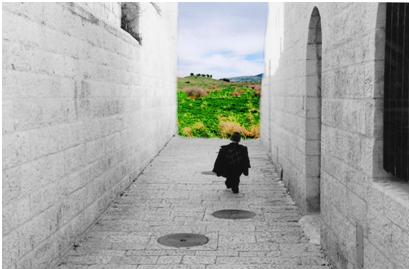
?מי מצווה אותך
In response to some guiding questions for my upcoming reflection group, I've put down some thoughts in my usual stream-of-consciousness fashion. As usual, these aren't polished ideologies, and I look forward to hearing the reactions of others as well as my own thoughts in the upcoming days, months, and years.
There are two ways to think of any given law, negative and positive. Negative: don’t steal, don’t run a red light, don’t defraud the government. Positive: pay for things you take, drive only on a green light, pay your taxes. But what about a law like don’t kill? What’s the positive side of that?
I believe that the positive side of that negative commandment is where morality comes into play. Insofar as existence is good, life is good, and therefore so too preserving life is good. Just as animals and plants live out their goodness in a natural way, so do we live out our goodness by staying alive. Ending life truncates (not negates) this goodness, though even death can’t be considered non-good.
But back to the original question. Are there acts which we can elect not to do that fulfill the opposite of “don’t kill?” For example, if a person is starving, is one legally bound to feed her? If someone is dying of an illness you can cure, are you legally bound to cure her? My moral sensibilities say yes. But what is the source of this “law?”
I do not feel commanded. I believe that one can create a self-reality wherein one is commanded, but that reality would not have an external source (just as no reality can have an external source). But I do not believe that I have created such a reality for myself. While many Jews throughout history have viewed mitzvot as commandments, I do not hold the same theology. Of course, this doesn’t discount their own theologies, but nor do their understandings invalidate my own.
So, if God isn’t commanding me to feed the starving, why do I feel obliged to do it? This is a hard question that I haven’t spent sufficient time trying to answer. This is my first rough draft…
A fundament of this universe is existence. I’m sure that existence as I know it is only a tiny shard of “reality,” but my humanity is based on existence. And as I know that my existence here isn’t meaningless, I can only conclude that it is good to be alive. And insofar as others exist, it’s good for them to be alive, too.
Now, I can’t negate that goodness, as I mentioned before. But I can enrich it, increase it, and nurture it. I can interact and co-operate with others so that we may all deepen our experiences of this world. I don’t know precisely why we’re here, but my best guess so far is that it has something to do with experience, and the only conceivable value of experience I can think of is change. That is, with every experience, I change. As perceived time is a relative construct, I can’t say that I change over time, but I do recognize that waves of experience surge at different intensities, and I believe that such changes can only occur via interactions with other consciousnesses. (Such interactions, of course, are impossible to avoid as every existence in existence is founded on consciousness.)
Therefore, while there will be no “punishment” for not feeding the hungry, I won’t be living up to my potential. As I realize this, I can’t turn my back on that. Call it a responsibility, call it a self-acceptance of the yoke of existence, call it ethics. Whatever you call it, I do believe in it, and I do believe in it as a universal constant.
Who commands me? Existence. Insofar as God is existence, I can say that God commands me, but not in a conscious, external, imposing fashion. What am I commanded to do? To live and to learn; to enrich others’ lives and to teach. This is the center of my reality right now - at least, I try for it to be. And how do I teach this to others? Ay, there’s the rub!
There are a few people who I believe will really feel me on all of this and know where I’m coming from. Most of the rest are going to be left with a great number of questions. I feel prepared to talk through those questions (learn and teach…) with each of those people, but such an endeavor takes a great deal of time. Thus, to really live according to the focus I see in my life, I have to donate my life to learning and teaching according to these principles.
And that’s what I’m doing in rabbinical school. Each of us has a voice; mine is largely accented by Judaism. The messages I feel commanded to teach are easily found in Jewish language, so devoting myself to Judaism (which has all kinds of associated personal, communal, familial, spiritual, and experiential benefits) allows me to find an appropriate mode of learning and teaching. I believe I will fit into the role of the rabbi, and I expect it to fit me, and from that harmony, I hope that I’ll be able to enrich my own life and the lives of others.
Showing posts with label ethical living. Show all posts
Showing posts with label ethical living. Show all posts
Thursday, December 11, 2008

Thursday, November 27, 2008
Second Draft of a Poem
Morning Confession
metal pierces blushing flesh
fingers probe, plunge into the land’s
heart-shaped child, pry into
intimate corners, prod
white fibers and pull forth
beads of flesh
they shatter
explode
between coffee-stained teeth
on the plate a carcass splayed open
bloodless, vacant, defunct
metal pierces blushing flesh
fingers probe, plunge into the land’s
heart-shaped child, pry into
intimate corners, prod
white fibers and pull forth
beads of flesh
they shatter
explode
between coffee-stained teeth
on the plate a carcass splayed open
bloodless, vacant, defunct
First Draft of a Poem
So I don't write poetry very often, and this is very much a first draft of something I've been thinking about for a while, but I'd appreciate your feedback as I think this has some potential if it were developed a bit.
Morning Confession
I eat pomegranates for breakfast.
And sometimes I yearn for the substance of
A slice of bread – its firmness and fullness
Familiarity, convenience, tidiness
Next to a cup of instant coffee
But instead
I slice into the pomegranate with my knife
And pry apart the insides with my hand
Prodding at the white fibers and
Pulling forth the beads of fruit
Pushing them between my lips
And crunching, devouring
I say that this connects me to the land
To the seasons – I eat what is
Growing here, now.
But I don’t know the land
And I don’t know the seasons
Although, at least, I do eat pomegranates
For breakfast.
From inside my apartment
I imagine myself a part of this vital world
And I cut into the land’s heart-shaped child
Grinding the seeds between my
Coffee-stained teeth
The environment is a cause for which
I enter my credit card number online
Donating chai for the source of all life
And closing my computer to shut it away
The environment is large and far away
It is a stranger whom I pity
An abstraction grounded only in the sky
But the round globe of the pomegranate
Feels firm in the palm of my hands
Flushed pink as I enter it with
My sticky fingers, plucking the
Pinkish blood and white, firm body
From a corpse splayed wide across my plate
A silenced heart upon a hospital bed
I drop the last teardrop-shaped seed
Into my cavernous mouth
The rind is empty, shredded
Its secrets revealed, it holds no more
And I throw the carcass in the trashcan
Close the lid, and
Walk away.
Morning Confession
I eat pomegranates for breakfast.
And sometimes I yearn for the substance of
A slice of bread – its firmness and fullness
Familiarity, convenience, tidiness
Next to a cup of instant coffee
But instead
I slice into the pomegranate with my knife
And pry apart the insides with my hand
Prodding at the white fibers and
Pulling forth the beads of fruit
Pushing them between my lips
And crunching, devouring
I say that this connects me to the land
To the seasons – I eat what is
Growing here, now.
But I don’t know the land
And I don’t know the seasons
Although, at least, I do eat pomegranates
For breakfast.
From inside my apartment
I imagine myself a part of this vital world
And I cut into the land’s heart-shaped child
Grinding the seeds between my
Coffee-stained teeth
The environment is a cause for which
I enter my credit card number online
Donating chai for the source of all life
And closing my computer to shut it away
The environment is large and far away
It is a stranger whom I pity
An abstraction grounded only in the sky
But the round globe of the pomegranate
Feels firm in the palm of my hands
Flushed pink as I enter it with
My sticky fingers, plucking the
Pinkish blood and white, firm body
From a corpse splayed wide across my plate
A silenced heart upon a hospital bed
I drop the last teardrop-shaped seed
Into my cavernous mouth
The rind is empty, shredded
Its secrets revealed, it holds no more
And I throw the carcass in the trashcan
Close the lid, and
Walk away.
Sunday, November 9, 2008
Hidden Dangers in Multiculturalism: Identity, Culture and Education in the Liberal State
This post is by no means as interesting as its title makes it sound. It is a post about a course that I have decided to take in place of the previously mentioned sociology course which was held at an inconvenient time. The Multiculturalism course is part of the curriculum for the MA in Jewish Education, and the students are all future and current educators of various ages. The professor immigrated from Argentina many years ago - he has a wide smile, very severe sarcasm, and he carries a pocket watch that must be somewhat imprecise, as he constantly has to ask the students to tell him the time, even after he's already looked at his timepiece.
Although I hadn't done the reading for the class as I was showing up at its second session, I found the conversation deeply interesting and am looking forward to spending my Sunday afternoons talking about what I think is one of the most real and important issues of our and all time: identity, and how we can acknowledge our own and others' identities respectfully and truthfully. Our teacher defines multiculturalism as "the call to overcome the way we think about each other that is so natural to us that we don't even think about it."
We talked about the historical transformation in the Western World from defining oneself solely according to a fixed social position to a recognition of citizen dignity as social heirarchies collapsed during the time of the French Revolution and thereafter. Suddenly (or perhaps more accurately, over the course of a long time) sense of self depended on one's personal definition and less on birth - people were able to chose more about themselves, and Dignity was grante to all, rather than the notion of "honor" being granted to some. St. Augustine declared that G-d is in everything you see, and therefore G-d is in everyone - this upgrades humans - all humans - to partially divine.
We discussed how the nation-state requires a different kind of organization and sets of loyalty and identity. Rather than kings identifying with kings, members of a particular nation-state identify as citizens of that nation-state and have obligations to that nation-state. In Feudalism, the idea was that the nobility had a respobsibility to the lives of the peasants, and poverty was a personal problem of the nobility that they could chose to act on, or not. In a more modern society, there is the notion of human rights, which changes things, if not entirely, then at least substantially, because citizenship is not about depending on someone else's honor or goodness, but about being granted certain rights by law (and having legal recourse if you aren't receiving them). Of course, this was, and is, not always the case, even in a nation-state (think women, slaves, etc.)
We talked about how the principle of universal identity (that is to say that everyone has an identity that is valuable) can be interpreted in two very divergent ways: everyone is equal because everyone has a valuable identity, and therefore everyone should be treated the same OR because everyone has a valuable and different identity, everyone is different and should be treated differently. Both interpretations can be used for good (as in universal education or recognizing the special needs of different individuals) or for bad (as in not recognizing special needs or talents, or treating people unfairly and attributing it to their difference). It can be argued that if schools in particular treat everyone the same, there isn't space to create a unique identity. But at the same time, if schools treat students differently, they may not all have access to the same opportunities.
We spent a long time on the difference between the public and the private sphere - the idea that one should or is permitted to act differently at home than elsewhere (like Jews of the Emancipation who were 'Jews in the home, but not in the street') We imagine that there is a clear separation between the public and the private, and that no one cares what you do in your private life, but in the public sphere you need to behave with the rules of the public. However, the lines are not nearly so clear (for instance, what I do on my computer, in the home, is actually rather public). And there is a big question about when it is appropriate for the government to interfere in the private. For instance: take the case of domestic or child abuse. In some cultures, it is frowned upon for the government to step in to what is seen as such a private issue, while in others it is seen as immoral for the government NOT to step in. And one student in the class noted that the public sphere intrudes into the private sphere much more often with regards to lower class or minority people - the government might more quickly intervene in the home of an immigrant family than an Anglo family because they are quicker to assume that abuse is happening (whether or not it actually is). In other words, the government might participate in racial or socio-economic profiling and assume that they need to step in more often in lower-income areas or areas with cultures that are different than the mainstream, and as a result those sectors of the population have much less separation between private and public than groups of people that are considered less threatening or suspicious.
We talked about the notion of "social cohesion" - if difference is allowed or encouraged in the public sphere, what is the glue that holds a society together? It is this question that leads some to argue that there needs to be a "core curriculum" in schools so that children are all taught the same "cannon" and form the same values and cultural referents, which makes them all a part of the community. On the other hand - what gets to be the cannon, and which community are the students being socialized to join? And is that fair?
Our teacher encouraged us to recognize that whatever seems natural to us is cultural, including the values of democracy, separation of state, etc. and to know that "liberalism is also a fighting creed" - when liberals wish to create a space that is accepting of everyone, they are forcing (or socializing, or encouraging) their values of respect for all cultures onto people who perhaps don't have those values. And who gets to say that their values are the right ones? On the other hand, if you reject all that seems to be natural to you, then you have no basis on which to base your opinions, or even your life. So you have to stick to what you believe in, but be aware that others might not share your values.
Some more interesting quotes from today's class include:
"Minority has nothing to do with numbers - it has to do with marginalization."
"The problem with immigration is that bodies move faster than minds"
"Our language gives us tools for racism that we have stopped noticing because of our need to communicate."
Anyway, it seems like it is going to be a great class, and I'm sure you'll be hearing more about it in the future.
Although I hadn't done the reading for the class as I was showing up at its second session, I found the conversation deeply interesting and am looking forward to spending my Sunday afternoons talking about what I think is one of the most real and important issues of our and all time: identity, and how we can acknowledge our own and others' identities respectfully and truthfully. Our teacher defines multiculturalism as "the call to overcome the way we think about each other that is so natural to us that we don't even think about it."
We talked about the historical transformation in the Western World from defining oneself solely according to a fixed social position to a recognition of citizen dignity as social heirarchies collapsed during the time of the French Revolution and thereafter. Suddenly (or perhaps more accurately, over the course of a long time) sense of self depended on one's personal definition and less on birth - people were able to chose more about themselves, and Dignity was grante to all, rather than the notion of "honor" being granted to some. St. Augustine declared that G-d is in everything you see, and therefore G-d is in everyone - this upgrades humans - all humans - to partially divine.
We discussed how the nation-state requires a different kind of organization and sets of loyalty and identity. Rather than kings identifying with kings, members of a particular nation-state identify as citizens of that nation-state and have obligations to that nation-state. In Feudalism, the idea was that the nobility had a respobsibility to the lives of the peasants, and poverty was a personal problem of the nobility that they could chose to act on, or not. In a more modern society, there is the notion of human rights, which changes things, if not entirely, then at least substantially, because citizenship is not about depending on someone else's honor or goodness, but about being granted certain rights by law (and having legal recourse if you aren't receiving them). Of course, this was, and is, not always the case, even in a nation-state (think women, slaves, etc.)
We talked about how the principle of universal identity (that is to say that everyone has an identity that is valuable) can be interpreted in two very divergent ways: everyone is equal because everyone has a valuable identity, and therefore everyone should be treated the same OR because everyone has a valuable and different identity, everyone is different and should be treated differently. Both interpretations can be used for good (as in universal education or recognizing the special needs of different individuals) or for bad (as in not recognizing special needs or talents, or treating people unfairly and attributing it to their difference). It can be argued that if schools in particular treat everyone the same, there isn't space to create a unique identity. But at the same time, if schools treat students differently, they may not all have access to the same opportunities.
We spent a long time on the difference between the public and the private sphere - the idea that one should or is permitted to act differently at home than elsewhere (like Jews of the Emancipation who were 'Jews in the home, but not in the street') We imagine that there is a clear separation between the public and the private, and that no one cares what you do in your private life, but in the public sphere you need to behave with the rules of the public. However, the lines are not nearly so clear (for instance, what I do on my computer, in the home, is actually rather public). And there is a big question about when it is appropriate for the government to interfere in the private. For instance: take the case of domestic or child abuse. In some cultures, it is frowned upon for the government to step in to what is seen as such a private issue, while in others it is seen as immoral for the government NOT to step in. And one student in the class noted that the public sphere intrudes into the private sphere much more often with regards to lower class or minority people - the government might more quickly intervene in the home of an immigrant family than an Anglo family because they are quicker to assume that abuse is happening (whether or not it actually is). In other words, the government might participate in racial or socio-economic profiling and assume that they need to step in more often in lower-income areas or areas with cultures that are different than the mainstream, and as a result those sectors of the population have much less separation between private and public than groups of people that are considered less threatening or suspicious.
We talked about the notion of "social cohesion" - if difference is allowed or encouraged in the public sphere, what is the glue that holds a society together? It is this question that leads some to argue that there needs to be a "core curriculum" in schools so that children are all taught the same "cannon" and form the same values and cultural referents, which makes them all a part of the community. On the other hand - what gets to be the cannon, and which community are the students being socialized to join? And is that fair?
Our teacher encouraged us to recognize that whatever seems natural to us is cultural, including the values of democracy, separation of state, etc. and to know that "liberalism is also a fighting creed" - when liberals wish to create a space that is accepting of everyone, they are forcing (or socializing, or encouraging) their values of respect for all cultures onto people who perhaps don't have those values. And who gets to say that their values are the right ones? On the other hand, if you reject all that seems to be natural to you, then you have no basis on which to base your opinions, or even your life. So you have to stick to what you believe in, but be aware that others might not share your values.
Some more interesting quotes from today's class include:
"Minority has nothing to do with numbers - it has to do with marginalization."
"The problem with immigration is that bodies move faster than minds"
"Our language gives us tools for racism that we have stopped noticing because of our need to communicate."
Anyway, it seems like it is going to be a great class, and I'm sure you'll be hearing more about it in the future.
Wednesday, September 10, 2008
The value of being Jewish.
.ערך קיום יהודי
Jessica briefly mentioned in her previous post that she was instructed to get a letter from an American rabbi attesting to her Jewishness in order to receive a student visa. The whole notion is absurd because one doesn't need to be Jewish to be a student in Israel, and the fact that it would even come up is troubling and frustrating to Jessica and me. That the officer at the Ministry of the Interior would even think to ask for such confirmation (even in error) belies the gross neglect of religious freedom in this country. Sure, if Reform Judaism is treated as a separate faith (as suggested by Rabbi Yisrael Rozen), we could have equal rights, but so long as we claim Judaism as our own, progressive Jews in Israel will continue to face religious and legal barriers that fly in the face of Deuteronomy 16:20's invective, "צדק צדק תרדף" (Justice, justice shall you pursue).
This is because, if the Ministry really wanted to push the matter (which I don't expect), the authority of the American rabbi that Jessica finds would have to be examined. Perhaps Jessica's pedigree would be up for discussion. Of course, Jessica is unquestionably Jewish even by the most orthodox standards, but someone who (A) didn't have a rabbi, (B) didn't have a Jewish mother, or (C) wasn't Jewish would certainly have a hard time receiving this visa! I can't believe that even here this letter is required, but that it's asked for is indicative of a pro-Jewish bias that exists in Israel to such a large degree that it can't even be seen.
And what's it based on? Israel was founded as a Jewish country and has been struggling with that title for the past sixty years. People have been asking, "What does it mean to be Jewish?" for a very long time, but I doubt the question is often raised of, "What's the value of us being Jewish?" If a magic genie gave me the option of making Israel a true model of civil liberty, a bastion of peace in the region, an anti-war advocate, and a democracy that values the voices of the few and seeks to bring peace and security to the whole but lose its Jewish identity, I don't know what I would do. Is being Jewish so important that I would choose it over an automatic guarantee of ethics?
On the one hand, I believe that Judaism is a gateway to ethical living and that the Torah is a medium through which we can gain wisdom and Truth. On the other hand, I don't believe that Judaism and the Torah are unique in these roles but rather are specifically efficacious and beneficial to those who identify with them. Why are there Jews? I don't know. But I believe that it's good for the Jewish people for us to be Jewish, and insofar as the Jewish people has a strong track record of "getting it right" in terms of ethics and spirituality, I'm proud to espouse the values of my religion. Yet being Jewish is neither necessary nor sufficient to being ethical, and if ethics are my ultimate priority (and my support of Judaism is a support of unification and ethical living among and outside of our people), should not ethics (or, religiously speaking, perhaps even "pure" spirituality?) outweigh Jewish identity?
I don't know.
Take the example I laid out during Wexner Post 3 about giving money to the questionably Jewish organization that I believed in. Why does Judaism have to enter into the equation at all? We might cede that Jews have a tendency to be more likely to be involved in social action/progress than a non-Jew (though I'm far from claiming that as an existential truth), but nevertheless, I would never feel comfortable making such a decision based on religion alone.
And yet, I also struggle with the notion that not only Israel's orthodox Judaism has an obvious, occasionally unjust bias towards Jewish identity. Also our very own movement has struggled and continues to struggle with this concept, as do I. Take marriage between Jews and non-Jews as an example of assumptive priority of Jewish identity. As of right now, the "official" position of the Reform Movement is as follows:
"The Central Conference of American Rabbis, recalling its stand adopted in 1909 that mixed marriage is contrary to the Jewish tradition and should be discouraged, now declares its opposition to participation by its members in any ceremony which solemnizes a mixed marriage. The Central Conference of American Rabbis recognized that historically its members have held and continue to hold divergent interpretations of Jewish tradition.
In order to keep open every channel in Judaism and Kelal Yisra-el [the Jewish People] for those who have already entered into mixed marriage, the CCAR calls upon its members:
1. To assist fully in educating children of such mixed marriage as Jews;
2. To provide the opportunity for conversion of the non-Jewish spouse; and
3. To encourage a creative and consistent cultivation of involvement in the Jewish community and the synagogue."
However, a statement given by CCAR president Harry Danziger in 2006 at the CCAR convention complicates the Reform movement's stance:
"I look back thirty-three years to the Atlanta convention of 1973, called by some the Battle of Peachtree. There after years of debate and too often acrimony, a ten line resolution was passed opposing officiation at intermarriages. Pamphlets and articles attacking one side or the other abounded. There were even threats of a split in the Conference as there had been before over Zionism.
Five years later, in 1978, Alex Schindler, zichrono livracha, proposed a comprehensive outreach program through which we turned our attention, not only to weddings – the beginning of a new household – but to outcomes – the nature of the family thus created.
In 1983, there were passionate divisions in this Conference over the proposed resolution on children of intermarriage, what has been termed “the patrilineal” resolution. The debate was intense. At the end, we broke new ground in response to new realities, and we proclaimed that, for us, the gender of the Jewish parents would not be the determinant of who is a Jew. Most of us came to live by it. Some still question it. That is part of who we are.
Move forward yet another eleven years. In 1994, in Philadelphia, I was invited to be part of a major program at the convention. Two rabbis and two lay leaders spoke. I was invited to speak on why and how I do in fact officiate at intermarriages. And the president of the Conference at that time, Shim Maslin, who deserves great credit for that program, was a leading proponent of the 1973 resolution. Beit Hillel – They studied and listened to the views of the other side.
This week we have workshops and programs that deal with how we respond to intermarriage, how we engage and involve, yes, and honor, the non-Jewish partner who lives as a Jew albeit without conversion – what some of us call a ger toshav – what I sometimes call a “common law Jew”. The official position may continue to be a ten line resolution in Atlanta, but the practice has become a consensus that there is more than one respectable way to deal with those issues."
So, in combining these two sources, we find that the Reform movement "officially" discourages interfaith marriages and, in the case of an interfaith marriage, encourages the raising of Jewish children, participation in the Jewish community, and the conversion of the non-Jewish spouse. Individual rabbis (including the president of the CCAR) may (and many do) disagree with any of these points and act according to their conscience. So there's an internal struggle in the movement about whether it's of existential value to marry a Jew.
What seems to be agreed upon is that a rabbi should encourage participation in a Jewish community and, ideally, the raising of Jewish children. A point of contention is whether a non-Jewish spouse should be encouraged to convert. Rabbi Richard Address, who was at the Wexner institute last month, told me that sometimes he's had non-Jewish members of his community angry because--in their perception--Rabbi Address was pushing them to convert; and he's also had members of his community angry because--in their perception--Rabbi Address wasn't pushing them enough to convert. Even on a personal level, this is a tricky situation.
But my question is: If a couple is raising their children Jewish and participating in the Jewish community, what value is there to the community for the non-Jewish partner to convert to Judaism? Obviously, if a person discovers a personal meaning in converting to Judaism, she should follow her convictions on whether to convert. But communally, what statement are we making by saying that, all other factors being equal, Jew A is more valuable to us than non-Jew B?
I can't ignore the fact that a Jewish identity is neither sufficient nor necessary for active participation in Jewish family or communal life. Nor can I ignore the fact that Jewish identity makes that participation significantly more accessible (or that an active non-Jewish identity can disrupt a family's Jewish participation). So, is emphasis on conversion a numbers game? "Sure, we agree that a non-Jew can raise Jewish children, but since a Jew is more likely to do so, we want as many Jews raising children as we can."
But that brings us right back to the original question (and please forgive me for traveling in circles; if it's not clear, this forum is largely an opportunity for me to work through complex issues) - Why be Jewish in the first place? Israel, the Jewish state, has done some terrible things. Jews all over the world act immorally and non-Jews act morally. What's the big deal?
Let's cut to the chase: I think that there is a big deal, but I can't back that up. I don't know where the feeling comes from, but I recognize that Jewish history is full of innovation and ethical progress that is worthy of praise. I also recognize that the Jewish community is like a family, and there's no necessary reason to be born into a family; one is simply a part of a family and inherently loves it. So, I suppose I have a blind love for the Jewish people and want to see us live morally and progressively in as many ways as possible.
Does that justify the following caveat in the HUC rabbinical school application?
"In addition to the above requirements, please note that applicants and their spouses, partners, fiancés or fiancées must be Jewish by birth or conversion."
In other words, if I admit to having a non-Jewish girlfriend, I won't be admitted into HUC.
Now, this statement doesn't define Judaism, nor was it ever mentioned during my entire application process. I have heard of students omitting the fact that they have non-Jewish partners and getting into HUC regardless (though as I understand, it generally doesn't happen that someone graduates from HUC with a non-Jewish partner). Nevertheless, the statement is there: Rabbis should have Jewish partners.
This is a topic I discussed with some Wexner Fellows in Stowe. Does a rabbi need to have a non-Jewish partner?
On the one hand, a congregational rabbi is meant to be a leader and example in the Jewish community. There are many Jews, one of my Wexner colleagues included, who would expect a rabbi's partner to participate fully in all congregational activities and have a strong Jewish identity that can be shared with the community. The rabbi's should be a model of a strong Jewish family, and the rabbi should be able to have an uncompromisingly Jewish household to raise children and welcome guests.
On the other hand, if I were talking about anyone else, I would continue to repeat that all those things can happen in an interfaith marriage. A non-Jewish partner can contribute to the Jewish community, participate in a Jewish household, and raise Jewish children. We often stress that rabbis are just like everyone else ... only with more specific knowledge about Jewish topics ... so why should the household of a rabbi be any different? If anything, a rabbi would be virtually guaranteed to have a Jewish household regardless of the religion (or non-religion) of the rabbi's partner, so a rabbi, in a way, could be given even more leniency to cohabitate with whomever she desires.
Furthermore, not all rabbis are communal leaders. Some rabbis become professors, work in Hillel, serve with non-profit organizations, teach at day schools, etc. Are we saying that a Jewish professor has to be married to a Jew if the word "rabbi" comes before (or after) the word "doctor" in his title?
Moreover, as I've mentioned, being Jewish doesn't necessitate that someone is going to be involved in a Jewish community. A rabbi could have a Jewish partner who is entirely disengaged from the Jewish community. If we are looking for Jewish engagement, perhaps there should be a "participation test" for the rabbinical school applicant's partner rather than a "religion test."
Ultimately, the question is: Are we comfortable with playing a numbers game with people's family lives? Are we comfortable saying that, because it is more likely that a Jew will raise a Jewish family, we should encourage Jew-Jew partnerships? I might be able to make that statement if I believed that being Jewish was an existentially superior state than being a non-Jew. I believe that being Jewish is special and unique and wonderful and should be promoted and supported. I believe that being Christian/Muslim/Buddhist/Sikh/Agnostic/Humanist/Unitarian/Alternative/Druid/Tribal/Hindu/Etc. is special and unique and wonderful and should be promoted and supported. I believe, ultimately, that being moral and promoting peace is the greatest value to be promoted and supported and that our focus should be on creating welcoming communities that foster positive interpersonal relations on all levels - familial, communal, and inter-communal.
It's a tough call, whether Jews should have a mission to promote Judaism. As a future rabbi (and according to my own beliefs), I say that Judaism should be supported and that it's generally a good thing for people (especially Jews) to involve themselves in a Jewish community. But, if someone is fulfilled by participating in another community and is going to work to bring peace to the world, I can only offer my blessings and wish them peace.
Jessica briefly mentioned in her previous post that she was instructed to get a letter from an American rabbi attesting to her Jewishness in order to receive a student visa. The whole notion is absurd because one doesn't need to be Jewish to be a student in Israel, and the fact that it would even come up is troubling and frustrating to Jessica and me. That the officer at the Ministry of the Interior would even think to ask for such confirmation (even in error) belies the gross neglect of religious freedom in this country. Sure, if Reform Judaism is treated as a separate faith (as suggested by Rabbi Yisrael Rozen), we could have equal rights, but so long as we claim Judaism as our own, progressive Jews in Israel will continue to face religious and legal barriers that fly in the face of Deuteronomy 16:20's invective, "צדק צדק תרדף" (Justice, justice shall you pursue).
This is because, if the Ministry really wanted to push the matter (which I don't expect), the authority of the American rabbi that Jessica finds would have to be examined. Perhaps Jessica's pedigree would be up for discussion. Of course, Jessica is unquestionably Jewish even by the most orthodox standards, but someone who (A) didn't have a rabbi, (B) didn't have a Jewish mother, or (C) wasn't Jewish would certainly have a hard time receiving this visa! I can't believe that even here this letter is required, but that it's asked for is indicative of a pro-Jewish bias that exists in Israel to such a large degree that it can't even be seen.
And what's it based on? Israel was founded as a Jewish country and has been struggling with that title for the past sixty years. People have been asking, "What does it mean to be Jewish?" for a very long time, but I doubt the question is often raised of, "What's the value of us being Jewish?" If a magic genie gave me the option of making Israel a true model of civil liberty, a bastion of peace in the region, an anti-war advocate, and a democracy that values the voices of the few and seeks to bring peace and security to the whole but lose its Jewish identity, I don't know what I would do. Is being Jewish so important that I would choose it over an automatic guarantee of ethics?
On the one hand, I believe that Judaism is a gateway to ethical living and that the Torah is a medium through which we can gain wisdom and Truth. On the other hand, I don't believe that Judaism and the Torah are unique in these roles but rather are specifically efficacious and beneficial to those who identify with them. Why are there Jews? I don't know. But I believe that it's good for the Jewish people for us to be Jewish, and insofar as the Jewish people has a strong track record of "getting it right" in terms of ethics and spirituality, I'm proud to espouse the values of my religion. Yet being Jewish is neither necessary nor sufficient to being ethical, and if ethics are my ultimate priority (and my support of Judaism is a support of unification and ethical living among and outside of our people), should not ethics (or, religiously speaking, perhaps even "pure" spirituality?) outweigh Jewish identity?
I don't know.
Take the example I laid out during Wexner Post 3 about giving money to the questionably Jewish organization that I believed in. Why does Judaism have to enter into the equation at all? We might cede that Jews have a tendency to be more likely to be involved in social action/progress than a non-Jew (though I'm far from claiming that as an existential truth), but nevertheless, I would never feel comfortable making such a decision based on religion alone.
And yet, I also struggle with the notion that not only Israel's orthodox Judaism has an obvious, occasionally unjust bias towards Jewish identity. Also our very own movement has struggled and continues to struggle with this concept, as do I. Take marriage between Jews and non-Jews as an example of assumptive priority of Jewish identity. As of right now, the "official" position of the Reform Movement is as follows:
"The Central Conference of American Rabbis, recalling its stand adopted in 1909 that mixed marriage is contrary to the Jewish tradition and should be discouraged, now declares its opposition to participation by its members in any ceremony which solemnizes a mixed marriage. The Central Conference of American Rabbis recognized that historically its members have held and continue to hold divergent interpretations of Jewish tradition.
In order to keep open every channel in Judaism and Kelal Yisra-el [the Jewish People] for those who have already entered into mixed marriage, the CCAR calls upon its members:
1. To assist fully in educating children of such mixed marriage as Jews;
2. To provide the opportunity for conversion of the non-Jewish spouse; and
3. To encourage a creative and consistent cultivation of involvement in the Jewish community and the synagogue."
However, a statement given by CCAR president Harry Danziger in 2006 at the CCAR convention complicates the Reform movement's stance:
"I look back thirty-three years to the Atlanta convention of 1973, called by some the Battle of Peachtree. There after years of debate and too often acrimony, a ten line resolution was passed opposing officiation at intermarriages. Pamphlets and articles attacking one side or the other abounded. There were even threats of a split in the Conference as there had been before over Zionism.
Five years later, in 1978, Alex Schindler, zichrono livracha, proposed a comprehensive outreach program through which we turned our attention, not only to weddings – the beginning of a new household – but to outcomes – the nature of the family thus created.
In 1983, there were passionate divisions in this Conference over the proposed resolution on children of intermarriage, what has been termed “the patrilineal” resolution. The debate was intense. At the end, we broke new ground in response to new realities, and we proclaimed that, for us, the gender of the Jewish parents would not be the determinant of who is a Jew. Most of us came to live by it. Some still question it. That is part of who we are.
Move forward yet another eleven years. In 1994, in Philadelphia, I was invited to be part of a major program at the convention. Two rabbis and two lay leaders spoke. I was invited to speak on why and how I do in fact officiate at intermarriages. And the president of the Conference at that time, Shim Maslin, who deserves great credit for that program, was a leading proponent of the 1973 resolution. Beit Hillel – They studied and listened to the views of the other side.
This week we have workshops and programs that deal with how we respond to intermarriage, how we engage and involve, yes, and honor, the non-Jewish partner who lives as a Jew albeit without conversion – what some of us call a ger toshav – what I sometimes call a “common law Jew”. The official position may continue to be a ten line resolution in Atlanta, but the practice has become a consensus that there is more than one respectable way to deal with those issues."
So, in combining these two sources, we find that the Reform movement "officially" discourages interfaith marriages and, in the case of an interfaith marriage, encourages the raising of Jewish children, participation in the Jewish community, and the conversion of the non-Jewish spouse. Individual rabbis (including the president of the CCAR) may (and many do) disagree with any of these points and act according to their conscience. So there's an internal struggle in the movement about whether it's of existential value to marry a Jew.
What seems to be agreed upon is that a rabbi should encourage participation in a Jewish community and, ideally, the raising of Jewish children. A point of contention is whether a non-Jewish spouse should be encouraged to convert. Rabbi Richard Address, who was at the Wexner institute last month, told me that sometimes he's had non-Jewish members of his community angry because--in their perception--Rabbi Address was pushing them to convert; and he's also had members of his community angry because--in their perception--Rabbi Address wasn't pushing them enough to convert. Even on a personal level, this is a tricky situation.
But my question is: If a couple is raising their children Jewish and participating in the Jewish community, what value is there to the community for the non-Jewish partner to convert to Judaism? Obviously, if a person discovers a personal meaning in converting to Judaism, she should follow her convictions on whether to convert. But communally, what statement are we making by saying that, all other factors being equal, Jew A is more valuable to us than non-Jew B?
I can't ignore the fact that a Jewish identity is neither sufficient nor necessary for active participation in Jewish family or communal life. Nor can I ignore the fact that Jewish identity makes that participation significantly more accessible (or that an active non-Jewish identity can disrupt a family's Jewish participation). So, is emphasis on conversion a numbers game? "Sure, we agree that a non-Jew can raise Jewish children, but since a Jew is more likely to do so, we want as many Jews raising children as we can."
But that brings us right back to the original question (and please forgive me for traveling in circles; if it's not clear, this forum is largely an opportunity for me to work through complex issues) - Why be Jewish in the first place? Israel, the Jewish state, has done some terrible things. Jews all over the world act immorally and non-Jews act morally. What's the big deal?
Let's cut to the chase: I think that there is a big deal, but I can't back that up. I don't know where the feeling comes from, but I recognize that Jewish history is full of innovation and ethical progress that is worthy of praise. I also recognize that the Jewish community is like a family, and there's no necessary reason to be born into a family; one is simply a part of a family and inherently loves it. So, I suppose I have a blind love for the Jewish people and want to see us live morally and progressively in as many ways as possible.
Does that justify the following caveat in the HUC rabbinical school application?
"In addition to the above requirements, please note that applicants and their spouses, partners, fiancés or fiancées must be Jewish by birth or conversion."
In other words, if I admit to having a non-Jewish girlfriend, I won't be admitted into HUC.
Now, this statement doesn't define Judaism, nor was it ever mentioned during my entire application process. I have heard of students omitting the fact that they have non-Jewish partners and getting into HUC regardless (though as I understand, it generally doesn't happen that someone graduates from HUC with a non-Jewish partner). Nevertheless, the statement is there: Rabbis should have Jewish partners.
This is a topic I discussed with some Wexner Fellows in Stowe. Does a rabbi need to have a non-Jewish partner?
On the one hand, a congregational rabbi is meant to be a leader and example in the Jewish community. There are many Jews, one of my Wexner colleagues included, who would expect a rabbi's partner to participate fully in all congregational activities and have a strong Jewish identity that can be shared with the community. The rabbi's should be a model of a strong Jewish family, and the rabbi should be able to have an uncompromisingly Jewish household to raise children and welcome guests.
On the other hand, if I were talking about anyone else, I would continue to repeat that all those things can happen in an interfaith marriage. A non-Jewish partner can contribute to the Jewish community, participate in a Jewish household, and raise Jewish children. We often stress that rabbis are just like everyone else ... only with more specific knowledge about Jewish topics ... so why should the household of a rabbi be any different? If anything, a rabbi would be virtually guaranteed to have a Jewish household regardless of the religion (or non-religion) of the rabbi's partner, so a rabbi, in a way, could be given even more leniency to cohabitate with whomever she desires.
Furthermore, not all rabbis are communal leaders. Some rabbis become professors, work in Hillel, serve with non-profit organizations, teach at day schools, etc. Are we saying that a Jewish professor has to be married to a Jew if the word "rabbi" comes before (or after) the word "doctor" in his title?
Moreover, as I've mentioned, being Jewish doesn't necessitate that someone is going to be involved in a Jewish community. A rabbi could have a Jewish partner who is entirely disengaged from the Jewish community. If we are looking for Jewish engagement, perhaps there should be a "participation test" for the rabbinical school applicant's partner rather than a "religion test."
Ultimately, the question is: Are we comfortable with playing a numbers game with people's family lives? Are we comfortable saying that, because it is more likely that a Jew will raise a Jewish family, we should encourage Jew-Jew partnerships? I might be able to make that statement if I believed that being Jewish was an existentially superior state than being a non-Jew. I believe that being Jewish is special and unique and wonderful and should be promoted and supported. I believe that being Christian/Muslim/Buddhist/Sikh/Agnostic/Humanist/Unitarian/Alternative/Druid/Tribal/Hindu/Etc. is special and unique and wonderful and should be promoted and supported. I believe, ultimately, that being moral and promoting peace is the greatest value to be promoted and supported and that our focus should be on creating welcoming communities that foster positive interpersonal relations on all levels - familial, communal, and inter-communal.
It's a tough call, whether Jews should have a mission to promote Judaism. As a future rabbi (and according to my own beliefs), I say that Judaism should be supported and that it's generally a good thing for people (especially Jews) to involve themselves in a Jewish community. But, if someone is fulfilled by participating in another community and is going to work to bring peace to the world, I can only offer my blessings and wish them peace.
Subscribe to:
Posts (Atom)