Showing posts with label Judaism. Show all posts

Tuesday, December 23, 2008

Observe and remember.

.שמור וזכור

[Originally written for my HUC blog but appearing here first!]
[Also published on the Reform Movement's blog!]

Chag urim sameach - happy Festival of Lights!

For the past two months, four classmates and I have been participating in Rav Siach, an interdenominational discussion group for rabbinical students through a pluralistic education center in Jerusalem. We meet every Tuesday night for two and a half hours, and we discuss and debate issues like commandedness, the role of the rabbi, and denominational distinctions. There are about a dozen participants with three facilitators, and participants come from Reform, Conservative, Reconstructionist, “orthodox,” and non-denominational backgrounds.

One of the most intense components of Rav Siach has been our recent Shabbaton, which began when we departed from Jerusalem at 7:15 am on Friday morning for the Arbel. The Arbel is a plateau overlooking Lake Kinneret, Sfat, Tiberias, and the coastal plain. From so high up, one can see for miles in any direction, and the views were simply stunning.


Rav Siach participants at the Arbel.

The wife of one of our facilitators is a tour guide in the Arbel, and she led us through paths down the side of the Arbel and around the face of the cliff. We rested in the abandoned caves that had been inhabited by the last remnants of the Hasmonean Dynasty that had gained control of the land of Israel following the events commemorated by Hanukkah, and we read the historical account of their eventual defeat in these very hills. Afterward, we climbed back up the cliff, gripping iron handholds and stealing final glimpses of the plains and hills laid out before us. When we reached the top, we ate our packed lunches and headed to the hostel/conference center where we’d be spending the night.

The actual hours of Shabbat were fascinating on many levels. First of all, there were a number of interesting lessons offered by our peers. Some of the topics included a comparison of the parsha with a selection from Homer’s Odyssey, Reform Responsa (religious/legal decisions in the Reform movement), and the recent ruling in the Conservative movement to allow for the ordination of openly gay rabbis. We walked on Saturday afternoon to the Kinneret Cemetery, where several influential figures in early Israeli history, including the poet Rachel, the songwriter Naomi Shemer, and the Zionist labor leader Berl Katznelson are buried. And, of course, the food was plentiful and terrific!

Two particular events especially defined the scope and depth of the Shabbaton for me. The first occurred on Friday night, when we walked to our assigned room to pray together. Upon arrival, we discovered that the light was off, and to turn it on would be a violation of the rules of Shabbat in the eyes of our observant participants. As this value isn’t part of my own Shabbat practice, I thought I could fix the situation by simply turning on the light in the room. I knew that it was unacceptable to ask someone to turn a light on for you, so I quickly walked to the room and flipped the switch on without saying a word. What followed was a wholly unique experience.

Immediately, the group had transformed. Everyone was in shock. What had I done? Although I didn’t know this at the time, it’s additionally not allowed for one who observes strict laws of Shabbat to make use of the result of a fellow Jew’s breaking those laws. In other words, though I had tried to make the room suitable for our use, I had actually made it entirely unkosher.

I’ve come head-to-head with halacha before, but this was the first time that I had really affected people that I cared about. Words were exchanged, apologies were made, and discussion ensued. This certainly serves of an example of the principle that being told something doesn’t make up for experiencing it firsthand. Never before had I felt so much access to the world of halacha as when I entered that world and shattered it for others. It was a painful lesson but an important one, and certainly the most important to me over the course of the Shabbaton.

On the other side of the spectrum, the spiritual high for me came on Shabbat morning. Our non-denominational rabbinical student led us in meditative morning blessings, and the combination of singing and silence launched me into a spiritual experience. While our voices had been in debate and discussion, not until this moment were they in harmony. I felt our small community coalesce into a praying body, and I was proud and delighted to be a part of it.

In my eyes, the Shabbaton was a terrific success and showed that pluralistic Shabbat experiences may not be easy but they can absolutely be transformative. Many of the Rav Siach participants felt a renewed interest in such programs, and I believe that we’re all better equipped to lead and learn in such environments in the future. While I’m disappointed that our official group will be coming to a close in a few weeks, I look forward to continuing my relationship with these future colleagues and continuing to learn from them for years to come.

Thursday, December 11, 2008

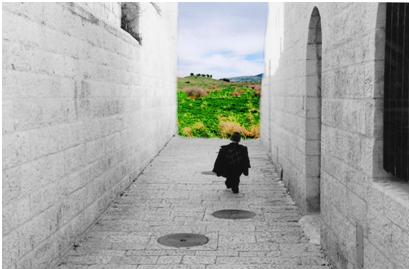
Who commands you?

?מי מצווה אותך

In response to some guiding questions for my upcoming reflection group, I've put down some thoughts in my usual stream-of-consciousness fashion. As usual, these aren't polished ideologies, and I look forward to hearing the reactions of others as well as my own thoughts in the upcoming days, months, and years.


There are two ways to think of any given law, negative and positive. Negative: don’t steal, don’t run a red light, don’t defraud the government. Positive: pay for things you take, drive only on a green light, pay your taxes. But what about a law like don’t kill? What’s the positive side of that?

I believe that the positive side of that negative commandment is where morality comes into play. Insofar as existence is good, life is good, and therefore so too preserving life is good. Just as animals and plants live out their goodness in a natural way, so do we live out our goodness by staying alive. Ending life truncates (not negates) this goodness, though even death can’t be considered non-good.

But back to the original question. Are there acts which we can elect not to do that fulfill the opposite of “don’t kill?” For example, if a person is starving, is one legally bound to feed her? If someone is dying of an illness you can cure, are you legally bound to cure her? My moral sensibilities say yes. But what is the source of this “law?”

I do not feel commanded. I believe that one can create a self-reality wherein one is commanded, but that reality would not have an external source (just as no reality can have an external source). But I do not believe that I have created such a reality for myself. While many Jews throughout history have viewed mitzvot as commandments, I do not hold the same theology. Of course, this doesn’t discount their own theologies, but nor do their understandings invalidate my own.

So, if God isn’t commanding me to feed the starving, why do I feel obliged to do it? This is a hard question that I haven’t spent sufficient time trying to answer. This is my first rough draft…

A fundament of this universe is existence. I’m sure that existence as I know it is only a tiny shard of “reality,” but my humanity is based on existence. And as I know that my existence here isn’t meaningless, I can only conclude that it is good to be alive. And insofar as others exist, it’s good for them to be alive, too.

Now, I can’t negate that goodness, as I mentioned before. But I can enrich it, increase it, and nurture it. I can interact and co-operate with others so that we may all deepen our experiences of this world. I don’t know precisely why we’re here, but my best guess so far is that it has something to do with experience, and the only conceivable value of experience I can think of is change. That is, with every experience, I change. As perceived time is a relative construct, I can’t say that I change over time, but I do recognize that waves of experience surge at different intensities, and I believe that such changes can only occur via interactions with other consciousnesses. (Such interactions, of course, are impossible to avoid as every existence in existence is founded on consciousness.)

Therefore, while there will be no “punishment” for not feeding the hungry, I won’t be living up to my potential. As I realize this, I can’t turn my back on that. Call it a responsibility, call it a self-acceptance of the yoke of existence, call it ethics. Whatever you call it, I do believe in it, and I do believe in it as a universal constant.

Who commands me? Existence. Insofar as God is existence, I can say that God commands me, but not in a conscious, external, imposing fashion. What am I commanded to do? To live and to learn; to enrich others’ lives and to teach. This is the center of my reality right now - at least, I try for it to be. And how do I teach this to others? Ay, there’s the rub!

There are a few people who I believe will really feel me on all of this and know where I’m coming from. Most of the rest are going to be left with a great number of questions. I feel prepared to talk through those questions (learn and teach…) with each of those people, but such an endeavor takes a great deal of time. Thus, to really live according to the focus I see in my life, I have to donate my life to learning and teaching according to these principles.

And that’s what I’m doing in rabbinical school. Each of us has a voice; mine is largely accented by Judaism. The messages I feel commanded to teach are easily found in Jewish language, so devoting myself to Judaism (which has all kinds of associated personal, communal, familial, spiritual, and experiential benefits) allows me to find an appropriate mode of learning and teaching. I believe I will fit into the role of the rabbi, and I expect it to fit me, and from that harmony, I hope that I’ll be able to enrich my own life and the lives of others.