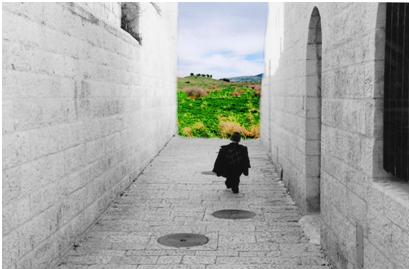
We have just finished commemorating what many consider the high holidays of the secular Israeli calendar - Yom HaShoah is the remembrance day for victims of the Holocaust, Yom HaZikaron is the remembrance day for fallen soldiers and victims of terror, and the day after Yom HaZikaron, Israelis celebrate Yom HaAtzmaut, Independance Day.
Our commemoration of Yom HaZikaron/Yom HaAtzmaut began the day before the holidays, when we attended a dress rehearsal for the national event to commemorate the ending of Yom Hazikaron and the beginning of Yom HaAtzmaut. It was a huge affair - we arrived at Mt. Herzl hours in advance to take our seats amidst an excited crowd. Much of the ceremony consisted of soldiers marching impressively carrying various flags, as well as a long torch-lighting ceremony in which people from different sectors of Israeli society lit torches to represent the 12 tribes of Israel, and a host of dancers. We took many pictures and have posted them online - please take a look! (Incidentally, the other photos in the album are from a game-show themed event that Daniel planned for HUC)
I spent the morning of Yom HaZikaron with the preschool, and aside from the kids standing still when a siren sounded through the city to signal a moment of silence, the atmosphere was celebratory in preparation for Independance Day - the kids left the preschool early so they could nap well in order to stay up to see the fireworks. My favorite conversation of the morning linked the celebration of Israel's independance with a discussion of how independant the preschoolers are becoming - some can even go to the bathroom by themselves!
We spent the afternoon at an orientation for the Encounter program we're attending tomorrow and Friday - you'll for sure be reading about this in a few days, but suffice it to say, for now, that we will be participating in a program in which we will have an opportunity to hear Palestinian perspectives on Israeli politics and on peace.
In the evening, beginning around 9pm, we heard the fireworks and scuttled out of our apartment. Walking toward the noise and music, we ran into a woman that we know from the Israeli Reform congregation we frequent, and we spoke to her about Independance Day and how it was different in her childhood, when Jerusalem was a small town and you could see the fireworks from anywhere. She was very eager to tell us about different options for the evening, from singing Israeli songs in a small group to dancing in the streets with a hipper crowd.
As we approached the corner of King George and Ben Yehuda we stumbled upon streets blocked off and filled bustling throngs of celebrants, music blasting, kids blowing horns and squirting silly string, vendors selling candied apples, ice cream, and corn on the cob. The festival atmosphere stretched on for whole city blocks, and we wandered around, snapping pictures, eating dessert, and watching fireworks. Eventually we met up with some HUC friends and made our way to the town hall, where we watched and tried to participate in a massive Israeli dancing event - you'll definately want to check out the video we posted on our photo webpage - it was quite a thing.
Today we went to the park for a picnic, having been told that a barbecue in the park is the Independance Day thing to do. While waiting for our friends to arrive, we watched military planes fly overhead, displaying their prowess. People here pack elaborate picnics, kind of like tailgating parties in the US, and it was fun to fit in. We had our own feast, as Paola (my Italian friend from Hebrew U) baked a pie that was to die for! We had a lovely afternoon under the very hot sun.
I don't have anything profound to say about the experience, I just wanted to give you a taste of what we've been doing over the past few busy days. Happy Independance Day!
Showing posts with label Israel. Show all posts
Showing posts with label Israel. Show all posts
Wednesday, April 29, 2009

Tuesday, April 21, 2009
Holocaust Memorial Day in Israel.
.יום הזכרון לשואה ולגבורה בארץ
Last night and today were Yom Hashoah (Holocaust Memorial Day). In Israel, this day is called "Memorial Day for Holocaust and Heroism" or Yom Hazikaron l'Shoah ul'gvurah. The commemoration day was inaugurated in 1951 in Israel, and it took decades for widespread Diaspora communities to regularly honor the day. Originally (and until about 20 years ago), this day focused much more on the "Heroism" than the "Holocaust" in Israel. The Jewish resistance fighters (partisans) were the center of attention, and for decades, they were featured prominently in Yom Hashoah ceremonies. Only in recent years (as partisan fighters have died and Israeli society has changed) have Israelis come to associate more with the victims of the Holocaust. Over the last 24 hours, the Yom Hashoah Jessica and I have experienced have been focused on the victims of Nazi aggression and the role that Israel has to play in the story.
Every year, Yad Vashem, the Holocaust museum in Jerusalem, puts on a ceremony for Yom Hashoah that is televised throughout the country (and almost universally watched among Jewish families). HUC was fortunate to receive tickets, so Jessica and I were able to attend the event in person.
We arrived two hours early, expecting large crowds and wanting good seats. We were very impressed with the ease with which we made it through the numerous security checks and to our seats. One of my classmates remarked today how meaningful it was that, for once, Israelis weren't being pushy. People seemed more patient last night, more sensitive.
The ceremony itself was very interesting, especially as this was an avowedly secular, state-sponsored commemoration. The army featured prominently, placed sequentially beside two statues in the Warsaw Ghetto Courtyard of Yad Vashem, thus effectively displaying a progression of "Jews on the Marching to their Deaths" to "Partisan Fighters" to "Soldiers of Israel Defending the People of Israel." Throughout the ceremony, this was the message: The Holocaust was a planned tragedy, and Israel was the closest thing to a "happy ending" that the Jews could hope for. Moreover, there are still people today who would plan a Holocaust against the Jews, and the State of Israel is the only thing that can prevent that.
This was the message that struck me the most. Both Israel's President (Shimon Peres) and its Prime Minister (Benjamin Netanyahu) included a healthy dose of politics in their speeches. Each of them condemned the World Conference against Racism, which is being boycotted by 10 nations (the US, Israel, Australia, Canada, Germany, Italy, the Netherlands, Sweden, Poland, and New Zealand) because of its heavy anti-Zionist message. They also cited Mahmoud Ahmadinejad and Iran as a critical threat against the Jewish people and called on the world to discredit him. (The same night, Ahmadinejad gave a speech at this conference so anti-Israel and anti-Jewish that at least 30 nations' representatives walked out.) Of course, they spoke about the tragedy of the Holocaust with force, condemning "Nazi Germans and their helpers" for the crimes they committed against the Jewish people. But the message rang loud and clear: the State of Israel is the only entity that exists to protect Jews against the possibility of another Holocaust.
In addition to these speeches, the former Chief Ashkenazi Rabbi of Israel, Meir Lau, gave a moving account of his own experience during the Holocaust, and a letter written by a child killed during the war was recited by an FSU-born Israeli actress. The singer Achinoam Nini (known outside of Israel as Noa) performed several pieces, as did an Israeli girls' choir (all of whom sang beautifully). The chief cantor of the Army sang a version of El Malei Rachamim (traditionally a prayer of comfort but used here as a dirge of mourning), the current Chief Sephardi Rabbi read a Psalm, and the current Chief Ashkenazi Rabbi led the Mourner's Kaddish.
The most powerful part of the ceremony for me (perhaps because it is most similar to what I'm used to) was the lighting of the six torches. Each torch was lit by a survivor (or two, in the case of the pair of twins) whose story was narrated and displayed via video. Many of the stories were of children separated from parents, forced to live in a ghetto or concentration camp, or of children who managed to escape the worst by virtue of Righteous Gentiles or partisan fighters. Each of the six stories was very Zionist, describing an early and ardent commitment to the Land of Israel that was able to be fulfilled. Although the Zionist component stood out, the rest of the story narration was similar to other Yom Hashoah events I've attended.
I'm not surprised that this event was so Zionist. After all, we were in Israel! Perhaps what was most interesting, then, was the negotiation between religious and secular. Of the 80 minute ceremony, probably 15 or 20 minutes was "religious." During those times (as at others), the soldiers stood at attention - and just before the Kaddish was recited, a large number of men in the crowd (including myself) produced and put on a kippah. Of course, only Orthodoxy was represented, but the Kaddish was led with men and women sitting next to each other, and there wasn't a stir when Noa and the choir sang. (Generally, ultra-Orthodox people consider it against Jewish law for men to hear women sing.) There weren't very many ultra-Orthodox people in the crowd, but the Chief Rabbis were both present and "well-behaved." The State respected them and vice versa.
However, the political speeches were definitely a new component for me. I knew to expect them, so I wasn't caught off guard, but before this year, I would never expect Yom Hashoah to be so political. A couple years ago at UVA, the Darfur Week of Conscience ended on Yom Hashoah, and Hillel worked with STAND (Students Taking Action Now: Darfur) to plan a week of programming together. Yom Hashoah itself, though, was (as I recall) reserved for commemoration of the Holocaust. The political message was implicit but not mentioned during Yom Hashoah itself. This event at Yad Vashem was different.
I'm not criticizing, though. This is how they do it publicly in Israel. Anyway, I'm not sure I'd get much out of an official religious ceremony because it would by definition have to be Orthodox. What we experienced last night was engaging, interesting, and very moving for a lot of students. I myself was in a fairly analytical state of mind, so I wasn't emotionally taken by the ceremony, but I understand that it was very powerful.
This morning, HUC sponsored its own Yom Hashoah commemorations, which were fairly different from Yad Vashem's. Our service this morning included what one would expect in a morning service, though we sang less than usual and included readings about the Holocaust. After a half-hour break, we were encouraged to stand in front of HUC for the 10:00 siren, which I'd heard about before coming to Israel.
On Yom Hashoah, at 10:00 in the morning, sirens sound throughout the country with the tacit understanding that people will stop what they are doing for two minutes. In my imagination, the country stopped entirely for this time period, but of course, the reality never lives up to the ideal. At 10:00, as expected, the sirens went off, and the cars stopped in the streets and their drivers got out. One driver honked his horn, though after about 30 seconds, he too decided to stand in the street and pay his respects. Three construction workers across the street were, like us, watching the stopped traffic, though other (presumably Arab) construction workers continued to use their buzz saw inside the building. A driver took advantage of the slowed traffic to pass the stopped cars. For the most part, the area around me became still, but of course, it wasn't as dramatic as I had expected.
Back in the courtyard of HUC was our own Yom Hashoah ceremony. This was more familiar to me with poems, music and song, personal stories, prayers, and a name-reading at the end. There were certainly similarities to the Yad Vashem ceremony (HUC's was designed by Israeli as well as American students), but the Zionist factor was significantly reduced. The ceremony was well planned and powerful, but again, I found myself being too analytical to get carried away. Don't get me wrong - of course I teared up a couple times. But I'm usually much more moved by Yom Hashoah than I was this year.
For the past several years, I've been intimately involved with Hillel's planning of Yom Hashoah's commemoration. I've picked up Holocaust survivors from their hotel, read names of victims at 2:00 in the morning, and helped plan the Week of Conscience mentioned above. Each of these experiences (and more) have been very moving and meaningful to me. But I realize now that very few people (and Jessica is one of them) experienced Yom Hashoah at UVA in this way. Most of the people read names for 15 or 20 minutes and possibly came to an event or the survivor's presentation. This year, I spent about 4 hours directly engaged with Holocaust commemoration (which would usually be considered a lot), but it seemed less powerful to me than before.
One thing I learn from this is that it can be hard to reach someone who didn't participate in the planning of an event. You do what you can do, but the "audience" has to bring itself to the table in order to be affected. I wasn't entirely present, so I didn't get all I could out of Yom Hashoah this year. I will keep this in mind not only for my own commemoration of similar events in the future but also when I'm planning such events.
In conclusion, the past 24 hours have been special, unique, and impactful - but I've learned more about Israel than about the Holocaust. I think that's okay - it is what it is, after all. And yet I find myself wishing for greater eloquence about the depth of the day. Perhaps next year, when I'm not in Jerusalem anymore.
Let me conclude with a poem that I did find moving that was included in HUC's memorial service this morning.
Yizkor by Abba Kovner, translated by Jules Harlow
We shall remember our brothers and sisters,
The city houses and the country houses,
The shtetl streets rushing like rivers
And the lonely inn on the country road --
The aged man and the features of his face,
The mother in her kerchief,
The young girl with her braids,
The child,
The people Israel in thousands of communities
Among all the human families,
The entire assembly of Jews
Brought down to slaughter on the soil of Europe
By the Nazi destroyer,
The man who suddenty screamed
And while screaming died,
The woman, clutching her infant to her breast,
Whose arms gave out,
The infant groping for his mother's nipple
Finding it blue and cold.
The feet,
The feet that sought refuge,
Though flight was no longer possible,
And those who made their hands into a fist,
The fist that gripped the iron,
The iron that became the weapon of vision,
Of despair, and of rebellion,
And those, the pure of heart,
Those whose eyes were opened,
Those who risked their lives,
Though they lacked the power to triumph.
We shall remember the day,
The day in its brightness, the sun that rose
Over the bloody conflagration,
The lofty silent heavens.
We shall remember the mounds of dust
Beneath the gardens in bloom.
The living shall remember their dead
For they are forever before us.
Look! Their eyes dart round and about,
Allowing us no peace, no peace,
Until our lives become worthy of their memory.
Last night and today were Yom Hashoah (Holocaust Memorial Day). In Israel, this day is called "Memorial Day for Holocaust and Heroism" or Yom Hazikaron l'Shoah ul'gvurah. The commemoration day was inaugurated in 1951 in Israel, and it took decades for widespread Diaspora communities to regularly honor the day. Originally (and until about 20 years ago), this day focused much more on the "Heroism" than the "Holocaust" in Israel. The Jewish resistance fighters (partisans) were the center of attention, and for decades, they were featured prominently in Yom Hashoah ceremonies. Only in recent years (as partisan fighters have died and Israeli society has changed) have Israelis come to associate more with the victims of the Holocaust. Over the last 24 hours, the Yom Hashoah Jessica and I have experienced have been focused on the victims of Nazi aggression and the role that Israel has to play in the story.
Every year, Yad Vashem, the Holocaust museum in Jerusalem, puts on a ceremony for Yom Hashoah that is televised throughout the country (and almost universally watched among Jewish families). HUC was fortunate to receive tickets, so Jessica and I were able to attend the event in person.
We arrived two hours early, expecting large crowds and wanting good seats. We were very impressed with the ease with which we made it through the numerous security checks and to our seats. One of my classmates remarked today how meaningful it was that, for once, Israelis weren't being pushy. People seemed more patient last night, more sensitive.
The ceremony itself was very interesting, especially as this was an avowedly secular, state-sponsored commemoration. The army featured prominently, placed sequentially beside two statues in the Warsaw Ghetto Courtyard of Yad Vashem, thus effectively displaying a progression of "Jews on the Marching to their Deaths" to "Partisan Fighters" to "Soldiers of Israel Defending the People of Israel." Throughout the ceremony, this was the message: The Holocaust was a planned tragedy, and Israel was the closest thing to a "happy ending" that the Jews could hope for. Moreover, there are still people today who would plan a Holocaust against the Jews, and the State of Israel is the only thing that can prevent that.
This was the message that struck me the most. Both Israel's President (Shimon Peres) and its Prime Minister (Benjamin Netanyahu) included a healthy dose of politics in their speeches. Each of them condemned the World Conference against Racism, which is being boycotted by 10 nations (the US, Israel, Australia, Canada, Germany, Italy, the Netherlands, Sweden, Poland, and New Zealand) because of its heavy anti-Zionist message. They also cited Mahmoud Ahmadinejad and Iran as a critical threat against the Jewish people and called on the world to discredit him. (The same night, Ahmadinejad gave a speech at this conference so anti-Israel and anti-Jewish that at least 30 nations' representatives walked out.) Of course, they spoke about the tragedy of the Holocaust with force, condemning "Nazi Germans and their helpers" for the crimes they committed against the Jewish people. But the message rang loud and clear: the State of Israel is the only entity that exists to protect Jews against the possibility of another Holocaust.
In addition to these speeches, the former Chief Ashkenazi Rabbi of Israel, Meir Lau, gave a moving account of his own experience during the Holocaust, and a letter written by a child killed during the war was recited by an FSU-born Israeli actress. The singer Achinoam Nini (known outside of Israel as Noa) performed several pieces, as did an Israeli girls' choir (all of whom sang beautifully). The chief cantor of the Army sang a version of El Malei Rachamim (traditionally a prayer of comfort but used here as a dirge of mourning), the current Chief Sephardi Rabbi read a Psalm, and the current Chief Ashkenazi Rabbi led the Mourner's Kaddish.
The most powerful part of the ceremony for me (perhaps because it is most similar to what I'm used to) was the lighting of the six torches. Each torch was lit by a survivor (or two, in the case of the pair of twins) whose story was narrated and displayed via video. Many of the stories were of children separated from parents, forced to live in a ghetto or concentration camp, or of children who managed to escape the worst by virtue of Righteous Gentiles or partisan fighters. Each of the six stories was very Zionist, describing an early and ardent commitment to the Land of Israel that was able to be fulfilled. Although the Zionist component stood out, the rest of the story narration was similar to other Yom Hashoah events I've attended.
I'm not surprised that this event was so Zionist. After all, we were in Israel! Perhaps what was most interesting, then, was the negotiation between religious and secular. Of the 80 minute ceremony, probably 15 or 20 minutes was "religious." During those times (as at others), the soldiers stood at attention - and just before the Kaddish was recited, a large number of men in the crowd (including myself) produced and put on a kippah. Of course, only Orthodoxy was represented, but the Kaddish was led with men and women sitting next to each other, and there wasn't a stir when Noa and the choir sang. (Generally, ultra-Orthodox people consider it against Jewish law for men to hear women sing.) There weren't very many ultra-Orthodox people in the crowd, but the Chief Rabbis were both present and "well-behaved." The State respected them and vice versa.
However, the political speeches were definitely a new component for me. I knew to expect them, so I wasn't caught off guard, but before this year, I would never expect Yom Hashoah to be so political. A couple years ago at UVA, the Darfur Week of Conscience ended on Yom Hashoah, and Hillel worked with STAND (Students Taking Action Now: Darfur) to plan a week of programming together. Yom Hashoah itself, though, was (as I recall) reserved for commemoration of the Holocaust. The political message was implicit but not mentioned during Yom Hashoah itself. This event at Yad Vashem was different.
I'm not criticizing, though. This is how they do it publicly in Israel. Anyway, I'm not sure I'd get much out of an official religious ceremony because it would by definition have to be Orthodox. What we experienced last night was engaging, interesting, and very moving for a lot of students. I myself was in a fairly analytical state of mind, so I wasn't emotionally taken by the ceremony, but I understand that it was very powerful.
This morning, HUC sponsored its own Yom Hashoah commemorations, which were fairly different from Yad Vashem's. Our service this morning included what one would expect in a morning service, though we sang less than usual and included readings about the Holocaust. After a half-hour break, we were encouraged to stand in front of HUC for the 10:00 siren, which I'd heard about before coming to Israel.
On Yom Hashoah, at 10:00 in the morning, sirens sound throughout the country with the tacit understanding that people will stop what they are doing for two minutes. In my imagination, the country stopped entirely for this time period, but of course, the reality never lives up to the ideal. At 10:00, as expected, the sirens went off, and the cars stopped in the streets and their drivers got out. One driver honked his horn, though after about 30 seconds, he too decided to stand in the street and pay his respects. Three construction workers across the street were, like us, watching the stopped traffic, though other (presumably Arab) construction workers continued to use their buzz saw inside the building. A driver took advantage of the slowed traffic to pass the stopped cars. For the most part, the area around me became still, but of course, it wasn't as dramatic as I had expected.
Back in the courtyard of HUC was our own Yom Hashoah ceremony. This was more familiar to me with poems, music and song, personal stories, prayers, and a name-reading at the end. There were certainly similarities to the Yad Vashem ceremony (HUC's was designed by Israeli as well as American students), but the Zionist factor was significantly reduced. The ceremony was well planned and powerful, but again, I found myself being too analytical to get carried away. Don't get me wrong - of course I teared up a couple times. But I'm usually much more moved by Yom Hashoah than I was this year.
For the past several years, I've been intimately involved with Hillel's planning of Yom Hashoah's commemoration. I've picked up Holocaust survivors from their hotel, read names of victims at 2:00 in the morning, and helped plan the Week of Conscience mentioned above. Each of these experiences (and more) have been very moving and meaningful to me. But I realize now that very few people (and Jessica is one of them) experienced Yom Hashoah at UVA in this way. Most of the people read names for 15 or 20 minutes and possibly came to an event or the survivor's presentation. This year, I spent about 4 hours directly engaged with Holocaust commemoration (which would usually be considered a lot), but it seemed less powerful to me than before.
One thing I learn from this is that it can be hard to reach someone who didn't participate in the planning of an event. You do what you can do, but the "audience" has to bring itself to the table in order to be affected. I wasn't entirely present, so I didn't get all I could out of Yom Hashoah this year. I will keep this in mind not only for my own commemoration of similar events in the future but also when I'm planning such events.
In conclusion, the past 24 hours have been special, unique, and impactful - but I've learned more about Israel than about the Holocaust. I think that's okay - it is what it is, after all. And yet I find myself wishing for greater eloquence about the depth of the day. Perhaps next year, when I'm not in Jerusalem anymore.
Let me conclude with a poem that I did find moving that was included in HUC's memorial service this morning.
Yizkor by Abba Kovner, translated by Jules Harlow
We shall remember our brothers and sisters,
The city houses and the country houses,
The shtetl streets rushing like rivers
And the lonely inn on the country road --
The aged man and the features of his face,
The mother in her kerchief,
The young girl with her braids,
The child,
The people Israel in thousands of communities
Among all the human families,
The entire assembly of Jews
Brought down to slaughter on the soil of Europe
By the Nazi destroyer,
The man who suddenty screamed
And while screaming died,
The woman, clutching her infant to her breast,
Whose arms gave out,
The infant groping for his mother's nipple
Finding it blue and cold.
The feet,
The feet that sought refuge,
Though flight was no longer possible,
And those who made their hands into a fist,
The fist that gripped the iron,
The iron that became the weapon of vision,
Of despair, and of rebellion,
And those, the pure of heart,
Those whose eyes were opened,
Those who risked their lives,
Though they lacked the power to triumph.
We shall remember the day,
The day in its brightness, the sun that rose
Over the bloody conflagration,
The lofty silent heavens.
We shall remember the mounds of dust
Beneath the gardens in bloom.
The living shall remember their dead
For they are forever before us.
Look! Their eyes dart round and about,
Allowing us no peace, no peace,
Until our lives become worthy of their memory.
Saturday, March 21, 2009
Sabbath joy.
.עונג שבת
Friday-Saturday is the best part of our week here in Israel. Jessica and I always try to do something special on Shabbat, usually with friends. Today, we decided to spend the whole day in the house (like a non-sick sick day!), and it's been delightful so far. Last night, though, was so much more eventful - a real Shabbat experience!
A program at my school has connected me with one of the Israeli rabbinical students, and though it's taken a long time, we finally managed to find a Shabbat to spend together. She lives in Tzur Hadassah, a "sleeper" town most of whose residents work in surrounding cities. Once a month, members of her community travel to an Elwyn community, which cares for Israeli special needs adults. We agreed to travel with my classmates to meet her at Elwyn and then return with them to Tzur Hadassah for services in their small Reform congregation and dinner.
Jessica and I met Leslie and Ari at 3:30 on Friday afternoon to start this journey. Right away, we met Asher, who is a cab driver that Leslie has befriended (and apparently the only cab driver the pair of them has taken to Elwyn that doesn't consistently get lost). Of course he didn't turn the meter on, and a price wasn't discussed until we arrived at our destination. During the time between leaving and arriving, we became acquainted with this rather eccentric Israeli man. He likes singing, Jerusalem, and Leslie. ;-) Although Leslie insisted that we didn't have time, Asher pulled over to buy her some water, and he insisted that next month, he would shave and join Ari and Leslie for their song-leading at Elwyn. He was very friendly and funny, but his flirtation with crossing boundaries was a bit off-putting.
When we arrived at Elwyn, Leslie told us that she had simply met Asher when she really needed a cab once, and he's been a great resource ever since. She's called him to pick friends up from the airport, and he's their standard transportation to Elwyn. She's even met his family as a Shabbat guest. So, he may have been a bit overmuch in some ways, but he seems to be just a jokester and overall, a pleasant fellow.
Waiting for us at Elwyn were Myra (the Israeli HUC student) and another member of the Tzur Hadassah community. They took us inside, and Jessica and I were surprised to be greeted enthusiastically by a room full of special needs adults. As the six of us visitors walked in, several of the residents darted to the door to shake our hands and wish us a Shabbat shalom. We made our way upstairs to the main room, which was apparently more full than usual. As Leslie and Ari set up, Jessica and I stayed by the main entrance to the room, and from there, we greeted residents as they arrived (most in wheelchairs).
Each resident wished us a Shabbat shalom and wanted to know who we were. Many were immediately insistent on hearing our names, and after we told them who they were, they went about their business. It was obvious that today was a very special day - not only was it Shabbat, but it was the Shabbat with the special visitors.
After waiting for everyone to arrive, Myra introduced Shabbat by saying that this was a special week with special guests (including Jessica and myself). We then spent the next half-hour singing Shabbat songs. The residents knew all the songs and sang and danced with enormous smiles. Never have I seen so much unabashed joy in one place - these men and women were openly ecstatic, and Jessica and I couldn't stop from smiling. A few residents near us engaged us in brief conversations and seemed excited to have visitors nearby. Myra invited Jessica and me to lead the Kiddush, so we went into the center of the room for the last five minutes or so. We were surrounded by the joy of these special needs adults, and it was a radiant experience.
Of course, it was also a difficult one. While I had a very positive experience there, I'm sure that continuing to work or volunteer at such a place would be very draining, especially since most of the time is not so specially wonderful as our short Shabbat visit. I don't know what life is like there all of the time, but I can only assume that the ecstasy of our Shabbat visit was fairly special. Still, witnessing the potential happiness that can manifest un-self-consciously on an adults face was an impactful experience, and I'm blessed to have been able to be present for that.
After leaving Elwyn, we rode in Myra's car to Tzur Hadassah. The view was beautiful as we traveled through secondary roads in the Judean Hills. When we arrived, I noticed that people here live in houses (not apartments) and that the community is mostly residential. There are elementary schools but not junior or senior high schools, and I didn't see any businesses or stores. The view was beautiful, though I came to learn that Tzur Hadassah, which is entirely walled-in, is 300 meters from the Green Line - so Shabbat walks are always to the north or west.
The Reform congregation of Tzur Hadassah meets in the Reform preschool trailer (which is part of a collection of preschool trailers). Although the congregation has recently been one of a handful of Reform congregations to receive a building from the government (where such buildings are relatively easy for new Orthodox congregations to attain), many months and thousands of dollars are still required to connect it to electricity and sewage. So, for the time being, Shabbat services are conducted on folding chairs among pictures of bible stories and spring festivals.
The service was "standard Israeli Reform" for the most part. Ari and Leslie led the songs, and the rabbi of the congregation, Ofer Sabath Beit-Halachmi, gave a d'var Torah about contributing to the empty Pesach seder tables of needy members of the Tzur Hadassah community. Although the congregation was small, the service was full, and the several children there (including a young woman who goes to the Army this Wednesday) proved that there is definitely a future for Reform Judaism in the town.
After services, we traveled back to Myra's house for a delicious vegetarian Shabbat dinner. We met her husband, Gilad, as well as Ofer's wife, Rabbi Rachel Sabath Beit-Halachmi, and two visitors from Holland. We met Ofer's and Rachel's daughter Tehillah and Myra's and Gilad's two sons and two daughters. It was a full dinner table, and Jessica and I immensely enjoyed the entire evening. I had a conversation with Myra's oldest daughter, Yael, about school, Progressive Judaism, and the weather in Israel, and I played Ratatouille War with 5-year-old Tehillah. I learned about Jewish life in Holland and Reform life in Tzur Hadassah. Rachel and I had a great conversation wherein I found that she's friends with some of our professors from UVA and is usually a teacher (on maternity leave) at HUC. It was really a very lovely evening, and Jessica and I hope to be able to go back before the end of the year.
Ofer (can't even call him Rabbi Beit-Halachmi because that applies to him and his wife!) drove Jessica and me home, and we heard his perspective on living in cities vs. the country, issues of race in Israel, and the touching story of how he met his wife. And when we got home, it was still just after 10:00, so we had had a full night and could still watch an episode of The West Wing before bed!
Although this was a unique Shabbat experience, it represents the specialness that Shabbat holds in our week during this year in Israel. I've really come to treasure our one day of rest, and I absolutely intend to keep the spirit alive when we move to New York next year.
And speaking of next year, it's really sneaking up on us! Next week, Jessica is joining my class on a Wed-Sat trip to the Negev desert, which I'm really looking forward to. A week and a half after we return, Jessica and I fly to Moscow to participate in the FSU Pesach Project! After Passover break, I have four weeks of class, a week of exams, a weekend of packing, and then I head back to the States. I'm not trying to rush the end of the year by any stretch of the imagination - on the contrary, I'm startled by how quickly it seems like it will be over, and I'm trying to appreciate each day for what it can bring! Still, I'm excited about the summer - I've accepted the position of Community Educator at Genesis, a program run through Brandeis University in Boston. And, of course, I'm looking forward to moving to New York and starting a new adventure.
All in good time, though. For now, I'm going to enjoy the rest of Shabbat ... before celebrating a friend's birthday with Contra Dancing! Shabbat shalom!
Friday-Saturday is the best part of our week here in Israel. Jessica and I always try to do something special on Shabbat, usually with friends. Today, we decided to spend the whole day in the house (like a non-sick sick day!), and it's been delightful so far. Last night, though, was so much more eventful - a real Shabbat experience!
A program at my school has connected me with one of the Israeli rabbinical students, and though it's taken a long time, we finally managed to find a Shabbat to spend together. She lives in Tzur Hadassah, a "sleeper" town most of whose residents work in surrounding cities. Once a month, members of her community travel to an Elwyn community, which cares for Israeli special needs adults. We agreed to travel with my classmates to meet her at Elwyn and then return with them to Tzur Hadassah for services in their small Reform congregation and dinner.
Jessica and I met Leslie and Ari at 3:30 on Friday afternoon to start this journey. Right away, we met Asher, who is a cab driver that Leslie has befriended (and apparently the only cab driver the pair of them has taken to Elwyn that doesn't consistently get lost). Of course he didn't turn the meter on, and a price wasn't discussed until we arrived at our destination. During the time between leaving and arriving, we became acquainted with this rather eccentric Israeli man. He likes singing, Jerusalem, and Leslie. ;-) Although Leslie insisted that we didn't have time, Asher pulled over to buy her some water, and he insisted that next month, he would shave and join Ari and Leslie for their song-leading at Elwyn. He was very friendly and funny, but his flirtation with crossing boundaries was a bit off-putting.
When we arrived at Elwyn, Leslie told us that she had simply met Asher when she really needed a cab once, and he's been a great resource ever since. She's called him to pick friends up from the airport, and he's their standard transportation to Elwyn. She's even met his family as a Shabbat guest. So, he may have been a bit overmuch in some ways, but he seems to be just a jokester and overall, a pleasant fellow.
Waiting for us at Elwyn were Myra (the Israeli HUC student) and another member of the Tzur Hadassah community. They took us inside, and Jessica and I were surprised to be greeted enthusiastically by a room full of special needs adults. As the six of us visitors walked in, several of the residents darted to the door to shake our hands and wish us a Shabbat shalom. We made our way upstairs to the main room, which was apparently more full than usual. As Leslie and Ari set up, Jessica and I stayed by the main entrance to the room, and from there, we greeted residents as they arrived (most in wheelchairs).
Each resident wished us a Shabbat shalom and wanted to know who we were. Many were immediately insistent on hearing our names, and after we told them who they were, they went about their business. It was obvious that today was a very special day - not only was it Shabbat, but it was the Shabbat with the special visitors.
After waiting for everyone to arrive, Myra introduced Shabbat by saying that this was a special week with special guests (including Jessica and myself). We then spent the next half-hour singing Shabbat songs. The residents knew all the songs and sang and danced with enormous smiles. Never have I seen so much unabashed joy in one place - these men and women were openly ecstatic, and Jessica and I couldn't stop from smiling. A few residents near us engaged us in brief conversations and seemed excited to have visitors nearby. Myra invited Jessica and me to lead the Kiddush, so we went into the center of the room for the last five minutes or so. We were surrounded by the joy of these special needs adults, and it was a radiant experience.
Of course, it was also a difficult one. While I had a very positive experience there, I'm sure that continuing to work or volunteer at such a place would be very draining, especially since most of the time is not so specially wonderful as our short Shabbat visit. I don't know what life is like there all of the time, but I can only assume that the ecstasy of our Shabbat visit was fairly special. Still, witnessing the potential happiness that can manifest un-self-consciously on an adults face was an impactful experience, and I'm blessed to have been able to be present for that.
After leaving Elwyn, we rode in Myra's car to Tzur Hadassah. The view was beautiful as we traveled through secondary roads in the Judean Hills. When we arrived, I noticed that people here live in houses (not apartments) and that the community is mostly residential. There are elementary schools but not junior or senior high schools, and I didn't see any businesses or stores. The view was beautiful, though I came to learn that Tzur Hadassah, which is entirely walled-in, is 300 meters from the Green Line - so Shabbat walks are always to the north or west.
The Reform congregation of Tzur Hadassah meets in the Reform preschool trailer (which is part of a collection of preschool trailers). Although the congregation has recently been one of a handful of Reform congregations to receive a building from the government (where such buildings are relatively easy for new Orthodox congregations to attain), many months and thousands of dollars are still required to connect it to electricity and sewage. So, for the time being, Shabbat services are conducted on folding chairs among pictures of bible stories and spring festivals.
The service was "standard Israeli Reform" for the most part. Ari and Leslie led the songs, and the rabbi of the congregation, Ofer Sabath Beit-Halachmi, gave a d'var Torah about contributing to the empty Pesach seder tables of needy members of the Tzur Hadassah community. Although the congregation was small, the service was full, and the several children there (including a young woman who goes to the Army this Wednesday) proved that there is definitely a future for Reform Judaism in the town.
After services, we traveled back to Myra's house for a delicious vegetarian Shabbat dinner. We met her husband, Gilad, as well as Ofer's wife, Rabbi Rachel Sabath Beit-Halachmi, and two visitors from Holland. We met Ofer's and Rachel's daughter Tehillah and Myra's and Gilad's two sons and two daughters. It was a full dinner table, and Jessica and I immensely enjoyed the entire evening. I had a conversation with Myra's oldest daughter, Yael, about school, Progressive Judaism, and the weather in Israel, and I played Ratatouille War with 5-year-old Tehillah. I learned about Jewish life in Holland and Reform life in Tzur Hadassah. Rachel and I had a great conversation wherein I found that she's friends with some of our professors from UVA and is usually a teacher (on maternity leave) at HUC. It was really a very lovely evening, and Jessica and I hope to be able to go back before the end of the year.
Ofer (can't even call him Rabbi Beit-Halachmi because that applies to him and his wife!) drove Jessica and me home, and we heard his perspective on living in cities vs. the country, issues of race in Israel, and the touching story of how he met his wife. And when we got home, it was still just after 10:00, so we had had a full night and could still watch an episode of The West Wing before bed!
Although this was a unique Shabbat experience, it represents the specialness that Shabbat holds in our week during this year in Israel. I've really come to treasure our one day of rest, and I absolutely intend to keep the spirit alive when we move to New York next year.
And speaking of next year, it's really sneaking up on us! Next week, Jessica is joining my class on a Wed-Sat trip to the Negev desert, which I'm really looking forward to. A week and a half after we return, Jessica and I fly to Moscow to participate in the FSU Pesach Project! After Passover break, I have four weeks of class, a week of exams, a weekend of packing, and then I head back to the States. I'm not trying to rush the end of the year by any stretch of the imagination - on the contrary, I'm startled by how quickly it seems like it will be over, and I'm trying to appreciate each day for what it can bring! Still, I'm excited about the summer - I've accepted the position of Community Educator at Genesis, a program run through Brandeis University in Boston. And, of course, I'm looking forward to moving to New York and starting a new adventure.
All in good time, though. For now, I'm going to enjoy the rest of Shabbat ... before celebrating a friend's birthday with Contra Dancing! Shabbat shalom!
Thursday, March 12, 2009
Purim in a walled city.
.פורים בעיר בחומה
I've had fun on Purim before, but celebrating in Jerusalem has been an entirely different experience. The fact that most of the people I encounter are celebrating the same Jewish holiday I am has made commemorating this most recent holiday--like others before and to come--particularly acute and memorable.
You could tell it was getting close to Purim even at the beginning of this week as children were walking to school in costume. Although the holiday was still several days off, the Purim spirit was alive in the air: hamentaschen (אוזני המן) have been in the bakeries for about two weeks, candies and gifts have been on sale, and even the liturgical calendar has been special for the Shabbatot preceding Purim. Anticipation was high for the annual fun-fest that is Purim.
In Jerusalem, as in other ancient walled cities (just a handful of cities in Israel), Purim is celebrated a day later than in the rest of the Jewish world. So, although "Shushan Purim" (as the delayed commemoration is known) began on Tuesday night, when I and my fellow volunteers traveled outside to Jerusalem to be with our families at the absorption center in Mivasseret Tzion, we entered into a Purim Zone and were allowed to have a Purim party for the kids of the neighborhood. We had sweets as well as art stations to make masks and noise-makers for the holiday. We played music and sang a Purim song. Though most of the kids who came weren't part of the families we work with, it was great to see a large room full of kids coloring clowns and wearing paper masks in celebration of Purim.
On Tuesday night, HUC had its own Purim celebration. I was one of the six primary planners and actors in our Purim service/play, and we had a terrific time. I got to stretch my creative muscles by writing six songs that fit the themes of the evening service and that could also fit into our pop music-style version of the Purim story. This was my favorite:
The Promised Land (an adaptation of Mi Chamocha sung to the tune of the Beach Boys’ Kokomo)
Samaria, Judea – ooo I wanna take ya
Through Moab, through Amon – come on, pretty mama.
Akko, Megido – Baby, why don’t we go?
Judea-
’Cross these mountains of sand,
There’s a place called “the Promised Land.”
That’s where God’s always planned
To make a home for us all.
Now we’ve crossed the sea;
Our God has taken us from slavery.
We’ll be swimming in milk
Tasting trees dripping with fig honey
Down in the Promised Land.
Samaria, Judea – ooo I wanna take ya
Through Moab, through Amon – come on, pretty mama.
Akko, Megido – Baby, why don’t we go?
Ooo I wanna take you to the Promised Land.
We’ll get there fast
Under our God’s command.
With a mighty arm and an outstretched hand:
Straight to the Promised Land.
Yes we can: from Be’er Sheva to Dan!
Now we’ve crossed the sea;
We dance with drum and tambourine.
I will sing to the Lord
For You have triumphed glor(i)ously!
Who is like You, o God,
Among the other gods?
The Lord will reign forever,
Doing wonders, awesome in splendor.
Down in the Promised Land…
Samaria, Judea – ooo I wanna take ya
Through Moab, through Amon – come on, pretty mama.
Akko, Megido – Baby, why don’t we go?
Ooo I wanna take you to the Promised Land.
We’ll get there fast
Under our God’s command.
With a mighty arm and an outstretched hand:
Straight to the Promised Land.
From Mount Nebo, we can see Jericho!

Singing at the service/spiel
The service got a lot of acclaim, and my co-authors/actors and I were very proud of the work we created. And, of course, we had a ton of fun! The megillah-reading in the middle of the service was also fantastic. All the cantorial students as well as some rabbinical students participated in reading the entire megillah (which is rare), and many of them read with strong expression and intent in order to convey the meaning behind the words. The chanting was beautiful and the text came alive - really terrific!


Megillah reading in costume
After the service and megillah reading, we had dinner at HUC, followed by a beit cafe (the Israeli version of a talent show), during which the highlight was Shacharit the Musical, which poked fun at Reform and HUC music and prayer traditions. Really delightful!
The following day (Wednesday) was a second day off of school, and Jessica and I had the opportunity to get out into the beautiful weather. We went to the shuk (market) to do our usually grocery shopping, but unusually, many customers and shoptenders were in costume or at least wearing funny hats. It was amazing to see so many adults going about their regular business in costume. If we had known, we would have brought our camera!
As we neared our apartment after shopping, we heard some loud music and decided to investigate. We dropped off our bags, grabbed the camera, and went to the pedestrian mall area near our apartment. There, we found a street fair with performers, cotton candy, and tons of people in costumes!

Superman on Hillel Street.
We ran into a pair of HUC faculty, and they told us that if we liked what we saw here, we should go to Mamilla Mall (near the Old City) where there was an even larger street fair. Of course we did, and we found there children's games, actors on stilts, and more Israelis than I've ever seen in this Anglo-friendly shopping center. It was terrific!

Queen Esther and admirers

Purim performer

Mordechai and Haman on stilts

Drummers' circle
After the street fair, we had a lovely walk through the warm and blossoming hills of Yemin Moshe, caught a glimpse of some Bratslavers celebrating off of Keren Ha-Yesod St., and were approached by a Yiddish-speaking man who managed to communicate to Jessica (to no avail) that he needed help finding his "friends."
Given that this was mid-March in the middle of the week, our Wednesday was certainly as topsy-turvey as one could hope on Purim. I certainly hope this isn't the last chance I have to celebrate in Jerusalem!
I've had fun on Purim before, but celebrating in Jerusalem has been an entirely different experience. The fact that most of the people I encounter are celebrating the same Jewish holiday I am has made commemorating this most recent holiday--like others before and to come--particularly acute and memorable.
You could tell it was getting close to Purim even at the beginning of this week as children were walking to school in costume. Although the holiday was still several days off, the Purim spirit was alive in the air: hamentaschen (אוזני המן) have been in the bakeries for about two weeks, candies and gifts have been on sale, and even the liturgical calendar has been special for the Shabbatot preceding Purim. Anticipation was high for the annual fun-fest that is Purim.
In Jerusalem, as in other ancient walled cities (just a handful of cities in Israel), Purim is celebrated a day later than in the rest of the Jewish world. So, although "Shushan Purim" (as the delayed commemoration is known) began on Tuesday night, when I and my fellow volunteers traveled outside to Jerusalem to be with our families at the absorption center in Mivasseret Tzion, we entered into a Purim Zone and were allowed to have a Purim party for the kids of the neighborhood. We had sweets as well as art stations to make masks and noise-makers for the holiday. We played music and sang a Purim song. Though most of the kids who came weren't part of the families we work with, it was great to see a large room full of kids coloring clowns and wearing paper masks in celebration of Purim.
On Tuesday night, HUC had its own Purim celebration. I was one of the six primary planners and actors in our Purim service/play, and we had a terrific time. I got to stretch my creative muscles by writing six songs that fit the themes of the evening service and that could also fit into our pop music-style version of the Purim story. This was my favorite:
The Promised Land (an adaptation of Mi Chamocha sung to the tune of the Beach Boys’ Kokomo)
Samaria, Judea – ooo I wanna take ya
Through Moab, through Amon – come on, pretty mama.
Akko, Megido – Baby, why don’t we go?
Judea-
’Cross these mountains of sand,
There’s a place called “the Promised Land.”
That’s where God’s always planned
To make a home for us all.
Now we’ve crossed the sea;
Our God has taken us from slavery.
We’ll be swimming in milk
Tasting trees dripping with fig honey
Down in the Promised Land.
Samaria, Judea – ooo I wanna take ya
Through Moab, through Amon – come on, pretty mama.
Akko, Megido – Baby, why don’t we go?
Ooo I wanna take you to the Promised Land.
We’ll get there fast
Under our God’s command.
With a mighty arm and an outstretched hand:
Straight to the Promised Land.
Yes we can: from Be’er Sheva to Dan!
Now we’ve crossed the sea;
We dance with drum and tambourine.
I will sing to the Lord
For You have triumphed glor(i)ously!
Who is like You, o God,
Among the other gods?
The Lord will reign forever,
Doing wonders, awesome in splendor.
Down in the Promised Land…
Samaria, Judea – ooo I wanna take ya
Through Moab, through Amon – come on, pretty mama.
Akko, Megido – Baby, why don’t we go?
Ooo I wanna take you to the Promised Land.
We’ll get there fast
Under our God’s command.
With a mighty arm and an outstretched hand:
Straight to the Promised Land.
From Mount Nebo, we can see Jericho!

Singing at the service/spiel
The service got a lot of acclaim, and my co-authors/actors and I were very proud of the work we created. And, of course, we had a ton of fun! The megillah-reading in the middle of the service was also fantastic. All the cantorial students as well as some rabbinical students participated in reading the entire megillah (which is rare), and many of them read with strong expression and intent in order to convey the meaning behind the words. The chanting was beautiful and the text came alive - really terrific!

Megillah reading in costume
After the service and megillah reading, we had dinner at HUC, followed by a beit cafe (the Israeli version of a talent show), during which the highlight was Shacharit the Musical, which poked fun at Reform and HUC music and prayer traditions. Really delightful!
The following day (Wednesday) was a second day off of school, and Jessica and I had the opportunity to get out into the beautiful weather. We went to the shuk (market) to do our usually grocery shopping, but unusually, many customers and shoptenders were in costume or at least wearing funny hats. It was amazing to see so many adults going about their regular business in costume. If we had known, we would have brought our camera!
As we neared our apartment after shopping, we heard some loud music and decided to investigate. We dropped off our bags, grabbed the camera, and went to the pedestrian mall area near our apartment. There, we found a street fair with performers, cotton candy, and tons of people in costumes!

Superman on Hillel Street.
We ran into a pair of HUC faculty, and they told us that if we liked what we saw here, we should go to Mamilla Mall (near the Old City) where there was an even larger street fair. Of course we did, and we found there children's games, actors on stilts, and more Israelis than I've ever seen in this Anglo-friendly shopping center. It was terrific!

Queen Esther and admirers

Purim performer

Mordechai and Haman on stilts

Drummers' circle
After the street fair, we had a lovely walk through the warm and blossoming hills of Yemin Moshe, caught a glimpse of some Bratslavers celebrating off of Keren Ha-Yesod St., and were approached by a Yiddish-speaking man who managed to communicate to Jessica (to no avail) that he needed help finding his "friends."
Given that this was mid-March in the middle of the week, our Wednesday was certainly as topsy-turvey as one could hope on Purim. I certainly hope this isn't the last chance I have to celebrate in Jerusalem!
Thursday, February 19, 2009
Politics update.
.עידכון פוליטיקה
Announced this morning:
Yisrael Beiteinu chairman Avigdor Lieberman announced Thursday that his party would back Likud leader Benjamin Netanyahu as Israel's next prime minister.
But Lieberman conditioned his support for Netanyahu on the Likud leader forging a broad coalition.
Looks like #3 is where we're headed. Unfortunately, Lieberman looks to be extremely influential in the next government:
Two days after Kadima responded positively to all of Israel Beiteinu's demands except for the initiation of a loyalty oath, Likud followed suit, agreeing to its requests to topple Hamas, change the electoral system, fund immigrants and find solutions for converts seeking an easier path into Judaism and couples seeking recognition for civil unions without a religious ceremony.
Kadima and Likud each mocked the commitments of the other for not being specific enough, but the head of Israel Beiteinu's negotiating team, MK Stas Meseznikov, said they were satisfied with the responses of both parties.
"Neither of their responses were perfect, but from the seriousness of what they wrote, we are confident that our five requests will be in the coalition guidelines, and that's what really matters to us," Meseznikov said.
Announced this morning:
Yisrael Beiteinu chairman Avigdor Lieberman announced Thursday that his party would back Likud leader Benjamin Netanyahu as Israel's next prime minister.
But Lieberman conditioned his support for Netanyahu on the Likud leader forging a broad coalition.
Looks like #3 is where we're headed. Unfortunately, Lieberman looks to be extremely influential in the next government:
Two days after Kadima responded positively to all of Israel Beiteinu's demands except for the initiation of a loyalty oath, Likud followed suit, agreeing to its requests to topple Hamas, change the electoral system, fund immigrants and find solutions for converts seeking an easier path into Judaism and couples seeking recognition for civil unions without a religious ceremony.
Kadima and Likud each mocked the commitments of the other for not being specific enough, but the head of Israel Beiteinu's negotiating team, MK Stas Meseznikov, said they were satisfied with the responses of both parties.
"Neither of their responses were perfect, but from the seriousness of what they wrote, we are confident that our five requests will be in the coalition guidelines, and that's what really matters to us," Meseznikov said.
Wednesday, February 18, 2009
Yes we can?
?כן, אנחנו יכולים
The past month has been an interesting one, and there certainly could have been a lot to write about. My apologies for being silent. I want to write a bit about the Israeli political scene on the eve of the period of transition in this country.
This year, 33 parties ran for the Israeli Parliament, the Knesset. Only parties that achieve 2% of the national vote (there's no regional representation in Israel) receive seats in the Knesset, so 12 of the 33 parties will actually receive some of the Parliament's 120 seats. Here are the election results:
Kadima (centrist) 28
Likud (center-right) 27
Yisrael Beitenu (right) 15
Labor (center-left) 13
Shas (Sephardic ultra-orthodox) 11
United Torah Judaism (Ashkenazi ultra-orthodox) 5
Hadash (Jewish/Arab far left) 4
United Arab List-Ta'al (Arab) 4
National Union (Religious Zionist) 4
Meretz (left) 3
Habayit Hayehudi (Religious Zionist) 3
Balad (Arab) 3
Voter turnout: 65.2% (low for Israel but still high for comparable democracies)
So what happens now? Today and tomorrow, the President of Israel, Shimon Peres, will be in consultation with the heads of these twelve parties. Based on that consultation, and possibly drawing on his own prerogative, the President will ask one of the party heads to form a government. Historically, the leader of the party with the highest number of seats is charged with forming the government.
What does it mean to form a government? A majority of the Knesset (61 seats) has to agree to be the "government;" the remaining Members of Knesset (MKs) make up the "opposition." Every party in the government agrees to support everything that the government does. So, for example, if there's a Prime Minister from the Likud party who is heading the government, and you're the Defense Minister from the Labor party, if the government decides to go to war with Gaza, you have to go along with it. Similarly, if you're a non-cabinet MK and an issue comes to a vote, you are contractually obligated to vote yea. This means that so long as the government stands, what it agrees to do is what gets done.
It's not as monolithic as it sounds, of course. The Prime Minister can't order that the government act in a certain way, and agreements are made in advance that dictate the direction of the governing of the state. So, if you're in the Labor party, and you agree to join a government with Shas (an ultra-orthodox party), both parties will agree in advance to support, for example, increased child support payments as well as an increased budget for secular education.
So, what does the opposition do? Well, not very much. They make speeches to show how the government is failing to live up to the best interests of the State in hopes that, next time there are elections, their party will fare better as the "told you so" party.
Of course, a party can join the government if it agrees to abide by its policy directions, and a party can leave the government and join the opposition. Thus, if you're Shas and part of your agreement to be in the government is the maintenance of the power of the rabbinical court, and the government puts up for a vote a change in the marriage laws that make civil marriage legal, you're likely to leave the government rather than support that initiative.
This happens relatively frequently. So, although elections are scheduled to happen every four years in Israel, only twice in its history has a government lasted a full four years. Usually, a party will leave the government, making the government drop below 61 seats and forcing new elections. That's exactly what happened last year: Ehud Olmert (Kadima) resigned as Prime Minister, and Tzipi Livni (Kadima) was charged with forming a government. She couldn't convince Shas to stay in the government (or, alternately, Shas couldn't convince Livni to keep them in the government), so new elections were called.
Which brings us to the possibilities of the current results. Let's review:
Kadima (Tzipi Livni) 28
Likud (Benjamin Netanyahu) 27
Yisrael Beitenu (Avigdor Lieberman) 15
Labor (Ehud Barak) 13
Shas 11
United Torah Judaism 5
Hadash 4
United Arab List-Ta'al 4
National Union 4
Meretz 3
Habayit Hayehudi 3
Balad 3
As you can see, Kadima and Likud are very close in seats, but neither of them is anywhere close to the 61 seat majority. So, if either Livni or Netanyahu (nicknamed Bibi) are charged with making the government, they'll have some serious work to do. Theoretically, either could be asked by Peres to form the government, though it's more likely that, due to the large number of right-oriented parties (65 seats), Bibi will get the offer. Here are some possibilities about where the government could end up:
1. Netanyahu at the head of a right-wing government
This would be the simplest solution. Bibi could probably fairly easily form a coalition of:


Likud 27
Yisrael Beitenu 15
Shas 11
United Torah Judaism 5
National Union 4
Habayit Hayehudi 3
TOTAL 65
This arrangement would result in a very right-wing government in Israel. Likud has already come out against the two-state solution, and although Yisrael Beiteinu is strongly in favor of the two-state solution, its peace process involves the forcible relocation of Jews and Arabs to their "new homes" and the administration of loyalty tests to all Arabs who already have Israeli citizenship. The path to peace seems rather grim in this scenario if you ask me.
Now, Netanyahu himself isn't extremely right-wing, and I don't think he wants to lead the most liberal segment of a very right-wing government. For one thing, it would simply be difficult to advance his own agenda. For another, such a right-wing government would look very bad internationally, especially with America. After a war in Lebanon two years ago and a war in Gaza less than two months ago, a reactionary government bordering on having racist elements is not what Israel needs internationally.
And on top of all that, the parties listed above would not get along with one another easily. Avigdor Lieberman of Yisrael Beiteinu is extremely secular and wants to significantly decrease the power of the rabbinical court and to make civil marriage legal in Israel. The spiritual advisor of Shas, Ovadia Yosef, has called Lieberman Satan, so an alliance between them would be shaky at best.
All in all, if this government is formed, it will (in my opinion) do harm to Israel and won't last more than a year.
2. Tzipi Livni at the head of a center-left government
If Livni gets pegged to form the government, she could theoretically put something like this together (bearing in mind that no Arab party, even the more moderate Hadash, is at all likely to join a government now or in the near future):
Kadima 28
Yisrael Beitenu 15
Labor 13
Shas 11
United Torah Judaism 5
Meretz 3
TOTAL 75
Shas and UTJ have already agreed to work together as a team during this coalition process, so if you need one, you need them both. But without Yisrael Beiteinu, Livni can't make it to 61, so once again, this government would pit bitter enemies against one another. On top of all that, Labor, which has historically been the most dominant party in Israeli politics, had a poor showing this year and has more or less already decided to join the opposition in order to regroup and refocus its message for the next election cycle.
So, this government, though theoretically possible, is extremely unlikely and wouldn't last very long anyway. Thus, there's virtually no way to keep Likud out of the government. I think the best we (read: I) can hope for is something like this:
3. Netanyahu at the head of a centrist national unity government
If Bibi doesn't want a right-wing government, he could put together (assuming Labor stays in the opposition, which I'm assuming it will if Likud forms the coalition):


Likud 27
Kadima 28
Yisrael Beitenu 15
TOTAL 70 (+ other parties that want to tag along)
OR


Likud 27
Kadima 28
Shas 11
United Torah Judaism 5
TOTAL 71 (+ other parties that want to tag along)
OR
Likud 27
Kadima 28
Yisrael Beitenu 15
Shas 11
United Torah Judaism 5
TOTAL 86 (+ other parties that want to tag along)
In any of these governments, Kadima would be given significant ministerial portfolios (Foreign Minister, e.g.), but probably so would Yisrael Beiteinu (Defense or Education, e.g.). I'm very wary about Lieberman as Defense OR Education minister, and I hope it doesn't come to that. On the other hand, I'm not very comfortable with Shas and UTJ being the primary coalition partners either.
Regardless of the details, this government would be mildly more stable than the previous ones because of the large number of total seats. It would be more centrist than Option #1, but the government would probably fall if it tried to make a peace deal (as Yisrael Beiteinu would likely bail) ... not that it would if Bibi is Prime Minister anyway. This government could probably continue with a hard-line foreign policy and fairly conservative domestic policy for a couple years but probably won't last the full four-year term. Unfortunately, I think that the government we get will look something like this.
However, there's always a chance for:
4. Livni at the head of a centrist national unity government
If Lieberman throws his support behind Livni at the outset and encourages Peres to charge her with forming the government (which is the only way she can get the nod), it's possible she could build a government that looks like this:
Kadima 28
Likud 27
Yisrael Beitenu 15
TOTAL 70 (+ other parties that want to tag along)
OR (even better)

Kadima 28
Likud 27
Yisrael Beitenu 15
Labor 13
TOTAL 83 (+ other parties that want to tag along)
OR (much less likely but my favored future)
Kadima 28
Likud 27
Labor 13
TOTAL 68 (+ other parties that want to tag along)
Any of these scenarios would have more or less the same outlook as #3; however, with Tzipi Livni as Prime Minister, I'm much more optimistic about progress with the peace process (especially if Labor can be coaxed into the government). Lieberman is a scary man to give power to, but I'd be much more comfortable with Livni keeping him in check than Bibi. Again, I think #1 and #3 are the most likely scenarios, but crazy things can always happen in this country. We'll just have to see.
The government won't actually be formed for 3 weeks at the very least, so we all have some waiting to do. At school, we engaged in a coalition exercise based on these election results, and I got a good first-hand taste of what coalition-building is like - it's really very complex. I'll be following the results with somewhat disappointed fascination, most likely, and I hope that things will be all right in the end. Peace is in our future--I know it is--it's only a matter of how much time and how many lives we go through to get there.
The past month has been an interesting one, and there certainly could have been a lot to write about. My apologies for being silent. I want to write a bit about the Israeli political scene on the eve of the period of transition in this country.
This year, 33 parties ran for the Israeli Parliament, the Knesset. Only parties that achieve 2% of the national vote (there's no regional representation in Israel) receive seats in the Knesset, so 12 of the 33 parties will actually receive some of the Parliament's 120 seats. Here are the election results:
Kadima (centrist) 28
Likud (center-right) 27
Yisrael Beitenu (right) 15
Labor (center-left) 13
Shas (Sephardic ultra-orthodox) 11
United Torah Judaism (Ashkenazi ultra-orthodox) 5
Hadash (Jewish/Arab far left) 4
United Arab List-Ta'al (Arab) 4
National Union (Religious Zionist) 4
Meretz (left) 3
Habayit Hayehudi (Religious Zionist) 3
Balad (Arab) 3
Voter turnout: 65.2% (low for Israel but still high for comparable democracies)
So what happens now? Today and tomorrow, the President of Israel, Shimon Peres, will be in consultation with the heads of these twelve parties. Based on that consultation, and possibly drawing on his own prerogative, the President will ask one of the party heads to form a government. Historically, the leader of the party with the highest number of seats is charged with forming the government.
What does it mean to form a government? A majority of the Knesset (61 seats) has to agree to be the "government;" the remaining Members of Knesset (MKs) make up the "opposition." Every party in the government agrees to support everything that the government does. So, for example, if there's a Prime Minister from the Likud party who is heading the government, and you're the Defense Minister from the Labor party, if the government decides to go to war with Gaza, you have to go along with it. Similarly, if you're a non-cabinet MK and an issue comes to a vote, you are contractually obligated to vote yea. This means that so long as the government stands, what it agrees to do is what gets done.
It's not as monolithic as it sounds, of course. The Prime Minister can't order that the government act in a certain way, and agreements are made in advance that dictate the direction of the governing of the state. So, if you're in the Labor party, and you agree to join a government with Shas (an ultra-orthodox party), both parties will agree in advance to support, for example, increased child support payments as well as an increased budget for secular education.
So, what does the opposition do? Well, not very much. They make speeches to show how the government is failing to live up to the best interests of the State in hopes that, next time there are elections, their party will fare better as the "told you so" party.
Of course, a party can join the government if it agrees to abide by its policy directions, and a party can leave the government and join the opposition. Thus, if you're Shas and part of your agreement to be in the government is the maintenance of the power of the rabbinical court, and the government puts up for a vote a change in the marriage laws that make civil marriage legal, you're likely to leave the government rather than support that initiative.
This happens relatively frequently. So, although elections are scheduled to happen every four years in Israel, only twice in its history has a government lasted a full four years. Usually, a party will leave the government, making the government drop below 61 seats and forcing new elections. That's exactly what happened last year: Ehud Olmert (Kadima) resigned as Prime Minister, and Tzipi Livni (Kadima) was charged with forming a government. She couldn't convince Shas to stay in the government (or, alternately, Shas couldn't convince Livni to keep them in the government), so new elections were called.
Which brings us to the possibilities of the current results. Let's review:
Kadima (Tzipi Livni) 28
Likud (Benjamin Netanyahu) 27
Yisrael Beitenu (Avigdor Lieberman) 15
Labor (Ehud Barak) 13
Shas 11
United Torah Judaism 5
Hadash 4
United Arab List-Ta'al 4
National Union 4
Meretz 3
Habayit Hayehudi 3
Balad 3
As you can see, Kadima and Likud are very close in seats, but neither of them is anywhere close to the 61 seat majority. So, if either Livni or Netanyahu (nicknamed Bibi) are charged with making the government, they'll have some serious work to do. Theoretically, either could be asked by Peres to form the government, though it's more likely that, due to the large number of right-oriented parties (65 seats), Bibi will get the offer. Here are some possibilities about where the government could end up:
1. Netanyahu at the head of a right-wing government
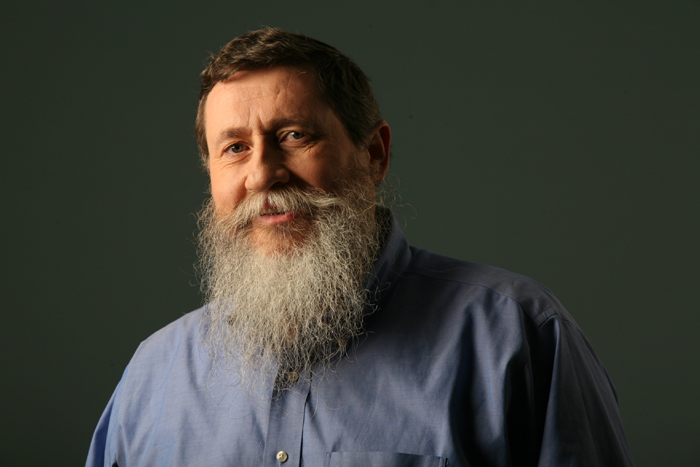
This would be the simplest solution. Bibi could probably fairly easily form a coalition of:
|  | |
Likud 27
Yisrael Beitenu 15
Shas 11
United Torah Judaism 5
National Union 4
Habayit Hayehudi 3
TOTAL 65
This arrangement would result in a very right-wing government in Israel. Likud has already come out against the two-state solution, and although Yisrael Beiteinu is strongly in favor of the two-state solution, its peace process involves the forcible relocation of Jews and Arabs to their "new homes" and the administration of loyalty tests to all Arabs who already have Israeli citizenship. The path to peace seems rather grim in this scenario if you ask me.
Now, Netanyahu himself isn't extremely right-wing, and I don't think he wants to lead the most liberal segment of a very right-wing government. For one thing, it would simply be difficult to advance his own agenda. For another, such a right-wing government would look very bad internationally, especially with America. After a war in Lebanon two years ago and a war in Gaza less than two months ago, a reactionary government bordering on having racist elements is not what Israel needs internationally.
And on top of all that, the parties listed above would not get along with one another easily. Avigdor Lieberman of Yisrael Beiteinu is extremely secular and wants to significantly decrease the power of the rabbinical court and to make civil marriage legal in Israel. The spiritual advisor of Shas, Ovadia Yosef, has called Lieberman Satan, so an alliance between them would be shaky at best.
All in all, if this government is formed, it will (in my opinion) do harm to Israel and won't last more than a year.
2. Tzipi Livni at the head of a center-left government
If Livni gets pegged to form the government, she could theoretically put something like this together (bearing in mind that no Arab party, even the more moderate Hadash, is at all likely to join a government now or in the near future):
| | |
Kadima 28
Yisrael Beitenu 15
Labor 13
Shas 11
United Torah Judaism 5
Meretz 3
TOTAL 75
Shas and UTJ have already agreed to work together as a team during this coalition process, so if you need one, you need them both. But without Yisrael Beiteinu, Livni can't make it to 61, so once again, this government would pit bitter enemies against one another. On top of all that, Labor, which has historically been the most dominant party in Israeli politics, had a poor showing this year and has more or less already decided to join the opposition in order to regroup and refocus its message for the next election cycle.
So, this government, though theoretically possible, is extremely unlikely and wouldn't last very long anyway. Thus, there's virtually no way to keep Likud out of the government. I think the best we (read: I) can hope for is something like this:
3. Netanyahu at the head of a centrist national unity government
If Bibi doesn't want a right-wing government, he could put together (assuming Labor stays in the opposition, which I'm assuming it will if Likud forms the coalition):
Likud 27
Kadima 28
Yisrael Beitenu 15
TOTAL 70 (+ other parties that want to tag along)
OR
Likud 27
Kadima 28
Shas 11
United Torah Judaism 5
TOTAL 71 (+ other parties that want to tag along)
OR
Likud 27
Kadima 28
Yisrael Beitenu 15
Shas 11
United Torah Judaism 5
TOTAL 86 (+ other parties that want to tag along)
In any of these governments, Kadima would be given significant ministerial portfolios (Foreign Minister, e.g.), but probably so would Yisrael Beiteinu (Defense or Education, e.g.). I'm very wary about Lieberman as Defense OR Education minister, and I hope it doesn't come to that. On the other hand, I'm not very comfortable with Shas and UTJ being the primary coalition partners either.
Regardless of the details, this government would be mildly more stable than the previous ones because of the large number of total seats. It would be more centrist than Option #1, but the government would probably fall if it tried to make a peace deal (as Yisrael Beiteinu would likely bail) ... not that it would if Bibi is Prime Minister anyway. This government could probably continue with a hard-line foreign policy and fairly conservative domestic policy for a couple years but probably won't last the full four-year term. Unfortunately, I think that the government we get will look something like this.
However, there's always a chance for:
4. Livni at the head of a centrist national unity government
If Lieberman throws his support behind Livni at the outset and encourages Peres to charge her with forming the government (which is the only way she can get the nod), it's possible she could build a government that looks like this:
Kadima 28
Likud 27
Yisrael Beitenu 15
TOTAL 70 (+ other parties that want to tag along)
OR (even better)
Kadima 28
Likud 27
Yisrael Beitenu 15
Labor 13
TOTAL 83 (+ other parties that want to tag along)
OR (much less likely but my favored future)
Kadima 28
Likud 27
Labor 13
TOTAL 68 (+ other parties that want to tag along)
Any of these scenarios would have more or less the same outlook as #3; however, with Tzipi Livni as Prime Minister, I'm much more optimistic about progress with the peace process (especially if Labor can be coaxed into the government). Lieberman is a scary man to give power to, but I'd be much more comfortable with Livni keeping him in check than Bibi. Again, I think #1 and #3 are the most likely scenarios, but crazy things can always happen in this country. We'll just have to see.
The government won't actually be formed for 3 weeks at the very least, so we all have some waiting to do. At school, we engaged in a coalition exercise based on these election results, and I got a good first-hand taste of what coalition-building is like - it's really very complex. I'll be following the results with somewhat disappointed fascination, most likely, and I hope that things will be all right in the end. Peace is in our future--I know it is--it's only a matter of how much time and how many lives we go through to get there.
Subscribe to:
Posts (Atom)