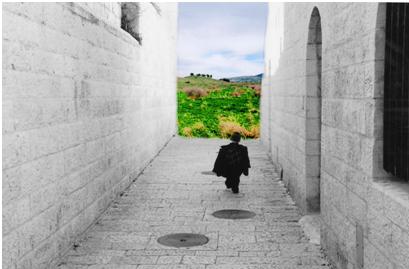
Earlier in the week I was feeling pretty lonely without Daniel here, but things are picking up, and people have been incredibly generous and nice in spending time with me. Last night after services at the synagogue around the corner from our apartment, I went to the home of an HUC couple for dinner and we chatted well into the night. This morning I went to services and the cantor invited me to his home for lunch, since he saw that I was alone. I had a lovely afternoon with the cantor and his wife, his parents, a lovely woman from the synagogue, and the cantor's bright and energetic toddler. The cantor made aliyah several years ago, and his family is all from the New York/ New Jersey area, so it was so warm and wonderful to hear the familiar accents. The cantor's wife is from Northern Virginia, and so I was able to chat about both of my homelands at one table! It was very nice.
The cantor asked me to sing in the synagogue choir for the commemoration of the birthday of the synagogue, so I'm going to be practicing for that. It's so nice that people are so eager to make me feel as though I belong. I really love this synagogue and in many ways it reminds me of CBI in Charlottesville - a small close knit community with a lot of things happening, people committed to their Judaism and to one another... If you're ever in Jerusalem, you should check out Har El. http://www.kbyonline.org/har-el/
---
Over the course of this Shabbat I've finally been able to understand a little bit about what it means that this country is at war. A few days ago an air raid siren went off in Jerusalem by accident while I was in class at Hebrew University, and the teacher told us that she was sure there was nothing to worry about. Class went on as usual and I didn't think much of it - I assumed that it had really been a police siren and I had been mistaking it for something more serious. However, last night at services during her sermon the rabbi spoke about hearing the siren, and trying to get all of the preschoolers out of the building and into the nearby bomb shelter (I later overheard a conversation where the cantor said that they should build a bomb shelter in the basement of the shul because if there was an emergency there's no way that they could get all of the kids to safety on time as things are). She talked about how scared the kids were, and how hard it was to see them so scared, and spoke of how this was only a taste of what children are experiencing in the south - on both sides of the conflict. The ferverency of the prayers for peace this week were almost palpable and when we prayed for the safety of the soldiers in the army, at least five pairs of parents and grandparents mentioned their loved ones who are in Gaza by name before we recited the prayer. Until now I had not really sensed how the conflict was affecting people here, as it is not disrupting the daily flow of life. But what must it be for so many people to go on with their lives knowing that their children or grandchildren are fighting not far away? On the other hand, last night at dinner I was speaking to some friends about the conflict and we remarked on how few Israeli casualties have resulted from this conflict as compared to Paelstinian casualties... Some say that Israel was right to start the conflict, but that now it has gone too far. Some say it should never have happened in the first place. Some say that it has been very successful so far and that when civilians are being used as human shields, perhaps it is moral to kill them in order to execute the aims of the war. I don't know what to think... I just keep reading the news and hoping that a lasting peace will come, and soon.
Showing posts with label peace. Show all posts
Showing posts with label peace. Show all posts
Saturday, January 17, 2009

Sunday, January 4, 2009
We need peace.
.אנחנו צריכים שלום
Yesterday, I learned about an Israeli phrase from the 1980s and 1990s: "Shooting and crying." It refers to the Israeli who defends himself and his country with deadly force but regrets having to do so. There are voices in Israel that focus on shooting: Kill our enemies at all costs. There are those that focus on crying: The pain caused by violence is unacceptable. And there are those who do both: I hate to kill you, but I have to do it.
The sermon I heard yesterday mounted a defense for shooting and crying. The offensive in Gaza, the speaker said, is necessary for the security of Israeli citizens, but the moral considerations cannot be forgotten even in such a critical situation. It may seem hypocritical to some, but it's the best we have.
Shooting and crying.
We're in a bad spot here in Israel. Hundreds of people are dying and everyone is weighing in with her opinion. What's the right thing to do in this situation? What's the right thing to say?
The advocacy group J Street (a liberal answer to AIPAC), released a statement condemning both Hamas and Israel and calling for an immediate cease-fire:
Israel has a special place in each of our hearts. But we recognize that neither Israelis nor Palestinians have a monopoly on right or wrong. While there is nothing "right" in raining rockets on Israeli families or dispatching suicide bombers, there is nothing "right" in punishing a million and a half already-suffering Gazans for the actions of the extremists among them.
And there is nothing to be gained from debating which injustice is greater or came first. What's needed now is immediate action to stop the violence before it spirals out of control.
I have to say that I agree. And it's hard to do so. The President of the Union for Reform Judaism, Rabbi Eric Yoffe, publicly opposes the sentiments expressed in this statement:
These words are deeply distressing because they are morally deficient, profoundly out of touch with Jewish sentiment and also appallingly naïve. A cease-fire instituted by Hamas would be welcome, and Israel would be quick to respond. A cease-fire imposed on Israel would allow Hamas to escape the consequences of its actions yet again and would lead in short order to the renewal of its campaign of terror. Hamas, it should be noted, is not a government; it is a terrorist gang. And as long as the thugs of Hamas can act with impunity, no Israeli government of the right or the left will agree to a two-state solution or any other kind of peace. Doves take note: To be a dove of influence, you must be a realist, firm in your principles but shorn of all illusions.
These words were welcomed by the commenters on the blog and likely reflect the prevailing attitude among American Reform Jews. We hate violence, but Israel has to defend itself. Moreover, Israel is the victim here: If Hamas didn't attack Israel, Israel wouldn't attack back, and therefore, every civilian death is on Hamas' hands. Rabbi Bob Orkand, president of the Association of Reform Zionists of America, defends this view by quoting Michael Walzer: "When Palestinian militants launch rocket attacks from civilian areas, they are themselves responsible--and no one else is--for the civilian deaths caused by Israeli counter fire."
But I don't buy it, and I certainly can't sell it. This view seems sound on paper: Israel's the victim, and Hamas is to blame for the people being killed. But is it entirely unimaginable for us to entertain the opposite view? If Israel hadn't acceded to the illegal settlement of Palestinian land and enforced hardships upon the Palestinian populace, maybe Hamas wouldn't be so powerful today. Both views are right, both views are wrong. And I return to J Street's point: "There is nothing to be gained from debating which injustice is greater or came first. What's needed now is immediate action to stop the violence before it spirals out of control."
I'm not surprised at what Israel has done, and I'm not surprised at the various reactions to Israel's decisions. However, I am disappointed that the rabbinic leadership of the Reform Movement isn't acting as the still, small voice reminding the public that it's wrong to kill. It's wrong to be killed, it's wrong to impose hardship, it's wrong to abandon your public. But it's also wrong to kill and that's a Jewish and universal value. And someone has to say it.
I would have been much more proud of Rabbi Yoffe if, instead of saying that influential doves have to condone killing sometimes, he had said that it's wrong to kill. Of the shooters and cryers, I'm a cryer, and I'll cry quietly to myself about the deaths of hundreds of people and I'll cry loudly from the rooftops that it's wrong to kill. Do with that information what you will, but do not ignore it.
I think that it is rabbinical responsibility to be the voice of moral conscience in this conflict, and regardless of what's politically sound or best for the people of Israel or more justifiable based on historical circumstances, someone has to be the voice that reminds the people that it's wrong to kill. Because we've seen what happens when people forget this most essential value.
I hear over and over again that "we pray for the end of the military action in Gaza." That's not my prayer. My prayer is simple.
We need peace.
We, Israelis. We, Palestinians. We, the people of the entire world. We can't separate ourselves from our neighbors, close or distant, and we can't forget that every single human being is created in the image of God. To save a life is to save the entire world.
Need. We don't want or wish for or expect or fight for or plan for or even hope for. We need. It is a basic and inalienable requirement for our lives. Our humanity depends upon it:
Peace. Non-violence. Co-operation. Reciprocal community. Respect, justice, brotherhood, acceptance, virtue, enrichment, depth, education, broadness, embraces, laughter. It's political, familial, moral, historical, and messianic.
We need peace.
That's my prayer.
It's not complex, it's not nuanced. It doesn't take into account historical arguments, and it doesn't discern winners from losers. It's a statement of existential reality, and it's my heart's loudest cry. And I believe that it needs to be heard and understood and taken into account and adhered to. You can't hear this sentence and then dismiss it because it's inconvenient right now. "We don't have time for peace, we're under attack."
We need peace.
Now. Can I simply say "We need peace" and go home? Can I make a blanket moral statement without applying it to the situation on the ground? If I do, is that irresponsible? Perhaps. So let me say this:
It's wrong for Palestinians to kill. I condemn terrorism, and I support freedom and democracy, two principles which Hamas tends to withhold from the people of the Gaza strip. Hamas is bad for the Palestinians, and if wishing made it so, I would wish that every Hamas-nik woke up in the morning and decided to step down from power. The poltical reality is that Israel has enemies, and they're trying to destroy Israel. Israel is defending itself and is not maliciously killing for the sake of killing. I understand the situation to the best of my ability, and if I had to cast a vote, I'd vote for democracy over terrorism every time. It's wrong to kill.
So what does that mean with regard to Israel today in the Gaza strip? I wish I knew... Is it justifiable for Israel to invade Gaza, trying to minimize civilian casualties, in order to demolish an aggressive enemy? Could very well be. Is it just? It's much harder for me to say. Is it right? I don't know.
But what I do know is that it's wrong to kill and that we need peace. So long as our first priority is security instead of peace, we'll be fighting for a secondary goal. We have to change our perspective, to realign our priorities, if we're ever going to reach the goal of peace that almost everyone can agree on. I believe that if, starting tomorrow, Israel's first priority were peace (regardless of what Hamas' goals are), their thinking process would be different. They would ask the question, "How do we protect Israeli citizens?" but they would also ask the question "How do we work for peace with ourselves and with our neighbors?" Right now the first question is the only one getting asked, and as soon as they find an answer, they go with it. I don't see the second question getting discussed, and that's painful to me.
So, the situation is very complicated, but I feel that there's a responsibility for a group of people to speak the moral truths that our tradition imparts upon us. We need peace. I'm at a loss for what else to say. What would I do if I were a politician? I don't know. But I believe that my role as a rabbi is to speak my heart on this issue and my heart reminds me that we need peace, and that's my message.
That's my prayer.
Sunday, August 31, 2008
Wexner Summer Institute, Part 3
.מכון ווקסנר קיץ, החלק השלישי
What follows is a series of thoughts that would normally probably not appear side-by-side. However, one of the greatest values I found at the Wexner institutes was the juxtaposition of topics and people in such a way to generate new and engaging thoughts. Although this post can't possibly reflect all that I learned at the Institute, it'll serve as a good start.
Let's get the ball rolling with an announcement: I will be officiating at my brother Josh's wedding.
I was honored and touched that he asked me before I left for Israel, but I had to think about whether I would accept the honor for about a month. My reservations focused mostly on my extreme lack of knowledge and my uncertainty about the "appropriateness" of my overstepping the bounds of my student-hood and serving in the capacity of a religious leader. At the Institute, I spoke to a rabbinical student at JTS who had recently officiated at his sister's wedding, and in talking to him, I came to realize that I wouldn't be serving so much as a rabbi as a brother in this capacity. In addition, at the Institute I heard several mentions of non-rabbis performing at wedding ceremonies, and I learned that traditionally, weddings have never needed a rabbi. On top of that, this ceremony isn't going to be a traditional Jewish wedding, so my rabbi-hood (or lack thereof) really shouldn't play into it. There's still the bit about my lack of knowledge, but the Wexner Fellow I spoke to shared with me the process of reflection he went through with his sister and her fiance, and I took heart from hearing about someone else going through a similar process. And, of course, I've promised to begin my studies immediately in order to be able to help Josh and Sheri create the most meaningful ceremony we can, and as such, I have a meeting with a rabbi at HUC about this very topic tomorrow afternoon!
Not everything I took away from the Institute was so personal, but I did engage in a number of internal reflections. For example, I spent much of the week being acutely aware of my status as a Reform Jew. Growing up, there were only Reform and Conservative Jews, and what that mostly meant to me was that a few students in my Sunday School class would have Bar and Bat Mitzvahs at the Temple while the rest would have their ceremonies at the Synagogue (in longer and, in my opinion, more boring services). When I immersed myself in the study of Judaism and religion at UVA, I relished in wading through the world of theological and historical Judaism ... but practically speaking, Jewish life was basically Reform, Conservative, or "Cultural." As I increased my involvement in Hillel, I became more "broad" in my thinking (while remaining Reform in my practice), and largely I focused on engaging the "Cultural" Jews in "Cultural" ways. At City Year, my Jewish experience was largely either virtually secular youth programming or deep, significant text study with my chevruta partner, Josh. Once I entered HUC, I was once again dropped into a world of Reform ... but a world that seemed to be surrounded by orthodoxy.
That's a hasty and broad portrayal of the views of Judaism throughout my life, but a common theme that I recall is a two-group system. In Roanoke, it was Reform/Conservative; in Hillel, it was Engaged/Cultural (not fair, I know, but that's how I felt a lot of the time); in Washington, it was spiritual/secular; and in Jerusalem, it's been Reform/Orthodox. During most of those periods, including a lot of my time here at HUC, I'd been more practically aware of what Reform isn't rather than what it is (though since a stimulating conversation with Jessica's parents in Toronto, I've had thoughts of "positive Reform identity" simmering on the back burner). However, that was different at the institute.
As I struggled to remember who was from what program, I also strived to learn from what perspectives my fellow Fellows were approaching various topics. And in juxtaposition with them (and in delayed response to a conversation I had with Ari, one of the Fellows in my class, in Jerusalem before the institute), I began to identify very strongly with the Reform movement. Now, don't get me wrong: I've always (or at least often) felt "very Reform," and I've always been a supporter of most if not all of the Union for Reform Judaism's policies and platforms. I've thought about what it means to be Reform, and I've had opportunities to explore in small ways the differences between Reform Judaism and other movements. But when I was sitting in a circle with 18 non-Reform Jews (and 1 HUC classmate), all of whom were people from whom I wanted to learn, I felt that I stood out as Reform. Since many Jews identify as post- or non-denominational though still "progressive," I believe most of the views about liberal Judaism are represented by Reform Jews. And there I was, at least in self-perception, the walking label of liberal Judaism.
And I didn't feel at all uncomfortable with this. On the contrary, I was proud to be representing my movement in this atmosphere of dialogue and progress. The particularism of that pride waned over the week, but I never entirely lost the feeling of being one of the Reform Jews, especially as I sat at the HUC table that was convened for one of the meals to talk about HUC things.
So, what did that do for my Reform identity? As we proceed, I'll write more about pluralism and my thoughts and interactions with different streams of Judaism; in conjunction with my exploration of other perspectives, I by default continued to define my own position. I talked last post about reading the Pittsburg Platform of 1885 and how I felt a certain identity with my movement in ways I hadn't felt before. On the other hand, the bonds I made with rabbinic students at JTS and American Jewish University, Yeshiva University, Hebrew College, and Yeshivat Chovevei Torah and students in other programs as well extended my communal identity and made my Reform more inclusive. I'm not entirely sure what all this means yet, but I hope that by the time I become a "real" rabbi in the Reform movement, I'll have a much better idea of how I feel about being a member of this specific community in relation, conjunction, and cooperation with members of other specific communities.
Now, of course, I say "specific communities," but I'm also talking about a larger "Jewish community," and in a major way, our institute about Jewish Family was dealing with the question "What is a Jewish Community?" Some corollary questions that came up in conversation were "Who is a Jew?" and "Why does it matter?"
Here's what I would say before the institute: No one can determine someone else's identity. If I identify as Jewish, no one has the authority to tell me that I'm not. (The same goes for gender, sexual orientation, and other classifications as well.) However, my ability to be a part of a community, by definition, requires the cooperation of other members of that community. So, a person says to me, "I believe that Christ is the messiah, I go to church every Sunday, my family doesn't identify as Jewish, and I have no intention of participating in Jewish life. However, my mother was Jewish, so I identify as Jewish as well." I can't tell that person that she's not Jewish, but I can inform her that (A) there are Jews out there who will (erringly, in my opinion) tell her flatly that she's not Jewish and (B) were she to seek acceptance as a member of the Jewish Community, she would not be successful. End of story (especially since extreme hypotheticals rarely reflect reality).
Now, I still largely believe that one's identity is one's own and that participation in a community is communal; however, I have a better appreciation for alternate points of view, and that appreciation came about through a series of discussions that touched on some of the following topics.
Let's move out of the realm of hypothetical and into the realm of actual. In Israel, a Jew can immigrate and become a citizen of the country; they are considered Jewish if at least one grandparent was Jewish. This Judaism is determined by documentation such as birth, Bar/Bat Mitzvah, marriage, or death certificates or affirmation by a rabbi. However, to get married in Israel, one must have an official Orthodox wedding. Official Orthodox weddings cannot happen between the following couples:
Let's say Lev, a Jew, marries Elizabeth, who has a Conservative conversion, and they have a daughter, Sarah. Sarah has two Jewish grandparents (Avi's parents) and therefore successfully makes aliyah. Now, she wants to marry Tomer, an Israeli Jew, and they're willing to have an Orthodox ceremony in Israel (instead of flying to Crete or someplace and coming back for a non-binding wedding ceremony in Israel). So, they go to apply for a marriage license.
When asked to supply affirmation of her Jewishness, Sarah may be asked to produce documentation that her mother is Jewish (which is the traditional halachic/legal definition of Jewishness). Although Sarah was "Jewish enough" to make aliyah under the Law of Return, her mother's conversion certificate isn't sufficient to grant her status as a Jew in the eyes of the rabbinic courts, despite having lived her entire life as a Jew. Now, she and Tomer cannot get married in the State of Israel unless Sarah undergoes an orthodox conversion or they leave the country and receive a foreign marriage license that will be retroactively recognized by the state.
In this instance, Sarah's Judaism is being defined for her and it has real legal implications on her life. I don't know to what degree situations like Sarah's would be enforced in Israel, but conversion, marriage, and divorce are hot topic issues in Israel as there is no separation between religion and state here.
So, getting back to our original question, what right does the rabbinic court have to tell Sarah that she is or isn't Jewish? If they were to follow my philosophy, they'd say, "Okay, so you're not orthodox; we wouldn't recommend trying to fit in to an orthodox community. However, since you identify as Jewish, that's good enough for us. Have a happy marriage!" Although I'm a fan of the separation of religious and legal matters, if Israel is determined to erase that boundary, I believe that they should have a more pluralistic/accepting approach to Judaism. Take the most liberal definitions of Judaism, the ones that include the most Jews and therefore strengthen most of the "Jewish community," and implement them on a broad scale.
A modern orthodox Fellow with whom I was discussing this topic more or less agrees with that assessment (and actually brought it up as a recommendation in our conversation). However, he pushed me to consider further examples where relying on someone's self-identity as Jewish (or on a community's inclusion of someone as a Jewish) may not be so simple. Some complicating examples:
Let's say I'm working with a Jewish non-profit organization that distributes grants to smaller Jewish organizations. An independent chavurah (prayer group) in my city has jointly participated in the Save Darfur campaign of a local synagogue and, inspired, is starting its own grassroots movement. Using college connections, this chavurah is going to undergo a relay bike-a-thon across the entire state and post interviews with state residents about the Darfur situation on YouTube. This chavurah is asking my non-profit for a start-up grant to buy bicycles and a digital recorder.
Background: the chavurah meets once monthly and doesn't include Hebrew in their meetings. They largely follow the Quaker meeting style of sitting in silence and combine it with yoga and meditations. Each meeting, a different member gives a short ethical "sermon," which is followed by discussion at a coffee shop over lunch. The founding members of the chavurah identify as Jewish, and several of their Jewish friends attend. However, a majority of the participants in the monthly meeting do not identify as Jewish.
Now, let's say that I and my colleagues really like the program idea and want to give the group money. However, our charter insists that we support only Jewish programs in order to create solidarity and strengthen support within Jewish communities. So the question is: Is the chavurah a Jewish group?
Let's say we deny them funds because they're not a Jewish group. Are we then stipulating methods of prayer as a definition of Jewishness? Or simply a majority of participants? Would an interfaith-friendly Humanistic congregation face the same fate?
Let's say we grant them funds, agreeing that they are a Jewish group. Are we then affirming that Jewish identity is good enough to be a Jewish group? "Jewish" ethics? Would a Messianic Jewish congregation be accorded the same status?
Here's a second example.
Let's say I'm a rabbi with a Reform congregation. A couple with a 12-year-old son approaches me to say they'd like their son to have a Bar Mitzvah in the sanctuary. The wife and husband don't pay dues to the Temple, they haven't participated in a Jewish event as long as I've been around, and the son hasn't received a religious education. Both parents and the son identify as Jewish; however, none are willing to commit to religious education for the son. They all feel that it's important to mark the son's 13th birthday, to commemorate his ascent into adulthood in the Jewish community (that, who knows?, he may someday participate in), but the demands on the son's time are too great for him to learn a Torah portion and read the prayers. What do I do?
They all identify as Jewish, they've expressed at least a theoretical future interest in Jewish communal life, and they are looking to me to help them commemorate what they feel to be a significant Jewish moment in an otherwise non-Jewish lifestyle.
Let's say I tell them that a true Jewish adult values learning, and therefore the son should make time for his studies. What does that say about the parents' Jewish identities?
Let's say I tell them that, since they haven't needed the Jewish community until now, they should have their own private Bar Mitzvah and continue to live a life of private Judaism. Does that mean I don't want to welcome them into my community?
Let's say I grant the request and offer blessings and commemoration from the bima. Does that send a message to the rest of the congregation that I don't value Jewish education?
The underlying question in these two scenarios is: What is the basis of inclusion in a Jewish community? Is it Jewish identity, singular or popular? Is it monetary contribution? Attendance of services/events? Adherence to tradition? Participation in education? Following a code of ethics?
Prior to the Wexner institute, my answers to these questions would be pretty broad. Largely, inclusion in a Jewish community is experiential. I feel something different about interacting with Jews than non-Jews - there's something special there for me. Perhaps I'd have to apply the same gut reaction to the examples above. Do I connect to the individuals involved as Jews? And are they also seeking inclusion in my Jewish community?
After the Wexner institute, I don't think I have any more specific answers, but I do have in my toolbox a helpful concept: Family. Jews are a family. According to our story, we all descend from Abraham. According to history, Judaism descends from a group of people that achieved a certain amount of national success and identity in Canaan and maintained that identity for thousands of years across the entire globe.
Just like a human-relations family, you can't pick who's related to you. I may not like my cousin (hypothetical here), but I "have" to love him because he's in my family. Just because I disagree with many orthodox points of view doesn't mean I can reject them entirely - we're all still members of this family. Members of a family fight, and they also support one another. They celebrate with each other even if they disagree, and sometimes they get irrationally angry when they wouldn't feel that way with someone outside of the family. The members of my family, like it or not, are related to me, and I have an inescapable bond with them for better or for worse.
And this idea is quite novel to me and really very deep. As pointed out to us by Rabbi Greenberg, this notion of Jewish family isn't just an existential reality but is the method of redemption established by God. God creates the world, and all is good. Then, things start to go wrong as soon as a family is created. Things get worse, and God destroys the world. God makes a covenant with Noah and says, "Okay, I get it, the world's not perfect. Just please try to adhere to some basic rules." Still things continue to go wrong, so God, instead of relying on a covenant with the entire world, turns to one family: Abraham's. God's covenant with Abraham is a unique outlook on the world that says that the instrument of salvation is not through obedience or divine intervention or transcendence or scientific progress but rather through family relationships. As Abraham's family grows, its struggles and developments will create something new and holy in the world. Sometimes it will be beautiful, and sometimes it will be murderous. But in the end, it will be bound by love, and in emulation of that binding love of the Children of Abraham, the world will be able to see past the things that separate people and recognize our responsibility of automatic devotion to one another as Children of Adam.
Of course, this outlook (like all outlooks) has a certain number of complications to it. A major one that was brought up in my conversations at the institute is that of universalism vs. particularism. That is, do I believe that there is something unique and holy about the Jewish family from which the rest of the world would do good to learn? My answer, as always, is complex and unstable.
On the one hand, I believe in a universal good. If one were to sum up ethics in a single statement, it could be, "Do not violate." However, to understand that sentence in all its myriad particulars is a daunting task, and a system by means of which people can order their lives ethically can be extremely helpful. Thus, I believe that the words of Torah are, existentially, holy and through studying them in community, one can touch truth in such a way that one's behavior is shaped in an ethical direction. The Jewish family has produced, protected, and championed a tradition of ethical action and evolution.
However, there are traditional Jewish texts that scream immorality, and I believe it's important to follow our instincts in interpreting the original statement of "Do not violate" in our search for a meaningful interpretation of Torah. For example, in this week's Torah portion (Re'eh), we read:
If anyone secretly entices you—even if it is your brother, your father’s son or your mother’s son, or your own son or daughter, or the wife you embrace, or your most intimate friend—saying, ‘Let us go and worship other gods’, ... you must not yield to or heed any such persons. Show them no pity or compassion and do not shield them. But you shall surely kill them; your own hand shall be first against them to execute them, and afterwards the hand of all the people. Stone them to death for trying to turn you away from the Lord your God, who brought you out of the land of Egypt, out of the house of slavery. Then all Israel shall hear and be afraid, and never again do any such wickedness (Deuteronomy 13: 6, 8-11).
Now, of course, the Jewish notion of idolatry is complex and ultimate, but whether we're talking about enticement away from recognizing God's singularity, encouraging conversion away from Judaism, propagandizing into nationalism, or preaching of immorality, I nevertheless believe that "show them no pity or compassion ... your own hand shall be the first to execute [your own son or daughter]" must be interpreted in a non-literal way because the literal translation absolutely transgresses the precept of "Do not violate."
But how do I know that it transgresses that precept if traditional Jewish texts aren't telling me? Well, the easy answer is that Jewish texts are telling me, and I surely could find Jewish texts to support my view. This becomes particularly evident with rabbis who want to give a sermon on a particular topic and go researching texts that will support their view. But, look more basically: How did the original authors of those Jewish texts (assuming they're identifiable) come up with the interpretations that they did? I could be wrong, but my assumption is that they were acting according to basic moral principles that guide our everyday life.
So, back to the question: What's so great about the Jewish family? The answer: I don't know. Perhaps it's merely historical/factual: In history, the Jews have done a lot of good things and continue to do a lot of good things, so we must have gotten something right. Of course, I also believe that not just the Jews but also the Christians, Muslims, Hindus, Sikhs, etc. also got a lot right. Perhaps what we've got, though, is a practical approach to peace:
Family. Christianity is focused on God as an instrument of salvation. Judaism is focused on our family. A universalizing of the Jewish message could therefore read: Cherish the human family, despite our differences, and we'll be able to love one another like the Jews do. Maybe it's not a perfectly thought-out conclusion, but I think it's pretty good. The model of family is an excellent paradigm of human interrelations, and our ability to recognize one another as true family members is essential to being able to spread peace throughout the world.
Easy, right? Maybe in thought but certainly not in practice. And the Jewish family still hasn't gotten it totally right. Jews continue to fight, disagree, and be separated from one another. We often talk about Jewish communities since agreeing about the Jewish Community is too difficult. This Wexner institute enormously helped me out personally in this field by getting me to challenge myself and my notions of pluralism. By trying to see "Judaism" through the eyes of a Jew of a different perspective, my own view was broadened.
To me, halacha (Jewish law) is not the literal word of God since to me, God is not a conscious actor in the world and therefore couldn't have told us, in language, what to do. I do believe that words of God exist but are more broad that halacha allows. We read in Genesis, "God said let there be light, and there was light." That is, everything in the world is a Word of God. In Hebrew, דבר means both "thing" and "word." They're the same. So claiming that the Talmud is the Word of God and that the New Testament or I am not is too exclusionary.
However, after conversations at Wexner, I can further shade my understanding. Just because halacha does not represent the entire corpus of God's words does not mean that they aren't holy. I believe that those who adhere to them should be concerned with constant re-examination in the light of ethical review (see the Conservative movement), but I can't say that living by halacha is not a good starting point.
And therefore, I allow that for many, Judaism is not just thought-based but also action-based. To many Orthodox Jews, Judaism does imply a necessary set of ethical and theological standards, but one must also act in a certain way to be Jewish. (For the purposes of this conversation, let's assume that an Orthodox Jew is defining herself and not trying to determine someone else's level of Jewish commitment or peoplehood.) Thus, if I'm Orthodox, believing in God and keeping kosher are identical.
This leads me to thoughts I've been having about pluralism. Generally, I have thought of pluralism as being a worldview - to be pluralistic is to accept that what I believe is true without making a judgement one way or another on whether what you believe is true (and leaving room for both of us to be right even if we're in contradiction). However, I now recognize another dimension of pluralism, at least within the context of Judaism: Pluralism of practice.
It was my experience at Hillel that, whenever we wanted to plan something "religious" for the entire community, we'd survey the most observant students and make sure that everything adhered to their standards. Over the years, I became somewhat frustrated by never being able to express the strong Reform identity that I mentioned way back at the beginning of this post. "Why can't we be pluralistic about this?" I'd wonder. "Why always be monolithic in our practical approach?"
Fast forward to the Wexner institute, where pluralism is the name of the game (though never actually mentioned officially). I found that the programs and dialogues were very pluralistic and sought to address challenges of building a welcoming and broad Jewish community. In talking with an Orthodox Fellow, I realized that this was a form of the same process I had experienced at Hillel but in the opposite direction.
Pluralism of practice leans to the right; pluralism of thought leans to the left.
At the institute, was that there wasn't an attempt to achieve pluralism of practice. Services were all separated, the food was strictly kosher, and we didn't have the institute over Shabbat. All practical considerations were handled deftly and in advance so that we could get to the meat of the pluralistic discussion.
However, the essentially practical elements of Judaism were excluded from our institute.
On the one hand, I loved the conversations, and I know that they were mind-stretching to us all, the most observant among us more than most. Yet, I feel a certain sense of guilt at having had everything "my way." In a sense, I was very at ease talking about interfaith marriages, homosexuality, conversions, and rational religion, but there were others who were forced into silence on these issues. If we were in an Orthodox service, perhaps I, too, would be forced into silence, and I would better have been able to appreciate the perspective of some of my fellow Fellows.
I'm not sure what this means for my life other than that I have a more nuanced appreciation for the practical challenges of pluralism. I will definitely keep this thought alive, though, and I may seek to address it at a future institute.
As is obvious, I learned a tremendous amount at the institute, and I deeply appreciated the opportunity to engage in serious critical thinking. Perhaps more than anything else, I learned so much about orthodox Judaism, orthodox outlooks on pluralism, challenges in the modern orthodox world, etc. To be honest, it was exactly what I needed. Yes, stories about the "Modesty Squad" still set my blood aboil, but I love my orthodox friends as family, and I hope that one day I can relate even to ultra-orthodox Jews in such a way that, though I disagree with them, I also love them (and vice versa). The Wexner institute, though imperfect, was a small-scale model of positive pluralistic thinking that hopefully will be translated into action. I very much look forward to future institutes and, moreso, to building a stronger Jewish family that reaches out to all of our fellow Children of Adam.
What follows is a series of thoughts that would normally probably not appear side-by-side. However, one of the greatest values I found at the Wexner institutes was the juxtaposition of topics and people in such a way to generate new and engaging thoughts. Although this post can't possibly reflect all that I learned at the Institute, it'll serve as a good start.
Let's get the ball rolling with an announcement: I will be officiating at my brother Josh's wedding.
I was honored and touched that he asked me before I left for Israel, but I had to think about whether I would accept the honor for about a month. My reservations focused mostly on my extreme lack of knowledge and my uncertainty about the "appropriateness" of my overstepping the bounds of my student-hood and serving in the capacity of a religious leader. At the Institute, I spoke to a rabbinical student at JTS who had recently officiated at his sister's wedding, and in talking to him, I came to realize that I wouldn't be serving so much as a rabbi as a brother in this capacity. In addition, at the Institute I heard several mentions of non-rabbis performing at wedding ceremonies, and I learned that traditionally, weddings have never needed a rabbi. On top of that, this ceremony isn't going to be a traditional Jewish wedding, so my rabbi-hood (or lack thereof) really shouldn't play into it. There's still the bit about my lack of knowledge, but the Wexner Fellow I spoke to shared with me the process of reflection he went through with his sister and her fiance, and I took heart from hearing about someone else going through a similar process. And, of course, I've promised to begin my studies immediately in order to be able to help Josh and Sheri create the most meaningful ceremony we can, and as such, I have a meeting with a rabbi at HUC about this very topic tomorrow afternoon!
Not everything I took away from the Institute was so personal, but I did engage in a number of internal reflections. For example, I spent much of the week being acutely aware of my status as a Reform Jew. Growing up, there were only Reform and Conservative Jews, and what that mostly meant to me was that a few students in my Sunday School class would have Bar and Bat Mitzvahs at the Temple while the rest would have their ceremonies at the Synagogue (in longer and, in my opinion, more boring services). When I immersed myself in the study of Judaism and religion at UVA, I relished in wading through the world of theological and historical Judaism ... but practically speaking, Jewish life was basically Reform, Conservative, or "Cultural." As I increased my involvement in Hillel, I became more "broad" in my thinking (while remaining Reform in my practice), and largely I focused on engaging the "Cultural" Jews in "Cultural" ways. At City Year, my Jewish experience was largely either virtually secular youth programming or deep, significant text study with my chevruta partner, Josh. Once I entered HUC, I was once again dropped into a world of Reform ... but a world that seemed to be surrounded by orthodoxy.
That's a hasty and broad portrayal of the views of Judaism throughout my life, but a common theme that I recall is a two-group system. In Roanoke, it was Reform/Conservative; in Hillel, it was Engaged/Cultural (not fair, I know, but that's how I felt a lot of the time); in Washington, it was spiritual/secular; and in Jerusalem, it's been Reform/Orthodox. During most of those periods, including a lot of my time here at HUC, I'd been more practically aware of what Reform isn't rather than what it is (though since a stimulating conversation with Jessica's parents in Toronto, I've had thoughts of "positive Reform identity" simmering on the back burner). However, that was different at the institute.
As I struggled to remember who was from what program, I also strived to learn from what perspectives my fellow Fellows were approaching various topics. And in juxtaposition with them (and in delayed response to a conversation I had with Ari, one of the Fellows in my class, in Jerusalem before the institute), I began to identify very strongly with the Reform movement. Now, don't get me wrong: I've always (or at least often) felt "very Reform," and I've always been a supporter of most if not all of the Union for Reform Judaism's policies and platforms. I've thought about what it means to be Reform, and I've had opportunities to explore in small ways the differences between Reform Judaism and other movements. But when I was sitting in a circle with 18 non-Reform Jews (and 1 HUC classmate), all of whom were people from whom I wanted to learn, I felt that I stood out as Reform. Since many Jews identify as post- or non-denominational though still "progressive," I believe most of the views about liberal Judaism are represented by Reform Jews. And there I was, at least in self-perception, the walking label of liberal Judaism.
And I didn't feel at all uncomfortable with this. On the contrary, I was proud to be representing my movement in this atmosphere of dialogue and progress. The particularism of that pride waned over the week, but I never entirely lost the feeling of being one of the Reform Jews, especially as I sat at the HUC table that was convened for one of the meals to talk about HUC things.
So, what did that do for my Reform identity? As we proceed, I'll write more about pluralism and my thoughts and interactions with different streams of Judaism; in conjunction with my exploration of other perspectives, I by default continued to define my own position. I talked last post about reading the Pittsburg Platform of 1885 and how I felt a certain identity with my movement in ways I hadn't felt before. On the other hand, the bonds I made with rabbinic students at JTS and American Jewish University, Yeshiva University, Hebrew College, and Yeshivat Chovevei Torah and students in other programs as well extended my communal identity and made my Reform more inclusive. I'm not entirely sure what all this means yet, but I hope that by the time I become a "real" rabbi in the Reform movement, I'll have a much better idea of how I feel about being a member of this specific community in relation, conjunction, and cooperation with members of other specific communities.
Now, of course, I say "specific communities," but I'm also talking about a larger "Jewish community," and in a major way, our institute about Jewish Family was dealing with the question "What is a Jewish Community?" Some corollary questions that came up in conversation were "Who is a Jew?" and "Why does it matter?"
Here's what I would say before the institute: No one can determine someone else's identity. If I identify as Jewish, no one has the authority to tell me that I'm not. (The same goes for gender, sexual orientation, and other classifications as well.) However, my ability to be a part of a community, by definition, requires the cooperation of other members of that community. So, a person says to me, "I believe that Christ is the messiah, I go to church every Sunday, my family doesn't identify as Jewish, and I have no intention of participating in Jewish life. However, my mother was Jewish, so I identify as Jewish as well." I can't tell that person that she's not Jewish, but I can inform her that (A) there are Jews out there who will (erringly, in my opinion) tell her flatly that she's not Jewish and (B) were she to seek acceptance as a member of the Jewish Community, she would not be successful. End of story (especially since extreme hypotheticals rarely reflect reality).
Now, I still largely believe that one's identity is one's own and that participation in a community is communal; however, I have a better appreciation for alternate points of view, and that appreciation came about through a series of discussions that touched on some of the following topics.
Let's move out of the realm of hypothetical and into the realm of actual. In Israel, a Jew can immigrate and become a citizen of the country; they are considered Jewish if at least one grandparent was Jewish. This Judaism is determined by documentation such as birth, Bar/Bat Mitzvah, marriage, or death certificates or affirmation by a rabbi. However, to get married in Israel, one must have an official Orthodox wedding. Official Orthodox weddings cannot happen between the following couples:
- Jew/non-Jew
- Kohen/divorcee, child of non-Jewish father, offspring of non-recognized marriage, a widow who performed chalitza, a widow who converted
- Man/man
- Woman/woman
- Mamzer/non-mamzer
Let's say Lev, a Jew, marries Elizabeth, who has a Conservative conversion, and they have a daughter, Sarah. Sarah has two Jewish grandparents (Avi's parents) and therefore successfully makes aliyah. Now, she wants to marry Tomer, an Israeli Jew, and they're willing to have an Orthodox ceremony in Israel (instead of flying to Crete or someplace and coming back for a non-binding wedding ceremony in Israel). So, they go to apply for a marriage license.
When asked to supply affirmation of her Jewishness, Sarah may be asked to produce documentation that her mother is Jewish (which is the traditional halachic/legal definition of Jewishness). Although Sarah was "Jewish enough" to make aliyah under the Law of Return, her mother's conversion certificate isn't sufficient to grant her status as a Jew in the eyes of the rabbinic courts, despite having lived her entire life as a Jew. Now, she and Tomer cannot get married in the State of Israel unless Sarah undergoes an orthodox conversion or they leave the country and receive a foreign marriage license that will be retroactively recognized by the state.
In this instance, Sarah's Judaism is being defined for her and it has real legal implications on her life. I don't know to what degree situations like Sarah's would be enforced in Israel, but conversion, marriage, and divorce are hot topic issues in Israel as there is no separation between religion and state here.
So, getting back to our original question, what right does the rabbinic court have to tell Sarah that she is or isn't Jewish? If they were to follow my philosophy, they'd say, "Okay, so you're not orthodox; we wouldn't recommend trying to fit in to an orthodox community. However, since you identify as Jewish, that's good enough for us. Have a happy marriage!" Although I'm a fan of the separation of religious and legal matters, if Israel is determined to erase that boundary, I believe that they should have a more pluralistic/accepting approach to Judaism. Take the most liberal definitions of Judaism, the ones that include the most Jews and therefore strengthen most of the "Jewish community," and implement them on a broad scale.
A modern orthodox Fellow with whom I was discussing this topic more or less agrees with that assessment (and actually brought it up as a recommendation in our conversation). However, he pushed me to consider further examples where relying on someone's self-identity as Jewish (or on a community's inclusion of someone as a Jewish) may not be so simple. Some complicating examples:
Let's say I'm working with a Jewish non-profit organization that distributes grants to smaller Jewish organizations. An independent chavurah (prayer group) in my city has jointly participated in the Save Darfur campaign of a local synagogue and, inspired, is starting its own grassroots movement. Using college connections, this chavurah is going to undergo a relay bike-a-thon across the entire state and post interviews with state residents about the Darfur situation on YouTube. This chavurah is asking my non-profit for a start-up grant to buy bicycles and a digital recorder.
Background: the chavurah meets once monthly and doesn't include Hebrew in their meetings. They largely follow the Quaker meeting style of sitting in silence and combine it with yoga and meditations. Each meeting, a different member gives a short ethical "sermon," which is followed by discussion at a coffee shop over lunch. The founding members of the chavurah identify as Jewish, and several of their Jewish friends attend. However, a majority of the participants in the monthly meeting do not identify as Jewish.
Now, let's say that I and my colleagues really like the program idea and want to give the group money. However, our charter insists that we support only Jewish programs in order to create solidarity and strengthen support within Jewish communities. So the question is: Is the chavurah a Jewish group?
Let's say we deny them funds because they're not a Jewish group. Are we then stipulating methods of prayer as a definition of Jewishness? Or simply a majority of participants? Would an interfaith-friendly Humanistic congregation face the same fate?
Let's say we grant them funds, agreeing that they are a Jewish group. Are we then affirming that Jewish identity is good enough to be a Jewish group? "Jewish" ethics? Would a Messianic Jewish congregation be accorded the same status?
Here's a second example.
Let's say I'm a rabbi with a Reform congregation. A couple with a 12-year-old son approaches me to say they'd like their son to have a Bar Mitzvah in the sanctuary. The wife and husband don't pay dues to the Temple, they haven't participated in a Jewish event as long as I've been around, and the son hasn't received a religious education. Both parents and the son identify as Jewish; however, none are willing to commit to religious education for the son. They all feel that it's important to mark the son's 13th birthday, to commemorate his ascent into adulthood in the Jewish community (that, who knows?, he may someday participate in), but the demands on the son's time are too great for him to learn a Torah portion and read the prayers. What do I do?
They all identify as Jewish, they've expressed at least a theoretical future interest in Jewish communal life, and they are looking to me to help them commemorate what they feel to be a significant Jewish moment in an otherwise non-Jewish lifestyle.
Let's say I tell them that a true Jewish adult values learning, and therefore the son should make time for his studies. What does that say about the parents' Jewish identities?
Let's say I tell them that, since they haven't needed the Jewish community until now, they should have their own private Bar Mitzvah and continue to live a life of private Judaism. Does that mean I don't want to welcome them into my community?
Let's say I grant the request and offer blessings and commemoration from the bima. Does that send a message to the rest of the congregation that I don't value Jewish education?
The underlying question in these two scenarios is: What is the basis of inclusion in a Jewish community? Is it Jewish identity, singular or popular? Is it monetary contribution? Attendance of services/events? Adherence to tradition? Participation in education? Following a code of ethics?
Prior to the Wexner institute, my answers to these questions would be pretty broad. Largely, inclusion in a Jewish community is experiential. I feel something different about interacting with Jews than non-Jews - there's something special there for me. Perhaps I'd have to apply the same gut reaction to the examples above. Do I connect to the individuals involved as Jews? And are they also seeking inclusion in my Jewish community?
After the Wexner institute, I don't think I have any more specific answers, but I do have in my toolbox a helpful concept: Family. Jews are a family. According to our story, we all descend from Abraham. According to history, Judaism descends from a group of people that achieved a certain amount of national success and identity in Canaan and maintained that identity for thousands of years across the entire globe.
Just like a human-relations family, you can't pick who's related to you. I may not like my cousin (hypothetical here), but I "have" to love him because he's in my family. Just because I disagree with many orthodox points of view doesn't mean I can reject them entirely - we're all still members of this family. Members of a family fight, and they also support one another. They celebrate with each other even if they disagree, and sometimes they get irrationally angry when they wouldn't feel that way with someone outside of the family. The members of my family, like it or not, are related to me, and I have an inescapable bond with them for better or for worse.
And this idea is quite novel to me and really very deep. As pointed out to us by Rabbi Greenberg, this notion of Jewish family isn't just an existential reality but is the method of redemption established by God. God creates the world, and all is good. Then, things start to go wrong as soon as a family is created. Things get worse, and God destroys the world. God makes a covenant with Noah and says, "Okay, I get it, the world's not perfect. Just please try to adhere to some basic rules." Still things continue to go wrong, so God, instead of relying on a covenant with the entire world, turns to one family: Abraham's. God's covenant with Abraham is a unique outlook on the world that says that the instrument of salvation is not through obedience or divine intervention or transcendence or scientific progress but rather through family relationships. As Abraham's family grows, its struggles and developments will create something new and holy in the world. Sometimes it will be beautiful, and sometimes it will be murderous. But in the end, it will be bound by love, and in emulation of that binding love of the Children of Abraham, the world will be able to see past the things that separate people and recognize our responsibility of automatic devotion to one another as Children of Adam.
Of course, this outlook (like all outlooks) has a certain number of complications to it. A major one that was brought up in my conversations at the institute is that of universalism vs. particularism. That is, do I believe that there is something unique and holy about the Jewish family from which the rest of the world would do good to learn? My answer, as always, is complex and unstable.
On the one hand, I believe in a universal good. If one were to sum up ethics in a single statement, it could be, "Do not violate." However, to understand that sentence in all its myriad particulars is a daunting task, and a system by means of which people can order their lives ethically can be extremely helpful. Thus, I believe that the words of Torah are, existentially, holy and through studying them in community, one can touch truth in such a way that one's behavior is shaped in an ethical direction. The Jewish family has produced, protected, and championed a tradition of ethical action and evolution.
However, there are traditional Jewish texts that scream immorality, and I believe it's important to follow our instincts in interpreting the original statement of "Do not violate" in our search for a meaningful interpretation of Torah. For example, in this week's Torah portion (Re'eh), we read:
If anyone secretly entices you—even if it is your brother, your father’s son or your mother’s son, or your own son or daughter, or the wife you embrace, or your most intimate friend—saying, ‘Let us go and worship other gods’, ... you must not yield to or heed any such persons. Show them no pity or compassion and do not shield them. But you shall surely kill them; your own hand shall be first against them to execute them, and afterwards the hand of all the people. Stone them to death for trying to turn you away from the Lord your God, who brought you out of the land of Egypt, out of the house of slavery. Then all Israel shall hear and be afraid, and never again do any such wickedness (Deuteronomy 13: 6, 8-11).
Now, of course, the Jewish notion of idolatry is complex and ultimate, but whether we're talking about enticement away from recognizing God's singularity, encouraging conversion away from Judaism, propagandizing into nationalism, or preaching of immorality, I nevertheless believe that "show them no pity or compassion ... your own hand shall be the first to execute [your own son or daughter]" must be interpreted in a non-literal way because the literal translation absolutely transgresses the precept of "Do not violate."
But how do I know that it transgresses that precept if traditional Jewish texts aren't telling me? Well, the easy answer is that Jewish texts are telling me, and I surely could find Jewish texts to support my view. This becomes particularly evident with rabbis who want to give a sermon on a particular topic and go researching texts that will support their view. But, look more basically: How did the original authors of those Jewish texts (assuming they're identifiable) come up with the interpretations that they did? I could be wrong, but my assumption is that they were acting according to basic moral principles that guide our everyday life.
So, back to the question: What's so great about the Jewish family? The answer: I don't know. Perhaps it's merely historical/factual: In history, the Jews have done a lot of good things and continue to do a lot of good things, so we must have gotten something right. Of course, I also believe that not just the Jews but also the Christians, Muslims, Hindus, Sikhs, etc. also got a lot right. Perhaps what we've got, though, is a practical approach to peace:
Family. Christianity is focused on God as an instrument of salvation. Judaism is focused on our family. A universalizing of the Jewish message could therefore read: Cherish the human family, despite our differences, and we'll be able to love one another like the Jews do. Maybe it's not a perfectly thought-out conclusion, but I think it's pretty good. The model of family is an excellent paradigm of human interrelations, and our ability to recognize one another as true family members is essential to being able to spread peace throughout the world.
Easy, right? Maybe in thought but certainly not in practice. And the Jewish family still hasn't gotten it totally right. Jews continue to fight, disagree, and be separated from one another. We often talk about Jewish communities since agreeing about the Jewish Community is too difficult. This Wexner institute enormously helped me out personally in this field by getting me to challenge myself and my notions of pluralism. By trying to see "Judaism" through the eyes of a Jew of a different perspective, my own view was broadened.
To me, halacha (Jewish law) is not the literal word of God since to me, God is not a conscious actor in the world and therefore couldn't have told us, in language, what to do. I do believe that words of God exist but are more broad that halacha allows. We read in Genesis, "God said let there be light, and there was light." That is, everything in the world is a Word of God. In Hebrew, דבר means both "thing" and "word." They're the same. So claiming that the Talmud is the Word of God and that the New Testament or I am not is too exclusionary.
However, after conversations at Wexner, I can further shade my understanding. Just because halacha does not represent the entire corpus of God's words does not mean that they aren't holy. I believe that those who adhere to them should be concerned with constant re-examination in the light of ethical review (see the Conservative movement), but I can't say that living by halacha is not a good starting point.
And therefore, I allow that for many, Judaism is not just thought-based but also action-based. To many Orthodox Jews, Judaism does imply a necessary set of ethical and theological standards, but one must also act in a certain way to be Jewish. (For the purposes of this conversation, let's assume that an Orthodox Jew is defining herself and not trying to determine someone else's level of Jewish commitment or peoplehood.) Thus, if I'm Orthodox, believing in God and keeping kosher are identical.
This leads me to thoughts I've been having about pluralism. Generally, I have thought of pluralism as being a worldview - to be pluralistic is to accept that what I believe is true without making a judgement one way or another on whether what you believe is true (and leaving room for both of us to be right even if we're in contradiction). However, I now recognize another dimension of pluralism, at least within the context of Judaism: Pluralism of practice.
It was my experience at Hillel that, whenever we wanted to plan something "religious" for the entire community, we'd survey the most observant students and make sure that everything adhered to their standards. Over the years, I became somewhat frustrated by never being able to express the strong Reform identity that I mentioned way back at the beginning of this post. "Why can't we be pluralistic about this?" I'd wonder. "Why always be monolithic in our practical approach?"
Fast forward to the Wexner institute, where pluralism is the name of the game (though never actually mentioned officially). I found that the programs and dialogues were very pluralistic and sought to address challenges of building a welcoming and broad Jewish community. In talking with an Orthodox Fellow, I realized that this was a form of the same process I had experienced at Hillel but in the opposite direction.
Pluralism of practice leans to the right; pluralism of thought leans to the left.
At the institute, was that there wasn't an attempt to achieve pluralism of practice. Services were all separated, the food was strictly kosher, and we didn't have the institute over Shabbat. All practical considerations were handled deftly and in advance so that we could get to the meat of the pluralistic discussion.
However, the essentially practical elements of Judaism were excluded from our institute.
On the one hand, I loved the conversations, and I know that they were mind-stretching to us all, the most observant among us more than most. Yet, I feel a certain sense of guilt at having had everything "my way." In a sense, I was very at ease talking about interfaith marriages, homosexuality, conversions, and rational religion, but there were others who were forced into silence on these issues. If we were in an Orthodox service, perhaps I, too, would be forced into silence, and I would better have been able to appreciate the perspective of some of my fellow Fellows.
I'm not sure what this means for my life other than that I have a more nuanced appreciation for the practical challenges of pluralism. I will definitely keep this thought alive, though, and I may seek to address it at a future institute.
As is obvious, I learned a tremendous amount at the institute, and I deeply appreciated the opportunity to engage in serious critical thinking. Perhaps more than anything else, I learned so much about orthodox Judaism, orthodox outlooks on pluralism, challenges in the modern orthodox world, etc. To be honest, it was exactly what I needed. Yes, stories about the "Modesty Squad" still set my blood aboil, but I love my orthodox friends as family, and I hope that one day I can relate even to ultra-orthodox Jews in such a way that, though I disagree with them, I also love them (and vice versa). The Wexner institute, though imperfect, was a small-scale model of positive pluralistic thinking that hopefully will be translated into action. I very much look forward to future institutes and, moreso, to building a stronger Jewish family that reaches out to all of our fellow Children of Adam.
Tuesday, July 29, 2008
Fear.
.פחד
Sort of a gripping title, isn't it?
Last night, a large group of us (31) went to see the new Batman movie, The Dark Knight. It was pretty awesome and has earned its place as the highest-grossing (in the first week) film of all time. Kudos.
On the way home from the movie, I was musing about what its success reflects in "our" (broadly interpreted) culture. One can see in recent popular movies such as Munich and The Incredible Hulk and even Shrek and The Incredibles a tendency away from the Good vs. Evil, black and white divisions of hero and villain that were perhaps more characteristic of an earlier time. Some of the most popular (and understandable) heroes have very significant flaws and are considered by some to be villains. What does that say about our times?
I think it's definitely a reflection of our insecurity in our own self-righteousness. For a long time, it was okay to feel like the good guy in the Good vs. Evil matchup, but I believe that people have become more cynical (realistic?) over the decades? In the Dark Knight, for example, Batman is ostracized for inadvertently causing the deaths of innocent people; for many, including himself, it's easy to see him as the agent of death in the city of Gotham. (In many ways, comic book movies of late like the Spider-man and X-Men series have been exploring this outlook.)
So, we're insecure in our ability to do the right thing. And still, we want to believe that that tortured, misunderstood hero is still good. We still want to believe that no matter how many wars we fight and how many countries we economically bully, we're still good. But can we have it both ways? Can we have peace and prosperity? It seems to me that, if we were really going to treat the rest of the world fairly, we'd have to give up a great deal, and I very much doubt that most Americans are willing to do that. We'd much rather pay $12.50 to see a movie about a person who really does inadvertently kill a lot of people but, after all, he [spoiler ahead] gets the bad guy in the end.
But let's take it out of the movies. We may pat ourselves on the back for a righteous moral battle well hypothesized-about, but when it comes down to it, how secure are we? Even while riding the bus back from the theater, I'll admit to feeling fear as we stopped next to a bulldozer. And today, when a man told me while I was hanging up my laundry not to worry about the package he was leaving at the top of the stairs - he'll be back for it later - I looked inside the bag to make sure it wasn't an explosive. Is this what moral self-congratulation has bought us?
Now, on the one hand, it's easy to say the following: "Sure Daniel, you say you'd like to do the right thing always, but that doesn't have an impact on society. And, were you in a place where you could impact society, you wouldn't be able to act according to your conscience." And there I actually do have to disagree. There are good people in this world, and they have done good things. It is not impossible to have leaders who pledge to follow a moral code, and it's also not impossible for that moral code to align with others'. Further, the greatest strides of peace that we have yet to attain will have to be taken by people who agree to act together for the betterment of humankind.
So, the post didn't exactly go where I anticipated, but that's the beauty of this "stream of consciousness" gig - it can lead all sorts of exciting places!
Subscribe to:
Posts (Atom)