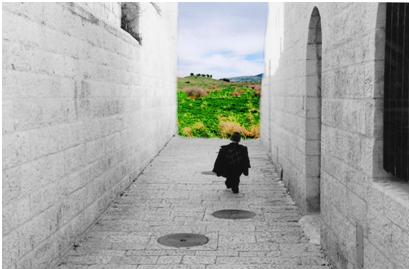
Tonight for services we visited a much-spoken-of shul called Shirah Chadasha. It's run by an Orthodox community who push the bounds of Orthodoxy with regard to gendered restrictions - most notably, women lead the kabbalat Shabbat services.
We met our friends at the front entrance and walked into the building together. When we arrived at the sanctuary Amanda and I went into the women's section and Daniel and Jon into the men's section. Amanda and I were greeted warmly and ushered into seats. All around us were women, some wearing pants but most wearing long skirts and long-sleeved shirts with high necklines. Several of the women were wearing head coverings. The women smiled at one another in greeting, but mostly were otherwise intense in prayer. Unlike in other traditional prayer environments I've experienced, the women were praying audibly, confidently, reading the words and chanting the melodies aloud. Their voices were solid but delicate, and the music of the prayers filled the modest room. The men sat on the other side of the room, on the other side of the mechitza which was a flimsy white chiffon curtain. They seemed like ghosts clouded, obscured, and distant, praying in partnership with the women, like mirror images, like echoes of our words and motions. There was something beautiful in the separation and the sameness, in seeing one another and yet being apart. And the white of the mechitza made the men seem somehow like the Sabbath bride. I found myself feeling strangely attracted to the mechitza, strangely inspired by it, while nevertheless repulsed by the notion of sex-segregated worship.
The music was beautiful. Melody followed melody, each intertwining with improvised harmonies from both sides of the curtain, as though the men and women were reaching accross to one another, defying and celebrating their separation. The beauty of the voices - and they really were quite talented singers -moved me, and though I had come to the services in order to say I had been to this synagogue, in order to experience a new cultural curiosity, and certainly not in order to pray, I found myself praying.
I did not expect to like Shira Chadasha - I was predisposed to think that any place that separates by sex was not a place in which I would comfortably be able to pray, because it is a place that perpetuates social injusitice and inequality. Although my feelings at Shira Chadasha directly contradicted my sense of disapproval of sex-segregated prayer, I am still not convinced that Shira Chadasha is doing enough - often people speak of this synagogue as "so progressive for Orothox", as really unusual, as making great strides. And before I visited I was frustrated with this idea, because they were still separating by sexes, and so they simply weren't doing enough. I felt this way and I still feel this way. And yet...I also really enjoyed services this evening, found them meaningful, perhaps, because of the beauty of coming together through separation, of separating to find one another in sound and voices, because of the eerie, holy sensation of seeing another through a veil, of the transformation of the familiar, of the community created by breaking the whole into halves. And so, I am torn about Shira Chadasha. I disapprove, and I am moved.
Showing posts with label prayer. Show all posts
Showing posts with label prayer. Show all posts
Saturday, April 4, 2009

Sunday, January 4, 2009
We need peace.
.אנחנו צריכים שלום
Yesterday, I learned about an Israeli phrase from the 1980s and 1990s: "Shooting and crying." It refers to the Israeli who defends himself and his country with deadly force but regrets having to do so. There are voices in Israel that focus on shooting: Kill our enemies at all costs. There are those that focus on crying: The pain caused by violence is unacceptable. And there are those who do both: I hate to kill you, but I have to do it.
The sermon I heard yesterday mounted a defense for shooting and crying. The offensive in Gaza, the speaker said, is necessary for the security of Israeli citizens, but the moral considerations cannot be forgotten even in such a critical situation. It may seem hypocritical to some, but it's the best we have.
Shooting and crying.
We're in a bad spot here in Israel. Hundreds of people are dying and everyone is weighing in with her opinion. What's the right thing to do in this situation? What's the right thing to say?
The advocacy group J Street (a liberal answer to AIPAC), released a statement condemning both Hamas and Israel and calling for an immediate cease-fire:
Israel has a special place in each of our hearts. But we recognize that neither Israelis nor Palestinians have a monopoly on right or wrong. While there is nothing "right" in raining rockets on Israeli families or dispatching suicide bombers, there is nothing "right" in punishing a million and a half already-suffering Gazans for the actions of the extremists among them.
And there is nothing to be gained from debating which injustice is greater or came first. What's needed now is immediate action to stop the violence before it spirals out of control.
I have to say that I agree. And it's hard to do so. The President of the Union for Reform Judaism, Rabbi Eric Yoffe, publicly opposes the sentiments expressed in this statement:
These words are deeply distressing because they are morally deficient, profoundly out of touch with Jewish sentiment and also appallingly naïve. A cease-fire instituted by Hamas would be welcome, and Israel would be quick to respond. A cease-fire imposed on Israel would allow Hamas to escape the consequences of its actions yet again and would lead in short order to the renewal of its campaign of terror. Hamas, it should be noted, is not a government; it is a terrorist gang. And as long as the thugs of Hamas can act with impunity, no Israeli government of the right or the left will agree to a two-state solution or any other kind of peace. Doves take note: To be a dove of influence, you must be a realist, firm in your principles but shorn of all illusions.
These words were welcomed by the commenters on the blog and likely reflect the prevailing attitude among American Reform Jews. We hate violence, but Israel has to defend itself. Moreover, Israel is the victim here: If Hamas didn't attack Israel, Israel wouldn't attack back, and therefore, every civilian death is on Hamas' hands. Rabbi Bob Orkand, president of the Association of Reform Zionists of America, defends this view by quoting Michael Walzer: "When Palestinian militants launch rocket attacks from civilian areas, they are themselves responsible--and no one else is--for the civilian deaths caused by Israeli counter fire."
But I don't buy it, and I certainly can't sell it. This view seems sound on paper: Israel's the victim, and Hamas is to blame for the people being killed. But is it entirely unimaginable for us to entertain the opposite view? If Israel hadn't acceded to the illegal settlement of Palestinian land and enforced hardships upon the Palestinian populace, maybe Hamas wouldn't be so powerful today. Both views are right, both views are wrong. And I return to J Street's point: "There is nothing to be gained from debating which injustice is greater or came first. What's needed now is immediate action to stop the violence before it spirals out of control."
I'm not surprised at what Israel has done, and I'm not surprised at the various reactions to Israel's decisions. However, I am disappointed that the rabbinic leadership of the Reform Movement isn't acting as the still, small voice reminding the public that it's wrong to kill. It's wrong to be killed, it's wrong to impose hardship, it's wrong to abandon your public. But it's also wrong to kill and that's a Jewish and universal value. And someone has to say it.
I would have been much more proud of Rabbi Yoffe if, instead of saying that influential doves have to condone killing sometimes, he had said that it's wrong to kill. Of the shooters and cryers, I'm a cryer, and I'll cry quietly to myself about the deaths of hundreds of people and I'll cry loudly from the rooftops that it's wrong to kill. Do with that information what you will, but do not ignore it.
I think that it is rabbinical responsibility to be the voice of moral conscience in this conflict, and regardless of what's politically sound or best for the people of Israel or more justifiable based on historical circumstances, someone has to be the voice that reminds the people that it's wrong to kill. Because we've seen what happens when people forget this most essential value.
I hear over and over again that "we pray for the end of the military action in Gaza." That's not my prayer. My prayer is simple.
We need peace.
We, Israelis. We, Palestinians. We, the people of the entire world. We can't separate ourselves from our neighbors, close or distant, and we can't forget that every single human being is created in the image of God. To save a life is to save the entire world.
Need. We don't want or wish for or expect or fight for or plan for or even hope for. We need. It is a basic and inalienable requirement for our lives. Our humanity depends upon it:
Peace. Non-violence. Co-operation. Reciprocal community. Respect, justice, brotherhood, acceptance, virtue, enrichment, depth, education, broadness, embraces, laughter. It's political, familial, moral, historical, and messianic.
We need peace.
That's my prayer.
It's not complex, it's not nuanced. It doesn't take into account historical arguments, and it doesn't discern winners from losers. It's a statement of existential reality, and it's my heart's loudest cry. And I believe that it needs to be heard and understood and taken into account and adhered to. You can't hear this sentence and then dismiss it because it's inconvenient right now. "We don't have time for peace, we're under attack."
We need peace.
Now. Can I simply say "We need peace" and go home? Can I make a blanket moral statement without applying it to the situation on the ground? If I do, is that irresponsible? Perhaps. So let me say this:
It's wrong for Palestinians to kill. I condemn terrorism, and I support freedom and democracy, two principles which Hamas tends to withhold from the people of the Gaza strip. Hamas is bad for the Palestinians, and if wishing made it so, I would wish that every Hamas-nik woke up in the morning and decided to step down from power. The poltical reality is that Israel has enemies, and they're trying to destroy Israel. Israel is defending itself and is not maliciously killing for the sake of killing. I understand the situation to the best of my ability, and if I had to cast a vote, I'd vote for democracy over terrorism every time. It's wrong to kill.
So what does that mean with regard to Israel today in the Gaza strip? I wish I knew... Is it justifiable for Israel to invade Gaza, trying to minimize civilian casualties, in order to demolish an aggressive enemy? Could very well be. Is it just? It's much harder for me to say. Is it right? I don't know.
But what I do know is that it's wrong to kill and that we need peace. So long as our first priority is security instead of peace, we'll be fighting for a secondary goal. We have to change our perspective, to realign our priorities, if we're ever going to reach the goal of peace that almost everyone can agree on. I believe that if, starting tomorrow, Israel's first priority were peace (regardless of what Hamas' goals are), their thinking process would be different. They would ask the question, "How do we protect Israeli citizens?" but they would also ask the question "How do we work for peace with ourselves and with our neighbors?" Right now the first question is the only one getting asked, and as soon as they find an answer, they go with it. I don't see the second question getting discussed, and that's painful to me.
So, the situation is very complicated, but I feel that there's a responsibility for a group of people to speak the moral truths that our tradition imparts upon us. We need peace. I'm at a loss for what else to say. What would I do if I were a politician? I don't know. But I believe that my role as a rabbi is to speak my heart on this issue and my heart reminds me that we need peace, and that's my message.
That's my prayer.
Yesterday, I learned about an Israeli phrase from the 1980s and 1990s: "Shooting and crying." It refers to the Israeli who defends himself and his country with deadly force but regrets having to do so. There are voices in Israel that focus on shooting: Kill our enemies at all costs. There are those that focus on crying: The pain caused by violence is unacceptable. And there are those who do both: I hate to kill you, but I have to do it.
The sermon I heard yesterday mounted a defense for shooting and crying. The offensive in Gaza, the speaker said, is necessary for the security of Israeli citizens, but the moral considerations cannot be forgotten even in such a critical situation. It may seem hypocritical to some, but it's the best we have.
Shooting and crying.
We're in a bad spot here in Israel. Hundreds of people are dying and everyone is weighing in with her opinion. What's the right thing to do in this situation? What's the right thing to say?
The advocacy group J Street (a liberal answer to AIPAC), released a statement condemning both Hamas and Israel and calling for an immediate cease-fire:
Israel has a special place in each of our hearts. But we recognize that neither Israelis nor Palestinians have a monopoly on right or wrong. While there is nothing "right" in raining rockets on Israeli families or dispatching suicide bombers, there is nothing "right" in punishing a million and a half already-suffering Gazans for the actions of the extremists among them.
And there is nothing to be gained from debating which injustice is greater or came first. What's needed now is immediate action to stop the violence before it spirals out of control.
I have to say that I agree. And it's hard to do so. The President of the Union for Reform Judaism, Rabbi Eric Yoffe, publicly opposes the sentiments expressed in this statement:
These words are deeply distressing because they are morally deficient, profoundly out of touch with Jewish sentiment and also appallingly naïve. A cease-fire instituted by Hamas would be welcome, and Israel would be quick to respond. A cease-fire imposed on Israel would allow Hamas to escape the consequences of its actions yet again and would lead in short order to the renewal of its campaign of terror. Hamas, it should be noted, is not a government; it is a terrorist gang. And as long as the thugs of Hamas can act with impunity, no Israeli government of the right or the left will agree to a two-state solution or any other kind of peace. Doves take note: To be a dove of influence, you must be a realist, firm in your principles but shorn of all illusions.
These words were welcomed by the commenters on the blog and likely reflect the prevailing attitude among American Reform Jews. We hate violence, but Israel has to defend itself. Moreover, Israel is the victim here: If Hamas didn't attack Israel, Israel wouldn't attack back, and therefore, every civilian death is on Hamas' hands. Rabbi Bob Orkand, president of the Association of Reform Zionists of America, defends this view by quoting Michael Walzer: "When Palestinian militants launch rocket attacks from civilian areas, they are themselves responsible--and no one else is--for the civilian deaths caused by Israeli counter fire."
But I don't buy it, and I certainly can't sell it. This view seems sound on paper: Israel's the victim, and Hamas is to blame for the people being killed. But is it entirely unimaginable for us to entertain the opposite view? If Israel hadn't acceded to the illegal settlement of Palestinian land and enforced hardships upon the Palestinian populace, maybe Hamas wouldn't be so powerful today. Both views are right, both views are wrong. And I return to J Street's point: "There is nothing to be gained from debating which injustice is greater or came first. What's needed now is immediate action to stop the violence before it spirals out of control."
I'm not surprised at what Israel has done, and I'm not surprised at the various reactions to Israel's decisions. However, I am disappointed that the rabbinic leadership of the Reform Movement isn't acting as the still, small voice reminding the public that it's wrong to kill. It's wrong to be killed, it's wrong to impose hardship, it's wrong to abandon your public. But it's also wrong to kill and that's a Jewish and universal value. And someone has to say it.
I would have been much more proud of Rabbi Yoffe if, instead of saying that influential doves have to condone killing sometimes, he had said that it's wrong to kill. Of the shooters and cryers, I'm a cryer, and I'll cry quietly to myself about the deaths of hundreds of people and I'll cry loudly from the rooftops that it's wrong to kill. Do with that information what you will, but do not ignore it.
I think that it is rabbinical responsibility to be the voice of moral conscience in this conflict, and regardless of what's politically sound or best for the people of Israel or more justifiable based on historical circumstances, someone has to be the voice that reminds the people that it's wrong to kill. Because we've seen what happens when people forget this most essential value.
I hear over and over again that "we pray for the end of the military action in Gaza." That's not my prayer. My prayer is simple.
We need peace.
We, Israelis. We, Palestinians. We, the people of the entire world. We can't separate ourselves from our neighbors, close or distant, and we can't forget that every single human being is created in the image of God. To save a life is to save the entire world.
Need. We don't want or wish for or expect or fight for or plan for or even hope for. We need. It is a basic and inalienable requirement for our lives. Our humanity depends upon it:
Peace. Non-violence. Co-operation. Reciprocal community. Respect, justice, brotherhood, acceptance, virtue, enrichment, depth, education, broadness, embraces, laughter. It's political, familial, moral, historical, and messianic.
We need peace.
That's my prayer.
It's not complex, it's not nuanced. It doesn't take into account historical arguments, and it doesn't discern winners from losers. It's a statement of existential reality, and it's my heart's loudest cry. And I believe that it needs to be heard and understood and taken into account and adhered to. You can't hear this sentence and then dismiss it because it's inconvenient right now. "We don't have time for peace, we're under attack."
We need peace.
Now. Can I simply say "We need peace" and go home? Can I make a blanket moral statement without applying it to the situation on the ground? If I do, is that irresponsible? Perhaps. So let me say this:
It's wrong for Palestinians to kill. I condemn terrorism, and I support freedom and democracy, two principles which Hamas tends to withhold from the people of the Gaza strip. Hamas is bad for the Palestinians, and if wishing made it so, I would wish that every Hamas-nik woke up in the morning and decided to step down from power. The poltical reality is that Israel has enemies, and they're trying to destroy Israel. Israel is defending itself and is not maliciously killing for the sake of killing. I understand the situation to the best of my ability, and if I had to cast a vote, I'd vote for democracy over terrorism every time. It's wrong to kill.
So what does that mean with regard to Israel today in the Gaza strip? I wish I knew... Is it justifiable for Israel to invade Gaza, trying to minimize civilian casualties, in order to demolish an aggressive enemy? Could very well be. Is it just? It's much harder for me to say. Is it right? I don't know.
But what I do know is that it's wrong to kill and that we need peace. So long as our first priority is security instead of peace, we'll be fighting for a secondary goal. We have to change our perspective, to realign our priorities, if we're ever going to reach the goal of peace that almost everyone can agree on. I believe that if, starting tomorrow, Israel's first priority were peace (regardless of what Hamas' goals are), their thinking process would be different. They would ask the question, "How do we protect Israeli citizens?" but they would also ask the question "How do we work for peace with ourselves and with our neighbors?" Right now the first question is the only one getting asked, and as soon as they find an answer, they go with it. I don't see the second question getting discussed, and that's painful to me.
So, the situation is very complicated, but I feel that there's a responsibility for a group of people to speak the moral truths that our tradition imparts upon us. We need peace. I'm at a loss for what else to say. What would I do if I were a politician? I don't know. But I believe that my role as a rabbi is to speak my heart on this issue and my heart reminds me that we need peace, and that's my message.
That's my prayer.
Saturday, December 6, 2008
Interfaith Encounter in the West Bank.
.מפגש בין-דתים בגדה המערבית
On Thursday-Friday, Jessica and I participated in a large retreat sponsored by the Interfaith Encounter Association and the Hope Flowers School. There were approximately thirty participants: in addition to Jessica and I there were two Arab Christians, two overseas Christians, five Jewish students in the Hebrew University Middle Eastern Studies program, five other Jewish Israelis, and about fifteen Palestinians (I don't think there were any Israeli Arabs at this event although IEA also facilitates encounters between Jewish and Arab Israelis). The theme was The Binding of the Son of Abraham.
Our experience started on Thursday afternoon. Jessica's bus was delayed in getting her home, so shortly after she made it back from school, we left the apartment and hailed a cab, which would take us to the meeting location for the organized transportation. A road was cut off, so we were stuck in traffic and ended up having to walk. During the weekend, we heard two explanations for the traffic: The first was that a חפץ חשוד (chafetz chashud, "suspicious package") was in the road so traffic was stopped and the other that the army's forceful removal of settlers from their houses in Hebron had backed traffic up all the way to Jerusalem. Regardless, we were late arriving at the meeting point, but we still got there before the van did, and we didn't end up leaving for another half hour as we waited for the arrival of one more participant who was also delayed because of the closed road.
We rode in the van with the five Hebrew University students, a local Israeli woman, and an Arab IEA coordinator. We drove through East Jerusalem and ended up just outside the boundaries of the city, not far from Bethlehem and on the way to Gush Etzion, between Gilo and Beit Jala. When we got the old, sparse Everest Hotel, we entered a large dining room that also served as lounge and that had a large green tarp serving as the "walls" of a small conference room. We stood awkwardly in this dining room, not knowing what to do. In addition to the nine of us from the van there were also a dozen or so Palestinians already there - smoking hookah, playing music, watching TV, and talking. No one seemed like they were in charge, and most of the people milling around were already formed into groups. But we were here for the weekend, so we tried to settle ourselves in.
We made our way over to Bob, an Orthodox Rabbi who volunteers with IEA and with whom Jessica has done some work in her internship. He was speaking to a Palestinian--let's call him Sahib--and we joined them. Sahib and Bob discovered that they both had a passing interest in geology, and Sahib invited Bob to look at a special stone that he had with him.
Shortly after being left alone, a hotel worker started assigning rooms to our group, and we were taken up to our room. It had two small beds, a desk, a closet, a window with a view of the roof, and a medium-sized bathroom. Not too shabby. We dropped off our things and made our way back downstairs.
Still there was nothing happening downstairs, so Jessica and I sat down at one of the tables. Shortly thereafter, Bob, Sahib, and a friend of Sahib's from engineering courses at university--let's call him Rabi--joined us at our table. Sahib and Rabi were both very friendly and were telling us about their hopes for peace between Israelis and Palestinians. There's no need for violence, they said; most people on both sides want peace. In their opinion, the problem is almost entirely with the politicians (on both sides though moreso on the Israeli side), who don't adequately represent the majority of their constituents. Of course, Hamas and the extremist terrorists are a problem as well. However, in their opinion, most Palestinians want peace. It should be simple: Give the Palestinians their own country with Jerusalem as its capital (and not Israel's), and let the peoples go on their ways. When I pressed Rabi about why Jerusalem couldn't be the capital of both countries, he said that one city can't belong to two countries. "Maybe with a name change..." suggested Sahib, and Rabi grudgingly agreed that it probably wasn't so important that West Jerusalem not be the capital of Israel if East Jerusalem were the capital of Palestine. At least, that's how I interpreted their position.
Additionally, Sahib told us the story of his and his brother's imprisonment for a year and a half. He recounted that he had left his hometown with papers to go into Israel and was stopped at a checkpoint and asked to produce identity. He didn't have any ID, and a Shin Bet soldier gave him an option: Work for him on the Sabbath or go to jail. "Would you betray your people? There are some things that I will never do." Rather than subject himself to the arbitrary demands of the soldier, Sahib and his brother agreed to go to jail.
There, Sahib put his life on hold but underwent a significant personal blossoming. He learned how to make stones into small pieces of art using just a screw. He wrote poetry, drew pictures, and crafted all sorts of items for personal use and for his friends. I asked him, "If you were put into prison for a year and a half just for not having ID, why aren't you angry at Israel?" Sahib said that such a position isn't healthy for the individual. His time in jail gave him ample time to think, to learn, and to be creative, and he's grateful for the time he had to explore himself. I'm sure that contributors to The Sun have had similar experiences, but I was certainly surprised to meet a Palestinian with that mentality here in the West Bank.
We were encouraged to move into the "conference room" for the first session, and Bob pulled us aside. "I don't deny that Sahib's story could be entirely true; there are absolutely soldiers, especially Shin Bet agents, who would act exactly like that. But the chances of him and his brother being jailed for a year and a half just for not having ID are extremely low." Bob volunteers as part of border security and has a lot of first-hand experience with illegal border crossings. "There just isn't enough room in the jails for guys like him. We don't have enough room for the real criminals, so every day we round up literally truckloads of guys just like him and ship them back to the West Bank. It seems to me very unlikely that he would be locked up for no good reason; that just doesn't make sense to me. Maybe he was totally innocent--I'm not saying it's not a possibility--but maybe not, or maybe they were after his brother. His story could be entirely true, and I have no reason to believe that he's lying, but it's hard to believe that those are all the facts."
Jessica and I appreciated Bob's sobering perspective on Sahib's story and were faced immediately with a real, complex issue in this society. What happens and what he thinks happened and what they think happened and what "we" think happened are all incredibly varied and variable. Bob's probably right - there probably is more to the story than just the fact that Sahib and his brother didn't have ID (though Sahib is the proud owner of a new ID card). On the other hand, what's important to focus on is that Sahib doesn't hate all Israelis, that he wants peace, and that even being in an Israeli prison didn't sour him to life. I'm sure his story is very complex, but ultimately he seems committed to wanting to just live his life in Palestine free of foreign oversight as well as domestic disturbances.
We sat down in a circle of chairs for the opening remarks. Yehuda Stolov, who founded and runs IEA, introduced the program, and the representative from the Hope Flowers School introduced herself and translated Yehuda's English into Arabic. Yehudah emphasized that all participants were to feel that they can share honestly with one another and that they should keep an open mind throughout the proceedings. Also, politics was completely off the table. This was going to be a cultural and religious exchange; politics was not up for discussion.
We had a round of names and then we were challenged to line ourselves up in order according to birthday - classic icebreaker! Having completed the simple task, we arranged ourselves into groups of four and then were told to introduce ourselves to the group. After everyone started talking, Yehuda added that it would be good to answer a question based on the weekend's theme: "When was there a time that someone else sacrificed for you?"
If the leaderless, aimless wandering before the opening session hadn't been clue enough, we were now to have the first real taste of the laissez-faire leadership style that Yehuda adopts. Many groups stood around, uninspired to move, including ours. One of our Palestinian group members was talking to someone else, and I and an Israeli student stood awkwardly waiting for him to finish. When he did, he followed another group out of the conference room, and the second Palestinian quietly followed him. The Israeli and I followed suit and we saw that he had joined with a second group, which we also joined, forming a group of seven. Jessica and I weren't in the same discussion group for the entire weekend, but that probably turned out for the best.
Although the official language of this encounter was supposed to be English, we learned quite quickly that most of the Palestinian participants were only comfortable speaking Arabic. Luckily for us, there was a member of our group fluent in both Arabic and Hebrew with a fair amount of English as well. He helped us facilitate introductions. We had an Israeli student (Tomer), an orthodox rabbi (Bob), a Palestinian musician, and three Palestinian coworkers in government jobs. Our group definitely wasn't interested in answering the sacrifice question, and about halfway through the allotted time, our organized discussion broke up.
Although I had been included in the conversation up to a certain point, once it became clear that the group was no longer on topic, most of the participants began conversing in Arabic together. I sat and listened for several minutes before Tomer asked me a question about living in Israel. I moved over to sit nearer to him, and two Palestinians joined in our conversation. We talked about Middle East studies at Hebrew University and in Israel in general - Tomer doesn't have a single Arab teacher (not even for Arabic language), and he thinks it's a big problem. I was later to learn that Tomer believes that Arabic language should be mandatory in all Israeli schools (officially it is, but it's not enforced at all) and that he might be interested in trying to institute such a change.
Our conversation was going well, but before long we were pulled into dinner. There was a natural separation of ethnicities at the dinner tables (not entire but sufficient), and we were served standard Middle Eastern fare (pita, hummus, babaganoush, peppers/tomatoes/cucumbers, onions in tomato-y sauce, cauliflower/pickles/carrots, etc.). The "vegetarian option" was a scoop of brown rice with a pea or two stuck inside, but the veggies on the table were good enough for a regular meal.
After dinner, we had our first "social activity." In addition to the religion-based discussion groups planned for the following day, general time to be and talk with one another was also deemed of high importance, and this first evening activity was intended to help people get to know one another. The musician from our group (as well as a couple other people) took turns playing the oud, a pear-shaped fret-less lute that reminds one of a guitar. According to Jessica, the instrumentalists were playing individual notes--rather than chords--on the strings (which were grouped in pairs), which would be significantly more difficult than playing the guitar. The music was interesting and soothing, and Jessica and I were fairly tired by this point, so we called it a night.
Although we hadn't specifically noticed that no one had taken their coats off during the entire retreat so far, it became extremely and painfully evident that there was no heat in this building and that our room was pitifully poor at retaining heat. Layers of clothes and multiple blankets couldn't keep the chill out, and the night passed slowly and uncomfortably. Sadly, the next day would also be plagued by the everpresent cold that had set in overnight.
Jessica and I went to breakfast the next morning at about 8:30. Believe it or not, I had a hard-boiled egg and pita, hummus, and falafel for breakfast (no veggies). Low budget but fairly tasty. There was nothing to drink, though luckily I had a water bottle in my backpack. During breakfast, Jessica and I sat with an Israeli Conservative Jew (and were later joined by Bob). This Jewish woman gave Jessica and me a primer of what different kippot/clothes signify in Israel and what you can learn from someone by looking at what they dress. From what I recall:
After breakfast, we went to the conference room for "The Jewish Perspective" on the Binding of Isaac. A rabbi from a nearby community (black beard, Sephardic accent, non-black knit kippah) made the following points about the story without running through the basic plot or characters of the story but more or less just jumped right in. (He was speaking in Hebrew, so while I believe that I got everything, I may have missed a few points.)
1. A believer is willing to sacrifice himself if there's a need. Similarly, he would rather die than go against his most basic principles (which would entail killing, engaging in illicit sexual acts, or committing idolatry). But, what if he's asked (by God) to sacrifice someone else to preserve these basic values, especially if that person is his son who represents the entire Jewish future? Of course, the sacrifice itself would both support and contradict the basic values: while remaining true to God, one would be mimicking the idolaters who practiced human sacrifice.
2. Abraham was promised that he would be the founder of a strong nation. Going through with the sacrifice of his future would be working against God's previous word. There seems to be a choice between valid options here, and any normal person would therefore choose what was easier and more comfortable for himself.
3. God doesn't want Isaac to be sacrificed; rather he just wants to see Abraham's willingness to sacrifice all that's dear to him. We see this because in the text, Abraham is told to "offer up" his son rather than to "sacrifice" him.
Upon completion of this third, somewhat unrelated or significantly supported claim, the rabbi ended his short presentation. Yehudah announced that we should combine our discussion groups from yesterday with a second discussion group and ... discuss. As I said: laissez-faire.
When we finally got our large group together, we sat and talked for a little while. We reiterated that there are several similarities to the Quranic version of the text and reaffirmed everyone's commitment to keep lines of communication open. However, the conversation didn't get very deep. Every once in a while, I'd try to get a more personal question in, but by the time it was translated into Arabic, no one wanted to answer. Once or twice, Bob answered my question, and that seemed to satisfy everyone. In-depth conversation was very difficult in this group setting.
Someone suggested we go outside into the sun (remember the deep-seated cold), and we did that. However, as soon as we got outside, our "translator" started taking various pictures of our group until one of the Israeli students insisted we sit down and continue the conversation. Once we were outside we had a bit more luck. Bob brought up some thoughts about sacrifice being a metaphor for getting in touch with our deeper selves, but no one wanted to reflect on this. There were several side conversations in Arabic or Hebrew, and while normally this would have frustrated me, I kept reminding myself that the point of this encounter is not to discover the hidden meanings of the Akeidah (which I think was a poorly-chosen topic) but rather to get Israelis and Palestinians talking to one another and getting to know one another as human beings. This was definitely happening despite the derailment of conversation, and when we broke for coffee, I was much less dissatisfied than I otherwise might have been.
Jessica and I checked out of our room during the coffee break, and when we came back, it was time for "the Muslim perspective" on the Binding. The speaker they had arranged for "the Muslim perspective" couldn't make it, so one of the Muslim participants had to pinch hit. This is what she reported (as translated into English by the Hope Flowers School representative):
1. Abraham's trials were harder than other prophets'.
2. Abraham didn't have children for 100 years and then Hagar gave him Ishmael.
3. Abraham had a vision to sacrifice his son.
4. Abraham told Ishmael and asked him what he thought. Ishmael told Abraham to do what he had to do.
5. Abraham was about to sacrifice Ishmael, but his knife stopped. God spoke through the angels and told Abraham that he had passed the test.
6. God sent a sheep for the sacrifice instead of Ishmael.
7. As a reward for God's faithfulness, God granted him the birth of Isaac.
8. To this day, a sheep is slaughtered on Eid al-Adha (which is this Tuesday!), the holiday remembering Abraham's faithfulness. (1/3 of the sheep is retained by the slaughterer, 1/3 goes to the family, and 1/3 goes to the needy.)
Upon coming home, I've done some extra research. Here are the relevant verses from the 37th surah of the Quran:
I was very interested in this version of the story, especially the gift of Isaac as the reward for Abraham's faithfulness. Unfortunately, all the Muslims in my discussion group seemed satisfied with the story as told with no need to further elaborate. I tried even harder to spark some in-depth religious conversation but was thwarted at every turn. People were chatting, sitting outside, and taking pictures so again, I wasn't entirely frustrated, but from a personal perspective, I feel I definitely could have learned more.
After I sat and listened to Arabic conversations for about five or ten minutes, Tomer moved over next to me and engaged me (in English!) in a conversation about Reform Judaism. We talked a lot about Reform Judaism, Israel, and Israeli education. Our conversation was terrific and shows that I was able to learn not only from Palestinians during this retreat!
Before lunch, I made my way to the conference room where Jessica's group had broken into smaller discussions. Jessica was talking one-on-one with a Palestinian history professor, and I joined them. She told him that she was studying Yiddish, and he perked up. He knew about Yiddish! Yiddish, he said, began in 1881 as a response to pogroms in Russia; since the Jews needed a way to communicate among themselves without being understood by the Russians and since they had been forced to live together in remote locations, they had and were able to create a language for use only among the Jews. When Jessica told the professor that Yiddish dates back to 1200, he was confused. He said that he'd read in a history of Judaism (or Zionism) that the language was created to confound the Russians. We insisted that that wasn't the case and pondered aloud the perspective of the book he'd read - was it a pro-Hebrew account denigrating the history of Yiddish? A loss in translation? (My thought is that he simply misunderstood what he had read.) After this slightly disorienting conversation, Jessica and I went to lunch.
There, we sat with one of the Christians who had been in Jessica's group. Apparently, they had been discussing the question of why bad things happen to good people - some in their group had said that such events are punishments (including Hurricane Katrina), and that made Jessica and this American Mennonite very uncomfortable. We talked about the issue and about the conference throughout lunch, and we had the pleasure of talking with Amy, a student from the Reconstructionist Rabbinical College whom we had met while visiting Alanna and Rebecca in Philadelphia.
Following lunch was a drumming circle that was interesting and engaging. About a dozen drums had been rented, and the conference participants were encouraged to play them. As soon as I walked into the room, the drum-master pulled me into the center of the drums and got me to start dancing. I had no idea what do to, so I kind of clapped my hands and walked in a circle. A tall Palestinian joined me in the center, and I followed his lead for a minute (he was doing a kind of male form of belly dance without the belly) before exiting the circle. I wasn't nearly as embarrassed as I would have expected.
This tall thin Palestinian seemed to feel comfortable taking charge of the situation. He danced a lot in the middle of the drums (at one point joined by a female Israeli student who was able to dance as well as he), and when he was done dancing, he took over the lead drum. Certain Palestinians tried to lead songs with the drums, and while that worked for a little bit of time, it eventually died out. Jessica was loving the drum, and I got into it a little, too. While the music wasn't great and people didn't exactly feel like they were creating rhythm together, we were all in the same situation together, and no one stopped smiling for the hour that we were drumming. People were taking pictures and movies all over the place, and in general, everyone seemed excited to have this inter-cultural opportunity.
The drum circle came to a close, and several Palestinians left. The musician who had been in my discussion group shook my hand and gave me four kisses - a remarkable and touching gesture! A fair number of Israelis and other Palestinians had already left as well, so we were down to about half our original number by this point. There was still about an hour before the next part of the retreat, so Jess and I found a corner to work on some crossword puzzles. At one point, the Conservative woman who had given us the kippah lesson told us that there were Shabbat candles we could light if we were so inclined, and we did so on our own. After finishing our second crossword, we went back into the conference room for prayers.
We started with Kabbalat Shabbat, led by a Hebrew University student. Several Muslims watched us pray with hushed voices and minimal spirit; I was somewhat embarrassed, but then I recalled that this is the Judaism that most of their neighbors experience. The silent prayer, the songs that people half-heartedly join in on - that kind of prayer is far from foreign in Israeli synagogues. I wish we could have shown them terrific religious leadership and real, meaningful prayer, but it wasn't to be - and this perhaps was more educational.
Then, six Muslim men prayed and we were allowed to witness. It was explained to us that before any of the five daily prayers, a Muslim must wash his hands, arms, feet, face, hair, behind his ears, and his hands again unless there's been nothing to break his cleanliness (going to the bathroom, sleeping, etc.) since his last prayer. Women prayer as men do but standing behind the men. One of the men stood in front and led the prayers, which lasted about ten minutes. Afterwards, I spoke briefly with the prayer leader and learned that anyone can lead prayers, but he has to have the relevant passages of the Quran memorized. Generally, among a group of Muslims, the most knowledgeable leads the prayers.
Our conversation was interrupted by Yehudah inviting everyone to participate in or witness the Ma'ariv service, which again was fairly lackluster. All this aside, though, I think that sharing a prayer space was incredibly important on a theoretical level, especially as this was the first time many of the participants had seen prayer of the others. As prayer in itself can be very intimate, I was glad that we were able to open up to one another even if the prayer itself wasn't that meaningful for the individual participants. (And really, who am I to determine whether the prayer was meaningful for anyone else? I could be the only one who wasn't satisfied with the prayer experience!)
After prayers, we had closing remarks wherein everyone shared a few sentences about their experience. Everyone had very positive things to share, and my strongest sentiment was joy at seeing everyone's smiles, especially during the drum circle. A Jewish Israeli shared that the entire retreat could be summed up by the four-kiss farewell given to him by our Palestinian musician, and in many ways, I agree with him. We were asked to brainstorm about the next retreat (this is, apparently, the first in a series of four), and several of the Palestinians strongly advocated to meet in Jerusalem to further explore the prayer spaces of each of the religions. Yehudah said he'd look into it, and personally, I think it would be incredible.
During dinner, Jessica and I made sure to sit with some Palestinians. I'd been trying to have mixed seating for every meal, but self-segregation was a powerful force. I saw a few Palestinians eyeing our chairs at the "Palestinian table," but we held our ground - and it was a good thing we did! One of them spoke very good English and engaged us in a lot of conversation.
We learned that this woman--let's call her Manab--volunteers at a cultural center where handicapped women make hand-crafts to sell. She studies social work or something like that and works very hard in school, though she wishes she had more time to devote to the handicapped women. Sahib shared more artwork and poetry with us, and they were each interested to hear about our hobbies. I told them that I loved to act, and they asked for a sample. Put on the spot, I could only think to recite a few stanzas of The Raven, which I'm sure they didn't understand (though I know they could see that I was definitely playing a character of some sort). Jessica said that she likes to sing, and they asked her to demonstrate. She began singing Autumn Leaves and immediately the entire table got silent and applauded when she was finished. She was an instant hit! They asked her to sing again, and she obliged them - though this time she was recorded by two cell phones! Manab told her she could make a career out of her singing, and everyone, of course, agreed.
We told jokes (I told a joke that Rabi had heard in Hebron) and laughed a lot, shared pictures, and entirely enjoyed one another's company. The same Israeli who had shared his reaction to the kiss-farewell played the harmonica and led some bodily-healing exercises - everyone was bouncing around and massaging their faces. Sahib showed me some magic tricks, and I showed him one. It was a terrific time! This was by far the best part of the entire conference. Sadly, all of the Hebrew U. students and most of the other Israelis were still talking at the "Jewish table," totally missing out. But, I don't think the effect was lost on the Palestinians.
Jessica and I were asked if we knew how to play the cardgame Tricks, and sadly we didn't. We were, however, invited to watch four of the Palestinian men play, and we gladly accepted. Having watched the game for about twenty minutes, I can tell you the very basic gist, but I have no idea what the individual rules are. The game seemed extraordinarily complicated, but the men played with carefree ease and lots of laughs. Jessica and I watched until our ride arrived to take us home. We said good-bye to the Israelis and to the Palestinians, shook many hands, grabbed a cookie for the road, and headed out.
The ride home was fairly uneventful except for our being asked to pull over at the checkpoint into the Jerusalem area. Jessica and I had thought to bring our passports, and I was extremely relieved that we had them (it's illegal not to carry ID in Israel), though thankfully we didn't need them. The glove box and trunk of our car were inspected, though of course nothing was discovered. The driver was supposed to take us to the original meeting point from which we had departed, but since the other two people who were supposed to be in the car had arranged to leave earlier, we were able to work out paying him 20 shekels to drive us to our apartment (which worked out incredibly well for us). We got home at about 10:45 pm on Friday and immediately put on sweatshirts - we'd been cold for the previous 30 hours!
All in all, I think the retreat was an excellent opportunity. It could have been much more smoothly organized and operated without sacrificing any of the social opportunities, but for the most part, I think that the primary goal in my eyes (getting Israelis and Palestinians to enjoy one another's company so that they can extrapolate this feeling of acceptance to other members of the appropriate group) was met. I came in contact with some very interesting people, I learned some significant lessons about life in Palestine, and I became much more comfortable with Arab culture. Hopefully there will be follow-up opportunities that Jessica and I can attend. In the meantime, I'll file away all those Palestinian smiles in my memory and try to share them with those who need to hear about them in the months and years ahead.
On Thursday-Friday, Jessica and I participated in a large retreat sponsored by the Interfaith Encounter Association and the Hope Flowers School. There were approximately thirty participants: in addition to Jessica and I there were two Arab Christians, two overseas Christians, five Jewish students in the Hebrew University Middle Eastern Studies program, five other Jewish Israelis, and about fifteen Palestinians (I don't think there were any Israeli Arabs at this event although IEA also facilitates encounters between Jewish and Arab Israelis). The theme was The Binding of the Son of Abraham.
Our experience started on Thursday afternoon. Jessica's bus was delayed in getting her home, so shortly after she made it back from school, we left the apartment and hailed a cab, which would take us to the meeting location for the organized transportation. A road was cut off, so we were stuck in traffic and ended up having to walk. During the weekend, we heard two explanations for the traffic: The first was that a חפץ חשוד (chafetz chashud, "suspicious package") was in the road so traffic was stopped and the other that the army's forceful removal of settlers from their houses in Hebron had backed traffic up all the way to Jerusalem. Regardless, we were late arriving at the meeting point, but we still got there before the van did, and we didn't end up leaving for another half hour as we waited for the arrival of one more participant who was also delayed because of the closed road.
We rode in the van with the five Hebrew University students, a local Israeli woman, and an Arab IEA coordinator. We drove through East Jerusalem and ended up just outside the boundaries of the city, not far from Bethlehem and on the way to Gush Etzion, between Gilo and Beit Jala. When we got the old, sparse Everest Hotel, we entered a large dining room that also served as lounge and that had a large green tarp serving as the "walls" of a small conference room. We stood awkwardly in this dining room, not knowing what to do. In addition to the nine of us from the van there were also a dozen or so Palestinians already there - smoking hookah, playing music, watching TV, and talking. No one seemed like they were in charge, and most of the people milling around were already formed into groups. But we were here for the weekend, so we tried to settle ourselves in.
We made our way over to Bob, an Orthodox Rabbi who volunteers with IEA and with whom Jessica has done some work in her internship. He was speaking to a Palestinian--let's call him Sahib--and we joined them. Sahib and Bob discovered that they both had a passing interest in geology, and Sahib invited Bob to look at a special stone that he had with him.
Shortly after being left alone, a hotel worker started assigning rooms to our group, and we were taken up to our room. It had two small beds, a desk, a closet, a window with a view of the roof, and a medium-sized bathroom. Not too shabby. We dropped off our things and made our way back downstairs.
Still there was nothing happening downstairs, so Jessica and I sat down at one of the tables. Shortly thereafter, Bob, Sahib, and a friend of Sahib's from engineering courses at university--let's call him Rabi--joined us at our table. Sahib and Rabi were both very friendly and were telling us about their hopes for peace between Israelis and Palestinians. There's no need for violence, they said; most people on both sides want peace. In their opinion, the problem is almost entirely with the politicians (on both sides though moreso on the Israeli side), who don't adequately represent the majority of their constituents. Of course, Hamas and the extremist terrorists are a problem as well. However, in their opinion, most Palestinians want peace. It should be simple: Give the Palestinians their own country with Jerusalem as its capital (and not Israel's), and let the peoples go on their ways. When I pressed Rabi about why Jerusalem couldn't be the capital of both countries, he said that one city can't belong to two countries. "Maybe with a name change..." suggested Sahib, and Rabi grudgingly agreed that it probably wasn't so important that West Jerusalem not be the capital of Israel if East Jerusalem were the capital of Palestine. At least, that's how I interpreted their position.
Additionally, Sahib told us the story of his and his brother's imprisonment for a year and a half. He recounted that he had left his hometown with papers to go into Israel and was stopped at a checkpoint and asked to produce identity. He didn't have any ID, and a Shin Bet soldier gave him an option: Work for him on the Sabbath or go to jail. "Would you betray your people? There are some things that I will never do." Rather than subject himself to the arbitrary demands of the soldier, Sahib and his brother agreed to go to jail.
There, Sahib put his life on hold but underwent a significant personal blossoming. He learned how to make stones into small pieces of art using just a screw. He wrote poetry, drew pictures, and crafted all sorts of items for personal use and for his friends. I asked him, "If you were put into prison for a year and a half just for not having ID, why aren't you angry at Israel?" Sahib said that such a position isn't healthy for the individual. His time in jail gave him ample time to think, to learn, and to be creative, and he's grateful for the time he had to explore himself. I'm sure that contributors to The Sun have had similar experiences, but I was certainly surprised to meet a Palestinian with that mentality here in the West Bank.
We were encouraged to move into the "conference room" for the first session, and Bob pulled us aside. "I don't deny that Sahib's story could be entirely true; there are absolutely soldiers, especially Shin Bet agents, who would act exactly like that. But the chances of him and his brother being jailed for a year and a half just for not having ID are extremely low." Bob volunteers as part of border security and has a lot of first-hand experience with illegal border crossings. "There just isn't enough room in the jails for guys like him. We don't have enough room for the real criminals, so every day we round up literally truckloads of guys just like him and ship them back to the West Bank. It seems to me very unlikely that he would be locked up for no good reason; that just doesn't make sense to me. Maybe he was totally innocent--I'm not saying it's not a possibility--but maybe not, or maybe they were after his brother. His story could be entirely true, and I have no reason to believe that he's lying, but it's hard to believe that those are all the facts."
Jessica and I appreciated Bob's sobering perspective on Sahib's story and were faced immediately with a real, complex issue in this society. What happens and what he thinks happened and what they think happened and what "we" think happened are all incredibly varied and variable. Bob's probably right - there probably is more to the story than just the fact that Sahib and his brother didn't have ID (though Sahib is the proud owner of a new ID card). On the other hand, what's important to focus on is that Sahib doesn't hate all Israelis, that he wants peace, and that even being in an Israeli prison didn't sour him to life. I'm sure his story is very complex, but ultimately he seems committed to wanting to just live his life in Palestine free of foreign oversight as well as domestic disturbances.
We sat down in a circle of chairs for the opening remarks. Yehuda Stolov, who founded and runs IEA, introduced the program, and the representative from the Hope Flowers School introduced herself and translated Yehuda's English into Arabic. Yehudah emphasized that all participants were to feel that they can share honestly with one another and that they should keep an open mind throughout the proceedings. Also, politics was completely off the table. This was going to be a cultural and religious exchange; politics was not up for discussion.
We had a round of names and then we were challenged to line ourselves up in order according to birthday - classic icebreaker! Having completed the simple task, we arranged ourselves into groups of four and then were told to introduce ourselves to the group. After everyone started talking, Yehuda added that it would be good to answer a question based on the weekend's theme: "When was there a time that someone else sacrificed for you?"
If the leaderless, aimless wandering before the opening session hadn't been clue enough, we were now to have the first real taste of the laissez-faire leadership style that Yehuda adopts. Many groups stood around, uninspired to move, including ours. One of our Palestinian group members was talking to someone else, and I and an Israeli student stood awkwardly waiting for him to finish. When he did, he followed another group out of the conference room, and the second Palestinian quietly followed him. The Israeli and I followed suit and we saw that he had joined with a second group, which we also joined, forming a group of seven. Jessica and I weren't in the same discussion group for the entire weekend, but that probably turned out for the best.
Although the official language of this encounter was supposed to be English, we learned quite quickly that most of the Palestinian participants were only comfortable speaking Arabic. Luckily for us, there was a member of our group fluent in both Arabic and Hebrew with a fair amount of English as well. He helped us facilitate introductions. We had an Israeli student (Tomer), an orthodox rabbi (Bob), a Palestinian musician, and three Palestinian coworkers in government jobs. Our group definitely wasn't interested in answering the sacrifice question, and about halfway through the allotted time, our organized discussion broke up.
Although I had been included in the conversation up to a certain point, once it became clear that the group was no longer on topic, most of the participants began conversing in Arabic together. I sat and listened for several minutes before Tomer asked me a question about living in Israel. I moved over to sit nearer to him, and two Palestinians joined in our conversation. We talked about Middle East studies at Hebrew University and in Israel in general - Tomer doesn't have a single Arab teacher (not even for Arabic language), and he thinks it's a big problem. I was later to learn that Tomer believes that Arabic language should be mandatory in all Israeli schools (officially it is, but it's not enforced at all) and that he might be interested in trying to institute such a change.
Our conversation was going well, but before long we were pulled into dinner. There was a natural separation of ethnicities at the dinner tables (not entire but sufficient), and we were served standard Middle Eastern fare (pita, hummus, babaganoush, peppers/tomatoes/cucumbers, onions in tomato-y sauce, cauliflower/pickles/carrots, etc.). The "vegetarian option" was a scoop of brown rice with a pea or two stuck inside, but the veggies on the table were good enough for a regular meal.
After dinner, we had our first "social activity." In addition to the religion-based discussion groups planned for the following day, general time to be and talk with one another was also deemed of high importance, and this first evening activity was intended to help people get to know one another. The musician from our group (as well as a couple other people) took turns playing the oud, a pear-shaped fret-less lute that reminds one of a guitar. According to Jessica, the instrumentalists were playing individual notes--rather than chords--on the strings (which were grouped in pairs), which would be significantly more difficult than playing the guitar. The music was interesting and soothing, and Jessica and I were fairly tired by this point, so we called it a night.
Although we hadn't specifically noticed that no one had taken their coats off during the entire retreat so far, it became extremely and painfully evident that there was no heat in this building and that our room was pitifully poor at retaining heat. Layers of clothes and multiple blankets couldn't keep the chill out, and the night passed slowly and uncomfortably. Sadly, the next day would also be plagued by the everpresent cold that had set in overnight.
Jessica and I went to breakfast the next morning at about 8:30. Believe it or not, I had a hard-boiled egg and pita, hummus, and falafel for breakfast (no veggies). Low budget but fairly tasty. There was nothing to drink, though luckily I had a water bottle in my backpack. During breakfast, Jessica and I sat with an Israeli Conservative Jew (and were later joined by Bob). This Jewish woman gave Jessica and me a primer of what different kippot/clothes signify in Israel and what you can learn from someone by looking at what they dress. From what I recall:
- black, velvet kippah = ultra-orthodox (with the clothes to boot)
- non-black knit kippah = (modern) orthodox
- big kippah that fits entirely over the head = modern religious (goes for men or women)
- small knit kippah = raised religious but might not fully participate in those circles anymore
- no kippah = secular OR "kippah in the back pocket" (the latter even more of an option if you have a beard)
- a mixture of any of these categories = "outsider" to a specific group
After breakfast, we went to the conference room for "The Jewish Perspective" on the Binding of Isaac. A rabbi from a nearby community (black beard, Sephardic accent, non-black knit kippah) made the following points about the story without running through the basic plot or characters of the story but more or less just jumped right in. (He was speaking in Hebrew, so while I believe that I got everything, I may have missed a few points.)
1. A believer is willing to sacrifice himself if there's a need. Similarly, he would rather die than go against his most basic principles (which would entail killing, engaging in illicit sexual acts, or committing idolatry). But, what if he's asked (by God) to sacrifice someone else to preserve these basic values, especially if that person is his son who represents the entire Jewish future? Of course, the sacrifice itself would both support and contradict the basic values: while remaining true to God, one would be mimicking the idolaters who practiced human sacrifice.
2. Abraham was promised that he would be the founder of a strong nation. Going through with the sacrifice of his future would be working against God's previous word. There seems to be a choice between valid options here, and any normal person would therefore choose what was easier and more comfortable for himself.
3. God doesn't want Isaac to be sacrificed; rather he just wants to see Abraham's willingness to sacrifice all that's dear to him. We see this because in the text, Abraham is told to "offer up" his son rather than to "sacrifice" him.
Upon completion of this third, somewhat unrelated or significantly supported claim, the rabbi ended his short presentation. Yehudah announced that we should combine our discussion groups from yesterday with a second discussion group and ... discuss. As I said: laissez-faire.
When we finally got our large group together, we sat and talked for a little while. We reiterated that there are several similarities to the Quranic version of the text and reaffirmed everyone's commitment to keep lines of communication open. However, the conversation didn't get very deep. Every once in a while, I'd try to get a more personal question in, but by the time it was translated into Arabic, no one wanted to answer. Once or twice, Bob answered my question, and that seemed to satisfy everyone. In-depth conversation was very difficult in this group setting.
Someone suggested we go outside into the sun (remember the deep-seated cold), and we did that. However, as soon as we got outside, our "translator" started taking various pictures of our group until one of the Israeli students insisted we sit down and continue the conversation. Once we were outside we had a bit more luck. Bob brought up some thoughts about sacrifice being a metaphor for getting in touch with our deeper selves, but no one wanted to reflect on this. There were several side conversations in Arabic or Hebrew, and while normally this would have frustrated me, I kept reminding myself that the point of this encounter is not to discover the hidden meanings of the Akeidah (which I think was a poorly-chosen topic) but rather to get Israelis and Palestinians talking to one another and getting to know one another as human beings. This was definitely happening despite the derailment of conversation, and when we broke for coffee, I was much less dissatisfied than I otherwise might have been.
Jessica and I checked out of our room during the coffee break, and when we came back, it was time for "the Muslim perspective" on the Binding. The speaker they had arranged for "the Muslim perspective" couldn't make it, so one of the Muslim participants had to pinch hit. This is what she reported (as translated into English by the Hope Flowers School representative):
1. Abraham's trials were harder than other prophets'.
2. Abraham didn't have children for 100 years and then Hagar gave him Ishmael.
3. Abraham had a vision to sacrifice his son.
4. Abraham told Ishmael and asked him what he thought. Ishmael told Abraham to do what he had to do.
5. Abraham was about to sacrifice Ishmael, but his knife stopped. God spoke through the angels and told Abraham that he had passed the test.
6. God sent a sheep for the sacrifice instead of Ishmael.
7. As a reward for God's faithfulness, God granted him the birth of Isaac.
8. To this day, a sheep is slaughtered on Eid al-Adha (which is this Tuesday!), the holiday remembering Abraham's faithfulness. (1/3 of the sheep is retained by the slaughterer, 1/3 goes to the family, and 1/3 goes to the needy.)
Upon coming home, I've done some extra research. Here are the relevant verses from the 37th surah of the Quran:
"37.100": My Lord! grant me of the doers of good deeds.
"37.101": So We gave him the good news of a boy, possessing forbearance.
"37.102": And when he attained to working with him, he said: O my son! surely I have seen in a dream that I should sacrifice you; consider then what you see. He said: O my father! do what you are commanded; if Allah please, you will find me of the patient ones.
"37.103": So when they both submitted and he threw him down upon his forehead,
"37.104": And We called out to him saying: O Ibrahim!
"37.105": You have indeed shown the truth of the vision; surely thus do We reward the doers of good:
"37.106": Most surely this is a manifest trial.
"37.107": And We ransomed him with a Feat sacrifice.
"37.108": And We perpetuated (praise) to him among the later generations.
"37.109": Peace be on Ibrahim.
"37.110": Thus do We reward the doers of good.
"37.111": Surely he was one of Our believing servants.
"37.112": And We gave him the good news of Ishaq, a prophet among the good ones.
"37.113": And We showered Our blessings on him and on Ishaq; and of their offspring are the doers of good, and (also) those who are clearly unjust to their own souls.
Although it's not explicitly stated in the Quran, Muslim tradition holds that the "boy" in verse 101 is Ishmael. I'm not sure where the "midrashic" additions of the vision, the angels, and the sheep come in (but the sheep obviously holds as a strong tradition as evidenced in the holiday).I was very interested in this version of the story, especially the gift of Isaac as the reward for Abraham's faithfulness. Unfortunately, all the Muslims in my discussion group seemed satisfied with the story as told with no need to further elaborate. I tried even harder to spark some in-depth religious conversation but was thwarted at every turn. People were chatting, sitting outside, and taking pictures so again, I wasn't entirely frustrated, but from a personal perspective, I feel I definitely could have learned more.
After I sat and listened to Arabic conversations for about five or ten minutes, Tomer moved over next to me and engaged me (in English!) in a conversation about Reform Judaism. We talked a lot about Reform Judaism, Israel, and Israeli education. Our conversation was terrific and shows that I was able to learn not only from Palestinians during this retreat!
Before lunch, I made my way to the conference room where Jessica's group had broken into smaller discussions. Jessica was talking one-on-one with a Palestinian history professor, and I joined them. She told him that she was studying Yiddish, and he perked up. He knew about Yiddish! Yiddish, he said, began in 1881 as a response to pogroms in Russia; since the Jews needed a way to communicate among themselves without being understood by the Russians and since they had been forced to live together in remote locations, they had and were able to create a language for use only among the Jews. When Jessica told the professor that Yiddish dates back to 1200, he was confused. He said that he'd read in a history of Judaism (or Zionism) that the language was created to confound the Russians. We insisted that that wasn't the case and pondered aloud the perspective of the book he'd read - was it a pro-Hebrew account denigrating the history of Yiddish? A loss in translation? (My thought is that he simply misunderstood what he had read.) After this slightly disorienting conversation, Jessica and I went to lunch.
There, we sat with one of the Christians who had been in Jessica's group. Apparently, they had been discussing the question of why bad things happen to good people - some in their group had said that such events are punishments (including Hurricane Katrina), and that made Jessica and this American Mennonite very uncomfortable. We talked about the issue and about the conference throughout lunch, and we had the pleasure of talking with Amy, a student from the Reconstructionist Rabbinical College whom we had met while visiting Alanna and Rebecca in Philadelphia.
Following lunch was a drumming circle that was interesting and engaging. About a dozen drums had been rented, and the conference participants were encouraged to play them. As soon as I walked into the room, the drum-master pulled me into the center of the drums and got me to start dancing. I had no idea what do to, so I kind of clapped my hands and walked in a circle. A tall Palestinian joined me in the center, and I followed his lead for a minute (he was doing a kind of male form of belly dance without the belly) before exiting the circle. I wasn't nearly as embarrassed as I would have expected.
This tall thin Palestinian seemed to feel comfortable taking charge of the situation. He danced a lot in the middle of the drums (at one point joined by a female Israeli student who was able to dance as well as he), and when he was done dancing, he took over the lead drum. Certain Palestinians tried to lead songs with the drums, and while that worked for a little bit of time, it eventually died out. Jessica was loving the drum, and I got into it a little, too. While the music wasn't great and people didn't exactly feel like they were creating rhythm together, we were all in the same situation together, and no one stopped smiling for the hour that we were drumming. People were taking pictures and movies all over the place, and in general, everyone seemed excited to have this inter-cultural opportunity.
The drum circle came to a close, and several Palestinians left. The musician who had been in my discussion group shook my hand and gave me four kisses - a remarkable and touching gesture! A fair number of Israelis and other Palestinians had already left as well, so we were down to about half our original number by this point. There was still about an hour before the next part of the retreat, so Jess and I found a corner to work on some crossword puzzles. At one point, the Conservative woman who had given us the kippah lesson told us that there were Shabbat candles we could light if we were so inclined, and we did so on our own. After finishing our second crossword, we went back into the conference room for prayers.
We started with Kabbalat Shabbat, led by a Hebrew University student. Several Muslims watched us pray with hushed voices and minimal spirit; I was somewhat embarrassed, but then I recalled that this is the Judaism that most of their neighbors experience. The silent prayer, the songs that people half-heartedly join in on - that kind of prayer is far from foreign in Israeli synagogues. I wish we could have shown them terrific religious leadership and real, meaningful prayer, but it wasn't to be - and this perhaps was more educational.
Then, six Muslim men prayed and we were allowed to witness. It was explained to us that before any of the five daily prayers, a Muslim must wash his hands, arms, feet, face, hair, behind his ears, and his hands again unless there's been nothing to break his cleanliness (going to the bathroom, sleeping, etc.) since his last prayer. Women prayer as men do but standing behind the men. One of the men stood in front and led the prayers, which lasted about ten minutes. Afterwards, I spoke briefly with the prayer leader and learned that anyone can lead prayers, but he has to have the relevant passages of the Quran memorized. Generally, among a group of Muslims, the most knowledgeable leads the prayers.
Our conversation was interrupted by Yehudah inviting everyone to participate in or witness the Ma'ariv service, which again was fairly lackluster. All this aside, though, I think that sharing a prayer space was incredibly important on a theoretical level, especially as this was the first time many of the participants had seen prayer of the others. As prayer in itself can be very intimate, I was glad that we were able to open up to one another even if the prayer itself wasn't that meaningful for the individual participants. (And really, who am I to determine whether the prayer was meaningful for anyone else? I could be the only one who wasn't satisfied with the prayer experience!)
After prayers, we had closing remarks wherein everyone shared a few sentences about their experience. Everyone had very positive things to share, and my strongest sentiment was joy at seeing everyone's smiles, especially during the drum circle. A Jewish Israeli shared that the entire retreat could be summed up by the four-kiss farewell given to him by our Palestinian musician, and in many ways, I agree with him. We were asked to brainstorm about the next retreat (this is, apparently, the first in a series of four), and several of the Palestinians strongly advocated to meet in Jerusalem to further explore the prayer spaces of each of the religions. Yehudah said he'd look into it, and personally, I think it would be incredible.
During dinner, Jessica and I made sure to sit with some Palestinians. I'd been trying to have mixed seating for every meal, but self-segregation was a powerful force. I saw a few Palestinians eyeing our chairs at the "Palestinian table," but we held our ground - and it was a good thing we did! One of them spoke very good English and engaged us in a lot of conversation.
We learned that this woman--let's call her Manab--volunteers at a cultural center where handicapped women make hand-crafts to sell. She studies social work or something like that and works very hard in school, though she wishes she had more time to devote to the handicapped women. Sahib shared more artwork and poetry with us, and they were each interested to hear about our hobbies. I told them that I loved to act, and they asked for a sample. Put on the spot, I could only think to recite a few stanzas of The Raven, which I'm sure they didn't understand (though I know they could see that I was definitely playing a character of some sort). Jessica said that she likes to sing, and they asked her to demonstrate. She began singing Autumn Leaves and immediately the entire table got silent and applauded when she was finished. She was an instant hit! They asked her to sing again, and she obliged them - though this time she was recorded by two cell phones! Manab told her she could make a career out of her singing, and everyone, of course, agreed.
We told jokes (I told a joke that Rabi had heard in Hebron) and laughed a lot, shared pictures, and entirely enjoyed one another's company. The same Israeli who had shared his reaction to the kiss-farewell played the harmonica and led some bodily-healing exercises - everyone was bouncing around and massaging their faces. Sahib showed me some magic tricks, and I showed him one. It was a terrific time! This was by far the best part of the entire conference. Sadly, all of the Hebrew U. students and most of the other Israelis were still talking at the "Jewish table," totally missing out. But, I don't think the effect was lost on the Palestinians.
Jessica and I were asked if we knew how to play the cardgame Tricks, and sadly we didn't. We were, however, invited to watch four of the Palestinian men play, and we gladly accepted. Having watched the game for about twenty minutes, I can tell you the very basic gist, but I have no idea what the individual rules are. The game seemed extraordinarily complicated, but the men played with carefree ease and lots of laughs. Jessica and I watched until our ride arrived to take us home. We said good-bye to the Israelis and to the Palestinians, shook many hands, grabbed a cookie for the road, and headed out.
The ride home was fairly uneventful except for our being asked to pull over at the checkpoint into the Jerusalem area. Jessica and I had thought to bring our passports, and I was extremely relieved that we had them (it's illegal not to carry ID in Israel), though thankfully we didn't need them. The glove box and trunk of our car were inspected, though of course nothing was discovered. The driver was supposed to take us to the original meeting point from which we had departed, but since the other two people who were supposed to be in the car had arranged to leave earlier, we were able to work out paying him 20 shekels to drive us to our apartment (which worked out incredibly well for us). We got home at about 10:45 pm on Friday and immediately put on sweatshirts - we'd been cold for the previous 30 hours!
All in all, I think the retreat was an excellent opportunity. It could have been much more smoothly organized and operated without sacrificing any of the social opportunities, but for the most part, I think that the primary goal in my eyes (getting Israelis and Palestinians to enjoy one another's company so that they can extrapolate this feeling of acceptance to other members of the appropriate group) was met. I came in contact with some very interesting people, I learned some significant lessons about life in Palestine, and I became much more comfortable with Arab culture. Hopefully there will be follow-up opportunities that Jessica and I can attend. In the meantime, I'll file away all those Palestinian smiles in my memory and try to share them with those who need to hear about them in the months and years ahead.
Tuesday, October 21, 2008
Dancing with the Torah, and Hearing the Voices from Behind the Curtain
Simchat Torah. It's probably my favorite Jewish holiday - a holiday devoted to the great joy and love our community has for its central holy text, a rollicking physical tribute to the joys of literacy, and the deep and urgent love our tradition has for the Torah, such that we cannot do without reading it and must start from the beginning as soon as we end it. Also, an acknowledgment of the liminal space between finishing the book and beginning it - in those moments between the readings of Deuteronomy and Genesis, who are we? The people who read Torah - and we are done with the Torah? It's scary, terrifying really, this crisis of identity, this moment of the unknown, when we are faced with the reality of our own times without the guidance of the wisdom of the past. I love it because of its recognition of the Torah as a finite book with a beginning and an end, along with its simultaneous assertion that Torah has no boundaries and is not like other books - it continues even when it ends and we don't need to start a new book, because everything is in this one text. I love it because usually we treat the Torah like royalty - turning toward it as it processes across the sanctuary, rising as it enters, etc., but on Simchat Torah we let our guard down and dance with the Torah like an old friend, and everyone can take turns holding the Torah and sharing the intimate physical experience of dancing with the holiest of objects in their tradition. I love it because it is fun - a different kind of fun from many Jewish rituals, not the fun of reading an interesting text or eating a good meal but the fun of movement and energy of beauty and silliness, of togetherness and individual expression. There's a really good explanation of Shemini Atzeret and Simchat Torah at the Shalom Center's website, and if you want to read more about, I recommend starting there.
For our Simchat Torah celebration, Daniel and I joined a large group of HUC students to go to Kibbutz Gezer, a kibbutz that was founded in 1974 by a group of olim (immigrants) from Habonim-Dror, a Zionist youth organization. It fosters liberal Judaism and social justice projects, including bringing in new immigrants from Peru each week to celebrate Shabbat in a liberal Jewish way, leading educational programs for Israeli and American groups, and holding educational and spiritual activities for inmates of Ramle prison. We arrived shortly before the services which were to be held in their outdoor synagogue, and were given a brief tour of Pinat Shorashim, their educational park. We walked around a bit and appreciated the educational tools at the park, which were perhaps not meant for students of our age but are interesting and effective ideas for the teaching some of us might be doing some day whether as Rabbis, Cantors, Educators, or simply Jewish parents. We made our way back to the prayer space, which was overflowing with guests - small children nestled in their parents' arms, nuns and priests, a contingent from an American Reform youth group, people speaking Russian, Hebrew, Spanish, and English. After the service which was led by a charming but somewhat long-winded Rabbi, a klezmer-style band started playing for the seven hakkafot. Frankly, we felt that not enough people danced, and that the dancing didn't last nearly long enough, but for what it was, we managed to have a good time, and to experience the joy of the holiday. We were all quite hungry afterwards as we didn't realize that there wouldn't be dinner at the celebration, so we went out to eat at Spaghettim, a restaurant near our apartment, with a large group from HUC.
This morning, we went to services at Har El, the Reform synagogue around the corner from our apartment, which is an unendingly warm and welcoming congregation. The services were quite full, and after prayer led jointly by the chazzan from Har El and a cantorial professor from HUC, we went out into their front garden to dance with the Torahs to music played by HUC students. The songs were short and the dancing mostly consisted of walking slowly in a circle, but the mood was joyous and the weather was lovely. I carried the Torah for a bit, and found it to be a powerful moment - holding something so holy, and that was for so long not accessible to women, the physicality of my closeness and access to the Torah so that I could feel the stiffness of the parchment through the decorative mantle just as though I were embracing a loved one and feeling his flesh and bones through the fabric of their clothing. After a short while we returned indoors for the Torah reading, the Haftorah reading, the prayer for the rain, and so forth. (SIDE NOTE: It looks, incidentally, like the rain will start soon, just on schedule. This is extremely important, as last year the Kinneret reached its lowest level in five years. The Kinneret (Sea of Galilee) is Israel's main source of drinking water, and Israel is dependent on the rainy season to produce the water that the country needs. Israel currently has two desalinization plants, and will have a third by 2013, and they do make a big difference, but nevertheless, prayers for rain are certainly prayed with urgency.) In the middle of the Torah reading I looked up to find an Orthodox man in the doorway, his dark brown peyot perfectly curled and reaching the tops of his shoulders. I'll admit, his presence scared me a little: was he here to interrupt our service by yelling at us and telling us we were profaning the Torah? Or worse? Would he steal the Torah? Throw something? In retrospect I am ashamed of these fears - he stood in the doorway for about a minute, and when a woman began to read the Torah, he walked away, presumably because he believes that it is forbidden for a man to listen to a woman singing. Perhaps he was just curious, like we are when we visit Orthodox shuls. I should have felt only excitement and joy to have someone else share in our prayes, and I felt fear. For this, I am ashamed. The service went on into the early afternoon, and so after chatting a bit after services, we returned home to eat lunch and then to write about our experiences.
_____________________________________
Simchat Torah wasn't the only interesting thing we've done lately. On Saturday night, Lauren (a cantorial student and friend) and I went to see a show produced by the BaMatMaBat Theater Company and the Professional Women's Theater, titled "Voices from Our Side of the Curtain." (You can read the blog version of the production here) It was an English language production, and all of the participants seemed to be American Jews, living in Israel, many of them about my age. The performance was by and for only women, the idea being that in Orthodox Judaism, many people feel that it is inappropriate for a man to hear a woman's voice, citing a Talmudic prohibition called Kol Isha. The Orthodox women in this production are concerned with issues of modesty but nevertheless feel that they deserve a forum to share there talents and their own stories.
The play was modeled off of the Vagina Monologues - a series of monologues in which women shared their personal stories. Each story helped me to better understand the American Orthodox world, which is in some ways (though not all) very different from the American Reform world, and helped me to respect and understand choices that women make to participate in a society in which they have differing roles from men. I think sometimes I lose sight of the fact that for many Orthodox women, they don't feel that they are being forced to wear "modest" clothing, sit in a separate section, etc. but are actually acting out of their own will and for their own reasons. In my own discomfort that these expectations might be forced upon me, I project this sense that these strictures are a hateful burden onto those who willingly participate in the system of which they are a part.
The first monologue, titled "Bald in the Land of Covered Hair" was an extremely evocative piece about a woman who was diagnosed with breast cancer and has to undergo chemotherapy and have a mastectomy. She is horrified at the notion of losing her hair and her breast, despite the fact that she already wears a wig and clothing that does not emphasize her body. Despite her modest clothing, she has always associated these parts of her body with her femininity. She comes to learn, with the help of an extremely supportive and loving husband, that femininity is something that is within her, and that her body parts are not what make her a woman, or a beautiful person. I suppose that an argument for modest dress is that by de-emphasizing the body, it allows the woman to be more than just her body parts - an argument that I can definately understand, especially having just graduated from university, where many women feel compelled to dress scantily when they are in social settings, as though their body is what they need to emphasize in order to make men interested in them. Nevertheless, I am uncomfortable with the notion that clothes - tight, short, loose, or long - should be important in establishing that a woman is more than her body. And I don't think the clothing solves the problem - is a woman seen less as a womb, a pair of breasts, or smooth legs, whether or not she covers them up? But I'm not writing this post to disagree or to agree with the atitudes in the play - I knew that I was attending a performance about a lifestyle very different from my own, and I was pleased to feel that I understood it as well as I did, and emphasized as well as I did. Although I don't wear clothes that are modest according to an Orthodox definition, I don't tend to wear tight, short clothing or emphasize my body, and yet if I were to lose that part of my body I think I too would undergo a crisis about whether I felt like a whole and complete woman.
The second piece, "Mourning Lullabies," was about an Orthodox couple that is infertile. Initially the woman thinks that it is her own fault, but eventually her husband gets tested and finds out that he is infertile. He offers his wife a divorce, but she tells him that she loves him and that even though it had been both of their dreams to build a family together, she wants to be with him even if it means being childless. This story would have been very different, I think, in a different cultural context - where having children is less at the center of the culture, where artificial insemination by a donated sperm was an option, etc. I wonder if adoption is an option in Orthodox communities - I assume it is, but I'm not sure. In any case, it was very moving to hear a woman speak about giving up her life's dream, to have children, because of her love for her husband.
I won't go through all the pieces in detail, because it occurs to me that this post will then go on for waaay too long and you will stop reading. So briefly, they included a piece about an abusive husband who refused to give his wife a divorce, a piece about a girl who didn't want to be part of the Orthodox world, a piece about a woman who feels that the Orthodox community is failing to retain its children, a piece about a girl who wants to be the perfect Jew but finds this impossible, a piece about an abused wife who doesn't want to leave her husband, a piece about a girl who is attracted to women but cannot act on it because of her Orthodoxy and resolves to be alone for life, a stunning piece about the transformative and communal power of the mikvah, a piece on feminism and it's role for Orthodox women, and a group dance piece about dancing for the sake of loving yourself, and not to attract or please someone else. They were all very beautiful and powerful, and the acting was quite good as well. I hope I'll have a chance to see more of their work this year.
________________________________
In the meantime, I continue to study for the GRE and work on grad school applications. The semester starts pretty soon and in the meantime I am working hard, and making a lot of progress. Keep your fingers crossed for me!
For our Simchat Torah celebration, Daniel and I joined a large group of HUC students to go to Kibbutz Gezer, a kibbutz that was founded in 1974 by a group of olim (immigrants) from Habonim-Dror, a Zionist youth organization. It fosters liberal Judaism and social justice projects, including bringing in new immigrants from Peru each week to celebrate Shabbat in a liberal Jewish way, leading educational programs for Israeli and American groups, and holding educational and spiritual activities for inmates of Ramle prison. We arrived shortly before the services which were to be held in their outdoor synagogue, and were given a brief tour of Pinat Shorashim, their educational park. We walked around a bit and appreciated the educational tools at the park, which were perhaps not meant for students of our age but are interesting and effective ideas for the teaching some of us might be doing some day whether as Rabbis, Cantors, Educators, or simply Jewish parents. We made our way back to the prayer space, which was overflowing with guests - small children nestled in their parents' arms, nuns and priests, a contingent from an American Reform youth group, people speaking Russian, Hebrew, Spanish, and English. After the service which was led by a charming but somewhat long-winded Rabbi, a klezmer-style band started playing for the seven hakkafot. Frankly, we felt that not enough people danced, and that the dancing didn't last nearly long enough, but for what it was, we managed to have a good time, and to experience the joy of the holiday. We were all quite hungry afterwards as we didn't realize that there wouldn't be dinner at the celebration, so we went out to eat at Spaghettim, a restaurant near our apartment, with a large group from HUC.
This morning, we went to services at Har El, the Reform synagogue around the corner from our apartment, which is an unendingly warm and welcoming congregation. The services were quite full, and after prayer led jointly by the chazzan from Har El and a cantorial professor from HUC, we went out into their front garden to dance with the Torahs to music played by HUC students. The songs were short and the dancing mostly consisted of walking slowly in a circle, but the mood was joyous and the weather was lovely. I carried the Torah for a bit, and found it to be a powerful moment - holding something so holy, and that was for so long not accessible to women, the physicality of my closeness and access to the Torah so that I could feel the stiffness of the parchment through the decorative mantle just as though I were embracing a loved one and feeling his flesh and bones through the fabric of their clothing. After a short while we returned indoors for the Torah reading, the Haftorah reading, the prayer for the rain, and so forth. (SIDE NOTE: It looks, incidentally, like the rain will start soon, just on schedule. This is extremely important, as last year the Kinneret reached its lowest level in five years. The Kinneret (Sea of Galilee) is Israel's main source of drinking water, and Israel is dependent on the rainy season to produce the water that the country needs. Israel currently has two desalinization plants, and will have a third by 2013, and they do make a big difference, but nevertheless, prayers for rain are certainly prayed with urgency.) In the middle of the Torah reading I looked up to find an Orthodox man in the doorway, his dark brown peyot perfectly curled and reaching the tops of his shoulders. I'll admit, his presence scared me a little: was he here to interrupt our service by yelling at us and telling us we were profaning the Torah? Or worse? Would he steal the Torah? Throw something? In retrospect I am ashamed of these fears - he stood in the doorway for about a minute, and when a woman began to read the Torah, he walked away, presumably because he believes that it is forbidden for a man to listen to a woman singing. Perhaps he was just curious, like we are when we visit Orthodox shuls. I should have felt only excitement and joy to have someone else share in our prayes, and I felt fear. For this, I am ashamed. The service went on into the early afternoon, and so after chatting a bit after services, we returned home to eat lunch and then to write about our experiences.
_____________________________________
Simchat Torah wasn't the only interesting thing we've done lately. On Saturday night, Lauren (a cantorial student and friend) and I went to see a show produced by the BaMatMaBat Theater Company and the Professional Women's Theater, titled "Voices from Our Side of the Curtain." (You can read the blog version of the production here) It was an English language production, and all of the participants seemed to be American Jews, living in Israel, many of them about my age. The performance was by and for only women, the idea being that in Orthodox Judaism, many people feel that it is inappropriate for a man to hear a woman's voice, citing a Talmudic prohibition called Kol Isha. The Orthodox women in this production are concerned with issues of modesty but nevertheless feel that they deserve a forum to share there talents and their own stories.
The play was modeled off of the Vagina Monologues - a series of monologues in which women shared their personal stories. Each story helped me to better understand the American Orthodox world, which is in some ways (though not all) very different from the American Reform world, and helped me to respect and understand choices that women make to participate in a society in which they have differing roles from men. I think sometimes I lose sight of the fact that for many Orthodox women, they don't feel that they are being forced to wear "modest" clothing, sit in a separate section, etc. but are actually acting out of their own will and for their own reasons. In my own discomfort that these expectations might be forced upon me, I project this sense that these strictures are a hateful burden onto those who willingly participate in the system of which they are a part.
The first monologue, titled "Bald in the Land of Covered Hair" was an extremely evocative piece about a woman who was diagnosed with breast cancer and has to undergo chemotherapy and have a mastectomy. She is horrified at the notion of losing her hair and her breast, despite the fact that she already wears a wig and clothing that does not emphasize her body. Despite her modest clothing, she has always associated these parts of her body with her femininity. She comes to learn, with the help of an extremely supportive and loving husband, that femininity is something that is within her, and that her body parts are not what make her a woman, or a beautiful person. I suppose that an argument for modest dress is that by de-emphasizing the body, it allows the woman to be more than just her body parts - an argument that I can definately understand, especially having just graduated from university, where many women feel compelled to dress scantily when they are in social settings, as though their body is what they need to emphasize in order to make men interested in them. Nevertheless, I am uncomfortable with the notion that clothes - tight, short, loose, or long - should be important in establishing that a woman is more than her body. And I don't think the clothing solves the problem - is a woman seen less as a womb, a pair of breasts, or smooth legs, whether or not she covers them up? But I'm not writing this post to disagree or to agree with the atitudes in the play - I knew that I was attending a performance about a lifestyle very different from my own, and I was pleased to feel that I understood it as well as I did, and emphasized as well as I did. Although I don't wear clothes that are modest according to an Orthodox definition, I don't tend to wear tight, short clothing or emphasize my body, and yet if I were to lose that part of my body I think I too would undergo a crisis about whether I felt like a whole and complete woman.
The second piece, "Mourning Lullabies," was about an Orthodox couple that is infertile. Initially the woman thinks that it is her own fault, but eventually her husband gets tested and finds out that he is infertile. He offers his wife a divorce, but she tells him that she loves him and that even though it had been both of their dreams to build a family together, she wants to be with him even if it means being childless. This story would have been very different, I think, in a different cultural context - where having children is less at the center of the culture, where artificial insemination by a donated sperm was an option, etc. I wonder if adoption is an option in Orthodox communities - I assume it is, but I'm not sure. In any case, it was very moving to hear a woman speak about giving up her life's dream, to have children, because of her love for her husband.
I won't go through all the pieces in detail, because it occurs to me that this post will then go on for waaay too long and you will stop reading. So briefly, they included a piece about an abusive husband who refused to give his wife a divorce, a piece about a girl who didn't want to be part of the Orthodox world, a piece about a woman who feels that the Orthodox community is failing to retain its children, a piece about a girl who wants to be the perfect Jew but finds this impossible, a piece about an abused wife who doesn't want to leave her husband, a piece about a girl who is attracted to women but cannot act on it because of her Orthodoxy and resolves to be alone for life, a stunning piece about the transformative and communal power of the mikvah, a piece on feminism and it's role for Orthodox women, and a group dance piece about dancing for the sake of loving yourself, and not to attract or please someone else. They were all very beautiful and powerful, and the acting was quite good as well. I hope I'll have a chance to see more of their work this year.
________________________________
In the meantime, I continue to study for the GRE and work on grad school applications. The semester starts pretty soon and in the meantime I am working hard, and making a lot of progress. Keep your fingers crossed for me!
Monday, October 6, 2008
Folk Ballad
Hi everyone,
So I've been thinking a lot about the word Israel, and the way that while it has so many meanings - Jacob of the Bible, the Jewish people (ancient, past, and present), the current modern state of Israel, and a hope of peace, to name a few - so many times the conflation of all of these meanings can be confusing, especially in prayer. Are we praying for peace in Israel - as in this Israel in the Middle East? No, I think it is something much bigger and more universal than this one country, and I think it always has been, but it is hard to remember that when I say the word Israel in prayer, hard to separate prayer Israel from the state of Israel in which I am living. I was going to post extensively and coherently on this, but instead decided to study for the Literature in English GRE subject test. Suddenly, I had a not-very-brilliant idea, for which I beg your forgiveness. I have decided to study poetic forms by writing poems of my own for this blog, using these forms, to express the ideas, experiences, or emotions I might otherwise convey in a much-more-pleasant-to-read way that is in many ways dissimilar from amateur poetry and cheap study tools. So, with my apologies, an attempt at a poem about the use of the word Israel in prayer, in the form of a Folk Ballad. The typical stanza of the folk ballad is called the ballad (go figure) and the length of the line isdetermined by the number of stressed syllables only (rather than all syllables) - in this way it is more similar to Old English poetry or to sprung rhythm than it is to, say, a sonnet (some of those will be coming your way soon if I keep up with this nonsense). The rhyme scheme is abcb.
With pride pouring from our lips
We speak of holy land
The words are words we all enjoy
Set to soulful tunes, and grand
And suddenly, although I wish
These solemn lines to pray
I feel as though they are a lie
I hesitate to say
Aligning past with present times
Our now with then and there
Conflating, confusing, entrapped in a maze
Of politics and prayer
Israel – what is this word
An ancient hope for peace?
The magic of which angels sing?
The goal that will not cease?
A people joined in blood or pride
A nation or a creed?
A promise made to Abraham?
An ever budding seed?
Or are our words directed toward
A Middle Eastern place
Imperfect as all nations are
With problems we all must face
Not holy, not perfect, not awesome, not pure
Not more righteous, noble, or just
Not above corruption or hate
Homelessness, hatred, or lust
Hear O Israel the Lord is One
I say with all my might
While children learn in religion-based schools
Before joining the army to fight
And I, an American living abroad
Who is this G-d I can’t see
Have I also been instructed to hear
Is Israel also me?
I am lost and confused in Israel
With no map for finding my way
Between the desire and reality
The ancient hope, the present day
So I've been thinking a lot about the word Israel, and the way that while it has so many meanings - Jacob of the Bible, the Jewish people (ancient, past, and present), the current modern state of Israel, and a hope of peace, to name a few - so many times the conflation of all of these meanings can be confusing, especially in prayer. Are we praying for peace in Israel - as in this Israel in the Middle East? No, I think it is something much bigger and more universal than this one country, and I think it always has been, but it is hard to remember that when I say the word Israel in prayer, hard to separate prayer Israel from the state of Israel in which I am living. I was going to post extensively and coherently on this, but instead decided to study for the Literature in English GRE subject test. Suddenly, I had a not-very-brilliant idea, for which I beg your forgiveness. I have decided to study poetic forms by writing poems of my own for this blog, using these forms, to express the ideas, experiences, or emotions I might otherwise convey in a much-more-pleasant-to-read way that is in many ways dissimilar from amateur poetry and cheap study tools. So, with my apologies, an attempt at a poem about the use of the word Israel in prayer, in the form of a Folk Ballad. The typical stanza of the folk ballad is called the ballad (go figure) and the length of the line isdetermined by the number of stressed syllables only (rather than all syllables) - in this way it is more similar to Old English poetry or to sprung rhythm than it is to, say, a sonnet (some of those will be coming your way soon if I keep up with this nonsense). The rhyme scheme is abcb.
With pride pouring from our lips
We speak of holy land
The words are words we all enjoy
Set to soulful tunes, and grand
And suddenly, although I wish
These solemn lines to pray
I feel as though they are a lie
I hesitate to say
Aligning past with present times
Our now with then and there
Conflating, confusing, entrapped in a maze
Of politics and prayer
Israel – what is this word
An ancient hope for peace?
The magic of which angels sing?
The goal that will not cease?
A people joined in blood or pride
A nation or a creed?
A promise made to Abraham?
An ever budding seed?
Or are our words directed toward
A Middle Eastern place
Imperfect as all nations are
With problems we all must face
Not holy, not perfect, not awesome, not pure
Not more righteous, noble, or just
Not above corruption or hate
Homelessness, hatred, or lust
Hear O Israel the Lord is One
I say with all my might
While children learn in religion-based schools
Before joining the army to fight
And I, an American living abroad
Who is this G-d I can’t see
Have I also been instructed to hear
Is Israel also me?
I am lost and confused in Israel
With no map for finding my way
Between the desire and reality
The ancient hope, the present day
Sunday, October 5, 2008
Prayer, leadership, and music.
.תפילה, מנהיגות, ומוזיקה
Yesterday morning, Jessica and I attended Reconstructionist services held in the student lounge of HUC. During the services, I had one of those periodic waves of anticipation and excitement about being a rabbi some day, and I was actively engaged in thinking about prayer and leadership. Add to that the several conversations I've had with Jessica and HUC colleagues about our Rosh Hashanah services here--and Jewish prayer services in general--and it turns out I've been thinking about this topic a lot. So, here are some of my thoughts (many of which are inspired and tempered by others).
Let's start with the Reconstructionist service. The leadership style of the service was fairly laissez-faire, with the leader announcing page numbers, starting a song, and then getting quiet. In some communities, that leadership style can be quite effective. I understand that a number of Reconstructionist congregations are comprised largely of Jews who want to take an active role in prayer and therefore, a strong central leader would detract from their prayer experience. This results in a more organic, ground-up form of prayer service.
Now, in the environment that we had yesterday, I didn't find this leadership style particularly conducive to my own prayer. We weren't in a "Reconstructionist community" as such but rather a somewhat hodgepodge collection of Jews, at least some of whom were quite new to Reconstructionism. This resulted in not only a quiet leader but also a quite congregation. The service was slow, perhaps contemplative, and though it may have been beautiful and meaningful for some or most of the participants, it wasn't for me.
Now, this presents a troubling question: Am I dependent on someone else to facilitate my prayer experience? That is, how much should I be able to pray in any circumstance? The goal of my liturgy teacher is to familiarize us enough with Jewish prayer that we will be able to pray in any Jewish environment, and I would love that. One of my goals for the year is to be able to better understand, and indeed be better at, prayer. The more Hebrew I learn, the more meaningful Jewish prayer becomes to me. Also helpful are learning more about the structure, history, and composition of Jewish prayer as well as the context within which a particular prayer service is conducted. I hope that sooner than later, I'll be able to find myself able to pray in any setting.
But I know that it's rare for a person to be able to pray anywhere (and I know it will require a lot of work on my part). For most people, the community and the service leader are integral parts of the prayer experience, and that will always be true for me as well. Being able to pray on my own, after all, is only a part of the picture: Jewish prayer is also communal, and without connecting to my prayer community, my prayer will be incomplete. (This, by the way, is why it will be difficult for me to pray fully in an orthodox congregation - the segregation of men and women will, I believe, pose a significant barrier to my being able to fully connect to that prayer community.)
So, what should I, as a future professional prayer leader (possibly), be aware of in prayer leadership? Personally, I like a leader who exhibits confidence and control. Even though I can't sing well, if I'm singing first and loudly, I hope to be able to inspire intentional and meaningful singing from the congregation as well. Although I might be speaking a Hebrew that some congregants don't understand, I hope to read with sufficient conviction to convey the heart of the prayer even if the specific words are lost.
Because to me, understanding a prayer is crucial to its beauty. Some Hebrew songs are just beautiful, period, regardless of their meaning. But, I've found that the more I know about what I'm saying, the more meaningful my prayer experience. (Duh.) So, I feel it will be important to convey meaning and not just words during prayer. If that requires English or explanations or whatever, I hope to be able to find it.
And then there's the question of music. For me, I don't have to say every word to feel prayerful. I can listen to a song like Avinu Malkeinu and not say a word and have it be meaningful. (I think I wrote about that here earlier.) Even more "everyday" songs can inspire me if I don't sing along. I am in the process of exploring the relationship between my self and my prayer community, and I believe that my own prayers can be uttered by others and vice versa. By saying amen, I am affirming my place in the Jewish community, and the tenet of Jewish prayer that at least ten people are required before a full service can take place further supports the idea that a community is necessary for an individual to pray.
Yet there are others who feel differently. I've heard from people who say that if they're not participating in the prayer, they're generally unable to have a prayerful experience. So for them, beautiful and intricate music is just that: music. Not prayer. And many people don't want to attend concerts in place of services.
Obviously, there's a compromise position of a cantor being able to switch between "cantorial" music and "congregational" music effectively. But the High Holy Days can be a problem because they're the Days of Awe. For many, perhaps the majority, "accessible" music is not what's expected or enjoyed during Rosh Hashanah and Yom Kippur. So, do we wash our hands of the Jews who don't like that kind of music?
I was hearing about a congregation back in the States that's actively engaged in this question of being able to provide meaningful prayer experiences to all of its congregants. The congregation offers different kinds of services, but the trade off is a further separation of the community. And that brings us back to the original question: How important is the individual in Jewish prayer, which is by nature communal?
Take, for example, our dilemma at UVA Hillel. For my last couple years at school, we had significant difficulty getting a minyan at both Reform and Conservative prayer services. The question before us was: Do we focus on the individual needs of the different groups, or do we sacrifice particular desires in order to bring the community together as a whole. I think I would have handled the situation differently now, especially as an outsider to the community, but we had so much difficulty understanding the question that I don't think we ever came up with a really satisfying solution.
It's one thing to say what I find most conducive to a positive prayer experience: A strong leader, beautiful music, and meaningful words in a language I understand. The challenge lies in finding what's most conducive to a positive prayer experience for a community.
Tomorrow, I will co-lead the first of the weekly student-led prayer services at HUC, and I'm fairly nervous about our ability to have accurately gauged the needs of our prayer community. I'm sure that we'll get some things wrong, and I'm really looking forward to seeing how other prayer leaders interpret the needs of our community. Hopefully by the end of the year, I'll have a better idea of how to assess those needs because I think that's going to be a vital skill to my future.
Ultimately, I'm just grateful and excited that I don't have to be a rabbi yet. Five years is a long time, and we're only just beginning. Hearing my colleagues discuss prayer in such a serious way for the past week has given me a lot of optimism about the degree to which we're going to be able to delve seriously into this business of Jewish professional life once we graduate from HUC. Let's hope we don't disappoint!
Yesterday morning, Jessica and I attended Reconstructionist services held in the student lounge of HUC. During the services, I had one of those periodic waves of anticipation and excitement about being a rabbi some day, and I was actively engaged in thinking about prayer and leadership. Add to that the several conversations I've had with Jessica and HUC colleagues about our Rosh Hashanah services here--and Jewish prayer services in general--and it turns out I've been thinking about this topic a lot. So, here are some of my thoughts (many of which are inspired and tempered by others).
Let's start with the Reconstructionist service. The leadership style of the service was fairly laissez-faire, with the leader announcing page numbers, starting a song, and then getting quiet. In some communities, that leadership style can be quite effective. I understand that a number of Reconstructionist congregations are comprised largely of Jews who want to take an active role in prayer and therefore, a strong central leader would detract from their prayer experience. This results in a more organic, ground-up form of prayer service.
Now, in the environment that we had yesterday, I didn't find this leadership style particularly conducive to my own prayer. We weren't in a "Reconstructionist community" as such but rather a somewhat hodgepodge collection of Jews, at least some of whom were quite new to Reconstructionism. This resulted in not only a quiet leader but also a quite congregation. The service was slow, perhaps contemplative, and though it may have been beautiful and meaningful for some or most of the participants, it wasn't for me.
Now, this presents a troubling question: Am I dependent on someone else to facilitate my prayer experience? That is, how much should I be able to pray in any circumstance? The goal of my liturgy teacher is to familiarize us enough with Jewish prayer that we will be able to pray in any Jewish environment, and I would love that. One of my goals for the year is to be able to better understand, and indeed be better at, prayer. The more Hebrew I learn, the more meaningful Jewish prayer becomes to me. Also helpful are learning more about the structure, history, and composition of Jewish prayer as well as the context within which a particular prayer service is conducted. I hope that sooner than later, I'll be able to find myself able to pray in any setting.
But I know that it's rare for a person to be able to pray anywhere (and I know it will require a lot of work on my part). For most people, the community and the service leader are integral parts of the prayer experience, and that will always be true for me as well. Being able to pray on my own, after all, is only a part of the picture: Jewish prayer is also communal, and without connecting to my prayer community, my prayer will be incomplete. (This, by the way, is why it will be difficult for me to pray fully in an orthodox congregation - the segregation of men and women will, I believe, pose a significant barrier to my being able to fully connect to that prayer community.)
So, what should I, as a future professional prayer leader (possibly), be aware of in prayer leadership? Personally, I like a leader who exhibits confidence and control. Even though I can't sing well, if I'm singing first and loudly, I hope to be able to inspire intentional and meaningful singing from the congregation as well. Although I might be speaking a Hebrew that some congregants don't understand, I hope to read with sufficient conviction to convey the heart of the prayer even if the specific words are lost.
Because to me, understanding a prayer is crucial to its beauty. Some Hebrew songs are just beautiful, period, regardless of their meaning. But, I've found that the more I know about what I'm saying, the more meaningful my prayer experience. (Duh.) So, I feel it will be important to convey meaning and not just words during prayer. If that requires English or explanations or whatever, I hope to be able to find it.
And then there's the question of music. For me, I don't have to say every word to feel prayerful. I can listen to a song like Avinu Malkeinu and not say a word and have it be meaningful. (I think I wrote about that here earlier.) Even more "everyday" songs can inspire me if I don't sing along. I am in the process of exploring the relationship between my self and my prayer community, and I believe that my own prayers can be uttered by others and vice versa. By saying amen, I am affirming my place in the Jewish community, and the tenet of Jewish prayer that at least ten people are required before a full service can take place further supports the idea that a community is necessary for an individual to pray.
Yet there are others who feel differently. I've heard from people who say that if they're not participating in the prayer, they're generally unable to have a prayerful experience. So for them, beautiful and intricate music is just that: music. Not prayer. And many people don't want to attend concerts in place of services.
Obviously, there's a compromise position of a cantor being able to switch between "cantorial" music and "congregational" music effectively. But the High Holy Days can be a problem because they're the Days of Awe. For many, perhaps the majority, "accessible" music is not what's expected or enjoyed during Rosh Hashanah and Yom Kippur. So, do we wash our hands of the Jews who don't like that kind of music?
I was hearing about a congregation back in the States that's actively engaged in this question of being able to provide meaningful prayer experiences to all of its congregants. The congregation offers different kinds of services, but the trade off is a further separation of the community. And that brings us back to the original question: How important is the individual in Jewish prayer, which is by nature communal?
Take, for example, our dilemma at UVA Hillel. For my last couple years at school, we had significant difficulty getting a minyan at both Reform and Conservative prayer services. The question before us was: Do we focus on the individual needs of the different groups, or do we sacrifice particular desires in order to bring the community together as a whole. I think I would have handled the situation differently now, especially as an outsider to the community, but we had so much difficulty understanding the question that I don't think we ever came up with a really satisfying solution.
It's one thing to say what I find most conducive to a positive prayer experience: A strong leader, beautiful music, and meaningful words in a language I understand. The challenge lies in finding what's most conducive to a positive prayer experience for a community.
Tomorrow, I will co-lead the first of the weekly student-led prayer services at HUC, and I'm fairly nervous about our ability to have accurately gauged the needs of our prayer community. I'm sure that we'll get some things wrong, and I'm really looking forward to seeing how other prayer leaders interpret the needs of our community. Hopefully by the end of the year, I'll have a better idea of how to assess those needs because I think that's going to be a vital skill to my future.
Ultimately, I'm just grateful and excited that I don't have to be a rabbi yet. Five years is a long time, and we're only just beginning. Hearing my colleagues discuss prayer in such a serious way for the past week has given me a lot of optimism about the degree to which we're going to be able to delve seriously into this business of Jewish professional life once we graduate from HUC. Let's hope we don't disappoint!
Tuesday, September 30, 2008
Welcoming the new year.
.הכנסת השנה החדשה
Another long week has passed since my last post - sorry for the lack of updates.
This weekend was, as I described it in Hebrew class, שופ''ש אוחים (a weekend of guests). On Friday night, Jessica baked challah with a friend of ours from HUC, and then the same friend joined us later in the day to watch a movie and cook dinner. A second friend arrived just as our movie finished, and the four of us shared a delicious meal and pleasant conversation.
On Saturday morning, Jessica and I went to Shabbat services at the Conservative synagogue affiliated with the Conservative Yeshiva, which I always find meaningful. During the kiddush, we met Rick, who's thinking about applying to rabbinical school HUC or Hebrew College next year. He was an interesting fellow, and we invited him to join us for lunch. He agreed, and we welcomed him and three other friends to a potluck lunch filled with delicious foods.
Saturday night, we had our final guest, who came over for S&S (Snacks & Scrabble). That, too, was delightful. All in all, a wonderful weekend!
Sunday, for me, began a time of finally entering into the period of High Holy Days (after the long buildup over the month of Elul). We had special programming at HUC about Rosh Hashanah, including a walk-through of the Rosh Hashanah liturgy that I found very helpful in my own ability to appreciate and find meaningful Rosh Hashanah services.
I'm finding that the more I learn about the liturgy, the more meaningful I find it. One of my goals for this year (I forget whether I've written about it yet) is to become more familiar with Jewish liturgy and to strengthen my "prayer muscles." For so many years, I sat through services, finding certain parts engaging and others less so - but I never had an appreciation for the service as an entire unit (let alone Rosh Hashanah and Yom Kippur being a unit, let alone their being a unit with Sukkot, let alone their being a unit with Elul), and I want that to change. I think it's important not only for me as a rabbi but for me as a praying Jew to know what the service is, what comprises it, and how it can be meaningfully experienced. In some ways, I feel like I could have figured a lot of this stuff out already if I had taken the time in previous years, but on the other hand, at least I've decided to begin now ... and so far, I find my own expressions of faith growing with my knowledge.
For example, as I know more Hebrew now than I ever have (and I expect to be saying that every year for many years to come), I find that I can understand the prayers much better ... which is very handy here because we don't read a single word of English here in Israel even though we use the same Gates of Repentance machzor here as in the States. Knowing what the prayers are actually saying helps me follow the flow, feel comfortable where I am, and focus on what's being said in an impactful way. I can really focus in on the כוונה (intention) of the service and in turn, relate to the words.
So, what have these relations yielded? Here are some thoughts I've been having recently, inspired by Rosh Hashanah:
First of all, I want to highlight the latest progress in the development of my appreciation for Reform Judaism as normative and authentic. While theoretically, I believe that Reform Judaism is for Reform Jews as authentic as "orthodox" Judaism is for "orthodox" Jews, it can nevertheless be difficult to feel that way all the time. For example, when discussing with Jessica what do on the second day of Rosh Hashanah, I mentioned that I wanted to continue our series of HUC services or go to the Conservative synagogue that we like. She said that if we're not going to have an Israeli "experience," we should stick with HUC as it will probably be similar to Moreshet Yisrael. I agreed.
But in subsequent conversations, we've been talking about how our HUC services are just as Israeli as any other service in Israel. They're entirely in Hebrew, the sermon was given by a non-American, and the music has an international, though certainly Ashkenazi, feel. The real differences aren't Israeli/non-Israeli but rather Reform/non-Reform.
So, should one go to a non-Reform service to have an "authentic" experience? Of course not. Modern Reform Judaism is just as much a part of the continuum of Jewish practice as any of the dozens of brands of "orthodoxy" out there, and to top it all off, I find the Reform Jewish experience meaningful. Our services are intentional, not minimalist; moving, not fleeing. My teachers at HUC are extremely learned--some might say pious--women and men who have made Judaism their life's work, and I'm proud to follow in their footsteps. It's tempting, especially here in Jerusalem, to think of ourselves as doing things the easy way or finding the most basic way of praying, but I do not believe that that's what Reform Judaism is, and when I'm a professional practitioner of Reform Judaism, I look forward to carrying myself with just as much pride and authority as any other self-respecting Jew.
While in the area of organized religion, I had a thought this morning at services about one of the greatest values of religion. I was listening to Avinu Malkeinu, perhaps my favorite piece of Jewish music, and it was having its customary significant impact on me. After the petition ended, I mused about the ability of that music and the choir and the Hebrew words to have a transcendent effect on me, to remind me that the corporeal world is an illusion and that reality is much more complex than our human senses can know. Something about the music helped me realize that.
And I realized in turn that religion can have this effect on all of its participants if they're open to it. There are certainly people in this world who can have truly transcendent, spiritual experiences on their own or in smaller communities, but generally, people need help. Sometimes help comes through a parent, friend, or mentor or a group comprised of those people. Sometimes, help comes through a non-human intermediary. And sometimes, help can come through communities. In my case, my Jewish community is the beneficiary of thousands of years of trial-and-error, of intense debate, and of serious study. Hebrew has become a holy language because of the infinitely deep contexts it has collected, and my prayer in Hebrew in a community of Jews has the ability to transport me beyond myself and, through relation to other Jews, beyond this physical world.
So, religion--at least my religion--is extremely powerful. But it's also entirely dependent on community. My theology, though certainly influenced by countless external factors, is my own ... but my ability to relate to theos is almost entirely in the communal setting. I think that if I'm like a lot of people, this is probably the primary raison d'être of religion worldwide.
Thus, religion is for us. It helps us connect through one another to the spiritual realities that compose and transcend this world - and therefore, I believe, all of religion is really about us. As much as we describe God and thank God and petition God and ask God for forgiveness ... it's really all about us. We say אבינו מלכנו שמע קולנו (Avinu Malkeinu, sh'ma koleinu) - our Father, our King, hear our voice ... and yet I believe it's much more about koleinu than it is about Avinu Malkeinu. When I ask forgiveness from God, it's because I recognize that I've done something that needs forgiving. We're taught that one doesn't receive forgiveness unless one has resolved not to repeat the transgression - so, we come to God with a contrite heart and readiness to change. Therefore, the value in "being forgiven" is not simply to receive God's forgiveness but rather to have changed in response to recognizing our own wrongdoing. I confess to confess, not to be forgiven by God.
Now, does that mean that I shouldn't think about God during prayer? I don't think so. I believe that there is a God but that God isn't able to be comprehended on this level. Nevertheless, there can be no greater achievement than to relate to God, so we shouldn't just give up. On the contrary, we should try even harder to transcend "this level." If thinking about God as a King helps us to do that, that's fine. For me, I don't believe that God rules over our daily actions, but I don't mind calling God King in order to further a theology that supports and enables people's connections to God. And, by participating in that communal prayer, I also build bonds between myself and my fellow community members, and those bonds can be of infinite value to my person and my super-person.
Because active t'filah (prayer) always comes to an end, and what we have left are the pray-ers who are ready to go about their daily lives, now in a stronger relation to one another than before the prayer service. It reminds me of Avinu Malkeinu - the music soars and transforms and concludes with a congregational melody that lacks the awesomeness of the previous lines. Similarly, we can be transformed and transported during prayer, but we always have to alight back on earth and continue living our lives. And those lives are made richer -- and re-transformation is made easier --- through the lives of others.
This can also be reflected in Rosh Hashanah's placement in the calendar: 25In the seventh month, on the first day of the month, you shall observe a day of complete rest, a holy convocation commemorated with trumpet blasts (Leviticus 23:24). According to (a) tradition, God created the world on Rosh Hashanah, on the first day of Tishrei (the seventh month). On the first day of creation, before which the world didn't exist, it was the seventh month. Thus, six months would, theoretically, have been in the history of this first day of existence. Why wouldn't the world be created on the first month?
One response I've been thinking about is that the world begins in the middle. Our acts of transcendence during prayer are timeless, and yet they are couched in history. Similarly, when we emerge from these moments, we will once again resume relating to the world in a timebound fashion, waiting for the next new beginning. Just as we can understand God to be "day by day renewing the works of Creation," so can we understand the very "first" creation to have taken place within a context of קודמות ("previousness" - both Hebrew and English made up by me).
So, those are a few of my raw thoughts that this period of holiness has inspired in me. I hope to continue to generate thoughts along these lines during the upcoming weeks, and hopefully I'll be able to share them here. And, of course, I look forward to elaborating on these ideas in a more significant fashion as I continue my path toward the rabbinate.
In the meantime, I wish all readers a sweet and good new year, despite and because of all its contexts and aspirations.
Another long week has passed since my last post - sorry for the lack of updates.
This weekend was, as I described it in Hebrew class, שופ''ש אוחים (a weekend of guests). On Friday night, Jessica baked challah with a friend of ours from HUC, and then the same friend joined us later in the day to watch a movie and cook dinner. A second friend arrived just as our movie finished, and the four of us shared a delicious meal and pleasant conversation.
On Saturday morning, Jessica and I went to Shabbat services at the Conservative synagogue affiliated with the Conservative Yeshiva, which I always find meaningful. During the kiddush, we met Rick, who's thinking about applying to rabbinical school HUC or Hebrew College next year. He was an interesting fellow, and we invited him to join us for lunch. He agreed, and we welcomed him and three other friends to a potluck lunch filled with delicious foods.
Saturday night, we had our final guest, who came over for S&S (Snacks & Scrabble). That, too, was delightful. All in all, a wonderful weekend!
Sunday, for me, began a time of finally entering into the period of High Holy Days (after the long buildup over the month of Elul). We had special programming at HUC about Rosh Hashanah, including a walk-through of the Rosh Hashanah liturgy that I found very helpful in my own ability to appreciate and find meaningful Rosh Hashanah services.
I'm finding that the more I learn about the liturgy, the more meaningful I find it. One of my goals for this year (I forget whether I've written about it yet) is to become more familiar with Jewish liturgy and to strengthen my "prayer muscles." For so many years, I sat through services, finding certain parts engaging and others less so - but I never had an appreciation for the service as an entire unit (let alone Rosh Hashanah and Yom Kippur being a unit, let alone their being a unit with Sukkot, let alone their being a unit with Elul), and I want that to change. I think it's important not only for me as a rabbi but for me as a praying Jew to know what the service is, what comprises it, and how it can be meaningfully experienced. In some ways, I feel like I could have figured a lot of this stuff out already if I had taken the time in previous years, but on the other hand, at least I've decided to begin now ... and so far, I find my own expressions of faith growing with my knowledge.
For example, as I know more Hebrew now than I ever have (and I expect to be saying that every year for many years to come), I find that I can understand the prayers much better ... which is very handy here because we don't read a single word of English here in Israel even though we use the same Gates of Repentance machzor here as in the States. Knowing what the prayers are actually saying helps me follow the flow, feel comfortable where I am, and focus on what's being said in an impactful way. I can really focus in on the כוונה (intention) of the service and in turn, relate to the words.
So, what have these relations yielded? Here are some thoughts I've been having recently, inspired by Rosh Hashanah:
First of all, I want to highlight the latest progress in the development of my appreciation for Reform Judaism as normative and authentic. While theoretically, I believe that Reform Judaism is for Reform Jews as authentic as "orthodox" Judaism is for "orthodox" Jews, it can nevertheless be difficult to feel that way all the time. For example, when discussing with Jessica what do on the second day of Rosh Hashanah, I mentioned that I wanted to continue our series of HUC services or go to the Conservative synagogue that we like. She said that if we're not going to have an Israeli "experience," we should stick with HUC as it will probably be similar to Moreshet Yisrael. I agreed.
But in subsequent conversations, we've been talking about how our HUC services are just as Israeli as any other service in Israel. They're entirely in Hebrew, the sermon was given by a non-American, and the music has an international, though certainly Ashkenazi, feel. The real differences aren't Israeli/non-Israeli but rather Reform/non-Reform.
So, should one go to a non-Reform service to have an "authentic" experience? Of course not. Modern Reform Judaism is just as much a part of the continuum of Jewish practice as any of the dozens of brands of "orthodoxy" out there, and to top it all off, I find the Reform Jewish experience meaningful. Our services are intentional, not minimalist; moving, not fleeing. My teachers at HUC are extremely learned--some might say pious--women and men who have made Judaism their life's work, and I'm proud to follow in their footsteps. It's tempting, especially here in Jerusalem, to think of ourselves as doing things the easy way or finding the most basic way of praying, but I do not believe that that's what Reform Judaism is, and when I'm a professional practitioner of Reform Judaism, I look forward to carrying myself with just as much pride and authority as any other self-respecting Jew.
While in the area of organized religion, I had a thought this morning at services about one of the greatest values of religion. I was listening to Avinu Malkeinu, perhaps my favorite piece of Jewish music, and it was having its customary significant impact on me. After the petition ended, I mused about the ability of that music and the choir and the Hebrew words to have a transcendent effect on me, to remind me that the corporeal world is an illusion and that reality is much more complex than our human senses can know. Something about the music helped me realize that.
And I realized in turn that religion can have this effect on all of its participants if they're open to it. There are certainly people in this world who can have truly transcendent, spiritual experiences on their own or in smaller communities, but generally, people need help. Sometimes help comes through a parent, friend, or mentor or a group comprised of those people. Sometimes, help comes through a non-human intermediary. And sometimes, help can come through communities. In my case, my Jewish community is the beneficiary of thousands of years of trial-and-error, of intense debate, and of serious study. Hebrew has become a holy language because of the infinitely deep contexts it has collected, and my prayer in Hebrew in a community of Jews has the ability to transport me beyond myself and, through relation to other Jews, beyond this physical world.
So, religion--at least my religion--is extremely powerful. But it's also entirely dependent on community. My theology, though certainly influenced by countless external factors, is my own ... but my ability to relate to theos is almost entirely in the communal setting. I think that if I'm like a lot of people, this is probably the primary raison d'être of religion worldwide.
Thus, religion is for us. It helps us connect through one another to the spiritual realities that compose and transcend this world - and therefore, I believe, all of religion is really about us. As much as we describe God and thank God and petition God and ask God for forgiveness ... it's really all about us. We say אבינו מלכנו שמע קולנו (Avinu Malkeinu, sh'ma koleinu) - our Father, our King, hear our voice ... and yet I believe it's much more about koleinu than it is about Avinu Malkeinu. When I ask forgiveness from God, it's because I recognize that I've done something that needs forgiving. We're taught that one doesn't receive forgiveness unless one has resolved not to repeat the transgression - so, we come to God with a contrite heart and readiness to change. Therefore, the value in "being forgiven" is not simply to receive God's forgiveness but rather to have changed in response to recognizing our own wrongdoing. I confess to confess, not to be forgiven by God.
Now, does that mean that I shouldn't think about God during prayer? I don't think so. I believe that there is a God but that God isn't able to be comprehended on this level. Nevertheless, there can be no greater achievement than to relate to God, so we shouldn't just give up. On the contrary, we should try even harder to transcend "this level." If thinking about God as a King helps us to do that, that's fine. For me, I don't believe that God rules over our daily actions, but I don't mind calling God King in order to further a theology that supports and enables people's connections to God. And, by participating in that communal prayer, I also build bonds between myself and my fellow community members, and those bonds can be of infinite value to my person and my super-person.
Because active t'filah (prayer) always comes to an end, and what we have left are the pray-ers who are ready to go about their daily lives, now in a stronger relation to one another than before the prayer service. It reminds me of Avinu Malkeinu - the music soars and transforms and concludes with a congregational melody that lacks the awesomeness of the previous lines. Similarly, we can be transformed and transported during prayer, but we always have to alight back on earth and continue living our lives. And those lives are made richer -- and re-transformation is made easier --- through the lives of others.
This can also be reflected in Rosh Hashanah's placement in the calendar: 25In the seventh month, on the first day of the month, you shall observe a day of complete rest, a holy convocation commemorated with trumpet blasts (Leviticus 23:24). According to (a) tradition, God created the world on Rosh Hashanah, on the first day of Tishrei (the seventh month). On the first day of creation, before which the world didn't exist, it was the seventh month. Thus, six months would, theoretically, have been in the history of this first day of existence. Why wouldn't the world be created on the first month?
One response I've been thinking about is that the world begins in the middle. Our acts of transcendence during prayer are timeless, and yet they are couched in history. Similarly, when we emerge from these moments, we will once again resume relating to the world in a timebound fashion, waiting for the next new beginning. Just as we can understand God to be "day by day renewing the works of Creation," so can we understand the very "first" creation to have taken place within a context of קודמות ("previousness" - both Hebrew and English made up by me).
So, those are a few of my raw thoughts that this period of holiness has inspired in me. I hope to continue to generate thoughts along these lines during the upcoming weeks, and hopefully I'll be able to share them here. And, of course, I look forward to elaborating on these ideas in a more significant fashion as I continue my path toward the rabbinate.
In the meantime, I wish all readers a sweet and good new year, despite and because of all its contexts and aspirations.
Sunday, September 14, 2008
A Few Updates
I just got back from a short, yet productive, meeting with Yehuda Stolov, the head of the Interfaith Encounter Association, an organization for which I plan on volunteering a few hours a week. We began by introducing ourselves to each other briefly, and then discussing what kinds of tasks I'd be willing to do. We came up with three possible tasks for the year: helping with fundraising, sorting and keeping track of e-mail addresses, and translating encounter groups' reports from Hebrew into English. The last of these is the most interesting to me but probably the least helpful to them as right now Yehuda does this task himself and is probably more qualified for the task. But hopefully I'll get to do some of it as it would certainly be good Hebrew practice for me! Really, I didn't expect this volunteering to be particularly interesting, but I believe in and am excited about the organization and wanted to help out in some small way that fit with what I imagine will be my busy schedule this year. In addition to volunteering, I will also be taking part in an interfaith encounter group. Yehuda told me that there are three groups that would be good for me in Jerusalem and that while each received identical training they are all quite different because of the people who are in the groups. One is located on Mt. Scopus, at Hebrew University, and is composed entirely of students. One meets around the corner from where we live and is for young professionals. The third (least convenient for me to meet with in terms of location but perhaps the most interesting?) is composed of five young Jews from Jerusalem and five young Palestinians from Hebron, a city in the West Bank. It meets in Jerusalem once a week. None of these groups is meeting during the summer, so I do have a little while to think about which group(s) I'll be a part of - any of them I think would be a great experience.
A bit about the Interfaith Encounter Association, because I think they are a truly inspiring group. Yehuda told me that the organization was founded seven years ago, when a few participants of other interfaith dialogue groups decided to form a new model because they felt that the old model wasn't working. According to Yehuda, the old model only encouraged participation by those few individuals who had already begun some work in interfaith studies. It mostly consisted of lectures or panels with passive listeners, which has its benefits as the group can control what kind of information is presented, but is ineffective if the goal is to have people get to know each other and lose their fears of one another. IEA was formed to encourage larger numbers of people from all walks of life to participate in an interactive and open form of dialogue. The group is only focused on religious issues and takes no political stances, nor does it have political conversations. They believe that religion can be a solution to conflicts and not only a cause, and that through coming together to talk about religion, members of diverse groups can lose their fear of one another and see themselves in the other. IEA's goal is to be a social movement involving thousands of groups accross the country, and to change the social fabric of Israel in a grassroots way by getting people to simply talk to one another. Seven years ago, IEA consisted of two interfaith dialogue groups, now it consists of something like 23 groups and thousands of active members. Some of its projects include weekend retreats, School Coexistance Projects that bring together Palestinian and Israeli school groups to talk about neutral issues (one group was recently educated on dental care, for instance), Womens Interfaith Encounter groups, three Youth Interfaith Encounter groups, and a Middle East Abrahamic Forum including groups from Egypt, the Palestinian Authority, Iran, Jordan, Turkey, and Israel. IEA has been recognized by UNESCO as an actor of the global movement for a culture of peace, a United Nations initiative. In 2006, IEA received the Immortal Chaplains Foundation's 2006 Prize for Humanity.
Flipping through the reports of various IEA events, I read about a Hannukah/Eid Al Adha party at a member's house, Palestinian and Israeli fifth graders doing a road clean-up together, a mother's day celebration where women from various groups came together to do programs on cooking, cosmetics, and sports, and art, a meeting of Christian, Muslim, and Druze women to discuss the issue of young marraige age, an evening of folklore and theater in a diverse community, meetings and presentations in churches, mosques, synagogues, and a Druze worship house, a meeting on the importance of dialogue led by a social worker and a psychologist, a bazaar at a community center where underprivileged people could come and get what they might need for an upcoming holiday, a conversation comparing and contrasting foods eaten by different groups, a discussion of holy day practices, a discussion of how different individuals relate to the idea of identity, what sounds like an intense discussion on predestination, conversion, sin, redemption, and asking forgiveness from G-d in Islam and Judaism, reading Hebrew and Arabic translations of Martin Luther King, Jr. together, an interfaith meeting of healthcare workers to discuss the influence of interpreters in healthcare settings, and the list goes on and on and on and on. In 2007, IEA held a total of 120 programs comprised of 96 inter-religious study sessions in the general program, 20 in the Women’s Program, and 4 in
the Young Adults program. The IEA website is quite informative, so if you want to learn more, you should definately check it out.
-------------------------
Yesterday, Daniel and I had some friends over for creme brulee french toast (made out of the challah which I've come to enjoy baking on Fridays) after Shabbat services. We played games, chatted, and had a great time. In the evening, we went to an HUC Havdalah event, a magical way to invite the week to begin again after the slow and lazy sigh of Shabbat.
----------------------
On Friday evening, Daniel and I went to the Jerusalem Great Synagogue, an Orthodox synagogue right around the corner from our apartment. It is a huge and impressive building. The foyer is home to an exhibit of artistic mezzuzot, which Daniel and I browsed eagerly as we nervously watched other people out of the corner of our eyes to figure out where we should go for services. Eventually we made our way up a grand flight of stairs, and parted as I headed further up, to the women's balcony. On the way, I walked next to an old lady with pleasantly crinkled leathery skin and smiling eyes, whose head was covered with a brown kercheif as though she were plucked out of a film about East European Jewish life in the 1800's. She said to me in Hebrew "A lot of stairs", and I smiled at her and walked up them slowly with her, just to be sure she made it to the top safely.
At the top, I sat next to a row of women with small children who chattered and cooed throughout the service, which would have been beautiful music to listen to had not the woman on the other side of me insisted on shushing the children almost constantly and chastizing their mothers for bringing them to shul if they were going to make so much noise. Everyone was very nice to me and there was a sense of community up there in the women's balcony. Not very many people seemed to be praying, but everyone seemed to be having a good time.
I had trouble following the prayers in the prayerbook - the chazzan faced the ark and prayed ferverently in an Ashkenazi accented Hebrew - but the prayer was nevertheless beautiful. The chazzan's voice was operetic and soulful, powerful, warm, and pointed, and it carried throughout the high-ceilinged, grand sanctuary. One of the most noticable features of the synagogue was its stained glass windows, tall, large, detailed, and glimmeringly colorful in the setting sun of Shabbat evening.
---------------------
On Thursday night, we had our accross the hall neighbors over for dinner. I arrived home from ulpan a bit early and began cooking and cleaning as soon as I got home. Mom, you would have been impressed to find me on my hands and knees cleaning the floor. I even dusted! (for those of you who don't know, I am an incredibly messy person, so this was no small feat). We made vegetarian quiche stuffed with parsnips, red pepper, parsely, and squash, steamed broccolli, oven roasted potatoes, and red lentil soup. Everything smelled delicious and we were very proud of ourselves when at 6:30 we sat down on the couch and waited for our guests to arrive, any minute. Any minute turned into a half hour, and we didn't know what to do - should we knock on their door? Wait longer? Should we assume they had forgotten and eat dinner? A half hour is a long time... Finally Daniel knocked on their door... three separate times.... and we waited some more. At 7:10 our neighbors arrived, flowers in hand. We think maybe the timing was a cultural difference we weren't prepared for, and our only question is, if they invite us over would it be uncouth for us to show up on time?
Our neighbors are Hebrew speakers whose English is not as good as our Hebrew, so the conversation was entirely in Hebrew. Thank goodness that they like to talk, because we can both understand much more than we can say. It was a lovely evening full of stories and laughter. We heard about their experiences in the army, how they met, about their children and grandchildren, their family histories, and more. We talked about literature and language, about food, and quite a bit about religion. They are very interesting, intellectual, warm, and patient people and we are excited at the possibility of growing close to them - and improving our Hebrew through interacting with them!
--------------------
Otherwise, things here have been quiet. Jerusalem is cooling down a bit - today there were clouds in the sky and the air was cool and calm until the afternoon - so much so that I may need to rethink my wardrobe in the upcoming weeks. Today I walked home from IEA in the afternoon and arrived home flushed from the heat, but the sun is setting now and the cool breeze from the window is pleasant and soothing. We haven't used the window fans in a few days.
I've been working on a presentation that I have to give on Thursday to my literature class about Amos Oz, and I imagine that it will be the primary concern of my week - devising questions to ask the class about the section we will read, looking up pertinent words, and reiterating to myself that I won't compleltely embarass myself when I try to speak Hebrew in front of the class with at least some semblance of an air of authority.
--------------------------
Daniel and I have noticed that while we love our blog, as it is a way for us to record, express, and process our experiences here in Isreal, it is in some ways a false way of keeping in touch because we don't have the opportunity to hear about all of your adventures. So, in your free time and when you get a chance, please send us e-mails, facebook messages, comments, phone calls, or whatever, and let us know how you are. We miss all of you so much.
A bit about the Interfaith Encounter Association, because I think they are a truly inspiring group. Yehuda told me that the organization was founded seven years ago, when a few participants of other interfaith dialogue groups decided to form a new model because they felt that the old model wasn't working. According to Yehuda, the old model only encouraged participation by those few individuals who had already begun some work in interfaith studies. It mostly consisted of lectures or panels with passive listeners, which has its benefits as the group can control what kind of information is presented, but is ineffective if the goal is to have people get to know each other and lose their fears of one another. IEA was formed to encourage larger numbers of people from all walks of life to participate in an interactive and open form of dialogue. The group is only focused on religious issues and takes no political stances, nor does it have political conversations. They believe that religion can be a solution to conflicts and not only a cause, and that through coming together to talk about religion, members of diverse groups can lose their fear of one another and see themselves in the other. IEA's goal is to be a social movement involving thousands of groups accross the country, and to change the social fabric of Israel in a grassroots way by getting people to simply talk to one another. Seven years ago, IEA consisted of two interfaith dialogue groups, now it consists of something like 23 groups and thousands of active members. Some of its projects include weekend retreats, School Coexistance Projects that bring together Palestinian and Israeli school groups to talk about neutral issues (one group was recently educated on dental care, for instance), Womens Interfaith Encounter groups, three Youth Interfaith Encounter groups, and a Middle East Abrahamic Forum including groups from Egypt, the Palestinian Authority, Iran, Jordan, Turkey, and Israel. IEA has been recognized by UNESCO as an actor of the global movement for a culture of peace, a United Nations initiative. In 2006, IEA received the Immortal Chaplains Foundation's 2006 Prize for Humanity.
Flipping through the reports of various IEA events, I read about a Hannukah/Eid Al Adha party at a member's house, Palestinian and Israeli fifth graders doing a road clean-up together, a mother's day celebration where women from various groups came together to do programs on cooking, cosmetics, and sports, and art, a meeting of Christian, Muslim, and Druze women to discuss the issue of young marraige age, an evening of folklore and theater in a diverse community, meetings and presentations in churches, mosques, synagogues, and a Druze worship house, a meeting on the importance of dialogue led by a social worker and a psychologist, a bazaar at a community center where underprivileged people could come and get what they might need for an upcoming holiday, a conversation comparing and contrasting foods eaten by different groups, a discussion of holy day practices, a discussion of how different individuals relate to the idea of identity, what sounds like an intense discussion on predestination, conversion, sin, redemption, and asking forgiveness from G-d in Islam and Judaism, reading Hebrew and Arabic translations of Martin Luther King, Jr. together, an interfaith meeting of healthcare workers to discuss the influence of interpreters in healthcare settings, and the list goes on and on and on and on. In 2007, IEA held a total of 120 programs comprised of 96 inter-religious study sessions in the general program, 20 in the Women’s Program, and 4 in
the Young Adults program. The IEA website is quite informative, so if you want to learn more, you should definately check it out.
-------------------------
Yesterday, Daniel and I had some friends over for creme brulee french toast (made out of the challah which I've come to enjoy baking on Fridays) after Shabbat services. We played games, chatted, and had a great time. In the evening, we went to an HUC Havdalah event, a magical way to invite the week to begin again after the slow and lazy sigh of Shabbat.
----------------------
On Friday evening, Daniel and I went to the Jerusalem Great Synagogue, an Orthodox synagogue right around the corner from our apartment. It is a huge and impressive building. The foyer is home to an exhibit of artistic mezzuzot, which Daniel and I browsed eagerly as we nervously watched other people out of the corner of our eyes to figure out where we should go for services. Eventually we made our way up a grand flight of stairs, and parted as I headed further up, to the women's balcony. On the way, I walked next to an old lady with pleasantly crinkled leathery skin and smiling eyes, whose head was covered with a brown kercheif as though she were plucked out of a film about East European Jewish life in the 1800's. She said to me in Hebrew "A lot of stairs", and I smiled at her and walked up them slowly with her, just to be sure she made it to the top safely.
At the top, I sat next to a row of women with small children who chattered and cooed throughout the service, which would have been beautiful music to listen to had not the woman on the other side of me insisted on shushing the children almost constantly and chastizing their mothers for bringing them to shul if they were going to make so much noise. Everyone was very nice to me and there was a sense of community up there in the women's balcony. Not very many people seemed to be praying, but everyone seemed to be having a good time.
I had trouble following the prayers in the prayerbook - the chazzan faced the ark and prayed ferverently in an Ashkenazi accented Hebrew - but the prayer was nevertheless beautiful. The chazzan's voice was operetic and soulful, powerful, warm, and pointed, and it carried throughout the high-ceilinged, grand sanctuary. One of the most noticable features of the synagogue was its stained glass windows, tall, large, detailed, and glimmeringly colorful in the setting sun of Shabbat evening.
---------------------
On Thursday night, we had our accross the hall neighbors over for dinner. I arrived home from ulpan a bit early and began cooking and cleaning as soon as I got home. Mom, you would have been impressed to find me on my hands and knees cleaning the floor. I even dusted! (for those of you who don't know, I am an incredibly messy person, so this was no small feat). We made vegetarian quiche stuffed with parsnips, red pepper, parsely, and squash, steamed broccolli, oven roasted potatoes, and red lentil soup. Everything smelled delicious and we were very proud of ourselves when at 6:30 we sat down on the couch and waited for our guests to arrive, any minute. Any minute turned into a half hour, and we didn't know what to do - should we knock on their door? Wait longer? Should we assume they had forgotten and eat dinner? A half hour is a long time... Finally Daniel knocked on their door... three separate times.... and we waited some more. At 7:10 our neighbors arrived, flowers in hand. We think maybe the timing was a cultural difference we weren't prepared for, and our only question is, if they invite us over would it be uncouth for us to show up on time?
Our neighbors are Hebrew speakers whose English is not as good as our Hebrew, so the conversation was entirely in Hebrew. Thank goodness that they like to talk, because we can both understand much more than we can say. It was a lovely evening full of stories and laughter. We heard about their experiences in the army, how they met, about their children and grandchildren, their family histories, and more. We talked about literature and language, about food, and quite a bit about religion. They are very interesting, intellectual, warm, and patient people and we are excited at the possibility of growing close to them - and improving our Hebrew through interacting with them!
--------------------
Otherwise, things here have been quiet. Jerusalem is cooling down a bit - today there were clouds in the sky and the air was cool and calm until the afternoon - so much so that I may need to rethink my wardrobe in the upcoming weeks. Today I walked home from IEA in the afternoon and arrived home flushed from the heat, but the sun is setting now and the cool breeze from the window is pleasant and soothing. We haven't used the window fans in a few days.
I've been working on a presentation that I have to give on Thursday to my literature class about Amos Oz, and I imagine that it will be the primary concern of my week - devising questions to ask the class about the section we will read, looking up pertinent words, and reiterating to myself that I won't compleltely embarass myself when I try to speak Hebrew in front of the class with at least some semblance of an air of authority.
--------------------------
Daniel and I have noticed that while we love our blog, as it is a way for us to record, express, and process our experiences here in Isreal, it is in some ways a false way of keeping in touch because we don't have the opportunity to hear about all of your adventures. So, in your free time and when you get a chance, please send us e-mails, facebook messages, comments, phone calls, or whatever, and let us know how you are. We miss all of you so much.
Subscribe to:
Posts (Atom)